Tag: Kapil Sibal

  • Achievers felicitated at Legal Era Awards

    By A Correspondent


    Sujeet Jain

    At the fifth Edition of the Legal Era Awards, Sujeet Jain, Group General Counsel & Company Secretary, Viacom18, won the Star General Counsel of the Year award, nominees for which included senior General Counsel’s from across sectors. The Viacom18 legal team won the Best In-house Legal Team award in media & entertainment category once again.


    Expressing his pleasure at receiving the awards, Jain said, “In-house counsel’s role is becoming more complex than ever since not only are they expected to have technical legal competence but also need to understand business in-depth; therefore this award is a recognition of excellence at business, leadership and law. The Media & Entertainment (“M&E”) sector in India has experienced robust growth over the last decade and the regulatory front of the sector has transformed over these years, throwing numerous challenges and growth opportunities. As we enter the new frontiers of digitization in the Media and Entertainment Industry, we will continue to evolve best practices for our legal, regulatory, IP and compliance needs.”


    At the same award ceremony, Kapil Sibal, Senior Advocate, Supreme Court of India, received the “Lifetime Achievement Award”, Dilip Udeshi, Udwadia & Udeshi, won the “Lifetime Achievement Award  for “ Law Firm Partner”. “Star of the Millennium” for ‘Outstanding Contribution & Excellence in the Legal Industry’ went to Justice B.N. Srikrishna, Former Judge, Supreme Court of India, whereas Justice A.P. Shah, Chief Justice, Delhi High Court, bagged “Legal Icon of the Year”.


  • Anil Thakraney: Decoding 66A. (And losing my head!)

    By Anil Thakraney


    I was watching Kapil Sibal battle with NDTV’s Barkha Dutt over Section 66A of the IT Act. Unfortunately, Barkha wasn’t able to nail the minister down, and that’s not her fault. Sibal is a seasoned lawyer and is in top form when it comes to debates on legalities. To me, it’s a no-brainer that this section needs to be completely re-written, and that making only a senior policeman in charge of slapping this law isn’t good enough. Simply because it’s too damn vague. And this vagueness and the recent arrests have already sent a chill down social media timelines, most tweets and updates seem to have lost their sting. And the diehards are busy opening up fake accounts to escape accountability.


    The problem is the three key words in 66A. They are so broad-based, William Shakespeare would have found it impossible to decode them in terms of intended criminality. These words are Offensive, Annoyance and Inconvenience. So here’s what I did, assuming that the confused policeman would most likely do ditto to find some answers in terms of interpretation in law. I consulted the good ol’ Collins Thesaurus. Here’s what it says:


    Annoyance: aggravation, anger, bedevilment, bother, displeasure, disturbance, exasperation, harassment, irritation, nuisance, provocation, trouble, vexation.


    Offensive: abominable, abusive, annoying, detestable, disagreeable, discourteous, displeasing, disrespectful, embarrassing, impertinent, insolent, insulting, irritating, nasty, objectionable, odious, repellent, rude, uncivil, unmannerly, unpalatable, vile.


    Inconvenience: annoyance, awkwardness, bother, difficulty, disadvantage, disruption, disturbance, drawback, fuss, hindrance, nuisance, trouble, uneasiness, upset, vexation.


    If the policeman (who I don’t envy at all in this case) has to take a call on this, he’ll either go crazy, or we’ll all have to forget about taking any further part on the internet. Because anything even slightly naughty can easily fall under any of these definitions. This is so bloody annoying! Oops, oops!!


    Ergo, our lawmakers need to put their thinking caps on. And re-write Section 66A in such a way that even a havaldar is able to interpret it without any difficulty. I am quite certain if Dr Babasaheb Ambedkar was alive today, he would have dealt with this in minutes. Sadly, we are stuck with the likes of Kapil Sibal. Great television debaters but not much else. (Hope the distinguished neta doesn’t charge me under 66A for this, er, inconvenience.)


    ***


    PS: Fabulous public service idea from students of a Miami school. You can donate your iPhone apps to charity through a digital donation box that’s been enabled in partnership with Apple. So much better than ‘gifting’ torn clothes, which we famously do back home. Also, please do share this idea with your bachchas, who might still be burning those idiotic crackers long after Diwali is done and dusted.


    [vimeo width=”400″ height=”200″]http://vimeo.com/52902206[/vimeo]


  • Anil Thakraney: You can’t curb the Net, Mr Minister!

    By Anil Thakraney


    Do you know what is similar between terrorism and technology? It’s impossible to control either. You can do all you can to put curbs on them, but these folks will eventually find a way to outwit you. We have all heard about how a banned terror outfit in Pakistan simply changed its name and returned (literally) with a bang. The same thing is happening with the movie download sites that were recently blocked. The pirates have changed the site URLs, and are back in roaring action. I am not kidding about this… you can download the latest Bollywood film, Shanghai, which got released only this weekend! Such is the audacity of technology. Which is why this whole ‘site blocking’ business is a bloody sham.


    Likewise, you will recall, very recently, the portly Minister of Communications and Information Technology, Shri Kapil Sibal, was threatening to curb the social media. What triggered the mantri’s outrage was not that people where generally misusing freedom of expression, but that some sods had been busy illustrating funny cartoons of his bosses, Soniaji and Manmohanji. So, not law and order, but loyalty seems to be at the core of Sibal’s anger. Well, the debate immediately died down because as Sibal (and everyone else) knows: It’s just not possible to gag technology. It’s seamless and flows like a river across the world, continuously re-inventing itself.


    In a sense, I suppose it’s a battle between the old world and the new world. The old worlders, used to living a controlled existence, aren’t able to deal with the rapidly changing world. And the new world, armed with its technology weapon, is determined to smash the shackles the old world is desperate to impose. And this is one battle the oldies are bound to lose. Because technology has outsmarted them. And sooner the fossil ministers of India accept it, the better. Now there’s no going back.


    So deal with it, people! This is the new world order. Where videos, opinions, news, cartoons, etc, flow like a smooth stream, across the globe. And no dam will be able to control their movement. The various mantris only make fools out of themselves when they talk about curbs. They should instead spend all their energies monitoring terror activities. Though even there they will find the going very, very difficult.


    * * *


    PS: Interesting read on which book to rush to when you feel creatively burnt out, and want to throw in the towel. When the ideas aren’t coming. Some of the global ad industry’s best minds tell you which book inspired them and made them start firing on all cylinders all over again.


    Link: http://creativity-online.com/news/whats-the-best-book-on-creativity-youve-ever-read/234040


  • UPA tenure sees surge in attempts on media curbs

    By A Correspondent


    Last month, Congress MP Meenakshi Natarajan, reportedly close to Rahul Gandhi, the party’s general secretary, proposed a legislation that sought to regulate the media. The private member’s bill, subsequently disowned by the ruling Congress after uproar, sought to empower the government to ban coverage of an event that may pose a threat to national security. The bill also prescribes detailed ‘standards’ that the media should follow.


    Late last year, communications and IT minister Kapil Sibal famously sought to regulate the social media. The itch to regulate the media is not new but ever since the United Progressive Alliance (UPA) returned to power in 2009, attempts to do so have become alarmingly frequent.


    “The problem started when media organisations across the country began reporting on political issues aggressively,” said IBN7 managing editor Ashutosh. This was in late 2009 and 2010, when a series of scams were exposed by different sections of the media, including the alleged 2G spectrum scam in which former minister A Raja and a clutch of bureaucrats and industrialists are on trial.


    When questioned, political parties and media groups across the board agree that the government should stay away from media regulation, but that has not stopped the government from trying at various levels.


    During the time Anna Hazare’s campaign was gathering steam last year, there were reports of impending curbs on the social media, which was being used to garner support by the Anna camp. “At some stage we were told that the mainstream media was instructed not to report on the Anna Hazare campaign,” said former top-cop Kiran Bedi, who is also a member of India Against Corruption. “People voice their opinions through the media and the moment government gags that, you are abusing people’s vote,” she added. However, no such curbs were eventually imposed.


    For a country that prides itself on its status as the world’s largest democracy, the years under the UPA government, which came to power in 2004, have seen an alarming slippage in press freedom. This is ironical, political observers say, as the Congress-led UPA had benefited from the media’s aggressive exposure of scams during the NDA era. The media’s extensive, and overwhelmingly negative coverage of the Gujarat riots had also helped turn public opinion.


    The 2011-2012 Press Freedom Index compiled by Reporters Without Borders shows that India has dropped on the index from the 80th position held in 2002 to the 131st position in 2011-12 among 179 countries.


    “There is a complete absence of confidence and lot of insecurity among the elected representatives today, which is adding to the problem,” said Abraham Koshy, professor of marketing at IIM, Ahmedabad.


    In recent years, a number of politicians have invested in media businesses across the country, which some say, is another way to restrict the media.


    “The politician-corporate nexus too has grown further over the years and that is also impacting freedom of the media as some of these corporate own parts of the media. The government should not try to impose restrictions on the media,” said Nilotpal Basu, central committee member of the Communist Party of India (Marxist).


    There is a school of thought that politicians and political parties should not be allowed to own media companies under the law as that could lead to media being used as a tool for propaganda.


    “TV channels and newspapers are watchdogs of the government but if they are owned by the politicians themselves, there is a conflict of interest and that is what should be regulated,” said an editor of a news channel, who did not wish to be named. “We must sit down and discuss these issues,” said Vinod Mehta, former editor-in-chief of Outlook India. While most of those quoted in this story are also concerned about the quality of reporting in the country, which needs to be improved, most prefer self-regulation.


    Mr Ashutosh said: “Self-regulation within the media is working. Media needs to improve the same way the functioning of the Parliament, the judiciary and the executive need to improve in the country.”


    Ms Bedi said the media needs to be more independent and non-partisan but it is a fact that “media plays the roles of a visual and verbal Lokpal. Without media exposing the scams, India would have been a Banana Republic.”


    Source: The Economic Times
    Copyright © 2012, Bennett, Coleman & Co. Ltd. All Rights Reserved


  • Press Club Bombay honour bigger than Padma Shri: Vinod Mehta

    By A Correspondent


    Acknowledging to the audience that his heart still favoured Mumbai over Delhi and it was Mumbai that saw him at his pioneering best, Vinod Mehta, now advisor to the Outlook Group, was a picture of pride and fulfilment as he received the coveted Lifetime Achievement Award bestowed on him by the Press Club of Mumbai on May 4.


    Receiving the award from Kapil Sibal, Union Minister of Communications & IT, Mehta thanked the members of the fourth estate and said that this award means more to him than even the Padma Shri. Mr Mehta was felicitated for his selfless contribution of more than 35 years to his passion – journalism. Mr Mehta joined a host of winners from the fourth estate that were honoured by the Press Club for outstanding contribution to the trade.


    The evening also witnessed two special awards being given to late Pradeep Vijaykar (formerly with Times of India) and eminent journalist Madhu Shetye for their outstanding contribution to the domain. Gurbir Singh, President of Press Club of Mumbai delivered the keynote address while veteran sports journalist Ayaz Memon was the emcee for the evening.


    Prior to the awards ceremony, the evening witnessed a scintillating panel discussion on the role that media was portraying in the country and whether it was headed in the right direction. The panellists included Arnab Goswami of Times Now, who moderated the session, Vinod Mehta of Outlook Group, Kumar Ketkar of Divya Marathi and Uday Shankar of Star India.


    Mr Goswami began by stating that there is no shortage of attention being showered on media but expressed concern when he said that never has the media done so wrong. “The question that all journalists and editors need to ask ourselves is, are we doing everything right today? Is the chase for news headed in the right direction?”


    Replying to his question, Mr Mehta said: “There is no problem with the direction, what is essential is for us to judge the media in the environment it works in. The judiciary and press media still function with a degree of idealism and integrity but there is so much of self-congratulation that is happening; that is something that is slightly out of proportion.”


    Expressing his views on the issue of responsibility, Mr Mehta said: “Where the young journos are concerned, I feel they have a good sense of idealism and integrity but if there is somebody who has to take the blame for the current state of affairs, it is the editor. Even if somebody from the team has committed an error, the editor has to take ownership of that and find a solution to it. The problem is that the editors have forgotten what their job is and are pursuing their own agenda. The need of the hour is self-examination; we need to introspect and be accountable for our actions.”


    Replying to Mr Goswami’s query on whether there was unity between members of the fourth estate and the role that editors essayed, Kumar Ketkar said: “It is the editors who stop news from being published and not the management as many think. The editors try and control their reporters and that should not be the case.” Mr Ketkar cited the example of the slain BJP leader Pramod Mahajan, who was shot by his brother a few years ago. “When his brother was arrested for his murder, he had written a letter from the jail explaining his stance and he wished to supply the letter to all in the media. I was told that most editors had agreed to play up the letter in their publication and so I went ahead and planned a big editorial spread for the news. But the next day, I was surprised to see that only my paper had carried the news. This shows the lack of unity existing between the media players today.” According to him, “The media today is not clear on the role that it has to essay. They are not mature enough and lack understanding skills. Journalists themselves are timid and lack courage.”


    Uday Shankar, CEO of StarIndia went on to describe how television as a medium emerged in a big way first during the 90s and then again during 2008-09. “A lot is being said about how news television has been crowded space but I feel it managed to rediscover its own agenda during 2008-09. I cannot understand when some people say media doesn’t do self-introspection. If that is what is claimed, then how come they’ve come to rediscover themselves? Personally, I feel media has done the right thing by chasing news. If there are people who still have questions about the role of news channels, then I cannot understand whether media should be responsible for what it does or whether it should concentrate on doing the right thing?”


    The panel went on to discuss how urban centres led by metropolitan cities were receiving maximum attention from the media and how stories from the rural and less important towns were being ignored in a large way. The need of the hour, the panel highlighted, was to bring out stories from these small cities and towns which were inspirational in nature.


    Winnerspeak:

    Ashish Khetan, Editor – Investigations, Tehelka

    “I bagged the top award for my story on the national rural health mission scam that was unfolding in UP. The story was not about the bonds between the corporation and ministers but how corruption was actually killing people. The funds which were allocated for improving healthcare for the needy and rural people were being siphoned off and embezzled by the whole gravy train of bureaucrats, including politicians. Unfortunately the story did not get much play in the national media because it was centered around the poor but I feel the story was more important than 2G, CWG or other scams that were covered by the media.”


    Abhijit Sathe, Sr Asst Editor, Mumbai Mirror

    “I won the runners-up award for Crime (Pradeep Shinde award) for my story Hiranandani vs Hiranandani. The award means a lot to me. The story was a big one that chronicled infighting between families of one of the biggest names in business today. I exposed how two siblings were sabotaging each other’s interests. I am greatful that I was selected for, and eventually won the award.”


    Rafique Baghdadi, Business India

    “More than react to the win, I would like to say this: more than 62 years ago, a lady called Ms Panna Shah, had done a PhD in Indian Cinema and since then there is nobody who has done that course in the industry as yet. It’s high time the business houses, film industry and the state government should give grants and scholarship to aspiring candidates to pursue that course.”


  • Department of IT (DIT) renamed Department of Electronics & IT (DeitY)

    By A Correspondent


    The Minister of Communications & IT, Kapil Sibal, has said thatIndia’s electronic sector aims to achieve a turnover of about $400 billion, with an investment of about $100 billion and employment to around 28 million by 2020.


    Shri Sibal said it is proposed to set up over 200 electronic manufacturing clusters and significantly upscale high-end human resource creation to 2500 PhDs annually by 2020 in the sector. He was presiding over a function in New Delhion Thursday where the Department of IT (DIT), Ministry of Communications and Information Technology, was officially rechristened Dept of Electronics & IT (DeitY).


    Dwelling on the name change of the Department, Shri Sibal said the introduction of electronics in the Department’s name is a signal of embarking on the development of electronics in the country, a journey which is essential if the country has to realize its dual objective of accelerating the growth momentum and enabling inclusive growth and development. The renaming of the department is reflection of the thrust which government provides to the electronics sector.


    Shri Sibal said the new National Policy on Electronics is under finalization, now that the process of widespread consultations is over. Its draft was released last October. He said the policy will provide a clear road map for the development of electronics sector in the country for the coming decade.


    He also said the Ministry has already initiated several initiatives for the development of electronics sector in the country.India has become the hub for semiconductor design, generating nearly $2 Billion in revenues. He said the government has, therefore, decided to set up semiconductor wafer fabrication facility in the country and the Cabinet has constituted an Empowered Committee to recommend technology and investors and incentives required to make the fabrication happen.


    In response to a global Expression of Interest, some of the leading technology providers have shown interest in participating in the fabrication project. The Minister said the Government has also decided to provide preference to domestically manufactured electronic goods in all Government procurement as well as all those electronic goods whose usage has security implications for the country.


    The policy is expected to strengthen the cyber security ecosystem in the country as well as provide a boost to the domestic manufacturing. Emphasising on developing human resource, Shri Sibal said the Department is in the process of extending and expanding the Special Manpower Development Programme for VLSI and chip design.


  • NDTV honours excellence in sports with ‘Spirit of Sport’ awards

    By A Correspondent


    In a grand finale, NDTV celebrated the success of ‘Marks for Sports’ campaign with the ‘Spirit of Sport’ awards held at the ITC Maurya Sheraton on Sunday. As part of the celebration, NDTV acknowledged excellence in sports by honouring renowned sports personalities across 14 categories. Union HRD minister, Mr. Kapil Sibal graced the occasion as the Guest of Honour.


    Highlighting the successful completion of the Marks for Sports campaign, Dr. Prannoy Roy, Chairman, NDTV, said: “I am delighted with the overwhelming response we received for the campaign. I would like to thank Ranbir Kapoor for his association with the initiative. I truly believe that we require youngsters like him to make this campaign a huge success.”


    Supporting the cause, the Guest of Honour, Mr. Kapil Sibal, said, “I believe it’s a wonderful initiative by NDTV.  We have to change the mindset of people and the change should begin from home; it can then be taken to the next level to change the mindset of teachers. I am very happy that Ranbir is associated with the campaign, because with support of youngsters like him it will reach the masses. ”

    Celebrating the spirit of Marks for Sports, campaign ambassador and co-host for the awards along with NDTV’s anchor Sonali Chander, Ranbir Kapoor said: “The campaign needs the support of men and women to make it a success. The role of the mother is extremely important as I strongly believe that women are the true achievers as they excel in everything they take up.”


    The awards were presented by Mr. Sibal,  the Minister of State for Information and Technology Sachin Pilot and Leander Paes, ace Tennis player.


    The awards function was attended by Leander Paes, Rahul Bose, Milind Soman, Vijender Singh, Sunil Chhetri, Pankaj Advani, Jwala Gutta, Karun Chandok, Milkha Singh, Mary Kom, Vineet Joshi, Chairman, CBSE, Bhupinder Singh Hooda, Chief Minister, Haryana and Dharmesh Jain, Chairman and Managing Director, Nirmal Lifestyle among other noted personalities.


    The highlights of the evening were music performance by Salim-Suleiman and stand up comedy by Papa CJ.


    Categories and Winners are as follows:

    1.    Legend Of Sport Award: Leander Paes

    2.    Lifetime Achievement Award: Late Mansoor Ali Khan Pataudi and Baichung Bhutia

    3.    India’s Outstanding Achievers (6 winners): Vijender Singh, Sunil Chhetri, Karun Chandok, Pankaj Advani, Saina Nehwal and Mary Kom

    4.    Fit For Life Award: Fauja Singh

    5.    Best Fitness Activist Award: Rahul Bose and Milind Soman

    6.    Generation Next of Cricket: Virat Kohli

    7.    Rockstar Performer in 2011 (outside of cricket) (7 winners): Dipika Pallikal, Ronjan Sodhi, Shiva Keshavan, Deepika Kumari, Vikas Krishnan, Jwala Gutta and Ashwini Ponappa

    8.    Best Sports Advertisement: TATA Group

    9.    Against the Odds (Young Achievers): Shubham  Jaglan, Kokila, Arjun Vajpayee and Sagar Dhahiya

    10. Against the Odds (Lifetime Achievement):  Mahantesh andShiraz

    11. Best Corporate involvement in sports: TATA and Mahindra Groups

    12. BestStatefor Sports Promotion: Haryana

    13. Best Promotion of Sports in Education: Magic Bus, Olympic Gold Quest, YUWA and EduSports

    14. Fittest Bollywood Celebrity: Bipasha Basu


    Launched as an initiative in 2011, the ‘NDTV-Nirmal Lifestyle Fit India’ campaign has become a movement. The NDTV-Nirmal Lifestyle Fit India Movement is the first to create a nationwide fitness movement and in the first year of this campaign, it has created awareness about the importance of fitness in life.

    The year-long Marks for Sports campaign reached out to policy and decision makers across the country with a series of activities that included special televised debates and discussion programmes with the Campaign Ambassador, televised interactive ground activities with sportspersons and children and a signature drive asking for policy changes with pledges for donations and equipment.
  • Headlines Today scores on 2G

    By Ranjona Banerji


    The fault is mine: I got to the television two hours late on Thursday – after the Supreme Court ruling on the 2G licences. The punishment was purgatory: I knew something had happened but I had no idea what. Every TV news channel showed a press conference addressed by the BJP’s Arun Jaitley reacting to the court ruling but no one told us what the ruling was. I travelled up and down the channels that my cablewallah allows me and learnt nothing. Jaitley could have been ranting or talking sense but since I had no context I could not fully appreciate or understand him.


    After 10 minutes of fruitless frustration I did the sensible thing: got online and read the latest updates by print journalists. Till Thursday evening, the whole thing was only about “reaction” on television, sometimes from small-time party functionaries and sometimes by bigwigs like Kapil Sibal who had to counter Jaitley with his own spin. One poor reporter even ran after the judge AK Ganguly as he retired and asked him how he felt. The honourable judge ran away as fast as he could. All through the day they broadcast a reaction from some telecom honcho but never told us who he was.


    It says something about the way television journalists operate that they cannot explain events or interpret them for viewers themselves. Something as important as this 2G ruling requires reporters and anchors to get all the facts themselves and tell the viewers exactly what has happened before playing the “reaction” game. Also, instead of telecasting every single press conference live in its entirety, they could edit or cut back to studio to explain what was happening mid-way.


    Business channels were, sadly, no better since they are all obsessed with the stock market and cannot consider implications beyond that. But one would imagine that the cancelling of 122 licences would have huge impact on their constituencies. I guess one imagines wrong.


    The most sensible TV debate on the subject was a surprise – it was not at prime time and it was on Headlines Today. Thanks largely to Paranjoy Guha Thakurta as well as to Sandeep Bamzai, we got a clear idea of the economic and political implications of the judgment.


    The rest of debates seem to have the usual suspects who talk about everything – Chandan Mitra, Ravi Shankar Prasad, Mahesh Jethamalani, Nirmala Seetharaman, Renuka Chowdhury and perhaps Suhel Seth was there somewhere but I didn’t catch him.


    Niira Radia and Ratan Tata were not there.


    * * *


    This round once again goes to newspapers who explained the matter in every detail from the political implications for the UPA government to the business implications for the telcos to the fortunes of A Raja and P Chidambaram and so on. However, while every newspaper and TV channel said it was 122 licences, The Times of India decided on 121. No idea why.


    Most newspaper editorials did raise the question of the unfairness meted out to telcos which were being punished for following government laws. This is a tricky one. It would be interesting to see whether there’s more discussion about the dangers of corporate lobbying and the role played by journalists in getting A Raja the ministry of his choice.


    I’m not holding my breath, actually.


  • Ramnath Goenka Awards presented, heated debate on journalists’ intellect ensues

    By Akash Raha


    The Ramnath Goenka Memorial Foundation hosted The Ramnath Goenka Excellence in Journalism Awards, one of the most prestigious awards that acknowledge excellence in all forms of journalism, print and broadcast, in all languages on January 16 in New Delhi.


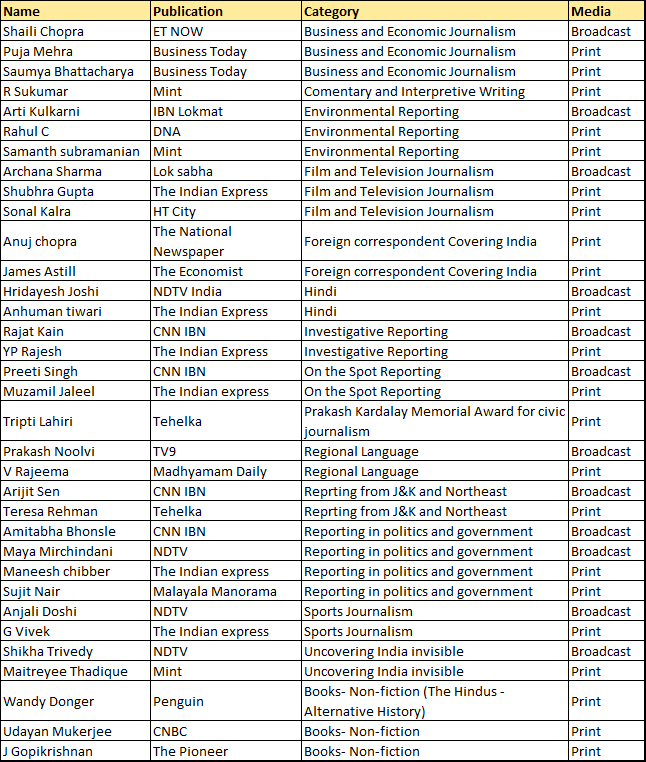
    The awardees for the year 2012 are as follows.


    Like every year, the award ceremony was followed by a panel discussion. This year, the subject based on the Press Council of India chairman Justice Markandey Katju’s observation: “The majority of media people are of poor intellectual level.”


    Justice Markandey Katju was present during the award ceremony and the discussion that followed. There were several politicians, journalists and academicians present, amongst the audience and the panel, who spoke on the topic and ensured that the discussion and debate was at a fever pitch with their war of words.


    Speaking on the issue, panelist Mr Digvijay Singh of Congress party said that there are black sheep in all works of life and the same holds true for the media as well, but to generalize and say that all of them have low intellectual level would be wrong. However, fellow politician and panel member Mr Sharad Yadav of JDU said that times have changed and with that the standards of journalism have fallen too, illustrating his argument by pointing towards the TV channels, who “invest too much in irrelevant news”. He also pointed at the issue of paid news which has tarnished the image of journalists and media houses alike. He said that the proliferation of media has caused the standards of news to fall.


    Furthermore, he said: “the media industry has to be accountable… If the Prime Minister of India is accountable for his deeds, so shall be the media.”


    Some panel members also raised the question whether it was important for journalists to be intellectually strong. According to some, journalism is of two kinds, hard news and opinion – and in the former, one does not need intellect, only moral integrity. LK Advani, who was the part of the audience said: “I don’t think that journalism has failed the democracy. However, there have been a few shortcomings off late. Yet, I will not say that they have low intellectual levels.”


    Digvijay Singh stated that intellect is required in the whole profession of journalism, be it opinion or reporting. However, he added that with the kind of expansion media has seen lately, it is possible that the training of young and budding journalists remains incomplete. He also advocated for accountability and self regulation in media.


    Union HRD minister Kapil Sibal agreed with Sibal: “Putting out information as soon as possible has become the need of the hour for those in visual media. At such times, news which needs to be evaluated is often not evaluated and is broadcasted without any checks. It is not the fault of the journalist, but that of the medium itself.”


    Pratap Bhanu Mehta, an academician, and a member of the panel said that when a state dictates terms as to what is to be broadcasted or not, it creates insecurity. He made his point when he censured Katju’s stand on Dev Anand’s demise, when he said that the news should not have been on the front page of all newspapers.


    Senior journalist and columnist Tavleen Singh engaged in a war of words with Katju when she questioned the credentials of judiciary. Katju evaded the question by asking her to “please confine yourself to the topic at hand… there will be other days for discussion on the judiciary,” but she persisted with her attacks on Katju and his authoritarian comments on media. She went on to say that PCI has to be more active in the future to regulate media, as judiciary is too incompetent to do so.


    Senior journalist Nalini Singh thought it important that journalists and media houses, especially the visual media, should introspect as to what kind of news stories they are doing. She said that usually only 5-6 big stories are followed on and so many news stories are ignored every day. Udayan Mukherjee of CNBC agreed: “A lot of our media are not up to the mark… and I don’t feel resentful of the idea that there is something wrong with the media.”


    When Shekhar Gupta of The Indian Express group was asked how he feels about visual media and the pace at which news is disseminated today he said: “Everybody with a camera is not a journalist, he is only a transmitter of raw unchecked data.” Editorial intimidation is very important and one has to ensure that the news published is factual, in public interest and of public interest.”


    The panel discussion was brought to an end by Mr Katju where he congratulated all the awardees.


  • Curb online voices? No way, Mr Sibal

    By Akash Raha


    Telecom and Information Technology Minister Kapil Sibal stirred up a hornets’ nest when he recommended censorship of online content. Both freedom of expression and the new world of social media came into focus, with several organizations hosting forums on the issue, such as the Foundation for Media Professionals’ panel discussion on December 19 in New Delhi, titled ‘The new puppeteers: Curbing Social Media’.


    The media has come down heavily on Mr Sibal’s suggestion that pre-screening or pre-censorship should be carried out to keep a check on the content of social media platforms. Anuradha Raman, Associate Editor, Outlook said that the government is still following the age-old programme codes set for Doordarshan and All India Radio which were formulated in 1982, and which are constantly used to rattle today’s media. She said that if the government wants to wall up websites and dot.com, why not bring it under a code through legislative sanctions rather than arbitrary discrimination? She said that the current system of censorship of media lacks accountability and there is a need for parliamentary representation to spell out these codes properly.


    Lawrence Liang, a lawyer from Centre for Internet and Society, said it is important that the freedom of speech and expression has to be extended to the terrain of internet rights. The issue of National Security has been brought out repeatedly and it is fine to keep it in mind but not at the cost of free speech and freedom of expression. The government is hereby performing a quasi-judicial role. Moreover, there is lack of transparency in the internet censorship proposal, and today, the work of censorship is being outsourced. He pointed out that the only place where pre-censorship exists is in the case of cinema.


    Saikat Dutta, Delhi Bureau Chief, DNA, said, “In the name of national security the government is increasing its surveillance footprint.” This has led to the growth of what he called the business of surveillance, which is today a multi-billion-dollar industry. The more the government wants to spread its ambit on surveillance, the more companies selling surveillance services will benefit. He went on to say that these days the government is coming down upon several sites and blocking them and if a site is blocked, no one will ever know what happened. There is no information on why something is blocked.


    Narayan Madhavan, a senior columnist from Hindustan Times said, “The right of free speech is a constitutional right and not a government-given one. Freedom should be a rule and not an exception. The government is not the state, it is only an arm of the state temporarily given the right by the people.” He added that National Security has become a more fashionable word to use for censorship and that while it is essential, but it should not be used to curb freedom. In a tweet earlier he had written, “Twitter is the new parliament and Facebook is the new café.” He observed that social media is an interactive media and pre-censorship sounds like an act of desperation or lack of technological knowledge.


    Government has the right to monitor social media just as we can monitor the government by RTI, but there has to be accountability involved. He added that we are culturally an open society and the government cannot put a lid on this. The rights vested by the constitution should not be blocked by a few in the government. This attempted curb should not be seen as a curb only on social media but on media as a whole. It is important to understand when we talk about censorship on social media that the content owners are those who post. Facebook therefore acts as a printer and not as a publisher.


    Sheela Bhatt from Rediff.com noted that there are still a lot of taboos against the digital medium and the online world, which needs to change quickly. The cause is lack of knowledge about the online space. She started off by condemning the censorship which Mr Sibal talks about, and dwelt on the issue of social media, its powers and nuances. She gave the example of the India Against Corruption page on Facebook and how it became a powerful tool to stand against corruption. She said that the government does not appreciate the form of media which is the internet, and such a mindset is regressive and hampers growth.


    Nikhil Pahwa of Medianama said that the censorship that we are discussing is already prevalent. The problem is that we don’t know why a certain site is blocked. National Security is a “nice and easy” way to serve political agendas. He said, “For example, if my site is blocked, I don’t know why it is blocked, who blocked it or how to unblock it… all it says at times is, this site is being blocked on request from DoT… We don’t know who gives the order for blocking and unblocking and there is no transparency.” He said that IT and surveillance rules under the garb of National Security needs to be fought as it threatens democracy.


    Prabir Purkayastha from Delhi Science Forum observed that there are serious problems for any new technology and the same is the case with the internet and social media. “For example, the boundaries of private speech and broadcast are diminishing in the world of social media. What earlier used to be broadcast, now with the internet has become multi-cast. Private censorship is what the government wants right now and it’s not like the one China practices. For China they have a hammer and for them everything else is a nail. But the Indian government is being clever here. It’s like the government is providing safe harbour to those who accept everything that the government is saying and for everyone else, it’s a lost battle. And it’s not social media versus traditional media any more, as what is traditional media is already on social media. The power of surveillance is more pervasive than ever before. The issue is that the government is checking you 24 hours a day, where you are and what you are doing and snooping into your conversations in the name of national security. Today, the new and the old media have to understand that they are not different, and work together to protect themselves.”


    Mishi Choudhary, Executive Director, SFLC.in, observed, “Taking offence on other people’s behalf has never been as fashionable as it is today,” and censorship has become the new name to protect this. The positive aspects of social media are ignored when there was a tsunami and an earthquake. What really bothered the government is the Arab spring and the revolution in Iran and the Anna Hazare movement.”


    Shubham Vij of Kafila.org said that pre-censorship of information is not feasible and possible in the current scheme of things and it is only a matter of time before the government realizes this too.

  • Anil Thakraney: Sibal in Blunderland

    By Anil Thakraney


    I think Shri Kapil Sibal lives in a world of fantasy. Much like Alice in Wonderland.


    If you recall, the portly mantri made a sensational ‘discovery’ not too long ago. He claimed there was NO loss to the country in the 2G spectrum scam, and the figure being bandied about was in the media’s wild imagination. Yeah right, Alice.


    And now he’s back with another dreamy idea: To gag the internet. I guess the loyal minister had a wondrous vision the previous night in his journey to Wonderland. Where he imagined millions of Indians collectively sucking up to Sonia G and family, even as scams raged in her backyard. I like Kapilji’s idea of Wonderful India. Except that it in reality it isn’t Wonderful India. It’s Incredible India. Where politicians loot and plunder the nation freely, and lord over the junta on the basis of the good ol’ ‘Divide & Rule’ policy.


    In his fantasy, the mantri overlooked one critical ground reality: Leave alone the fact that it’s impossible to pre-screen millions of posts, the Indian Constitution guarantees every citizen the right to free speech. And when that right is misused, the courts decide on the fate of the alleged abuser. If we follow this principle when it comes to the traditional media, why must the digital media practise censorship?


    It’s simple, really: You defame someone, promote communal hatred or indulge in any writing/creation that’s illegal, you face a court trial and if convicted, you get punished. A tweet or a Facebook update can as easily be retrieved as a newspaper article or a television bite. In fact, Mr Suhel Seth is currently battling a lawsuit because of some allegedly defamatory tweets on ITC. So there you are.


    Basically, the man’s logic is so steeped in unreality, even little Alice would be confounded. What must worry us even more is that this nation is ruled by such fantastic ministers.


    ***


    PS: Great work from Coke. Very touching. Keep a handkerchief on standby.

  • IT use can bring transparency: Sibal

    By A Correspondent

    “Increased use of information technology will bring about transparency and accountability in the system,” minister for communications and information technology Kapil Sibal has said. Mr Sibal, inaugurating the 8th Assocham International Summit on e-Governance, added that the government would introduce the Electronic Services Delivery Bill in the next session of Parliament. This Bill is aimed at making public services available in only electronic mode in all State and Central government departments over the next five years.

    The scope of human intervention must be reduced with information and telecommunication technologies playing a lead role to curb corruption in public life and ensure good governance across the country, Mr Sibal added.

    He said that though the government is working on a new law to deal with the menace of corruption, only mass adoption of technologies for e-governance and m-governance can improve the quality and speed of public services delivered to citizens in urban and rural areas.

    “Much of the talk of corruption that we have had in the recent past will be dealt with through the initiative of IT. What we need to do is to ensure that the scope of human interface – which is the scope of all corruption – is excluded. IT should play an important role in finding solutions and we are in the process of doing it,” said Mr Sibal.

    By 2014, every gram panchayat in the country will be connected with fibre optic cables and the last mile connectivity will be with wireless broadband. The true empowerment of people is possible when government services are made available at the doorstep of every citizen – be it for tax returns, insurance premiums, banking operations or payment of e-bills, he remarked.

    Mr Dilip Modi, president of Assocham (The Associated Chambers of Commerce and Industry in India), said digital inclusion is the critical pillar of the chamber’s agenda of making inclusive transformation happen.


    “E-governance can bridge the gap between deficits and surpluses in rural and urban India. With six lakh villages in the country, land records need to be digitised. We are quite bullish on the internet’s potential to provide fair transparent governance structures,” said Mr Modi.

    Mr Umang Das, chairman of the Assocham National e-Governance Council, said the concept offers a unique opportunity to move away from piecemeal reforms to an era of institutionalised transparency.

    India has 73 million internet subscribers and the figure is poised to grow to 275 million by 2015, according to Assocham.