Tag: Kantar South Asia

  • Internet usage in India > half a billion people: Kantar IMRB


    By A Correspondent


    Kantar IMRB has released its ICube 2018 report on digital adoption and usage trends in India. The annual tracking study, considered as the currency for digital adoption in the country, gauges the changing digital ecosystem in India, measuring Internet usage by demographic, activity and device segments.


    Said Preeti Reddy, CEO, Kantar South Asia:  “The Internet is transforming the way consumers and marketers interact with each other in today’s digital world. Kantar IMRB’s ICube; which has tracked the digital evolution in India for last 20 years, provides key measurement metrics necessary for planning any digital marketing or communication initiative. ICube continues to provide government, policy makers, digital businesses, marketers and communication specialists the intelligence necessary to stay on top of the developments across different facets of digital platforms and services.”


    Key findings include:

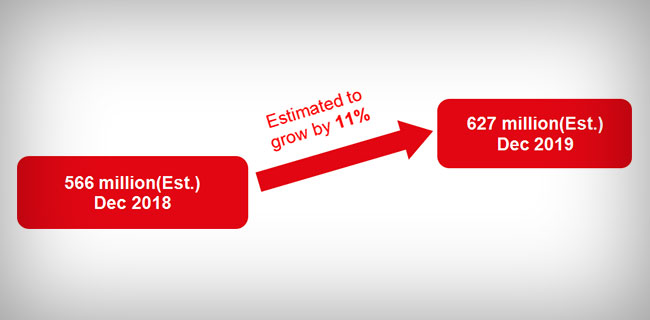
    :: The number of Internet users in India has registered an annual growth of 18% and is estimated at 566 million as of December 2018 – 40% of overall internet penetration.

    :: The report also projects double digit growth for 2019 and estimates that the number of internet users will reach 627 million by the end of this year.


    :: Of the total user base, 88 percent, or 493 million Indians, are defined as regular users, having accessed internet in last 30 days. 293 million active internet users reside in urban India, while there are 200 million active users in rural India.

    :: Unsurprisingly, the 97% of users use mobile phone as one of the devices to access Internet


    Rural India’s Digital Frenzy

    While internet users grew by 7% in urban India, reaching 315 million users in 2018, digital adoption is now being propelled by rural India – registering a 35% growth in internet users over the past year. It is now estimated that there are 251 million internet users in rural India, and this is expected to reach 290 million by the end of 2019.

    Increased availability of bandwidth, cheap data plans and increased awareness driven by government programmes seem to have rapidly bridged the digital gap between urban and rural India. Consequently, the penetration in Rural India has increased from 9% in 2015 to 25% in 2018

    :: Bihar shows the highest growth in new Internet user addition

    With one of the highest growth rates in the state GDP, it is no wonder that Bihar registered the highest growth in Internet users across both urban and rural areas; registering a growth of 35% over last year. This is closely followed by Orissa.


    Internet is now more gender balanced than ever before

    The gender digital divide is now closing. Kantar ICUBE 2018 reports that women today comprise 42% of total Internet users. Besides their sheer presence in the digital universe, women are also equally engaged and active in the digital world – spending as much time on the Internet as men.


    Added Hemant Mehta, Managing Director, Media and Digital, Kantar IMRB: “The latest edition of Kantar IMRB ICubeTM report shows that today the digital base in India is growing by over 75 million users each year – as much as the entire population of Germany! It is fascinating to note that the digital revolution is now sweeping small towns and villages perhaps driven by increased accessibility at affordable data costs. What is also particularly interesting, is the increase in the usage of digital in Rural India, where more than two-thirds of active internet users are now accessing the internet daily to meet their entertainment and communication needs. Marketers have a big opportunity today where they can use digital to reach their consumers – both in urban and rural India.”


  • MMA, Kantar IMRB unveil ‘The Power of Mobile Gaming in India’

    By A Correspondent


    The Mobile Marketing Association (MMA), with Kantar IMRB have released a report titled ‘The Power of Mobile Gaming in India’, offering the latest data and insights on mobile gaming trends in the country. With India’s mobile app market growing at breakneck speed, mobile gaming platforms are increasingly commanding a substantial share of the advertising pie. The report was released in association with POKKT, a smart phone advertising platform for mobile games.


    According to the report, three out of four Indian gamers play mobile games at least a twice a day, for an average of 60+ minutes, each day. Mobile gaming is also quite prevalent in Tier 2 and Tier 3 cities, with similar amounts of time spent on gaming by users in these regions. With over 250 million mobile gamers, India has emerged as one of the Top 5 gaming countries, globally. With so much time spent on mobile devices, there lies a huge opportunity for marketers to tap into the space.


    “While it is common to assume that gamers tend come from a younger generation, this research has proven otherwise, and removes the stereotypes of a typical gamer. By changing their perception of what a “gamer” is, marketers can tap into a relatively untouched space and reach out to a sea of customers. Furthermore, since 55% of gamers perceive ads to be more personalised on gaming platforms, there is a much higher level of acceptance,” said Rohit Dadwal, Managing Director of MMA in Asia Pacific.


    “The Indian market is already known to be a mobile-first economy. The fact that mobile gamers are on their devices twice a day or more, there is ample opportunity for marketers to get creative in the way they run their marketing strategy. Whether it’s through partnerships or simply putting in an algorithm to retarget customers, the potential for monetisation is huge,” added Moneka Khurana, Country Head, MMA India.


    Said Hemant Mehta, Managing Director, Kantar IMRB and Chief Strategy Officer, Kantar South Asia: “Consumers have taken to mobile gaming in a big way, yet it still remains a relatively untapped advertising channel in India. Our study shows that mobile gaming is truly mainstream today, attracting a wide range of audiences. Besides being a highly sticky medium, it offers high engagement levels akin to OTT platforms. Personally, one of the most interesting findings was the low resistance to in-game advertising, as compared to other channels. This is a golden opportunity for marketers to communicate with their consumers, especially since mobile gamers perceive in-game ads to be more personalized and relevant than traditional media,”.


    Added Rohit Sharma, CEO & Co-founder, POKKT: “POKKT has today more than 140 million monthly users who are average spending more than 60 minutes every day playing mobile games on average. On top of this we have built huge machine learning and data capabilities to do better targeting for advertisers. Brands can certainly benefit from advertising on mobile gaming platforms due to the longer attention span given to mobile games, agreeing with the fact that mobile games is a huge platform for mobile advertising in India.”


  • Kantar​ ​& GroupM combine analytics teams to launch Kantar Analytics Practice

    By A Correspondent​


    Kantar, WPP’s data investment management division, ​has announced the launch of a new global analytics practice that unlocks deeper insights to fuel business growth.​ ​Integrating analytical capabilities from across the company, Kantar Analytics Practice will combine the ​an understanding of consumers with a​n ​analytics toolkit. In India, WPP has combined the Analytics teams from Kantar and GroupM to form one combined practice.


    Kantar Analytics Practice ​will ​offer capabilities across five areas of expertise:

    :: Brand and Media ROI: Maximising value creation from brand and media investments, by balancing short-term sales performance with long-term brand valuation and profitability.


    :: Customer Analytics: Making the right operational and strategic investment decisions in customer experience and loyalty marketing, to maximise the value of each and every customer relationship.


    :: Segmentation and Activation: Targeting your highest potential customers and prospects with personalised content, to drive profitable growth with maximum efficiency.


    :: Innovation Analytics: Optimising your customer-led innovation lifecycle for long-term growth, from spotting new trends before your competitors, to optimising the profitability of your product launches.


    :: Retail and Shopper Analytics: Maximising the commercial return from your investments in sales, retail and e-commerce via optimising decision-making in channel choice, assortment, promotions and pricing.


    Discussing the launch, Eric Salama, CEO Kantar, ​said:​ ​“Less than half (44%) of advertisers believe they have the right, actionable data. Clients feel data rich but insights poor and impact short. Kantar is unique in having the most complete view of consumers across the entire demand cycle: the way they live, feel, shop, watch and post. Combining our insights with data from across any client’s organisation can unlock deeper insights that fuel growth. “


    ​Added CVL Srinivas, Country Manager WPP India & CEO GroupM South Asia​: “The new practice addresses the clients’ ask for data driven transformation for better ROI from marketing investments in the digital era. GroupM and Kantar have been working closely together in India, co-creating services for our clients. The launch of the Kantar Analytics practice is another step in this direction and demonstrates the ability of our group to come together to provide enhanced value for clients”.


    ​Said ​Preeti Reddy, CEO Kantar South Asia​: ​The practice formalises the connected journey with GroupM in bringing data driven products to the markets like Campaign Watch (for during campaign ROI management) and consulting services on TV audience measurement data. Proprietary assets like SAAS platform ‘Athena’(built in India) will offer marketers a predictive and near real time opportunity to add up to 20% improvement in ROI from marketing investments including those in e-commerce.And, in Sunder Muthuraman, who will take over as CEO APAC & Global Chief Client Officer, we have a great leader for the practice’.


  • More efficiency & productivity with Kantar First


    Earlier this month, WPP group’s Kantar announced a new corporate identity and management structure. This meant that operating brands not previously Kantar-branded now have a Kantar prefix and a new, common typeface.  For example: Millward Brown, IMRB, and TNS will now become Kantar Millward Brown, Kantar IMRB, and Kantar TNS. MxMIndia had a detailed chat with Preeti Reddy, CEO of Kantar South Asia- Insights, who leads Kantar’s India & South Asia operations


    Congratulations on being elevated to the position of head of Kantar’s India operation as CEO of Kantar South Asia- Insights, and this in year after taking charge of IMRB. Can you talk us through the change that has been effected?

    The change was brought about as a end result of a strategy that Kantar Worldwide put into place where the strategy is called Kantar First and the intent is to try and offer clients the best of Kantar all the time and not only on occasions. Clients have been asking us to be more responsive, more agile and more collaborative because they realise that across Kantar if you look at the work that we do, the assets that we have, the people we have. The real benefit to clients come when we give them solutions that access excellence across Kantar. So, essentially the strategy was one of bringing in more efficiency and productivity and the ability to invest in operations which is the foundation of our business and shared services so that all the Kantar brands enjoy that and you actually have scale to be able to invest in technology for efficiency and productivity and then at the client end, offer clients the benefit of getting service from various brands that Kantar has.


    So you have all three working under Kantar umbrella?

    One of the key elements of this strategy was to create a management structure under Kantar insights which has three insight companies under it. In India, the three companies are – IMRB, TNS and Millward Brown. These are very powerful brands in their own right but what we are doing now is that we are saying that they all come from the stable of Kantar so all the brands will be prefixed with Kantar to say they are from the same family yet they are different and they are strongly differentiated. The values and benefits that each one of them brings are different, so clients will have the choice of choosing from the best, choosing depending on the business situation actually choosing the solution that each one of them offers whichever they think fits their requirements best and also in some situations, the solution may be one or two or three of the companies coming together to offer the client a solution. This is really a unique model and it’s a very powerful mix because you can come together when the client needs it and you can diverge when that is the solution that the client needs.


    The WPP group of which Kantar has several agencies run separately, often each of them doing things differently. Like in the case of creative agencies. And it also has media agencies under GroupM. So would you say the new Kanar – with the three  brands- IMRB, TNS and Milward Brown- will be a conglomerate like say GroupM?

    In a sense yes, because GroupM has various companies under the umbrella of GroupM. So, yes, it is similar to that and they each retain their individual branding and their individual identity so yes it is amalgams to that model. The other thing that we have done as a part of the strategy is  we are creating one another new brand in India which is going to be called – Kantar Public which will be launched in September, under which we will sit all the government and developmental and political work that we do


    While the objective of the integration is to facilitate seamless solutions to all the clients of the operating brands, how do you ensure that each company has its independence?

    They all have their own CEOs. They all have their own products and services. We are encouraging co-locations but even when we locate together they will maintain their separate identity. Also what each company stands for and how they deliver their service is going to be quite differently positioned.


    Could you talk to us about the individual companies – IMRB, TNS, Millward Brown. Millward Brown has a new head. Also, now that you have taken on a larger role, will IMRB have a separate business head?

    I took over IMRB in September [2015] and IMRB is very large and complex. Luckily for the person who runs IMRB, it is run by very senior people highly respected in the industry and they run their own units independently. So for sometime I will be the person heading IMRB. Kantar is also encouraging senior people double-hatting in some of their roles. Millward Brown has its own CEO, TNS has and I look after IMRB as well as South Asia.


    And will they compete with each other like a Maxus competes with Mindshare?

    Absolutely, in fact in 80-85% of the cases it will be business as usual where we will compete. In the balance 10-15% of cases where the real benefit to a client is because of the collaboration and there are many clients who are asking us for that. In the sense they appreciate what Millward Brown brings to the table, what IMRB or TNS brings to the table but they often also want holistic solutions. So we will collaborate there but otherwise yes, we will compete against each other.


    Since you are going to be leading Kantar, it would be interesting to know the services and best practices that would now be adopted and offered to the clients? For instance, how will Kantar IMRB be different from IMRB?

    IMRB will also be now part of a far more global network. Earlier, Millward Brown and TNS were already global brands whereas IMRB is a regional brand but it’s a very strong brand in the region. So the difference it makes to IMRB is that it is now part of a global network and we are looking to see if India as a county can actually can play a stronger role in Kantar. One of the key elements of Kantar’s new strategy is that they have identified nine countries which are focused markets because they recognise the importance of these countries and India is one of them. So India is important because it is a growing emerging market. It is also important because the three Kantar companies together have the highest share of business in this market. It is also an important market because given capabilities that we have in India it is absolutely possible for reverse innovation to happen. Instead of new thinking, new products new services coming from the West to us, we are saying that we are emerging marketing experts, developing marketing experts and we can do fragile, agile innovation for you that you can take to the rest of the world.


    Can you share some thoughts about Kantar’s immediate plans in the region. And how is it in other parts of the region – Sri Lanka, Bangladesh…. And is Pakistan also part of the region for Kantar?

    Pakistan is a part of the Meena region for us. It is very difficult for us to do business in Pakistan from here. It’s much easier to do it from Dubai. So that’s not part of the region. Bangladesh and Sri Lanka are in a sense microcosms of India and they are at different stages of evolution. To some extent they do look to India for new thinking, new products and services but at the same time many of our clients have; like MNCs and even our large indian clients have to look at the region as a whole for them. Servicing them across the three markets and ensuring that protocols are followed and that the best of Kantar is given to them in all three markets is actually a benefit for them.


    A word on the challenges that lie ahead of the insights business?

    Everybody in the insights business realised that the industry is undergoing a transformation because consumers are changing. Consumers are far more connected and are changing in ways that makes clients themselves now look for much quicker, agile and holistic understanding of consumers. So the first demand that’s been made on us is on speed and agility. The next demand that clients are making on us is that it’s no longer about do this survey and give me the findings. Consumers themselves are generating so much data through social media, through all the opinion that they offer so its about now integrating a multiple data sources of which primary questioning of the consumers is only one data source. The most significant change that’s happened is the connected consumer and digital and it’s because of mobile phones. Recognising that and being ready for that is really the most important challenges that we face.


    There are also a few new practices that you have announced… Kantar Public and Kantar Consulting. What is the roadmap for these?

    The three Insights brands are already there and they are strong. Kantar public has already been announced and will be launched in September. We have another brand in India – Kantar World Panel which has been there for sometime now. The other brands that are present globally but are not in India is- Kantar Health, it is there in a smaller way, There is a team which does Kantar Health work here. What is not available here is Kantar Consulting which is a new brand that Kantar proposes to develop which actually is a coming together of various consulting businesses that they have – Added Value, Vermeer and the futures company. That’s not yet present in India but yes we are looking to see when the market will be ready for us to bring that in. it’s unlikely in immediate future.


    Kantar is also a 50 per cent partner in TAM.  Given that television measurement – which was the bulk of the revenue earner – is out of its purview, what is the plan for TAM?

    TAM audience measurement business has moved to BARC but now there is a joint venture which has formed between TAM and BARC which will do the data collection and provide the data to BARC. BARC will release the currency. TAM will continue to be in business of ADEX and other businesses that they had like Eikona and sports measurement, etc. So other than audience measurement business the rest of it will stay will TAM.