Tag: Kantar Millward Brown

  • Kantar’s report delves into gender targeting in advertising

    By A Correspondent


    Marketers are reinforcing rather than helping to eradicate harmful gender-based stereotypes. That’s according to the latest AdReaction report released by Kantar, which reveals the disconnect between consumer and business opinions of gender portrayals in advertising. While the clear majority of marketers globally think they are avoiding gender stereotypes, 76 per cent of female consumers and 71 per cent of male consumers believe that the way they’re portrayed in advertising is completely out of touch.


    The latest AdReaction report from Kantar includes analysis on advertising creativity and media effectiveness both globally and in India. This is based on a comprehensive analysis of how women and men are portrayed in ads, and how they respond differently to marketing. The report aims to guide marketers on their gender progress journey and help brands grow, by Getting Gender Right.


    Commenting on the study findings, Vishikh Talwar- Managing Director- Kantar Millward Brown, South Asia, said: “Gender is a sensitive topic – one that society is currently renegotiating across social, cultural, political and commercial spheres. The India leg of the survey comes at a very pertinent time as the subject of gender portrayal has gained immense importance both globally and closer to home. The report highlights that the bulk of ads in India are targeted at women; but marketers appear to be targeting them led more by stereotypes. Gender targeting should not be an either/ or decision and we need to challenge these outdated assumptions. From a portrayals perspective, more emphases need to be made towards aspirational and authoritative roles. The industry as a whole needs to be more aware than ever that things need to change.”


  • Mindshare and Diageo win big at the Smarties India awards 2017

    By A Correspondent


    The Mobile Marketing Association (MMA) announced the winners of its 2017 Smarties India Awards, held in Gurugram last week. As many as 42 awards were presented for mobile strategy in industry-focused categories celebrating innovation, creativity, and success across the mobile marketing ecosystem. Diageo was crowned ‘Marketer of the Year’, while Mindshare was recognised as ‘Agency of the Year’.


    Mindshare received 19 awards over 11 categories, ranging from Brand Awareness, Mobile Native and Programmatic, amongst others.Sony Entertainment Channel’s ‘Waltzing across TV: How 300,000 people switched channels to Super Dancer’ by Zapr Media Labs was recognised as ‘Best in Show’.


    Said Rohit Dadwal, Managing Director, MMA Asia-Pacific:“All our winners have demonstrated the ability to communicate their brand’s story with mobile using creative concepts and innovative technology that lead to real business impact. The Smarties India Awards are our way of recognising outstanding key players in the industry, and we hope that through sharing their campaigns, we can inspire marketers across India to harness the power packed in this tiny device. We’re optimistic about where the industry is headed in India, and look forward to seeing what next year’s Smarties India Awards has in store for all of us,”


    In an ongoing partnership with Knowledge Partner, Kantar Millward Brown, the research-based consultancy presented industry trends and characteristics of the winning campaigns.


    Commenting on the winners, Shaveta Bhardwaj, Senior Executive Director, Kantar Millward Brown said: “We saw very interesting entries in comparison to last year; scale stood out for winning campaigns. Measuring brand outcomes is critical to success. It is important to think what ‘mobile’ can do for your ‘brand’ rather than what ‘brand’ can do on mobile.”


    This year, MMA partnered Gunn Report and WARC to launch the first-ever Business Impact Index.


  • HDFC Bank stays #1 in BrandZ India study


    By A Correspondent


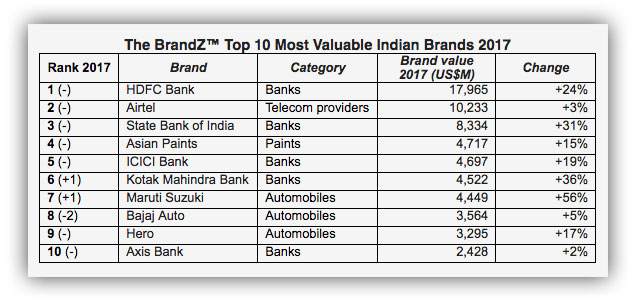
    India’s most valuable brands have increased their brand value by 21% to US$109.3 billion in the last year, according to the BrandZ Top 50 Most Valuable Indian Brands 2017 announced on Wednesday by WPP and Kantar Millward Brown. This compares with a 2% decline in 2016, and is well ahead of the 8% value increase of the BrandZ Top 100 Most Valuable Global Brands 2017.


    HDFC Bank (24%) is India’s most valuable brand for the fourth year running, almost doubling its brand value since the ranking started in 2014 from $9.4bn to $18.0bn. It has a strong purpose – to improve lives by bringing world class financial services to all sections of India – and demonstrates it through increased access to banking in rural areas, an expanded digital presence and leveraging the latest technology to simplify its offering for customers. BrandZ data shows that consumers perceive the bank as increasingly innovative.


    The BrandZ ranking and report highlights the success that many Indian companies have had in 2017 with managing their most important intangible asset: their brand. For many that has been driven by a rapid response to rising consumer optimism, and evolving to meet people’s needs as their financial circumstances, preferences and expectations change.


    Said David Roth, CEO EMEA and Asia, The Store WPP: “Indian consumers seek authenticity and value for money, and the meaning of those things is being constantly redefined. As consumers become wealthier, they look beyond price to factors like extra features, innovation and a personalised experience. As reflected in this year’s ranking the most agile Indian brands have recognised the complexity in the market, and achieved just the right balance between aspirational and affordable.”


    The automobile category, which also includes tyres, lubricants and motor fuels, grew 23% in value. Brands responded to the changing market with new models that combined smart pricing and functionality with style and power. Royal Enfield, Maruti Suzuki and TVS were among the Top 10 overall fastest risers. Royal Enfield (no.40, 59%) engaged with biker groups on social media, and marketed a range of accessories. Maruti Suzuki (no.7, 56%) extended the brand beyond its traditional appeal to the value segment of the market, while introducing new showrooms called NEXA to reach premium customers.


    According to a communique, the India Top 50 have faced successive disruptions in the last year, some global, some created by fast-growing competitors and others strategically imposed by the government – including demonetisation.


    The FMCG category, which includes alcohol, food and dairy, personal care and soft drinks, was significantly affected by these challenges but still managed to grow 6% in total value. Some brands achieved impressive value increases by accurately understanding and responding to Indian sensibilities. Noodle brand Maggi (no.32; 66%), the overall second-fastest riser, aligned itself with the trend for nostalgia. This helped it bounce back after a difficult couple of years; its rapid regrowth demonstrating how a strong brand can help a company weather a crisis and recover faster, although it is still some way below its peak brand value of $1.1bn in 2014. Health food brand Saffola (no.36; 24%), meanwhile, introduced oats in new localised flavours and expanded its range of oils into a new super premium sub-segment.


    The financial services category increased its value by 26%. The fastest rising banks were Punjab National Bank (no.39; 43%), which is highly customer-focused and more agile than some of its competitors, and Kotak Mahindra Bank (no.6; 36%), which has innovated in areas including digital banking. Both of these brands still have significant catching up to do, however, if they are to reach the top of the leader board.


    Other trends highlighted in this year’s BrandZ Top 50 Most Valuable Indian Brands include:

    :: There are seven newcomers to the ranking. Telecom provider Jio ranks at no.11 only months after its launch, having disrupted its category with free-data promotions. The others are newly listed retailer D-Mart (no.24), appliance brand Whirlpool (no.45), insurance brand Bajaj Allianz (no.49), Canara Bank (no.50) and entertainment brands Sun Direct (no.27) and Dish TV (no.47)


    :: The long-term growth curve of the Top 50 is positive, with the total brand value of the ranking up 57% since the study was first carried out in 2014, when it amounted to $69.6bn


    :: India experienced a resurgence in national pride, while also embracing globalization. This manifested in a desire for products and brands that best reflect Indian heritage, sensibilities and tastes, which benefited local brands and put pressure on multinationals to follow suit. Colgate (no 28; 2%) launched a toothpaste with Ayurvedic properties to meet this demand


    :: The top riser is insurance brand ICICI Prudential (no.35; 89%). It benefited from the ‘halo effect’ of other brands’ successful responses to rising consumer affluence, which led to an increase in sales of assets such as cars that need insurance protection


    Said Vishikh Talwar, Managing Director, Kantar Millward Brown, South Asia: “There are now ‘multiple Indias’. Consumers continue to love the brands they’ve loved for generations, while equally embracing the brands of the future. Brands must be completely in rhythm with the pulse of the market. Those that can accurately interpret Indian sensibilities, while ensuring smart pricing, are likely to be most successful. This is easier for local brands, but people will relate just as positively to a global brand if it uses insight to understand and meet their needs, and communicate in a way that builds trust.”


    According to a communique, for the first time, this year’s BrandZ Top 50 Most Valuable Indian Brands 2017 study incorporates new research from Y&R’s BAV Group into what it takes to build powerful nation brands. According to the 2017 Best Countries report, India stands out for its history, cultural influence, distinction and reputation for entrepreneurship; especially among the world’s business decision-makers. Because there is a strong relationship between how people perceive a country and how they view the brands associated with it, India’s reputation has a significant impact on the global power of its brands.

     

  • Shortlists announced for APAC edition of MMA Smarties Awards

    By A Correspondent


    The Mobile Marketing Association (MMA) has announced the final awards shortlist for the 2016 APAC edition of the MMA Smarties Awards, the mobile awards that honours innovation, creativity and success in the field of mobile marketing both regionally and globally. Mindshare India leads with 23 nominations in total, while Mindshare Indonesia and PHD India follow closely behind with 7 and 5 nominations on the list respectively.


    The awards feature new categories: Social Impact/Not for Profit; Cross Screen Advertising; Programmatic; Mobile Native; Tablet Campaign; Mobile Social; Mobile Video; Mobile Audio. Aimed at honoring excellent work on mobile by both brands and agencies, the categories are born out of a recognition of the ever-increasing prominence of mobile in the region, and the new, creative operational technologies powering the medium. The 2016 Awards are presented in partnership with Kantar Millward Brown.


    Commenting on the shortlist, Rohit Dadwal, Managing Director of Mobile Marketing Association in Asia Pacific said, “There was a fantastic range of entries this year that demonstrate creative thinking and strategic execution, and as always, the decision-making process was challenging. The jury panel, including myself, was impressed by the way each of the shortlisted campaigns leveraged mobile’s interactive capabilities to deliver real business results. We hope this year’s winning campaigns continue to serve as an inspiration, and push the industry beyond the predictable in mobile.”


    From among brands, Unilever stood out by landing 32 nominations across Indonesia, India, China and Thailand. PepsiCo is the next in line, with 11 nominations for its work in Vietnam, Malaysia and India. Winners will be celebrated at an awards dinner at the 2016 MMA Forum Singapore on Friday, 28 October 2016.


  • Benchmark to reach a consumer’s mind is getting tougher: Dinesh Kapoor, MD, Kantar Millward Brown (Text+Video)

    Text & Video by Santosh Jangid


    There are brands from large FMCGs like Surf or Ariel or Dettol which are as much Indian as any other international brand. They do appreciate local nuances. Aloo-tikki is the bestselling item on the McDonald’s menu. So how come we don’t see these popular brands  in the Brandz Top 10?

    The scope of Brandz in India includes Indian brands as well as multinational brands. We are including all brands that are available in India and are relevant to consumers because there is a consumer comprehend involved as well, so we are not excluding any brand. The framework would include any brand, so if we have selected x number of categories that we are going to include in BrandZ this year, we look at brands that are listed because that’s the only way we can get financial information about them and we will have a consumer component where we will talk about all those brands among consumers.


    The fact that an HDFC Bank has scored over various others for the third consecutive year underscores the strength of the brand. But it is hardly advertised… would you say there is a co-relation with advertising and promotions and brand salience?

    HDFC Bank has a large consumer base which is experiencing the brand on a day-to-day basis. The key element to success is how meaningful is the experience that you are creating for your consumers. Second element is: appealing communication which is getting your word out to the market. So, you have so many consumers, so many users, you’re building equity with them on day-to-day basis, you are meaningful, you are introducing new things in the market place. Therefore, communication is one of the things that helps you take it to your customers. Brands which have low awareness will have a bigger task in taking out to the consumers but larger brands are safe because of their size as they get out to consumers much faster.


    Why do you think that Airtel despite its large spends on advertising and some memorable campaigns has not been able to attain the top slot?

    In a consumer’s mind, when we watch a communication, we do not think – that this is a telecom communication or this is an FMCG communication. For us, it’s a lot of brands that are trying to reach us and we don’t watch it by silos or categories. All of the brands are trying to break into our minds to create space for themselves but only a few reach as there is so much competition and clutter, the benchmark is becoming tougher and tougher to reach into a consumer’s mind. So an ad has to be phenomenally good. It should connect with you, say something relevant and you should carry it with you when you buy it next time.


    It is interesting to say that premiumisation is key to the success of brands in the study. But in the final analysis, it’s dhanda or the revenues that matter, right?

    There are different niches in the market for every category. Finally it’s about money but which route I am going to take to get there is important. Some brands choose the route of premiumisation whereas some want to go with mass and want to reach as many people, gain share and some brands could do it in a different way.


    You say that brand loyalty is weakening, especially in urban centres. Would you say that is the case in rural India too?

    Based on the other work that we are doing for the clients, I would say probably that urban is a little different. Whenever you have more choice, then loyalty comes down because it becomes much more difficult to build loyalty when you have so much choice in front of you. In urban, probably there is a little more choice so loyalty could be a little lower but there is not too much to differentiate between rural and urban in India.


    Lastly, any standout features or trends of the Indian study vis-a-vis BrandZ in other centres? How are we different from the rest?

    The role of difference is becoming more important in India. It is more important now than it was 10 years ago, it is more important than other regions as well. So, just having a meaningful brand which is great is not sufficient now. You need to do that and also create a point of difference versus the next competitor so that finally you are chosen because finally it’s the customer’s preference. Personally for me, the difference was very interesting and the fact that it’s more important than the rest of the world is even more interesting.


    We couldn’t adding one more last question: given the way it’s growing, do you think Patanjali will be in the Top 10 next year? And at what slot?

    We need companies with financial revelation, financial information, so we are only looking at companies that are listed.


  • Financial brands score in BrandZ’s Most Valuable list

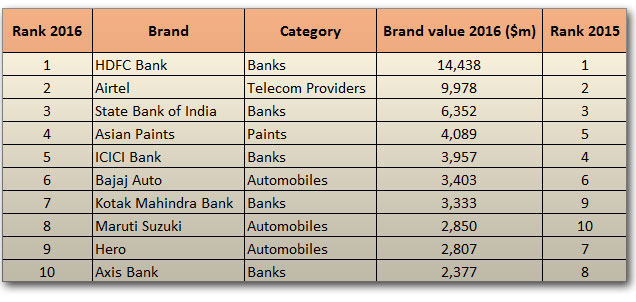
    BrandZ Top 10 Most Valuable Indian Brands 2016


    By A Correspondent


    The total value of India’s most valuable brands has risen by 30% over the last three years, with the Top 50 brands now worth $90.5 billion, according to the third annual BrandZ Top 50 Most Valuable Indian Brands ranking released by WPP and Kantar Millward Brown on Wednesday (Sep 21). HDFC Bank stands firmly at number one for a third consecutive year with a brand value of $14.4 billion following a 15% growth over the past year.


    Brands in the financial sector made the largest contribution to the overall value, but significant growth was also seen across multiple other sectors including auto and consumer goods. The airline sector made the BrandZ IndiaTop 50 rankings for the first time with IndiGo and Jet Airways positioned at 26 and 36 respectively.


    Key highlights of the2016BrandZ Top 50 Most Valuable Indian Brandsstudy include:

    :: Financial brands continue to dominate. With 10 brands in the Top 50, accounting for 38% of its value ($34.28billion), the financial sector has built brand value by making a consistent effort to serve consumers better. Private banks make up three of the fastest risers: HDFC Bank (No.1, +15%), Kotak Mahindra Bank (No.7, +39%) and IndusInd Bank (no.12, +18%).

    :: Airlines enter the BrandZ India Top 50. With the entrance of IndiGo (26) and Jet Airways (36), the airlines category gains representation in the BrandZ India Top 50 Ranking for the first time. This year, an automobile brand has also made an entry in the Top 50 ranking with TVS (48).

    :: Retail sector debuts on BrandZ India Top 50. For the first time in three years, a retail brand has secured a position in the Top 50 ranking, Reliance Retail (50) signalling a strong growth in the sector.

    :: Local Indian brands gaining ground.Over 5000 years of rich cultural inspiration and tradition is gaining ground as locally-grown brands are inculcating national pride amongst consumers. An example of this is the growth of emerging brand Patanjali from an Ayurvedic products brand to a full-fledged FMCG brand.

    :: Brand Contribution Leaders ranking remain strong. Cosmetics brand Lakmé ranks first in Brand Contribution, with all the 2015 Brand Contribution leaders returning for 2016, illustrating the stability that a strong brand offers.Focusing on the core essence of a product after distilling price and other purchasing influencers, the Brand Contribution Index suggests that the consumers’ decision to use a particular brand is based on emotional affinity, distinctive and trendsetting characteristics, and high recall.

    :: Quality over quantity. Indians are choosing to trade up and selecting quality over quantity, and have benefited from price promotions as the online shopping space continues to gain prominence and fuel aspirations amongst rural Indians. Premiumisation is a growing trend affecting multiple categories including mobile phones, beauty parlours and services on public transport.

    :: Brand loyalty is weakening. Internet penetration has risen sharply as the number of people living in rural areas accessing Internet almost doubled over the past year, with almost 69% of urban internet users using the internet every day. This access educates consumers while providing them access to larger diaspora of premium brands available at affordable prices.


    Said David Roth, CEO EMEA & Asia, The Store WPP: “The 2016 BrandZ study shows the extent of change India has witnessed and its continuing potential. India has relaxed ownership rules across key industries and is making doing business in India easier, parliament has taken unprecedented steps to replace a complicated mix of national, state, and local taxes with as ingle Goods and Services Tax (GST).India does branding India’s way.This country is so multifaceted, it needs to be viewed through a wide-angle lens, which is what this report and its insights provides and why it’s of such value to marketers building valuable brands in India.”


    Added Dinesh Kapoor, Kantar Millward Brown’s Managing Director, South Asia: :“Over the past year, brands have had to work hard to hold on to their position in the Top 50. 20 brands have witnessed a drop in their ranking within the Top 50. Brands which have managed to sustain their ranking over the past two years have only been able to do so by increasing their brand value by over 35%. For these brands, it is critical that they identify fundamental insights about consumer needs and also assert their difference from the competition. Innovation helps create the perception of difference while meaningfully different brands build salience with great creative advertising and a strategic media mix. Brands that are meaningful, different, and salient inspire love. Love has a multiplier effect that helps accelerate brand value growth.”


  • Kantar unveils new corporate identity & management structure

    By A Correspondent


    WPP-owned data, insights and consultancy network Kantar has announced the launch of a new corporate identity- for the parent brand and its 12-strong family of operating brands- designed to create a unified look-and-feel across the whole business. Operating brands not previously Kantar-branded will now take a Kantar prefix and a new, common typeface.  For example: Millward Brown, IMRB, and TNS will now become Kantar Millward Brown, Kantar IMRB, and Kantar TNS.


    Kantar’s new identity reflects and externalises an on-going change programme that started in January. The programme includes greater collaboration between operating brands and the creation of a new insights group through much closer alignment of the company’s custom brands. In addition, global operations capabilities have been brought together into a single entity and the company is moving towards more aligned shared services in HR, finance and IT. The company will shortly be adding to the portfolio of expert brands with the launch of Kantar Public, uniting its global expertise in governmental and public policy work; and Kantar Consulting, which will draw expertise from several of our brands to provide a full and broader range of marketing and sales consulting solutions and capabilities to our clients.


    Commented Kantar CEO Eric Salama: “The rebranding is a tangible, visible expression of our desire to present clients with more easily-navigable and connected solutions that bring together the best of Kantar’s expertise,” adding: “We believe our clients and partners have started to experience the benefit of this approach – in more rounded, detailed and holistic research and recommendations. And it is helpful that for the first time we really look like a single family of brands serving a common purpose.”


    Along with the rebranding, Kantar is introducing a new tagline, “Inspiration for an extraordinary world”, drawn from its new corporate purpose statement, “To inspire our clients, our people and society to create and flourish in an extraordinary world.”


    Said Preeti Reddy, CEO, South Asia – Insights, on the rebranding: “Clients have consistently asked us to be more collaborative in the way we work with them; faster and more agile at a local and global level. They want the ‘best of Kantar’ on a consistent basis, not just on occasions. Earlier this year, we put in place a whole new way of working to remove siloed thinking and barriers between the Kantar companies to collaboration for client benefits. In South Asia, we will be able to bring together the thought leadership of three powerful brands and harness the power for our clients. This combination brings with it an ability to converge thoughts when required to solve a problem as well as an ability to diverge solutions when clients need choice. That is a unique mix and in, my view, will make Kantar an even more dominant force in South Asia.


    The new identity, developed by WPP branding firm The Partners, will be rolled out across all external and internal communications channels in the coming months.