Tag: Kantar Media

  • Brands be the change: Kantar study

    Photograph courtesy: Kantar’s Covid-19 Barometer


    From a Kantar media communique

    As governments around the world attempt to reboot their economies, consumer uncertainty is continuing to hinder progress. Reassurance from authorities that ‘opening up’ is safe is becoming less and less sufficient for a return to normal life. Wave 7 of Kantar’s Covid-19 Barometer, with more than 100,000 consumer interviews around the world, identified:


    Consumers around the world are becoming less supportive of governments relaxing restrictions with a 9% drop in acceptance of measures (from 28% in June to 19% today), and a 10% drop in support for a full reopening of social and leisure environments (from 27% in June to 17% today)


    Consumers are less willing to return to normal activities, hindering an economic recovery with just 36% willing to return to travelling on public transport vs. 41% in July and an increasing number of people delaying visits to the hairdresser (46%), restaurants/bars (56%), religious sites 67%, gyms (70%), cinemas (72%) and large events (79%) for at least one more month.


    Government disapproval continues to increase with two in five globally saying their government isn’t doing enough to tackle the pandemic, and 29% overall are unhappy with their Government’s approach


    Disapproval is highest in the countries currently with the highest numbers of cases of coronavirus such as the USA where disapproval in the Government’s approach has risen from 36% in May to 48% today


    With some countries showing signs of a second wave, health concerns are growing; 2% more people are now classed by Kantar’s researchers as part of the Precarious Worrier tribe, and 1 in 2 are now very scared about the situation. This is most prominent in South Africa (where Precarious Worrier numbers increased from 17% of the population last month to 26% today), USA (from 18% to 26%) and Spain (from 17% to 23%).


    Finding a near-term recovery

    Kantar’s research suggests a near-term recovery will be difficult to achieve for many countries. Consumer finances continue to remain heavily impacted, with nearly three quarters of the population claiming to have already, or expect to have, their income damaged by the pandemic. The result has been changing priorities for many:


    64% are prioritising financial planning


    The number of people paying special attention to prices when they shop has grown from just over half (56%) in April to two thirds (67%) today


    Focus on personal needs is growing, such as preparing for future challenges (29%), focusing on loved ones (30%) and supporting a local economy/ buying local (68%)


    To drive recovery, brands will need to deliver the right messages and experiences to specific consumer ‘tribes’’ needs in the new normal.


    Post-Covid-19 opportunities are emerging

    “Despite the challenges we are all addressing, we see a growing appetite for change and renewal in our research,” observed Rosie Hawkins, Chief Innovation Officer, Kantar. “Environmental causes and demand for brands to enact positive change have always been a priority for many, but we see a renewed focus in these areas. Demand for brands to be an example and guide change has consistently grown over several months to become the primary expectation of consumers. Our research highlights an opportunity for brands in prioritising product sustainability, waste reduction and purpose driven products and experiences.”


    The study re-establishes Kantar’s Coronavirus Tribes as the prominent segmentation to help brands design the most effective strategies to connect with consumers, with all six tribes expressing a desire to see the environmental causes prioritised:


    22% of global consumers think environmental issues are more critical than ever and 51% think they remain important


    Waste and pollution reduction top the agenda of concerns, followed closely by product sustainability and local production


    Consumer demand that brands be an example and guide the change has consistently increased over several months to be the number one thing consumers expect of brands at 25% (vs.17% in April)
     

  • INMA South Asia Media Fest in Delhi from Nov 18-22

    By A Correspondent


    The 13th annual International News Media Association’s (INMA) South Asia Media Festival will be held from November 18 – 22 in New Delhi.


    This year’s theme is relevant to the current landscape – `What matters most now – how to win in a world of unprecedented competition and disruptive changes.’ At the Festival, delegates will gain insights and a forward-looking perspective into the unique strategies and best practices of the South Asian news media industry, initially over two days of a  study tour (Nov 18 and 19), seminars (Nov 20) and concluding with two days of the conference (Nov 21 and 22).


    Among the many stars speaking at this year’s edition will be Shailesh Prakash, CIO and Vice President of Digital Product Development of the Washington Post who will address the audience on ‘News Media Today – The perfect storm or the perfect opportunity?’. Then there will be Andy Brown, CEO & Chairman, Kantar Media who will talk about `What do brands want now’ and Earl J. Wilkinson, Executive Director and CEO, INMA will present the `News Media Outlook 2019 – What’s over the horizon for publishers in South Asia’.


  • Advertisers on FIFA World Cup 2018 & IPL 2018

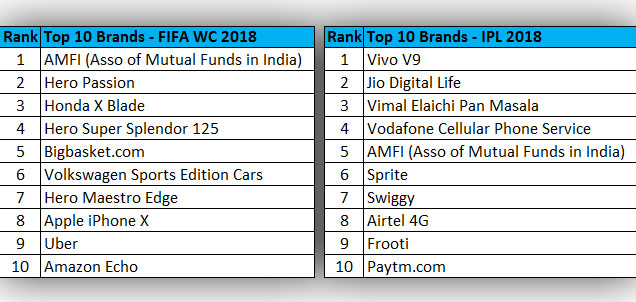
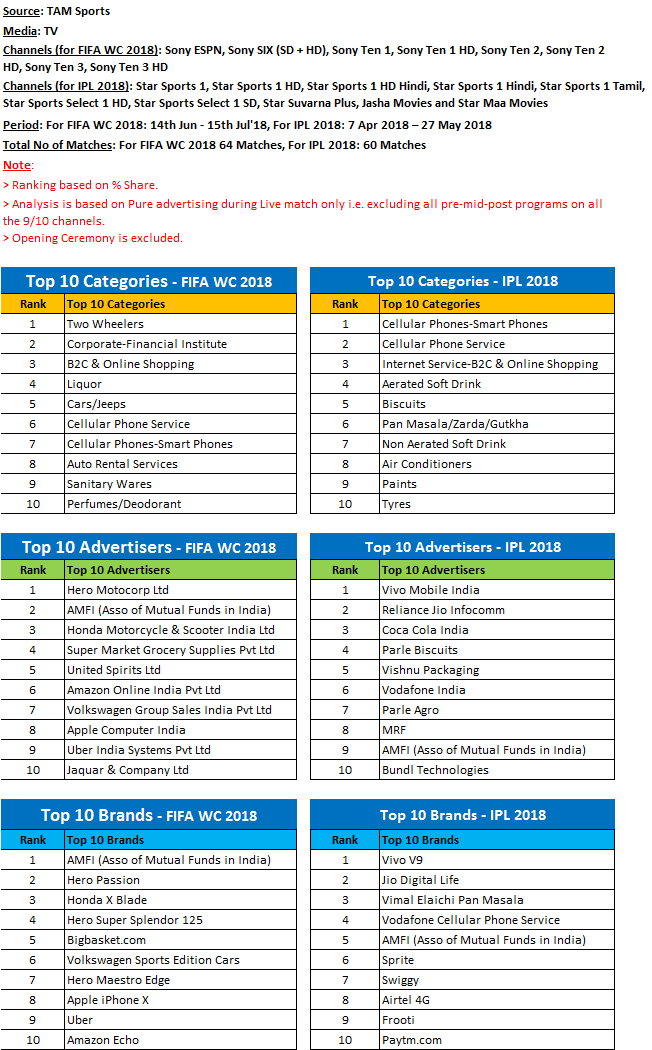
    TAM Sports, a jv of Kantar Media and Nielsen, tracks leading sporting events. In the set of tables below, we have a list of the leading categories, advertisers and brands across the television coverage of the 2018 editions of FIFA World Cup and the Indian Premier League (IPL).
  • Thomas Pulliyel, Mr IMRB


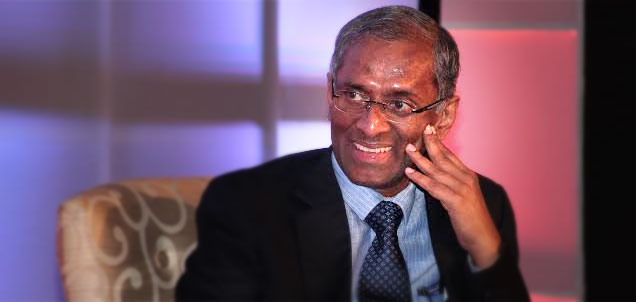
    Thomas Pulliyel, long-time President of IMRB International, retires today (August 31). The IIM Calcutta graduate began his career with the Operations Research Group and first joined IMRB in 1981 as Manager for Overseas Projects, and a decade later, became Senior Vice President. In 1992, he moved out to Research International India as Country Manger, but was back at IMRB in September 2000 for a second stint. Friends, colleagues and even business rivals fondly remember the ‘strong and silent’ Pulliyel, and how he took the organisation to new heights.


    Dorab Sopariwala

    The Al-Futtaim group had asked IMRB to set up a market research unit for them. Thomas spent a year there and I spent the first and the last month. So that’s how I came to know Thomas; you needed to get to know him a bit, before he would open up to you. We were trying to see how we would run this company, and it was only through extensive discussions, that we could work. He would come back in the evening and work till eight pm. I don’t know how we managed for food and such. — Dorab Sopariwala, Consultant and Advisor to NDTV


    Sunil Karve

    I could trust Thomas very much. He is very straight and there are no lies or false claims with him. He helps you along even if you make mistakes, and is always there to support you. When he started Research International in 1992, nobody knew about it. It was a tough and challenging task for him at the time because there was IMRB and MARG, which were the biggies out there, along with MRS and others. I think that he built up an extremely good team, and the work ethics and output were the main reasons for the success of RI. — Sunil Karve, Partner at Autumn Leaves, Innovation and LLP, Varenyam Consulting


    Partha Rakshit

    I still remember the first Board meeting I had with Thomas. Everybody says that he is a man of few words. I found that this was, indeed, his way, but he could also be very firm. I can tell you that if Thomas has got something into his head, you cannot convince him to change his mind. It’s quite difficult to do that. But I think he was a great partner to work with. I think we got on pretty well, and I think of the time when even though we were fierce competitors on the outside, we had a fantastic relationship. — Partha Rakshit, Proprietor, Partha Rakshit Associates, and former MD for South Asia, The Nielsen Company


    Colvyn Harris

    I think the values of IMRB are the values of Thomas. When you think of Thomas, he is a strong, silent type of person. The leadership values of IMRB and the way Thomas conducted himself for the IMRB company, is what has kept the company where it currently is. — Colvyn Harris, Executive Director of Global Growth and Client Development at J Walter Thompson Company??


    Eric Salama

    Thomas has given all the freedom to his people to make their own decisions and even guided some of them over the years. He was always incredibly protective of IMRB – the company, the brand and the people within. He had a paternal instinct towards people and is incredibly patient. Incredibly also, he took both failure and success in his stride. I knew Thomas when he was at Research International, and he has been the heart of an industry that has grown [around him]. I can think of so many clients, so many competitors and so many colleagues who have worked for IMRB at one stage or another. As a talent magnet and a talent machine, IMRB has produced some of the most special people in the industry. Not just one or two people, but at scale, and Thomas has been at the heart of all that. — Eric Salama, CEO of Kantar Media


    Preeti Reddy

    It is always easier to take over a company which is not making money; where everybody hates the boss and hate each other. Fortunately, we are a growing company where everybody loves Thomas and he is a legend, so you can understand how much harder Thomas has made it [to hate the boss]. I would say that it is a huge legacy. Thomas has nurtured it for 15 years, but it is a 45-year legacy. IMRB has defined the industry and you have heard everybody talk about that. In a sense, it is actually giving the industry credibility. So it is a privilege to carry that legacy forward. I think that he epitomises the values of IMRB and, again, many people have said that. I think IMRB is what Thomas is, and he has been a mentor to not just me, but so many people. I’m hoping he will continue to be somebody whom we can turn to, in good times and bad, in the years to come. — Preeti Reddy, SVP & President-designate, IMRB International


    This story first appeared in dna of brands dated August 31


  • Eric Salama slams MxM report. Says no selling TAM to BARC. MxMIndia stands by story

    By A Correspondent


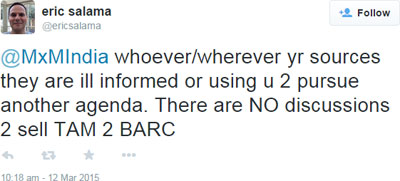
    Kantar Media CEO Eric Salama tweeted us back Thursday evening saying: “Whoever/wherever your sources, they are ill-informed or using you to pursue another agenda. There are no discussions to sell TAM to BARC.”


    This followed an earlier tweet where he said: “Happy to cooperate with BARC to improve ratings but no discussions for us to sell TAM to BARC.”


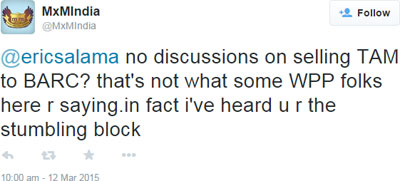
    This was reacting to our tweeting the link to the story to Mr Salama and other industrypersons.  We responded to this tweet by saying: “No discussions on selling TAM to BARC? That’s not what some WPP folks here are saying. In fact I’ve heard you are the stumbling block.”


    We are normally not so direct or rude, but in this case, we’ve heard from more than one source – on the WPP and the industry side – that the counter-offer made by the Kantar CEO was unacceptable and hence a potential deal-breaker. In fact, some industry sources even told MxMIndia in confidence, that it was because of some statements made by someone senior at WPP (suggesting Mr Salama, but not confirming it) that the talks with Kantar fell through in the early days of the BARC contract finalisation.


    One senior industryperson associated with BARC was even told that BARC will not be able to run its business without the intervention of Kantar. In fact the senior industryperson feared the future of his career because the offensive was pretty strong, he told us.


    Meanwhile, MxMIndia strongly stands by the story it published yesterday. The fact of the matter that a deal is being looked at. This could also mean that TAM will publish its ratings every week and hand over the data to BARC which will then use it for its purpose or club it with its panel size and present to its consumers.


  • Respite for Kantar (and TAM) as Delhi High Court hearing adjourned till July 11

    By A Correspondent


    It’s an election gift from the government to the section of the broadcasting and media fraternity which didn’t want a ratings black-out.


    So after all the back-and-forth to the Courts, the much awaited verdict that we were awaiting today didn’t happen, because, yes, you heard it right, the government’s counsel wasn’t available for hearing.


    Now, the ball will be in the new government’s court as the hearing has been adjourned to July 11, 2014.This part of the news (and not the interpretation before) was confirmed to MxMIndia by Kantar Media’s advocate, Diya Kapur on the phone from New Delhi.


    This is of course some respite for all parties. For channels – especially those banking big on reality shows because there will be ratings around, for newer channels because they can prove to the world what they are worth, for special events like the IPL because they will need the support on viewership.


    For TAM of course because they’ve got a fresh lease of life and for BARC too, as in the absence of ratings dark period, they can do their work at their normal pace.


    The Delhi High Court has adjourned the hearing in the Kantar case till 11 July as the government’s counsel is not available for hearing. Kantar counsel Diya Kapur and News Broadcasters Association (NBA) counsel Anup Bhambhani confirmed the news to TelevisionPost.com. The adjournment means that the stay on the clauses related to cross-media holding in the Television Rating Agency Guidelines will continue till final orders. The HC bench comprising Justice Manmohan had on 12 February stayed four clauses in the ‘Policy Guidelines for Television Rating Agencies in India’ pertaining to cross-media ownership thereby preventing a rating blackout. Additionally, the bench had given more time to Kantar to comply with the remaining provisions of the guidelines. It asked Kantar to register itself within two weeks under the new policy guidelines. The bench also directed Kantar to upload a list of affiliated advertising companies on its website along with the list of its major clients.


  • Government concerned about TAM data: Ambika Soni

    By Vijaya Rathore


    The government has been concerned about the discrepancies in TAM Media Research’s TV viewership data for a while now, and has even questioned their methodology and transparency, Union information & broadcasting minister Ambika Soni said on Wednesday.


    In an exclusive interview to ET, Ms Soni said that she always had issues with the number of boxes put up by TAM, as it (such a small number) was not enough to gauge the mood of a diverse nation like India.  “I have asked questions about the methodology of TAM. I knew that they were not being transparent. When it came to the number of boxes, rural areas were not covered. Very populated states such as UP and Bihar were not covered.


    So, I felt that 7,000 boxes could hardly be indicative. How can you put boxes as conveniently as you want to and not cover more than half of the country?” the minister asked.


    Following NDTV’s lawsuit against Nielsen and Kantar Media – the co-owners of TAM Media Research – the I&B ministry has decided to support Prasar Bharati, the state broadcaster and the Directorate of Advertising and Visual Publicity (DAVP), the government’s media buying arm, to take legal action against TAM. Ms Soni said that the ministry is also open to support the broadcasters “provided they lodge a formal complaint with the government against TAM.”


    NDTV has filed a lawsuit against the companies in a New York court alleging TAM fudged TV viewership data to favour a few broadcasters for a bribe. Both NDTV and TAM have refused to comment on the issue.


    Concerned by the developments, broadcasters and advertisers are now asking TAM to stop publishing its data, and have been meeting the government on the issue.


    “Today everybody is talking about TAM… why didn’t we talk about it all this while? The issue was raised by the ministry and me several times in the past. I am glad that this issue is now coming out in the open, as this clearly shows that there is need for competition,” Ms Soni said.


    According to the minister, lack of transparency in TAM’s system does not only concern broadcasters, advertisers and media agencies, but also Prasar Bharati that operates Doordarshan and All India Radio.


    “Prasar Bharati is collecting facts and the figures and finally even they decide to put up a lawyer. We will have to allocate resources for which permissions have to be taken. If Prasar Bharati and DAVP feel that they have to take a legal action (against TAM), they will do so in consultation with the I&B ministry and the law ministry,” she said. In 2011-12, DAVP’s advertising spend was Rs 618 crore.


    Ms Soni said that there is a need to have an alternative to TAM, which is why Broadcast Audience Research Council (BARC) is underway: “We have had several meetings with the Indian Broadcasting Federation on BARC. I have had four meetings (from 2010-12).”


    Asked if she thought a tighter regulatory mechanism needs to be evolved to check such discrepancies in future, the minister said, “There have been  suggestions for setting up regulatory bodies for content, and to censor realty shows, but the government is against any strong regulatory mechanism and we are for self-regulation.”


    Source: The Economic Times

    Copyright © 2012, Bennett, Coleman & Co. Ltd. All Rights Reserved