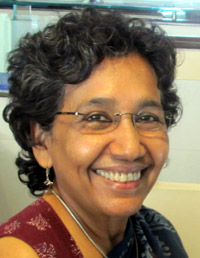
Tag: Kalpana Sharma

  • Population First partners KC College for study on media coverage on gender issues

    By A Correspondent


    Population First, the communication and advocacy initiative working towards gender sensitivity, has conducted a study on ‘Media: How Gender Sensitive, How Inclusive’ in collaboration with the Gender Issues Cell of KC College, Mumbai. The report of this research will be released in the presence of several dignitaries and students on Friday July 28 at the KC College auditorium in Mumbai at 3:30 pm.


    The findings of the study will be shared in a panel discussion with leading mediapersons Kalpana Sharma (Former deputy Editor, The Hindu), K V Sridhar (Founder, Hyper Collective), and Devleena Majumdar (President HR, Culture Machine).


    Said Dr A L Sharada, Director, Population First: “The study was conducted with funding support from UNFPA.  The project was restricted to media organizations within Mumbai Metropolitan Region and covered a total of 87 respondents drawn from 36 media organisations across languages. The conclusions, thus, are derived from the rich data gathered from interviews with media personnel and from review of previous research studies and existing literature on the subject. Data on gender distribution at different levels within media houses have clearly reflected gender disparity.  Board members, Founder members, CEO etc are predominantly men.  Women are found in large numbers as HR personnel across print and advertising but are less in number in broadcast. The presence of women camerapersons, photographers in technical sections is dismal across all media. The study also throws light on beats being highly gendered, awareness of Prevention of Sexual Harassment of Women at Workplace, demands of work and family life came out as a major hindrance for women professionals in media and more.”


  • Kalpana Sharma on Himmat’s defiance of press censorship in the Emergency

    Senior journalist Kalpana Sharma worked with Himmat magazine when the Emergency was declared. She took charge as Editor in the year 1976 until 1981 when the magazine ceased operations. Since then she has worked with The Indian Express, The Times of India and The Hindu and is currently Consulting Editor with Economic and Political Weekly. In an emailed interview with Dyanne Coelho, Sharma recalls the Dark Days and how when freedom of the press is denied, it is the poor who suffer the most 


    Q: Give us some insight about the plight of the press at the time. What was it like working under the pressure

    A:  On June 26, 1975, press censorship was imposed.  No one had a clear idea what that actually meant including those given the task.  In Mumbai, in Mantralaya, a room was set up for the Special Press Adviser (the official name for the Censor).  Around 15 people from the department of publicity of the Government of Maharashtra were assigned to assist him.  In the intial weeks, apart from daily newspapers that were compelled to follow the “guidelines” the government had issued, many smaller publications remained outside the net.  I worked with one such publication, Himmat, an English language weekly edited by Rajmohan Gandhi.  We read the guidelines and decided that we would not submit to pre-censorship.  If the government thought we had violated one of these guidelines, they could move against us.  Of course, this was risky, and we experienced the challenges right through the 20 months of the emergency.  But our defiance showed us that it was possible to challenge the censorship regime if you were prepared to take risks.  I might add that this was easier for smaller publications like ours than the big newspapers.  Even so, some like the Indian Express did resist, thanks to their owner Ramnath Goenka.


    Q: Would you share some incidents, memories, anecdotes during the period of Emergency, particularly in your capacity as a journalist.

    A:  There are too many to recount.  As I said, Himmat had decided not to submit to censorship.  But within a few weeks of the declaration of emergency, we were served a notice that we had printed “prejudicial” material and would have to submit to pre-censorship.  This was a report about a meeting on Gandhi Jayanti in Delhi at Raj Ghat where Acharya J. B. Kripalani spoke.  Those sitting on the stage with him were arrested by the police which disrupted the meeting.  For carrying that news, we had apparently violated the so-called “guidelines”.

    Many more such incidents took place, including a demand that we deposit Rs 20,000 with the Commissioner of Police or would be denied the right to continue printing.  Our printing press was also served a notice not to print Himmat.  We went through some really challenging times.  But we did not miss a single issue.  This was only possible because of the committed group of journalists working with the publication.

    What it taught me, and all of us, above all is that when freedom of the press is denied, it is the poor who suffer the most.  The government can then do what it likes, as it did during the emergency, and in the absence of the check that a free press provides, it can literally get away with murder. After the emergency, we heard about the terrible violations of human rights, the mass sterilisation campaign, the slum demolitions, the torture in jails, fake encounters etc.  Not a word of this could be reported during the emergency.


    Q: Do you think we’ve evolved since then, in terms of ensuring the freedom of the press is protected. Where do we stand now in your opinion?

    A:  Legally, it will be difficult to impose that kind of emergency and to bring in press censorship.  But I’m not sure we really value the freedom we have.  If we did, we would make sure that the untold and unrecorded stories, of the people who are marginalised, virtually invisible, find space.  But where do we see that?  We have another form of self-censorship in the media today where the nexus between big business and politics has ensured that certain stories never get told.  And is anyone really defying or resisting that?  Fortunately, the internet is providing some kind of democratic space for some of this information to come forth.  But for these stories to see the light of day, we need many more journalists committed to seek out the truth and report it.


    Q: In your opinion do we as a country have a strong enough leadership today to ensure history doesn’t repeat itself?

    A:  My short answer is No.  I don’t think any of our present lot of politicians, including those who suffered during the emergency, feel passionately enough about the real meaning of the freedoms guaranteed under a democracy.  These freedoms are not words on paper; they have to be seen in the actions and decisions made by those who govern.  Yet, no sooner than a group gets power, they are willing to resort to any measure to hold on to it.  How different is that from what Mrs Gandhi did 40 years ago?


  • Newswatch: Kalpana Sharma on the falling standards in newspapers

    By Kalpana Sharma


    When the new chair of the Press Council of India, Justice Markandey Katju held forth on the competence, or rather incompetence and lack of learning of journalists, we were outraged. How dare a person from outside the media cast aspersions on our competence? Has he any idea how difficult it is to produce readable newspapers and magazines and watchable TV shows?


    Yet what was considered inexcusable only a few decades ago now passes without anyone being hauled over the coals. By this I mean the bloomers one can find almost every day, particularly in print. On TV we now know that there probably are as many mistakes as in print. It took the former chair of the Press Council, Justice PB Sawant to catch one such “inadvertent” mistake and to ensure that it was never forgotten. But in print, the errors jump out at you every day – wrong photographs, captions, erroneous headlines, inaccurate data. Are all these inadvertent or do they reflect a lowering of standards in the media – where the rush to print has introduced carelessness that can sometimes prove costly?


    Earlier, nothing you wrote could find its way into print without passing through several filters, including people who were clued in on the law. Headline writers generally read the whole story before giving a headline. Even these would be checked before the page was passed. Much of this still exists but there is an obvious slackening of rigour. If there is a ‘post-mortem’ the next morning, and many media organisations have dispensed with this altogether, heads probably don’t roll if there is a mistake unless it provokes a legal notice.


    Take just one day in the life of newspapers in Mumbai. On November 28, three newspapers that I read carried stories on the efforts of two NGOs to have a car-free day in South Mumbai. The divergence in the numbers quoted in the reports tells its own story.


    On page 5, The Times of India had the following headline: “8,000 ditch vehicles to celebrate car-free SoBo”. (For the uninformed, SoBo is the fashionable name for south Mumbai.) But while the headline was unambiguous about 8,000 people participating, the first paragraph of the report read:


    “An initiative to reclaim south Mumbai for pedestrians and cyclists got off to a great start on Sunday morning, with around 800 Mumbaikars ditching their vehicles to participate in a walkathon and a bike-a-thon.”


    So who is right? The headline writer or the reporter?


    If you thought reading another paper might yield more accurate information, you would be mistaken. Hindustan Times, on the same day, had a six column headline on page 5 stating, “SoBo’s Car Free Day fails to gather steam” and below that: “Poor response: Only 150 people turn up for event, participants complain of poor arrangements.”


    How did HT spot only 150 people when TOI counted 800? Or 8,000?


    In frustration, I then turned to Express Newsline of Indian Express. It echoed HT’s headline: “Lukewarm turnout, but walkers and cycling enthusiasts have free run”. But unlike the 150 number of HT, Express quoted an organiser claiming that 150 cyclists and 200 pedestrians had participated. So that adds up to 350. So in the end were there 8,000, 800, 350 or 150?


    For those outside the media, this might sound like nitpicking. What does it matter? In any case, people only read one newspaper – that is if they read anything except the entertainment supplement.


    Yet, the fact that a simple report like this could show such variance actually points to a very basic problem in journalism today. The golden rule about statistics and numbers is: if in doubt, leave out. The structure of newspapers is supposed to provide the checks so that inaccuracies are caught. Journalists are supposed to be trained to be especially careful with numbers. And to double- check everything, even the most trivial detail. When something so basic begins to break down, then you are laying the ground for the kind of mistakes that bring in lawsuits.


    So even if Justice Katju’s remarks were sweeping generalisations, I would suggest that they were not entirely off the mark.


    Kalpana Sharma is an independent journalist and columnist.