
Tag: K. Ramakrishnan

  • Parle tops Kantar’s annual Brand Footprint India report

    Kantar released the 12th edition of its annual Brand Footprint India report. The report ranks the Most Chosen (in-home and out-of-home) FMCG Brands based on Consumer Reach Points (CRPs). CRP considers the actual purchase made by consumers and the frequency at which these purchases are made in a calendar year.

    Key findings: In-Home segment:

    1. With a CRP score of 7980 million, Parle holds the top spot for a record 12th year in a row, followed by Britannia, Amul, Clinic Plus and Tata Consumer Products.
    2. Consumer Reach Points (CRP’s) continue to grow, however is slightly lower than last year. Overall, CRP’s have increased almost 33% in the last five years.
    3. All sectors have seen a CRP growth slow down, except dairy:
    4. Brands chosen more often have greater probability of growing in CRP:
    5. Haldiram’s and Balaji are the only two brands in the 2024 top 25 in-home brand list to grow by more than 30% in CRPs in 2023.
    6. Sunfeast leads the way in biggest penetration gains in 2023 at 6.4. The following brands make it to the top 10 list:
    7. Seven brands in the top 25 in-home rankings show more than 20% penetration increase in the last decade. Britannia leads the way, followed by Surf Excel, Sunfeast, Haldiram’s, Patanjali, Brooke Bond and Vim.

    Key findings: Out of Home segment:

    1. Britannia leads the way in the 2nd edition of OOH brand rankings with 628Mn CRP’s. It is followed by Haldiram’s, Cadbury, Balaji and Parle. The top 5 rankings are all snacking brands and remain the same as 2023.
    2. The five Most Chosen OOH beverage brands in India are Thums Up, Frooti, Amul, Maaza, & Bisleri.

    Speaking about this year’s report and rankings, K. Ramakrishnan, Managing Director- South Asia, Worldpanel Division at Kantar said: “Consumer choice is very reliable strength test for a brand across market conditions and Brand Footprint has been a widely acclaimed ranking system to measure this for over a decade now. As we see over the years, consumers are making increasing trips for purchase and that adds their options and in-turn, their choice. This is reflected in the constant increase in CRP’s. We also introduced an out of home rankings last year as OOH consumption is on the rise and has different choice triggers.”

  • Parle tops Kantar Brand Footprint report

    By Our Staff


    Kantar India released the 9th edition of its annual Brand Footprint report today. The report ranks the Most Chosen FMCG Brands based on Consumer Reach Points (CRPs). CRP considers the actual purchase made by consumers and the frequency at which these purchases are made in a calendar year.


    Parle Products leads this year’s rankings, followed by Amul, Britannia, Clinic Plus and Tata Consumer Products. With a CRP score of 5715 (Mn), Parle holds the top spot for a record 9th year in a row.


    In a year dominated by health and hygiene, Dettol unsurprisingly grew a whopping 48% in CRP’s (923 Mn) and entered the top 25 brand list. Dettol was followed by Lifebuoy with a growth of 25% CRP’s (1798 Mn), Vim at 21% CRP’s (1454 Mn), Dabur at 14% CRP’s (1458 Mn) and Britannia at 11% CRP’s (4694 Mn).


    Speaking about this year’s report and rankings, K Ramakrishnan, Managing Director- South Asia, Worldpanel Division at Kantar said: “Brand footprint is a great way of measuring and rewarding brands by the extent to which they are chosen by consumers. Choice is a function of penetration and frequency. However, we always year after year find that brands grow a lot more on account of penetration gain than frequency gain. The biggest gainers in brand footprint 2020 were expectedly the hygiene brands. That said, the traditional leaders also held their positions by ensuring penetration growths even during the pandemic.”


  • Parle is most chosen brand in India in Kantar’s Brand Footprint 2020 report

    By A Correspondetn


    Last week, Worldpanel Division of Kantar, the leading data, insights and consulting company, released its report, Brand Footprint 2020. The report is an annual ranking of FMCG brands based on the Consumer Reach Points the brands scored in a year. The report is in its 8th edition this year.


    Key findings:

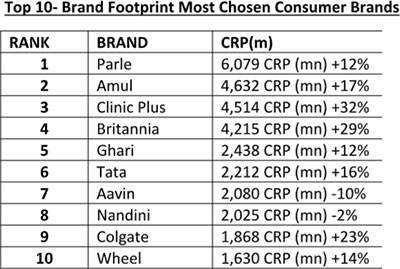
    Scoring the highest CRP (mn) at 6029/ +12% Parle, ranks first followed by Amul at 4,632 CRP (mn)/ +17%, Amul at 4,632 CRP (mn)/ +17%, Clinic Plus at 4,514 CRP (mn)/ +32%, Britannia at 4,215 CRP (mn)/ +29% and Ghari at 2,438 CRP (mn)/ +12%

    Five new brands joined the Billion CRP Club this year Dabur, Vim, Sunfeast, Brooke Bond & Patanjali. 21 brands made it to this group in 2019 compared to 16 in both 2018 and 2017.

    Over 2/3rd of the top 50 brands are Indian Origin brands (36) while global stands at 14.

    Global brands (29 %) show 1.8x growth compared to Indian Origin brands (16%). Global brands are growing almost twice as fast at 29% compared to Indian Origin brands at 16%.

    Consumers make significantly more choices this year leading to a significantly better CRP performance by brands- 57 % brands record growing CRPs.

    Bigger brands find better growth and follow the Golden Rule, brands grow faster by growing penetration

    Colgate stands at the highest penetrated brand at 88%

    Surf excel remains marks a consistent CRP growth rate at +20% scoring 1566 mn CRP.

    58 brands saw a penetration gain of 1% or more. Leading the category is Ponds at 5.8% followed by Harpic (4.8%), Comfort (4.5%). 1% penetration gain adds an extra 2.9mn shoppers to the brand.

    In the foods category Britannia clearly charts out a success story as the 2nd most chosen brand, 7th highest penetrated brand with a household penetration at 67.6%. While Aashirvaad saw a surge with 4% penetration increase and +55% CRP growth.

    Within homecare surf excel marks +48% CRP growth while recording +3.4% penetration increase, closely followed by Vim at +44% CRP growth and +3.2% penetration.

    Dabur comes out strong in the personal care & foods category with +34% CRP growth, making it the 5th most chosen beauty & health brand in India with a 70.0% household penetration.


    Impact of Covid-19:

    Food & Beverage brands get picked up more often except Parle and Tata due to drop in frequency. For example, Amul is chosen over 100,000 additional times during the COVID months of March-May.

    While personal and home care brands drop CRPs

    Despite CRPs, trip size increases causing top brands to grow volume


    Said K Ramakrishnan, MD- South Asia, Worldpanel Division, Kantar: “Consumer Reach Points are a great way to measure and rank brands as it is a measure of the number of opportunities a brand has, to interact with a consumer. It is great to see consistent validation for the fact that if you build penetration, frequency and growth follow. This has really been a year of global brands in terms of their higher growth than others. Like these, this year’s report has a lot of interesting nuggets to derive a lot of information and insights on top the behaviour of consumers towards brands in the last year.”


  • More on the Importance of Penetration


    We have carried a quick chat with K Ramakrishnan, GM and Country Head, IMRB Kantar World Panel along with Josep Montserrat, global CEO of Kantar Worldpanel recently.  We had also spoken to Ramakrishnan on Parle being the #1 brand. Here is the complete interview with him by Anuka Roy


    There are brand studies and brand studies, how would you say is the Brand Footprint Global Ranking different from the others?

    The basis on which Brand Footprint works is penetration. It looks at the population size you are trying to reach, the penetration that the brand has, at least what percentage of them has access to your product in the last one year and also how often they have used. So, to that extent there is no other ranking which tries to take these in to account. They may take some brand parameters in to account or any of those but this one specifically takes the extent to which a brand has penetrated in to a household. That becomes the biggest point on which it is based and that way it is different.


    What would you say is the reason for Parle to be the No 1 brand in India?

    In India it is #1 because it reaches a very large number of people, a highly penetrated brand and bought at a frequency. You may have heard that many parts of the country, there is a lot of chai and biscuit happen. So, Parle has taken that occasion pretty well and to that extent that is the reason why it is right on top


    In the Indian context where it’s said that India actually comprises many India, can you elaborate on the relevance of the Brand Footprint ranking? Especially the entire Loyalty v/s Penetration debate?

    In my mind, it is really not a debate. Loyalty is important and penetration is important. But if you see growth of brands, the brands that have grown what have they improved on? Have they improved on penetration or have they improved on loyalty? At this point, it is very clearly established that penetration is what is leading to growth. In that sense, there is really no clash. So, therefore it is not a competition. And, the relevance in India for something like a Brand Footprint is very clear that the new measure or the new metric by which brands are getting assessed is actually penetration which means the number of new customers they are having, the extent to which you are able to reach. If that is the case, and if this is becoming a metric globally and in India many brands are taking on it, then there is clearly no other metric which can tell them well enough about their standing apart from Brand Footprint.


    Has the proliferation of digital impacted the salience of brands in a country like India?

    If anything, it has only added to it. Brand salience already exists because of the presence in media. Then the presence of these brands on the digital media. Third, the discussion about these brands on social media. If you add all these things together, it is only building salience in my view


    And how would you rate the impact of e-commerce. It’s said that thanks to e-commerce, even the hinterland has access to products (if not services) that were not available because retailers wouldn’t stock the products because of low consumption.

    E-commerce at this point of time in our household panel data is a very small percentage. But that said, there are enough sources of information from Kantar itself which state that where and which part is e-commerce growing. Hinterland contributes to a significant percentage of business coming from e-commerce. That is one of the hypothesis is fundamentally those markets do not have access to products because of distribution reasons and other reasons. Since they do not have access by physical availability, they are reaching them through e-commerce is some of the Kantar studies are saying. It is not household panel but it is from Kantar.


    Could you elaborate on the term CRP used in the Brand Footprint Study?

    Brand Footprint study aims to assess the performance of brand year after year on a certain set of parameters. The term that Brand Footprint uses is called Consumer Reach Point (CRP). So, CRP is actually a product of the population that is available and that can be addressed by the brand, the penetration, which is what percentage of them have reached by this brand in the last particular year and their frequency. It tries to assess is by what extent is the brand able to touch that household in terms of its usage. So, that is what Brand Footprint tries to measure. Therefore, it is a real measure of consumer behaviour towards your brand.


    Your study observes that consumers in India expect brands to contribute to creating a better society. But does that really result in better sales?

    At the end of the day, we are talking about a case if it is only contributing something in society and not addressing the need for which the brand or product was created that would not be the case. But the fundamental assumption here is that there is product parity. So, each product is delivering on a certain promise. Over and above that, if it identifies with a certain cause then that cause affects a certain set of people and they get associated with the brand that is the benefit. Is there a direct correlation to sales? No. But if they do that consistently, repeatedly and if they are seen as doing that, it has a long term impact on sales.

     

  • The Importance of Penetration in a Brand’s Success


    At last Consumer Connections 2016 conference, organised by IMRB, Josep Montserrat, Global CEO at Kantar Worldpanel and K Ramakrishnan, General Manager and Country Head – Household Panel at IMRB Kantar Worldpanel spoke with Anuka Roy about how the importance of penetration for a brand to succeed. Excerpts from the discussion:


    About Brand Footprint and Penetration

    Josep Montserrat (JM): Penetration is basically about how many people are buying your brand. The metric that we analyse here is how many interactions the consumer has with your brand, and how many times has your brand has been bought by a consumer. It is a matter of penetration: How many people and how often are they buying it? When we analyse that, we see the brands that have raised the number of times buyers have bought them. The top leaders, and the brands that have grown more in terms of consumer reach points, have done so because of increased penetration. Considering the size of the population that we are measuring, which is a billion households, one per cent penetration translates into 10 million people.

    K Ramakrishnan (KR): The basis on which Brand Footprint works is Penetration. It looks at the population size you are trying to reach and the penetration the brand has — at least what percentage of them has had access to your product in the last year, and also how often they have used them. So, to that extent, there is no other ranking which tries to take these into account. They may take some other brand parameters into account, but this one specifically considers the extent to which a brand has penetrated a household. That becomes the biggest point on which it is based, and also the things that makes it different.


    On Penetration as a yardstick

    JM: I would say it is much more relevant in India than any other country because here, consumer backgrounds and hence choices, differ depending on geographies. What are the drivers and initiatives that you can put in place in India to win penetration, is different in other markets. Considering penetration of the products and the brand and the population can afford is a key driver for the success of the brand. There is an increasing trend of marketers to rate penetration as one of the key metrics in their scorecards in a way of measuring success in terms of the initiatives they have put in place and more we have clients at the local level and global level, that they put the penetrating and go to the CEOs to see the brand performance.

    KR: Loyalty is important and penetration is important. But if you consider growth of brands, the brands that have grown, what have they improved on? Have they improved on penetration or have they improved on loyalty? At this point, it is clearly established that penetration is what is leading to growth. In that sense, there is really no clash. Therefore it is not a competition. The relevance in India for something like a Brand Footprint is very clear; the new measure or the new metric by which brands are getting assessed is actually penetration, which means the number of new customers they have, the extent to which you are able to reach. If that is the case, and if this is becoming a metric globally — and in India many brands are taking it on — then there is clearly no other metric which can tell them well enough about their standing, apart from Brand Footprint.


    On Penetration and Mass Media Advertising

    JM: There is no general rule to see how much mass media advertising has impacted penetration. Of course, we have services and solutions that allow the marketers to understand that by investing in advertising — either digital or offline — what is the effect in purchase behaviours. Not only in terms of sale, but also growth due to new people engagement by the brand, or an increase in buying frequency. Advertising is important because you need to be in the mind of the consumer.

    KR: If anything, it has only added to it. Brand salience already exists because of the brand’s presence in media. Then the presence of these brands on the digital media. Third, the discussion about these brands on social media. If you add all these things together, it is only about building salience, in my view.


    First appeared in dna of brands on July 18


  • There’s a lot brewing at CCD, Madison wins Media AOR, Creativeland creates TVC

    By A Correspondent


    Gautam Kiyawat

    Madison Media has been appointed as the media AoR (Agency on Record) Cafe Coffee Day. The account size is estimated to be approx Rs. 40 crores and will be handled by Madison Media Omega in Bangalore. Said Gautam Kiyawat, Group CEO, Madison Media,”We are delighted to have India’s premier and leading Cafe chain, Cafe Coffee Day, to our roster of clients and are confident of helping it grow and gain further market share in the country.”


    CCD today has over 1,450 Cafes across over 185 cities and as a brand has never advertised in mass media in the last 16 years of its existence. It has been built solely through marketing initiatives, coffee category building activities, public relations, social media, engaging the ever-aspirational Indian consumer.


    K. Ramakrishnan, President Marketing, Cafe Coffee Day said, “Cafe Coffee Day being a brand for the young and the young at heart, we needed a partner who would be passionate about the brand, to be able to understand the category in depth and the varying dynamics to enable us to move along at a fast pace. We are confident of Madison Media’s thought leadership and competence in executing the campaigns. We are delighted to have them on board.”


    However, with brand presence expanding over 185 cities into newer, emerging towns and markets, it’s time for the brand to introduce their first ever television commercial campaign ‘Sit Down’ aiming to reinforce itself into every single household in India, as they make inroads into several newer and unconventional markets.


    The ‘Sit Down’ TVC, conceptualized and created by Creativeland Asia, is part of a 360-degree-campaign. This is CCD’s first-ever TVC in its 16 years of existence.


    The TVC captures CCD-goers across Cafes in India, telling, actually singing about what they are sitting down for. From sitting down for love and peace, to sitting down to make friends and to tweet, to sitting down to read and to dream, the film showcases plenty of ‘sit downs’ that happen at over 1450 CCDs every single day. The film ends with the line, “Sit Down. A lot can happen over coffee”.


    Sajan Raj Kurup

    Sajan Raj Kurup, Founder and Creative Chairman, Creativeland Asia, said, “This is the first ever TVC for CCD. I feel extremely fortunate to have had this unique historic opportunity. We have given it our most honest shot at it. And I hope CCD regulars like it. Personally, as someone who goes to CCD and someone who has been working on the brand for five years now, I feel extremely happy when I see this piece of work. We wanted CCD’s first ever TVC to be a little more than an Advert. Something that CCD goers identify with. Something that is effortless and not trying to hard. Something that is neither too heavy nor too frivolous. In the whole idea of Sit-down, we eventually found all these and more. A powerful thought which is socially relevant in India at this juncture.”


    He added, “While the hype initially may be on the TVC, the campaign will be integrated across media. Digital and social playing a very poignant role. Many campaign specific acts have been planned over the last year and will be executed phase-wise.”


    The TVC was shot over seven days across various CCDs across the country with a cast of over 75 youngsters. The unique craft of the TVC intelligently combines two contrarian culture. One, the Cafe and the other, the social media space. The storyline of the TVC shows how a bunch of youngsters started a movement call sit-down by self-recording videos across various CCDs across the country to the self anthem and then posting it via various avenues on social media. The central message of the TVC being to stop creating morchas or standing up against things, and instead Sit-down talk  over a cup of coffee and find a way forward. Over 130 social-media profiles were used. Live posts were diligently crafted and created to become the frame-work of the TVC.


    The TVC is produced by Equinox Films and directed by Ram Madhvani. “Great effort has gone into crafting every detail in the TVC by Ram, myself and our respective teams who have relentlessly worked over months to design each and every frame in the TVC,” added Mr Raj Kurup.


    Speaking on the launch of its first TVC, Mr Ramakrishnan said, “CCD as a brand has never advertised in mass media in the last 16 years of its existence. It has been built solely through unique and pioneering marketing initiatives, coffee category building activities, public relations and more recently through social media. We believe it is the right time to get deeper into our customers lives, possible only through television.”