With the new government set to assume office in a few days, the media and entertainment sector is also hoping to see its ‘achche din’. MxMIndia spoke to a few stakeholders to know how they see this change of power and what they are hoping to get from the new government.
Ashish Bhasin
Ashish Bhasin, Chairman & CEO South Asia Dentsu Aegis Network, Chairman Posterscope and psLive – Asia Pacific
From the Media & Entertainment point of view, what one wants is a strong and stable economy which depends upon a government that takes decisions and takes them forward. A clear majority government is much required as there seems to be a paralysis for the last few years on decision making. To that extent, whatever is good for the economy is good for the media and entertainment sector. From that point of view, having a stable government with a clear majority will be a good change.
Nagesh Alai
Nagesh Alai, Group Chairman, FCBUlka
There is a lot of hope after the 10-year Congress mishap. There are no industry specific expectations from the new government other than doing away with insidious muzzling of freedom of speech. I would like to see the new government walk the talk on eradicating corruption, have a zero tolerance on corruption and bring about probity and accountability in public life – to start with their own elected candidates and then amongst corporates and avoid crony capitalism. Once this is done, the rest will fall in place.
Jehil Thakkar
Jehil Thakkar, Head of Media & Entertainment, KPMG
The Media & Entertainment sector is enthused about the fact that there is a majority verdict in this election. A majority verdict will hopefully mean a decisive government and movement on the regulatory front. This government will take office with the weight of a lot of expectations – including the expectations from the M&E industry. There are several areas that the industry will expect movement from the government which are:
1. Speedy implementation of Phase III licensing in Radio and associated regulations (networking, multiple station ownership, etc.).
2. Greater friendliness to FDI in Media. The industry is hoping that the government will raise the FDI caps in several areas including Cable to at least 74% if not 100%, DTH to 100%, Radio to 49% and progressively higher than 50%.
3. The industry is also hoping that the government will allow the radio industry to carry news. It does not make sense that news is restricted to AIR in radio but allowed to be privatized for all other media.
4. Solving the service tax issue for the media industry where due to content being on the exception list, a pass through option is not available. This will provide great relief to the industry.
In addition, there are other issues that are not specific to media but will certainly help the industry. Rationalisation of customs duty, implementation of GST (assuming entertainment tax is part of GST) and increased focus on infrastructure development.â€
Apurva Purohit
Apurva Purohit, CEO, Radio City 91.1FM
We are happy with any government that promises to end the policy paralysis that has been operational for the last few years. The good news is that with a decisive victory of this nature there will not be in any internal pulls that will prevent the government from moving ahead with sectoral reforms. We hope to see good governance, an end to the policy paralysis and a focus on development, specifically infrastructure and thereby job creation.
As far as the FM industry is concerned, we have been waiting for the last 3 years for the implementation of Phase 3 and the policy that was announced in July 2011. Unfortunately the previous government chose to do nothing; resulting in the stagnation of the industry, a failure to expand FM beyond the current 90 cities and thereby create job opportunities in the 300 more cities where Phase 3 has been planned for. This failure to expand has harmed not only job seekers, potential listeners but also small businesses and retailers who do not have the choice of a cost effective medium to advertise on to expand their businesses in these towns. We expect the government to urgently help kick start and proceed with Phase 3 of the FM deregulation – a process which by the way has the consensus of all the constituents but has not seen light of day due to the inertia exhibited by the previous government.
While 2013 may have been a slowdown year for most sectors, an opposite trend was observed for the Indian Media & Entertainment (M&E) industry that registered growth of approximately 12 per cent, according to the FICCI-KPMG report.
Overall growth remained muted, noted the study that was caused largely by the slowdown of the Indian economy. The economic slowdown impacted advertising revenue dependent sectors such as TV and print the depreciation in the rupee also affected print, cable and DTH companies adversely but helped export oriented sectors such as animation and VFX to some degree. At the same time, this was countered by the impact of continued digitization of media products and services, and growth in regional media.
Digitization of cable saw progress of television industry moving in the right direction, with the mandatory Digital Access System (DAS) rollout almost complete in Phase II cities. The impact was felt to the extent that carriage fees saw a reduction of 15-20 per cent overall, however the anticipated increase in ARPUs and subscription revenues for broadcasters and MSOs (Multi System Operators) is expected to be realized only over the next 2-3 years. Other key highlights in 2013 were the inclusion of LC1 (less than class I) markets in TV ratings, the 12 minute advertising cap ruling and the shift from TRP to TVT ratings.
The study also noted that the film industry recorded a double digit growth, albeit slower than in 2012, with multiple movies scoring big on box office collections. Approximately 90-95 per cent movie screens are now digitized in the country, with a shift in focus to tier II and III cities. Going forward, multiplex growth is expected to slow down, in line with the overall delays and future expectations for retail sector and commercial real estate development, impacting box office growth in the short term
The print sector too continued to buck the global slowdown trend. The sector grew at a CAGR of 8.5 per cent this year to reach INR 243 billion. Regional markets performed exceedingly well on the back of steady advertiser spends, state election impact and new launches. However, with the validity of IRS data called into question by the industry majors, the sector in the short term suffers from the lack of a robust measurement system, critical for decisions on media planning and allocations.
The total internet user base in India grew to approximately 214 million by end of the year with almost 130 million going online using mobile devices. Mobile Internet users dominated the total internet user base capturing an overall share of 61 percent. Digital media advertising in India grew faster than any other advertising category. Streaming and download services continued to see growth in the music industry, with the growth in mobiles, in particular smartphones, contributing significantly to increased consumption of music ‘on-the-go’. However, with the continued decline in physical sales, compounded by the significant fall in ringback tone revenues (following the backlash of TRAI guidelines issues in 2012), the sector saw an overall fall in size by 10 per cent in 2013. Going forward, digital revenues are expected to drive growth in the sector. Further, the vibrant live events sector is expected to continue its role as a catalyst for driving growth in artists’ fan-base, and public performance royalties.
Uday Shankar, Chairman, FICCI M&E committee said,“2013 has been an extraordinary year for the media and entertainment sector – a year of challenges and significant change which saw the industry dealing with a host of issues. Television saw the implementation of the 10+2 advertising cap and significant progress in seeding of set top boxes in DAS 1 and II – setting the stage of revenue growth and expansion in genres. The film sector continued to mature on the back of multiplex expansion and a wide variety of content. Radio and print continue to defy global trends and await positive regulatory intervention that will take these sectors to greater heights. I am certain that the insights and findings from this report will provide a comprehensive and useful lens for all of us in the industry.”
According to Jehil Thakkar, Head of Media and Entertainment, KPMG in India, “2013 was a year in which many parts of the M&E industry paused and took stock. Focus shifted from top line growth to bottom line growth with companies focusing on operations and efficiency. Inspite of a very challenging macro environment, the industry grew 12 per cent, a far better performance than many other industries. The structural changes taking place in the industry – especially in television and digital, continued to take the industry down the path of fulfilling its potential.”
This year, the report highlights opportunities that could come from tapping international markets such as the US and Middle East, with a special feature on opportunities in South Africa and Nigeria.
Going forward, there is need for continued positive regulatory intervention, such as implementation of Phase III for the radio sector. In an increasingly digitized media world, the ability to create compelling and targeted content across multiple channels, will be the bedrock for creating differentiation in a cluttered market, the report observed.
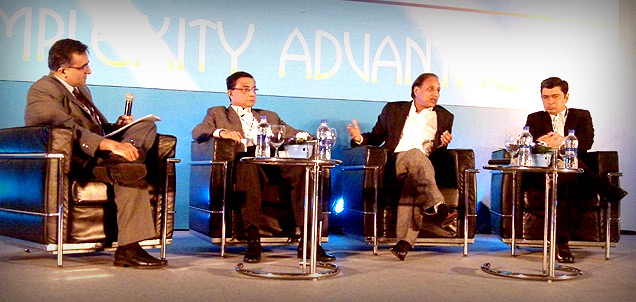
L to R: Jehil Thakkar (KPMG), DD Purkayastha (ABP), Ravi Dhariwal (BCCL, INMA) and Santosh Desai (Future Brands)
By A Correspondent
The second day of the International Newspapers Marketers Association (INMA) South Asia 2012 conference in Delhi threw light on the complexities and challenges of the print newspaper media. The first session of the day was ‘Media 2020: A future backward kaleidoscope’. The session focussed on how the newspaper industry is readying itself to face the challenge from digital media usage.
Mr Jehil Thakkar, Partner, Head-Media & Entertainment, KPMG India made some interesting observations about the levers that are changing the Indian newspaper industry. He pointed out how empirical studies prove that there exists a positive relationship between the wealth of a nation and newspaper readership: “There also exists positive correlation between growth of economies and technology adoption, which has significant potential to disrupt media consumption.”
“The rapid proliferation of new-age devices and growth of alternate media has reduced newspaper consumption by 40 per cent with audiences preferring to access paper via their mobile phones,” added Mr Thakkar. According to him, technology would alter the workings of newspaper industry as coverage would become electronic, delivery would become faster; collaboration would become the key; cloud-based service would become a norm; interactivity through QR and barcodes would see an upsurge.
DD Purkayastha
If you are having trouble in viewing this video, see link
Talking of how things will shape up in 2020, DD Purkayastha, MD & CEO, ABP Pvt Ltd said that the future belongs to newspapers who become hyperlocal as cities reach the saturation point. He said: “Regional publications will grow. And consolidation will happen at a much faster pace.”
Mr Ravi Dhariwal, President, INMA Worldwide and CEO, The Times of India, noted how newspaper of 2020 will undergo a dramatic change. He noted: “Three critical things will emerge in 2020: what brand you own will become important as there will be many more brands on the digital media; curation of the product will become more important as the role of a journalist will shrink and need for analytical news pieces will arise; and business model will change as ad revenue will become a critical source of revenue. As technology improves, and people get more comfortable with using technology, the ad rates would only increase.”
Mr Santosh Desai, MD & CEO, Future Brands India, remarked: “The larger issue that would emerge would be the tension between decentralisation of news media and fragmentation.” The panel, however, coherently agreed that despite the changes and challenges that the newspaper would undergo, it would still exist with the digital media.
The session on ‘Increased circulation; dwindling readership: Is it time to measure ‘access’?’ saw panellists discuss the much-debated measurement metrics available. ‘Newspaper distribution channel: How best to nurture it for the future’ and threw light on the vendors and agents who distribute the newspapers. Moderating the session, Mr Sanjeev Vohra, Executive Vice-President – Audiences, BCCL, said: “The vendor currently exists as an independent businessman and as an investor in newspaper business.” His view was supported by Mr PS Venkat, Vice-President, Circulation, The Hindu, who said that changes are needed in distribution model to enable the vendors to become partners in progress.
Mateen Khan
If you are having trouble in viewing this video, see link
Mr Mateen Khan, Product Head of Lokmat Samachar pointed out how the distribution channel in rural areas is still a problem, while it may not seem so in a metro. Taking the discussion ahead, Mr Rakesh Sharma, CEO, Aaj Samaj & ITV Group said: “There should be distribution points every three kilometres, and more distribution points.” He, however, noted that the vendors will remain the key to distribute newspapers in India beyond 2020. Mr OP Rajgharia, Chairman & MD, Overnite Express Ltd appreciated the effort put in by newspaper vendors to ensure the timeliness of delivery.
‘Needed to be sector-neutral’
If you are having trouble in viewing this video, see link
Bhaskar Das, President & Principal Secretary to MD, The Times of India Group, talks to MxMIndia on curating the INMAÂ South Asia 2012 conference
When I was talking to the organisers, and was given the task of preparing the content architecture of INMA, I told them very clearly that it is not about newspaper industry -it is about business. So, we have to be sector-neutral since principles of business are same. Newspaper is a sub-set of business. This was the first consideration.
Secondly, in my case, the delegates were my guiding point. Why should people attend the conference? Are we going to be just another conference? How do I make it distinctive?
The distinctiveness of the conference is that it creates fluid knowledge; knowledge that one can import when they go back. So, I had to ensure that they learn from each session. That led to the subject. In most of the conferences, people state the obvious. I thought why we don’t address the fact that there are complexities, there are challenges. Being an incumbent player, I realised that if we talk about problems, it is not solved. We should then talk about how we can leverage that problem or challenge. This led me to look for various industries. I scouted the internet, books, academic journals, about what happens when an industry goes through huge challenges, air pockets. There are initial signs of a problem, which I came to know of while researching, such as ‘butterfly effect’ that led to complexity science. This became the theme. The theme has to be intriguing to people rather than being a newspaper conference. The theme was then decided as ‘complexity advantage’. Now that complexity is a given, why not leverage it.
On the audience mix:
This time it has been a record attendance. I am not very happy but you to also have to market it that way. If one can maintain this level of content architecture, attendance will grow. For an event that happens once a year, I will have to sustain noise throughout the year. The community needs to talk about it, so that you can have user-generated content architecture next time. Then, there are regional peculiarities that may not be only one; there are eastern and western peculiarities.
We also have to be industry- or sector-neutral in our audience mix. Why should they be from newspaper industry? Why not from television industry or from client side to discuss business? When people know what you are delivering, I am sure diversity will happen in the audience.
The session was followed by speakers from Pakistan and Bangladesh who spoke on ‘Managing complexity in South-Asian markets – A Pakistan and Bangladesh Experience.’ The session saw interesting insights about newspaper industry in the two neighbouring countries.
Industries across the globe are increasingly learning from other industries to improve their operating efficiencies and innovation capabilities across various spectrum of businesses. ‘Media learning from other industries’ saw three specialists from sectors such as retail, telecom and finance discuss the wisdom that newspaper industry could imbibe, given the onslaught of digital media. The panel discussed how the evolution could gain from the exploration of the new path.
Mr Jaideep Ghosh, Partner, Management Consulting, KPMG pointed out that print media continues to remain the second largest medium in the Indian media and entertainment industry. He also pointed out the key challenges of talent, operational cost, monetizing digital media and fragmentation that the industry faces currently. He said: “Media can leverage data analytics to strengthen the understanding of its customers and build brand loyalty, much like the way telecom, retail and finance sector have done.”
Drawing from the e-retail experience, Mr Rajiv Prakash, ex-CEO, FutureBazaar.com, said, “The audience is increasingly turning Clomosol, which is an aggregation of Cloud+Mobile+Social+Local. Thus, the digital consumer is a channel omnivore, and should be serviced at every touch-point.”
Mr Jairam Sridharan, Head, Retail Banking, Axis Bank said that the newspaper organisations should focus on getting their product on mobile, rather than internet as, “the consumer is leapfrogging the internet and becoming increasingly mobile-savvy.”
The closing session of the two-day INMA conference saw Prof Rishikesha T Krishnan., Chairperson, Corporate Strategy and Policy Area, IIM Bangalore talking about sustainable and thriving media business model that can successfully withstand the vicissitudes of business environment.
He said, “The internet tends to dampen bargaining power of newspaper channels by providing direct avenues of access to customers. But the other hand, it will help the industry to create new substitutes, and new geographical markets will emerge.” He further noted, “The internet has and would result in targeted advertisements, disappearing role of editor as decision maker; fall in advertising revenues and young people moving away from printed newspaper.” The key decision variables, according to him, were how to embrace internet, and change strategy. Giving the example of Schibsted, Norway, he said that the paper now brings readers to its webpage through the front page and even Google was denied the permission to crawl its pages. “This helped them to monetise the banner ad on its front page,” Mr Krishnan said, adding, “Huffington Post has enaged in user-generated content, and its ad revenues are growing. Axel Springer/Bild has extended its brand to other media.”
As Indian newspaper industry struggles with low cover price, growth of paid news, entry of non-traditional players, investment to establish presence in non-metros, the panel at INMA South Asia conference tried to address issues as closely as possible. Whether the industry would learn, and implement the learning remains to be seen.
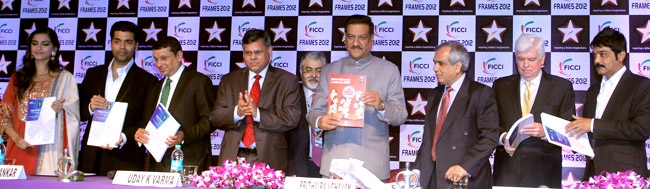
FICCI Frames 2012, now in its 13th year, kicked off on March 14, Wednesday at Hotel Renaissance, Mumbai. The morning session started with a welcome address from Karan Johar, Co-chair, FICCI Entertainment Committee. After Mr Johar’s welcome address, Uday Shankar, CEO, Star India & Chairman, FICCI Broadcast Forum, took the stage to address the audience.
In keeping with the theme, ‘Embracing the Digital World’, Mr Shankar said “digitisation is a big reality which will revolutionise the way content (creation and distribution) is offered”. Even though he said that digitisation will create a level playing field for the broadcasters and the cable operators, he had a word of caution to ad when he said that his biggest concern was “the chaos which will be caused by the broadcast industry’s inaction”.
Mr Shankar was of the opinion that instead of lamenting the loss of carriage fees, the MSOs should appreciate the opportunity of “customisation and localisation of content” being presented by digitisation.
Though Mr Shankar admitted that there is a need for legislative enablers to remove the bottlenecks, he also said that the broadcast industry is still not ready to move to the digital format. To drive home his point he used the example of the film The Artist, where the star of the silent era films loses out when he refuses to move with times. With this word of caution, Mr Shankar ended his keynote address.
Prithviraj Chavan, Chief Minister,Maharashtra, next took the stage to talk about the “exciting times that we are living in”. He said that the challenge is to adopt the regulatory framework to the new technology and ensure that over regulation doesn’t kill a good thing. He also said that the move towards digitisation will create a huge employment opportunity. He stressed on the need to balance technology with creativity, adding that “growth should not be lopsided but all inclusive”.
Shri Chavan also stated that the government is taking all possible steps to ensure that content piracy is curbed but accepted that the state has not delivered on its promises to curb piracy till now.
He also touched upon the need for regulation and said that regulation is a major challenge. Shri Chavan suggested that instead of the state regulating the media; it should look at self regulation.
Moving on, Shri Chavan welcomed the foreign delegates and announced that his government was creating new centres for film shooting in the state. He stated that the first such centre will come up atKolhapur, where entrepreneurs would be provided with lots of financial incentives. He said that the government will “protect any creative attempt within the framework and not allow any fascists elements to disrupt it”. He also assured the film industry that its concerns over policing on film locations would be looked into.
The Chief Minister also released the FICCI-KPMG Indian Media and Entertainment Industry Report 2012; FICCI-Amarchand Lawbook and ‘Positivity: The impact of television on India’ by The Indian Broadcasting Foundation.
Mr Jehil Thakkar, Head, Media & Entertainment Practises, KPMG made a brief presentation about the highlights of the FICCI-KPMG Indian Media and Entertainment Industry Report 2012.
Senator Chris Dodd, Chairman, Motion Pictures Association of America, who took the stage next, underlined the need to look into stringent regulations against content theft.  “When content is stolen, 95 per cent of the people who contribute to the vitality and success of a film are adversely affected”, he said. Quoting an Ernst & Young report, he said, movie theft contributes to a loss of US$ 1 billion annually and threatens the jobs of half a million people. He stated thatIndiais among the top 10 nations as far as online copyright infringement is concerned. He said that technology (digitisation) and content need each other and one can’t be without the other.
Mr Uday K Varma, Secretary, Ministry of I&B, opened his address by stating that the concerns that the industry had over digitisation and the Phase 3 of FM radio have been addressed by the move to allow 839 new FM stations and 500 community radio stations.
He stressed that the government is committed to ensure time bound digitisation and said that come July 1, the four metros will switch over to the digital format and the plan is to ensure that the move to digitalisation is completed by December 31, 2014. He agreed that the challenge was mammoth- to convert 80 million analog connections to digital format but added that the move will ensure faster and deeper penetration. “This will address a plethora of issues facing the television industry, such as addressability, carriage fees, audience measurement and consumer choice,” he said.
Mr Varma added that in order to combat piracy, they intend to carry out an all-encompassing multi-media campaign during the 12th five year plan period involving all stakeholders from the film and music industries.
He also outlined the ministry’s plan to celebrate 100 years of cinema inIndia. Mr Varma said that the Government of India, in cooperation with the film industry, has a line of activities between May 3, 2012 and May 3, 2013. It also proposes to present a tableaux of ‘100 years of Indian Cinema’ at the Republic Day parade next year where the plan is that the stalwarts of the industry also take part.
Mr Varma also announced that the government is setting up a National Film Heritage Mission to safeguard India’s celluloid history by undertaking picture and sound restoration of more than 2,500 films. In Addition, theMission, with a budget of over Rs500 crore, would also look at constructing preservation vaults for archiving restored material, and for conducting workshops and training.
The session closed after a vote of thanks given by Dr. Rajiv Kumar, Secretary General, FICCI.