Tag: Jay Panda

  • Top 5 Voices Of Sanity in Political Debates


    By Shailesh Kapoor


    The General Elections are finally here. Even as the nation goes to polls, the quality of political debate has hit an all-time low. From Rahul Gandhi’s imbecile answers to vitriolic personal attacks by stray politicians (including one who said he will chop Narendra Modi to pieces) to using the Indian Army to polarise votes, I thought I had seen it all. And then yesterday, Mulayam Singh Yadav decided to make light of gangrape by calling it as a “mistake” young boys could make.


    Expecting a bit of courtesy, intelligence and maturity in political discourse is perhaps asking for too much. Even Narendra Modi’s language comes across as uncouth at times; language that’s certainly not befitting a potential Prime Minister. But if one’s benchmark is a Prime Minister who hardly communicated for 10 years, one should not be too demanding.


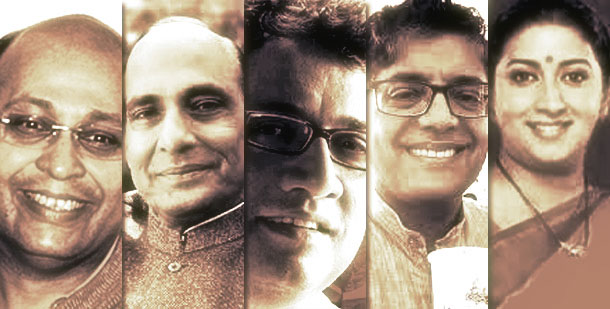
    In the midst of this class-less and even dangerous pitch, some politicians stand out as being the odd ones. Here’s my pick of five politicians who have brought some sanity to the degenerating political debate:


    5. Abhishek Manu Singhvi: It is difficult to pick a Congress talking head who makes sense these days, but Singhvi comes across as the most articulate and well-mannered of the lot. He is no political heavyweight himself, unlike some others on this list. But he communicates well, even in the midst of what are turning out to be by far the roughest elections for his party.


    4. Rajnath Singh: Even as Modi plays to the gallery via the lowbrow route, BJP chief Rajnath Singh has maintained dignity and composure throughout this campaign. He is evidently the back-end man here, keeping the pieces together, while leaving the talking to others. But when he speaks, he makes an impression alright, especially with his clarity of thought. Is there a chance he may be the compromise choice for the top position if NDA falls short by a small margin and other parties give support under the condition that Modi should not be the PM? Let’s wait for May 16.


    3. Derek O’Brien: The quizmaster turned Trinamool Congress leader has the unenviable task of defending the indefensible at times. His party chief Mamata Banerjee suffers from occasional bouts of the foot-in-mouth disease, but O’Brien is now well experienced in handling the mess. He has gift of the gab, and can even be cheekily entertaining at times. I have a feeling we will hear a lot more of him after May 16, as TMC may end up playing a crucial role at the Centre.


    2. Jay Panda: I find the BJD leader by far the most affable face in Indian politics today. He is always soft-spoken and dignified, and never short of deep knowledge and a clear view on the subject matter. Read his Wiki page to know what a model Member of Parliament could be!


    1. Smriti Irani: Throw the ‘actors can’t become serious politicians’ argument out of the window right away. Smriti Irani means business. Having struggled her way up the ranks in BJP, she has now got the exposure and the confidence that will catapult her in to top league soon. Irani is super entertaining too. Her sarcasm can be scathing at times, yet never unreasonably personal. In the true sense, she combines the qualities of a good politician and a good actor. Watch her recent Aap Ki Adalat episode with Rajat Sharma or her chat with Barkha Dutt earlier this week and you are sure to root for her. She is all set to stretch Rahul Gandhi in Amethi. More power to Smriti Irani and her commitment to a political career.
     

  • #Frames2013: Need for reforms to take centrestage

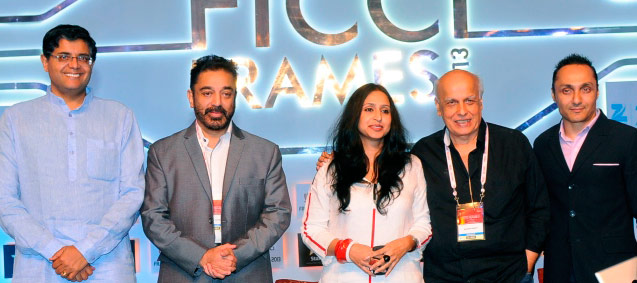
    L-R – Jay Panda, Hon’ble Member of Parliament, Lok Sabha, Kamal Haasan, Chairman of FICCI Media & Entertianmnet Business Concalave (MEBC),Shoma Chaudhury, Managing Editor, Tehelka, Mahesh Bhatt, Film Director,Rahul Bose, Actor


    By Kshama Rao


    Day 2 of FICCI-Frames started with a session on ‘The Gag Orders: Are we stifling creative expression?’ Managing editor, Tehelka, Shoma Chaudhary moderated the session which had Kamal Haasan – who was recently at the receiving end when his ambitious 90-crore film, Vishwaroopam met with some opposition from certain religious quarters – MP Jay Panda, “liberal intellectuals” Mahesh Bhatt and Rahul Bose.


    Ms Chaudhary who admitted to believe in “absolutist freedom” had the panelists talking about the very definition of freedom, the role of art in society, on whether the Indian constitution is robust enough to tackle the various groups and diverse ones at that who get easily offended by any piece of art – be it a book, a piece of music, film or art. Mr Panda talked about how while the constitution doesn’t provide us with absolute freedom it does come close. What worried him were the Supreme Court rulings being defied by high courts and state governments when they should be tried for contempt of court. “The job of leaders is to resist lynch-mobs and not pander to populist measures.”


    While Kamal Haasan confessed to have curbed his daughters from always following their minds, he said as a filmmaker, he felt “curbing creativity and freedom is not a dignified thing. It shouldn’t be just about me. It should be about anyone and everyone irrespective of where he comes from who shouldn’t be pushed to a wall like I was.”


    Mr Bhatt said that the notion of absolute freedom is still a fantasy. “Right from the time I made Arth, which had people from my own fraternity ganging up against me for making a film that threatened the institution of marriage, the very bedrock of our culture and our being, I am still waiting to be free.”


    He added how the “offenders who are most often than not engineered to disrupt and disturb things” ensured that a little fear went a long way and did an irreversible damage to the society. “Timidity has now become a philosophy and every filmmaker lives with that dread of facing a lynch mob outside his door,” he said.


    The discussion also veered to demanding a film certification board rather than a censor board. Kamal Haasan observed, “Why should there be representatives from political parties on film certification boards? They are in no way connected with the aesthetics of cinema.”


    Mr Panda called for an urgent need for political reforms which could only be put in place with the rising middle class. “Their sensibilities are worthy of emulation and I do see a hope in the middle class who have already begun a movement for change if you go by the protests they recently staged in the case of the rising rape and violence.”


    Mr Bhatt rubbished Mr Panda’s trust in the middle-class, who, he saids are interested only in fighting battles they are comfortable with. “They will stand up for a Kamal Haasan but not a Kamaal Khan, a big Hindi film but not a Bhojpuri one.” Mr Bose agreed with him saying, “The middle class will come out in large numbers outside the PM’s house to fight for a rape victim but I wonder if they will be equally passionate about an issue that’s bothering some other part of the country.” Kamal Haasan added that sensibility is not the sole bastion of the middle-class. “It can come from any strata of society, from anyone.”


    The rather interesting conversation was ended with Chaudhary calling for everyone to first define the very idea of freedom and if the entire nation was ready to fight for it every time it was threatened by a few offending groups. She also placed the onus on the film and television industry to rise above their roles of mere entertainers and instead bring about social change through cinema.