Tag: Janardhan Pandey

  • History TV18 @ 1: Factual, eclectic, successful


    By Meghna Sharma


    A year ago, it may have seen like yet another big bang launch of an all-new channel crowding the Indian satellite space. The niche offering, History TV18, a joint venture between TV18 and A+E Networks, aimed to redefine the factual entertainment genre through an eclectic mix of local and international shows.

     

    Ajay Chacko

    “As we stand at this first anniversary milestone, I believe we have challenged some of the established rules of the game in this genre. Our consistent leadership in time spent per viewer and our phenomenal contribution to the genre growth is a testament of our success,” CEO Ajay Chacko told MxMIndia. “This is just the beginning. Now that we’ve carved a niche for ourselves in the genre, we look forward to replicating our global leadership in the factual entertainment space in India.”


    As the channel broadens its horizons and carves a niche for itself with its edgy and differentiated programming mix featuring shows with greater emphasis on creating fact-based entertainment, thrill and action formats that appeal to a much wider audience, Sangeetha Aiyer, the Channel’s General Manager (Marketing) says, “The journey has been quite interesting so far. When we launched our intent was to make a distinct change in the factual entertainment genre and after one year of completion, we are honoured to have achieved this. Immediately after the launch, History TV18 accelerated growth for the entire genre from 2 percent and 15 percent in ’10 and ’11 to a whopping 29 percent post-launch.”

     

    Sangeetha Aiyer

    The channel boasts of delivering content which is vividly different. “Our content is contemporary; full of action and adventure. It has lot to do with achievement. It is about people making history every day. Also our objective has been to grow the factual entertainment genre and not just compete within the genre. We also got overwhelming response for our The Greatest Indian initiative. It was History TV18’s first local production in India and successfully garnered amazing response over the three month period with over 2 crore votes coming through missed calls and online. The campaign also sustained a healthy engagement on social media platforms reaching over 20 lakh Facebook users through viral content,” adds Ms Aiyer.


    The channel differentiates itself from the rest in the genre and claims that History TV18 is a factual entertainment channel, emphasizing that its content is based on ‘facts’ and has a heavy dose of ‘entertainment’, whereas other channels in this genre are more of factual knowledge. The USP of the channel lies in its programming mix and the target audience of the channel is CS 15+ AB market. However, another reason what makes it different from the rest is the fact that it is available in six languages (English, Hindi, Tamil, Telugu, Bengali & Marathi) in full HD across all major markets in India. “This has helped us enormously to broad-base and grows the entire genre,” says Ms Aiyer.


    The marketing budgets in the launch year of the channel was in the range of Rs 8-10 crore, but in the subsequent years the channel plans to consolidated and leverage network synergies.

     

    Dhruv Jha

    In terms of ratings, the channel accelerated growth for the entire genre from 2 percent and 15 percent in ’10 and ’11 to a generous 29 percent post-launch. But how is the genre doing?


    According to Dhruv Jha, business head, Lodestar UM Content and Experiences, there is definitely a market and audience for the genre, but it will always remain a niche. “Viewers of such channels are a sub-set of a larger audience which are very loyal to it and seek more and more of it. And as time progresses, we’ll see an increase in the number of viewers too but it will never to able to attain the appeal/popularity of a mass-consumed channel.”

     

    Janardhan Pandey

    Agreeing with Mr Jha, Janardhan Pandey, associate VP, DDB Mudra expands, “I see this genre picking up audience consistently with increased mass appeal. The channels have done quite well in attracting audiences. I see a good amount of viewership addition to this segment in coming years and I am sure these players have been doing exactly what the audiences want to experience, ie the right mix of world-class programming aligned locally.”


    The channel promises to continue to push the envelope in terms of a differentiated, clutter-breaking, world-class programming mix; and thus grow the genre. “In the process we plan to consolidate our leadership in 6 metros, 1 mn+ towns and finally all India. One of our great successes this year was the phenomenal success of our first local production ‘The Greatest Indian’. We plan to replicate this through similar innovative, path-breaking concepts,” concludes Ms Aiyer.

     

  • Crime pays for GECs

    By Meghna Sharma


    What is it about the dark side that attracts us? A glance over any newspaper or news channel will tell us the increased attention being given to the gruesome incidents.


    The media, especially the television which is a reflection of the society, has reflected this growing interest with the increasing popularity in the number of the unglamorous, and sometimes, gory crime shows. From Karamchand in the 80s on DD to the latest Gumraah on Channel V, most crime shows have done well and have been able to garner an interest that other genres might not be able to. The longest running show on the Indian television, CID, is a crime show which was started in 1998 and recently turned tri-weekly.


    Speaking about the show’s success, Sneha Rajani, senior EVP and business head, Sony Television, said: “CID has been doing well for years now; it’s not a recent phenomenon. On an average, the show gets TVR of 3.3-3.5, and sometimes even goes up to 4.5. So, it’s no surprise that show has its share of viewers, as week after week people switch on their TV sets to get inspired by the bravery and the relentless passion of CID against crime.”


    Popular Crime Shows

    Karamchand – 1980 – DD

    CID – 1998 – Sony

    India’s Most Wanted – 1999 – Zee

    Aadalat – 2010 – Sony

    Gumrah – 2012 – Channel V


    According to industry experts, most GEC experiments with crime shows have been successful – some have garnered a little interest and others have gone on to become national hits like Adaalat and India’s Most Wanted.


    Such crime shows consist of an economically viable format – no huge sets, no major actors, no glamorous outfits or expensive judges are required – hence, the channels don’t mind investing in them.


    Janardhan Pandey

    Janardhan Pandey, associate vice president, DDB Mudra Max feels that apart from reality shows, only crime shows have the ability to create sensationalism and that’s the main reason people are attracted towards the format. “People want to know what’s happening around them. And these shows are able to portray facts through dramatization, without costing too much for the channel.”


    ‘Curiosity killed the cat’ is the apt reason why crime shows work on television according to Anand Chakravarthy, executive vice president, Marketing, RBNL and business head, Big Magic. “Crime, as a genre, has an extremely wide appeal, irrespective of the country. In a developing nation likeIndiawhere crime and corruption are a part of the societal fabric, the audience is most likely to appreciate televised content in the genre.”


    Anand Chakravarthy

    He added: “The fascination with the morbid and intrigue that the genre provides work across a cross section of audience, regardless of age and gender, making it acceptable to a larger and diverse audience base.”


    However, the question which still arises is – aren’t such shows the figment of the writers’ imagination? The writers of such shows may choose to disagree about the authenticity. “Though some might say they are a writer’s figment of imagination, but in reality, newspaper reports, sometimes even FIRs and investigations done by channels help us gather facts and details about various cases,” said a writer with a national GEC.


    According to Priti Murthy, national director – Insights, Maxus, crime shows attract not only the middle-aged, but a large number of youth too. “Crime cuts across genres and finds a large number of youngsters hooked on to the genre like action, thriller, and crime. One could say it gives them adrenaline rush.”


    Prem Kamath

    Channel V recently launched a teen crime show, Gumraah, which has became popular for its disruptive format and unique viewpoint of understanding the psyche of young criminals. “V’s Gumrah, in its second season now, details the ecosystem in which a teen crime is conceived and the extraordinary circumstances that lead to it. The show has had an immense impact on us, in terms of viewership as well as vindicating our research and understanding of the youth. We have seen a tremendous response in terms of feedback and appreciation on social media and other consumer responses. It has also further encouraged us to try bolder formats and continue on our chosen content strategy,” said Prem Kamath, Executive VP and GM, Channel V.


    Most crime shows do attract a large number of eyeballs, but most GECs also claim that it’s not about entertainment alone; they are helping the society as well. “As for adults, and specifically parents, this show is an eye-opener: if one neglects their child’s need for attention or dismiss it as juvenile behaviour, it can have serious repercussions and lead to moment of madness, eternally irreversible,” added Mr Kamath.


    “Shows such as Police Files (aired on Big Magic), while showcasing crimes from the region, also attempt to educate and empower the viewer. The depiction of the crimes help the viewers to understand and accept the need to be vigilant in safeguarding themselves and their loved ones. The information imparted by way of applicable laws of the Indian Penal Code, safety tips by experts and NGOs help empower the viewer,” said Mr Chakravarthy.


    So, if one has to go by what industry experts have to say: it’s entertainment with awareness that makes one switch on their television sets to watch crime shows.  Whatever be the reason, the channels can surely say that ‘crime pays’!


  • 73 matches on IPL5 get an average TVR of 3.36

    By A Correspondent


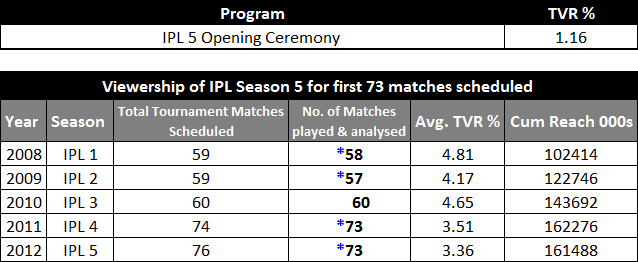
    Despite delivering the lowest television ratings in the history of the tournament, the weekly data released by TAM sports has shown some consistency in its overall IPL 5 viewership. According to the latest numbers released by TAM Sports for the first 73 matches (CS 4+ All India), IPL 5 recorded a TVR of 3.36 per cent, which is slightly lower than the first 73 matches of season four which received a TVR of 3.51 per cent.


    These ratings do not include the final match played between Chennai Super Kings and Kolkata Knight Riders on May 27. A total of 76 matches were played in season five, the highest so far in the entire tournament, and out of the 76 matches played, two matches were abandoned due to rain.


    The inaugural IPL season (IPL1) however continues to remain the most watched tournament till date with a TVR of 4.81 per cent for the 58 matches whereas IPL3, which celebrated the home coming season, witnessed the second highest viewership for the first 60 matches with a TVR of 4.65 per cent; IPL season two which was played in South Africa received a TVR of 4.17 per cent for the first 57 matches.


    What has shown improvement is the cumulative reach for the 73 matches in IPL 5 that stands at 161 million. This is nearly the same for IPL 4 where the reach was 162 million and far better than IPL 3, 2, and 1 where the reach measured was 143 million, 122 million and 102 million respectively.


    It may be recalled that for the first 59 matches IPL 5 delivered a TVR of 3.33 per cent and during the first 48 matches, IPL 5 delivered a TVR of 3.40 per cent whereas for the first 36 matches IPL 5 delivered a TVR of 3.41 per cent, for the first 27 matches, it delivered a TVR of 3.53 per cent and the first 16 matches, a TVR of 3.65 per cent.


    Mr Janardhan Pandey, Associate Vice-President, DDB Mudra Max said that he was not disappointed with the ratings as season five was expected to deliver lower ratings than last year, although he did expect the ratings to be closer to season four. On the factors that might have affected the viewership, Mr Pandey said: “I feel that on the face of very high expectations, too much confusion before the start of this season along with poor Indian team’s performance in last one year and overdose of cricket did impact the IPL season five viewership. I am also of the view that certain IPL teams are weak with few relevant star players as compared to many other teams, so the matches involving them delivered low ratings, thus impacting the overall score.”


    “I believe that the game is extremely popular and audiences are still around. Only the crowd needs to swell further. The weaker teams must get boost up with inclusion of adequate star players” he added.


    Source : TAM Sports, TG : CS 4+ yrs, Market : All India, Channel : MAX, No. of Matches analysed : As mentioned in the table

    * In IPL 1 one match (47th) was abandoned due to rain
    * In IPL 2 two matches (7th & 13th)were abandoned due to rain
    * In IPL 4 one match (20th) was abandoned due to rain
    * In IPL 5 two matches (32th & 34th) were abandoned due to rain


  • No (or low) ads on HD. Anybody complaining?


    By Meghna Sharma


    While there is no denying the importance of advertisements in a world where subscribers are unwilling to pay subscription fee for channels, there exist many viewers who are tired of innumerable ads interrupting their favourite soaps or sporting. The good news for them is that their ordeal has been put to an end through HD channels. At least for the moment


    With various broadcasters launching HD variations of their channels, many upper-end subscribers are shifting to HD set-up boxes or subscribing to an HD channel. However, as there are no free lunches in the world, these channels come at a premium.


    What media planners think?

    Most media planners feel that since HD channels come with a certain cost attached to them, it is but obvious that they cater to a limited audience.  So, most channels are aware of it and their target group.


    Anita Nayyar

    Talking about the HD channels’ reach, Anita Nayyar, director (customer strategy), BCCL, agrees that not many avail of the facility. However, with digitization being made compulsory, especially in the four metros things might change. “Unlike the West, inIndia a broadcasters make most of their money through advertisements, and not distribution. So, if HD channels reach only a certain section, then how will a channel make its revenue?”


    Ms Nayyar added: “Today, one might pay a premium cost to watch an ad-free telecast, but in the near future, if availability doesn’t increase then channels won’t have an option but to make exception to the rule. They will be forced to show advertisements; however, they might charge a higher cost or have a limited time slot.


    On the other hand, Hiren Pandit, managing partner of Group M, felt that broadcasters with HD channels aren’t feeling the pinch, since they want to cater to a different audience: “Apart from the top-notch TG, most broadcasters have non-HD channels as well, so they capitalize through them. And over a certain period of time, they’ll be able to cut losses.”


    Agreeing with Ms Nayyar and Mr Pandit, Janardhan Pandey added: “It’s not just about reach or money, there is another reason which plays an important part in making HD channels a hit and that’s viewers’ psyche.  A person who might be able to afford HD package might still go for cheaper option because he/she might feel why pay more when the same can be watched at a lesser cost. For them, a few advertisements don’t matter.”


    Marketers’ foresight

    A brand reaches its target audience through advertisements and in today’s time one can reach a cross-section of society through television. Hence, most marketers spend their most of their ad-revenue on TV.


    Karthi Marshan

    Karthi Marshan, EVP & Head Group Marketing, Kotak Mahindra Bank said: “Our estimate is that of the 136mn cable and satellite homes in India, 44mn are DTH. Of these, about 8 lakh are currently HD subscribers. That is less than 2% of DTH homes and a tad over 0.5% of all C&S homes. Now whether this affects a marketer or not depends on who is her core TG. For the average brand with SEC A & B as their TG this probably does not matter much, but yes, premium and super premium brands do stand to miss out on what could be core TG due to the fact that some of the HD channels still don’t run advertising.”


    He added: “The next question that marketers will have to contend with is broadcasters expecting to be paid separately or additionally for these audiences. While brands will make the argument that we have bought programs or channel presences and hence our ads should carry seamlessly to HD as well, broadcasters may well have a tenable argument to the effect that they are in the audience delivery business, and a premium audience can and should command a premium for access.”


    Similarly, Ashutosh Tiwary, EVP- Strategic Marketing, Godrej, feels that one needs to observe the situation over a period of time to know what will happen next: “If the ratings and numbers of non-HD channels on which the media deals are based, get affected due to HD feeds, then HD channels will probably will have to air the ads to make up. However, if HD numbers prove to be totally incremental, then the converse might hold true. Overall, if viewer retention and engagement goes up due to higher quality and reduced clutter, HD might require specific treatment.”


    While Simeran Bhasin, marketing head, Fastrack and new brands at Titan said that as a consumer she loves to watch her favourite programmes on ad-free HD channels, but as marketer she’ll have to look for other methods to reach the TG. “HD is here to stay and marketers will have to figure out ways to reach out their consumers. Because with technology available everywhere, one can easily switch-off their TV sets to watch something online which is accessible without any interruptions. So, marketers will have to sooner or later adapt to survive.”


    Vipin Mehra, former sales head, Pidilite, said: “It’s very important for any brand to send constant reminders to its TG about its existence, especially in today’s competitive market. So, brands will prefer a channel which will help them in doing so.”


    Keeping their fingers crossed

    Creative people on the other hand aren’t very happy with HD channels as they affect their work/business, but feel that things will change for good.


    KS Chakravarthy, director, DraftFCB Ulka, felt that though one might want to enjoy an ad-free telecast, it’s just a passing phase because channels have to make revenue which comes from advertisements. KV Sridhar, National Creative Director at Leo Burnett, too agreed with Mr Chakravarthy, adding: “When and as HD channels availability increases, broadcasters might be forced to start showcasing advertisements as well.”


    Who’ll be the ‘real’ beneficiary?

    Advertisements or not advertisements, broadcasters have to follow a business plan and many feel that they’ll have to succumb to it. “One or two networks have begun taking a smattering of ads, and this will only grow, I am guessing,” said Mr Marshan. A business is run on revenue and if it cannot be generated, then changes have to be made. However, for the time being, the viewer can enjoy an ad-free programme.

    One will just have to wait and watch.


  • Halfway through, IPL 5 ratings stabilize

    By A Correspondent


    The downward slide continues though not as stark as it is made out to be. Numbers released by TAM Sports for the first 48 matches of IPL 5 have shown the ratings to be the least recorded thus far compared to previous four seasons. At 3.40 TVR (CS 4+, all India), IPL 5 is faring poorly when compared to 2011 where it recorded a TVR of 3.54, 4.53 in 2010, 4.05 in 2009 and 4.72 in 2008.


    It may be recalled that for the first 36 matches, IPL 5 delivered a TVR of 3.41 per cent, for the first 27 matches, it delivered a TVR of 3.53 per cent and the first 16 matches, a TVR of 3.65 per cent.


    What has shown improvement is the cumulative reach for these 48 matches in IPL 5 that stands at 151 million. This is nearly the same for IPL 4 where the reach was 152 million and far better than IPL 3, 2, and 1 where the reach measured was 137 million, 118 million and 98 million respectively.


    Delving on the suggested trend, Janardhan Pandey, Associate Vice President, DDB Mudra Group said: “Despite what is being said, the sport remains most popular and the reach deliveries also seem to be in line with our expectations. Maybe it’s a period of stabilization for IPL20 viewership. It cannot be doing excellent forever after all. There were many issues to start with such as overdose of cricket & the consistent poor performance by Indian cricket team. Keeping all those factors in mind I will give thumbs up to overall performance of IPL 5.”


    On the reported rise in reach numbers, Mr Pandey said: “This shows the strong appeal that the game of cricket enjoys in India. The ever increasing eye balls for cricket are testimony to this fact.”


    Program TVR %
    IPL5 Opening Ceremony 1.16
    Viewership of IPL Seasons for first 48 matches
    Year Season No. of Matches Avg. TVR % Cum Reach 000s
    2008 IPL 1 *47 4.72 98988
    2009 IPL 2 *46 4.05 118698
    2010 IPL 3 48 4.53 137049
    2011 IPL 4 *47 3.54 152720
    2012 IPL 5 *46 3.40 151585


    (Source: TAM Sports; Market: All India; TG: CS 4+ yrs; Period: Wk 14 to 18, 2012; this data is for first 48 matches of all IPL seasons.)

    * In IPL 1 one match (47th) was abandoned due to rain

    * In IPL 2 two matches (7th & 13th) were abandoned due to rain

    * In IPL 4 one match (20th) was abandoned due to rain

    * In IPL 5 two matches (32th & 34th) were abandoned due to rain


  • Movies OK will focus on families: Hemal Jhaveri

    By Meghna Sharma


    After the launch of Life OK in December 2011, Star India is planning to launch a new channel on May 6 under the OK banner – Movies OK.


    The channel promises to be different from Star Gold, the movie channel launched by the network in 2000. “There is a difference between the two channels. Movies OK will focus on family audience. This means we are going to showcase movies which a whole family can enjoy together,” said Hemal Jhaveri, general manager, Star Gold, who heads the channel. The channel plans to concentrate on genres like comedy. “There is going to be more comedy and less action on the channel,” he added.


    Apart from content, the other thing which will differentiate the channel from the competitors is the treatment. “The promos are going to be very different and unique from what the other channels do. For instance, we are going to have a Best of Salman Khan Festival called ‘Bhai Ok Please’ where no film footage has been used. So, for the first time, people will see a promo for Salman Khan without him in it. Communication is going to be unique,” explained Mr Jhaveri.
     

    If that’s not enough, the channel also boasts of having a World TV Premiere every night by the end of this month. Mr Jhaveri said: “The 7 day 7 premiere is something which no other channel has experimented with earlier. I think it’s the first-of-its-kind in the world as well. So, every night at primetime, one will get to see movies like Kahaani, London Paris New York, Jodi Breakers and others. We are planning to build our channel as a unique platform.”


    The channel also hopes to use the learnings from their other channels, especially Star Gold which was revamped last year. So, one can expect shorter breaks.


    The channel has a library of over 1000 movies. “We have been investing in the channel from the past two-three years and will continue to do so in the future as well. Therefore, it’s going to be a unique library. Last year, we acquired the Viacom18 library so that will also add to it,” elaborated Mr Jhaveri.


    The Hindi movie genre enjoys the third largest viewership pie, trailing behind regional channels and Hindi GECs, according to a FICCI-KPMG report on the Indian media and entertainment industry, released in March.


    “There are various Hindi movie channels, but there is always space for one more, if it’s different and has good content,” said Mr Jhaveri. Agreeing with Mr Jhaveri’s sentiments, Ashwini Kamat, general manager, MediaCom added: “People don’t have loyalty towards movie channels. So, if a channel has a good library, then it doesn’t need to worry about others because people will switch to it, if they want to watch a particular film.”


    Janardhan Pandey, associate vice-president, DDB Mudra Max elaborated: “There is enough space on TV to launch a channel but all depends on if one can sustain it at the top slot. A new channel might showcase latest movies, but after some time, many stop investing in a new library and repetition starts. It is then people tend to move away from it. So, it might make an impact in the beginning, but it is difficult to say how a channel will do in the future.”


    However, advertisers aren’t optimistic about it. “One more channel means more segmentation. So, I don’t think it’s going to benefit us,” said Praveen Kulkarni, general manager (marketing), Parle. The categories which spend heavily on Hindi movie channels are services, auto, personal accessories and telecom. “Launch of any new channel means fragmentation and overall inflation for advertisers,” added LK Gupta, CMO, LG.


    The channel has a 360 degree promotional plan for the channel. It will also be promoted during Star’s new show, Satyamev Jayate, which will also be premiered on May 6. Radio and digital platforms will be used too.


  • IPL5 Week 1 TVRs touch new low, media planners say it’s still early days

    By A Correspondent


    Indian Premier League (IPL) season five kick started on April 4 amid speculations and fear that the season would fail to deliver high viewership. The recent TVR figures released by TAM Sports may have just proved the naysayers right.


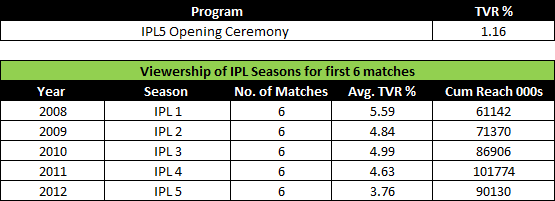
    According to TAM Sports, All India Market, CS 4+ years, IPL5 witnessed an average TVR of 3.76 per cent in the first six matches, which is far lower than the previous IPL seasons. The opening ceremony itself received a mere 1.16 per cent of the average TVR.


    While the IPL season five ratings for the first six matches is the lowest in comparison to previous seasons, the inaugural season (IPL1) continues to remain the highest viewed with a TVR of 5.59 per cent.


    Interestingly, the cumulative reach for the first six matches too have shown a slight decline in season five as compared to season four. The cumulative reach which has been on a rise since the inaugural season of IPL reached its peak in season four and thereafter in season five witnessed a slight decline.


    Mr Venkata Subramanian, Senior Director-Investments, MPG India is of the opinion that not only are the numbers positive but, also that the numbers will increase as the matches become more interesting. “These are initial ratings so the numbers are looking positive. As the matches continue to become more interesting, we can expect the ratings to also go up. Even if the TVR reaches 4.5 or 4.6 per cent, the delivery will be good not only because it is the fifth season but, also because of more number of matches.”


    According to Mr Janardhan Pandey, Associate Vice President, DDB Mudra, some drop in the reach numbers were expected owing to the poor Indian team performance during the last one year and the fatigue of cricket overdose amongst the viewers. However there is no cause for major worry. “I am of view that, as the game seems to be picking up well and with the onset of vacations, the numbers will improve. Also if the games progresses well, the reach numbers towards the second half of the series may be far better than anticipated. So over all it will deliver value, obviously there will always be standard deviation, after all it’s a huge sporting extravaganza.”


    The media planners are of the view that although IPL 5 may not come close to the season one ratings or even cross the season three ratings, nevertheless as the tournament progress the viewership will also increase. What remains to be seen is whether the ratings do improve or will it remain lower than the previous season?


    Source : TAM Sports, Period : Wk 14, 2012, TG : CS 4+ yrs, Market : All India, Channel : MAX

    This data is for First 6 matches of all IPL Seasons

    * In IPL 1 one match (47th) was abandoned due to rain

    * In IPL 2 two matches (7th & 13th)were abandoned due to rain

    * In IPL 4 one match (20th) was abandoned due to rain

  • With Nai Dunia in the bag, Jagran is #1 print group


    By Archita Wagle


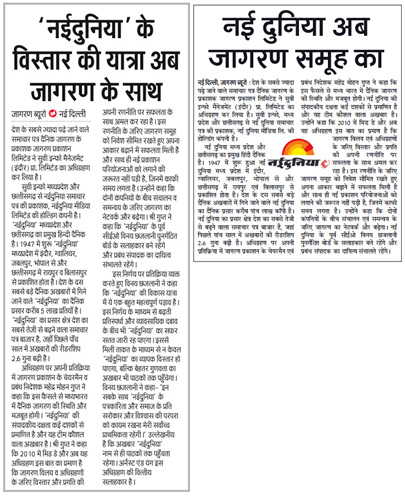
    There was no press conference announcing the deal. The Kanpur-based Jagran Prakashan Limited (JPL) simply did it by notifying the stock exchanges. The acquisition of Nai Dunia was done via Suvi Info Management (Indore) Private Limited which in turn owns Naidunia Media. It was an all-cash deal.


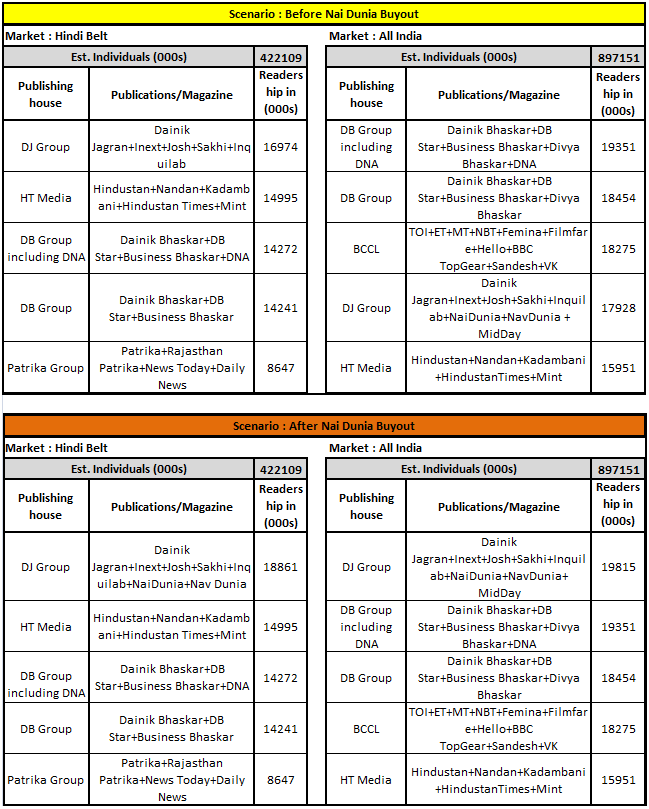
    What it does for the Jagran group is significant as its hold on the Hindi belt becificant, a factor that could help strike better contracts with advertisers. In fact, as an analysis with IRS 2011 Round 4 numbers shows, the Nai Dunia acquisition has helped JPL become the numero uno print media group in the country (see accompanying story: Saala Jagran No 1 print media group ban gaya…)


    Announcements of the deal on the front pages of Nai Dunia (left) and Dainik Jagran (right)

    According to an analyst from a domestic brokerage firm, this deal makes sense to JPL as the enterprise value assigned to Nai Dunia is Rs2.25 billion and had JPL planned a greenfield expansion in MPC, the total cost could have run into at least Rs3 billion.


    In an email interaction with MxMIndia, Mr Amit Jaiswal, Company Secretary, JPL clarified that JPL has acquired only Nai Dunia. NewsX and Webdunia are not a part of the deal. Talking about the changes after the deal he said: “Mr Vinay Chhajlani will continue as Advisor to Board. His vast experience of print and knowledge about the market will be quite useful for us. We will add some new members to the team at senior level in sales, marketing and editorial. Our corporate brand team will help in branding and communication. As far as the staff, the erstwhile promoters have already rationalized the staff strength to a large extent.”


    Commenting on the acquisition in a communique, Mr Mahendra Mohan Gupta, Chairman and Managing Director of Jagran said, “This was a logical market expansion for us and enables us to strengthen our presence in Central India. Nai Dunia is a newspaper with a very strong team and has demonstrated editorial excellence over the last decade.”


    Nai Dunia is the flagship publication of Naidunia Media Limited, which was launched June 5, 1947. Nai Dunia features amongst the top 10 Hindi dailies of India and has multiple editions in MP and Chhattisgarh and is the third largest read newspaper in Madhya Pradesh and the fourth largest read newspaper in Chhattisgarh (IRS Q4 2011). According to a Jagran communique, Nai Dunia’s current circulation base is around half a million copies per day with the readership growing 2.6 times over the last five years.


    The industry is almost unanimous in saying that the deal is windfall for both the parties involved, especially JPL, which can now enter the Madhya Pradesh-Chattisgarh (MPC) market. JPPL, controlled by GD Gupta family publishes the Jagran editions in Bhopal and Rewa in Madhya Pradesh and JPL, promoted by the PC Gupta family, has been barred from using Dainik Jagran banner in MP as it has been in litigation since 2007. But with the Nai Dunia acquisition, the other option for JPL, they are entering the MPC market with an established newspaper, which is the second largest newspaper in terms of readership and business volumes in MPC.


    “JPL will benefit in terms of circulation and readership as it gets two new territories, Madhya Pradesh and Chattisgarh, with the acquisition of an established and well-known newspaper. JPL couldn’t enter Madhya Pradesh as per the agreement in the family, but now taking over Nai Dunia has opened the MP market for them,” said Mr Vijaydutt Shridhar, senior MP-based journalist and ex-editor of Navbharat.


    Mr Abhishek Karnani, Director, Free Press Journal which also has an edition in Indore, echoed Mr Shridhar’s sentiments: “The takeover deal is a windfall for both, JPL and Nai Dunia. Entering the MPC market was the next logical move for JPL. Initially the market had only Dainik Bhaskar and Nai Dunia but several local new publications with strong backing were launched in the market. Nai Dunia made a smart move in selling out rather than being marginalised in the market.”


    Says Mr Sundeep Nagpal of leading media consulting firm Stratagem, “This is in line with what other leading groups have done – like the Times of India group did with Vijaya Karanataka.” According to Mr Nagpal, the acquisition is a win-win for all parties involved.


    “With Nai Dunia’s acquisition, JPL has gained foothold in an important and growing market for Hindi publications. Nai Dunia never grew much beyond Indore, though they had launched editions in other cities. But with an aggressive player like JPL taking over we can expect to see Nai Dunia growing in other centres too. JPL has now entered Dainik Bhaskar’s territory. We can now expect a good fight,” said Mr Janardhan Pandey, associate VP, DDB Mudra.


    Stockmarket analysts though are a little cautious about this face-off as they believe that DB Corp will not be impacted because of the entry of JPL from a short to medium term perspective. But they say that Patrika would be impacted as Jagran would become aggressive to win back the No. 2 slot in MPC. The analysts also feel that the price paid (net of tax benefits) is inexpensive and should derive benefits in the medium to long-term.


    For the cash-rich Jagran group, the Nai Dunia acquisition follows that of Mid-Day two years ago and the management plans that Nai Dunia will be consolidated once a year just like Mid-Day.

    Saala Jagran No 1 print media group ban gaya…

    By A Correspondent


    Question: Until last fiscal, which was the largest print publishing house in the country?

    Answer: No, the answer is not Dainik Jagran. It’s Dainik Bhaskar, In fact, Jagran was at No 3 until two days ago, just behind the BCCL group. But with the buyout of the Nai Dunia group, Jagran now becomes the largest print media group in the country. Check tables below:


    Note: MRUC does not share detailed IRS numbers with the media. Given that we had adequate time for the confirmation of the Nai Dunia buy, we collected the information from what MRUC shared with us and from respective media entities.


  • Star gets set for Life OK…


    By Rishi Vora


    The channel was rumoured to be called Star Desh. A predictable name to ward off those on the hunt for info on the channel that was set to replace the beleaguered Star One.
     

    But the identity has now been revealed on billboards and social networks. It’s called Life Ok. The descriptor on the channel’s YouTube page says: “Life OK, a new television channel from 18th Dec, through its unforgettable and powerful stories brings to life its unique philosophy of ‘cherishing what you have’. Life OK reminds and invites everyone to value the things that well and truly matter in life like family ties, relationships, valuing traditions and peace of mind, while in the eternal quest for more.”


    Since Star India and its public relations agency are tightlipped on the details, we don’t know whether Star One will shut on December 17 or be phased out gradually.


    Life OK, it is learnt, will cater to a wide audience targeting Tier 1 and Tier II cities of the country. Special attention is being paid on packaging and presentation. The leadership team has former MSM Sony business head Mr Ajit Thakur at the helm. That, indeed, is testimony of Star India’s plans to launch a serious challenger brand.


    A high decibel marketing push is planned for the launch.

    But, is there a scope for yeta another general entertainment channel? Top of mind, of course is Colors’ success in the not too distant past. Madison Media CEO Punitha Arumugam explains, “Yes there is room for more channels in the GEC space. A case in point being the launch of Colors when one thought that the GEC market was saturated, Colors launched and expanded the GEC channel share. Also, given the high demand situation for GEC inventory today, there does seem to be room for another channel.”


    Colors was backed by differentiated content and big-ticket shows; aggressive marketing and distribution, which helped the channel to grab the No 3 position weeks after its launch. That, however, was introduced as Viacom 18’s flagship GEC channel. Will Life OK be a successful second GEC channel?


    There are instances where the second channel hasn’t delivered results as per expectations. Zee Next and Star One are a few examples. Historically, second channels have received motherly treatment from networks, as the strategy has always been towards prioritising investments towards flagship channels. There have been cases where successful shows on the second channel shifted to flagship channels… but, from what is seen of the new channel from Star, special efforts are being made to ensure differentiated programming.


    Dentsu Media CEO Divya Gupta believes that a new channel needs to create and carve a niche for itself. “Is there a need? Perhaps not from the consumer perspective, but definitely from the marketers’ perspective! Star would do well to have a successful flanker brand.To be successful, however, it needs a distinct and independent raison de etre, which is a big challenge. The plan to feature ‘Sach Ka Saamna’ may draw initial eyeballs, but longevity and distinctiveness remain a challenge.”


    Janardhan Pandey, AVP, Mudra Max had a different view. “It is hard to predict if the new channel from Star will succeed or not. The market keeps changing, so one has to constantly evolve as a channel. In the GEC space, success is rare for a new channel, but not obsolete.”


    On the programming front, several shows are set to go on air on the new channel. Sach Ka Saamna… Bhrashtachaar Ke Khilaaf, which was to initially feature on Star Plus, has been shifted to Life OK as a strategy to give that extra push to the channel. Others include Tum Dena Saath Mera, Meri Maa, Dil se di dua…Saubhagyavati Bhava and Devon ke Dev…Mahadev.


    The channel will launch at 12 noon on Sunday, December 18 with an eight-hour live ‘online concert’ featuring leading leading rock bands and artists like Shankar Ehsaan Loy, Euphoria, Agni, Shaa’ir and Funk, Indus Creed, Salim Sulaiman and Kailash Kher amongst others. Interestingly, the live event will happen only for audiences on the internet, signifying an attempt to woo young, digitally-inclined viewers.


    Ms Arumugam remarked, “The success of the GEC channel depends totally on the content and engagement they provide the viewer – so it does not matter whether it is the second channel or the umpteenth channel from the same network”


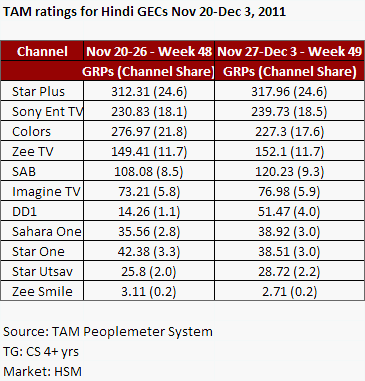
    While all eyes will be on the new channel from Star, there is no doubt these are interesting times in the GEC space, where there is healthy competition between No 2 and No 3 (see table alongside for GRPs and channel shares from November 20-December 3, 2011). If Life OK does have a successful launch, battles will intensify and healthy competition will help increase the genre further.


    With bureau reports

  • RAMcheck: Media agencies on new FM listenership numbers

    By Robin Thomas


    The latest RAM data on radio listenership for the month of September to mid-October has thrown up a few surprises in radio listenership. New leaders have emerged in cities that were once strongholds of their rivals. Barring Kolkata where Radio Mirchi continues its leadership position, the remaining three markets – Mumbai, Delhi and Bengaluru have new No. 1s.


    Take Mumbai for instance, once a Radio Mirchi bastion, the latest RAM figures (category: all people 12+, all places of listening, shares) show Radio City as the number one private FM station in the city, slightly ahead of Radio Mirchi. However this time (i.e. week 38-42, 2011) Radio City had to share the No. 1 slot with the government owned FM radio – AIR FM2-Gold. Bengaluru where Big FM held its number one status for a very long time is now overthrown by Radio City. In Delhi Fever FM has become number one taking over from AIR FM2- Gold, Radio Mirchi which was number one in the city for very long time has slipped to number three position. These figures are according to RAM, All People 12+, all places of listening and all daypart (i.e. Sunday to Saturday 12 am to 12 am).


    In addition to these developments we find that when we compare week 35- week 38, 2011 (last week of August to 1st three weeks of September, 2011) and week 39- week 42, 2011 (Last 2 weeks of September and 1st two weeks of October, 2011) not all FM stations have witnessed growth in their listenership. When asked whether FM stations have reached a stagnation point in listenership, Mr Janardhan Pandey, Associate VP, Mudra Max explained, “It has not reached a stagnation point, but a period of stabilization. To further increase listenership, FM stations will have to take the quality of content and programming to the next level along with higher-level product promotions.”


    Mr Ajay Rao, Vice President, Dentsu observed, “FM stations do not have novelty working for them any more. It is today a force of habit for people who find themselves without a smartphone to keep them going. For the young people FM is losing out to other more engaging past times. Can one differentiate basis the content? Listeners tune in for music and switch channels during breaks.”


    AIR FM2- Gold which has been growing strong in listenership particularly in Mumbai and Delhi where it has emerged as a strong number two contender. What remains to be seen is whether this trend continues or will it see a decline or stagnation in listenership. Media planners are however of the view that since AIR FM2- Gold offer only specific contents it is not considered as often as the private stations. Mr Narendra Kumar Alambara, Vice President, Starcom Chennai was of the view that, “Since the entertainment content is limited in AIR, the advertisers do not consider AIR as often as compared to the private stations.”


    “AIR FM- Gold has been consistently delivering impressive numbers, this suggest that the music is most important content of a radio station and RJ/ innovations and promotions alone cannot keep you on top,” said Mr Janardhan Pandey.