Tag: Jaldi 5

  • Jaldi 5 with Zafar Rais: Likes mean nothing

    Zafar Rais

    01. Have the clients become more open to pushing boundaries when it comes to their social media strategy in the recent past?

    Absolutely! Clients have evolved and welcomed social media. They are keeping themselves adept with the latest campaigns and case studies by brands and their competitors and are keen to do bigger and better. It is, however, up to their agency to provide them with the right guidance and conviction to invest in mindshifting campaigns versus basic presence management on social media. It’s only when you go beyond the ordinary that you truly can optimize social media.


    02. Can you give an example of your recent work that is a perfect example of pushing boundaries in the digital domain?

    We recently had a campaign on Twitter for Reliance 3G to announce the association with Google Android. We started this campaign on a Monday norning when people usually Feel Blue because of the start of a long week ahead and got influencers across twitter to interact by using the Hashtag, #FeelingBlue. As the day went by, we got the same influencers and more across India to join in and use the Hashtag in a positive manner, denoting how #FeelingBlue is now a happy emotion. As the campaign progressed, we go not just India but the world using the hashtag in a positive manner.


    At the end of the campaign, the hashtag trended in every city in India, country-wide and worldwide until the next day. To add to it, the Reliance twitter handle trended too.


    What we tried to achieve out here was for users to have fun and interact on the platform, while subtly getting the message across. The fact that the twitter handle of the brand trended too was an indication that brand outreach was created too.


    While a lot of inhibitions was showcased prior to the campaign, needless to say, the Reliance 3G team and their partners were #FeelingBlue and excited after the campaign. This trend received 800 tweets in less than an hour. The contest held by twitter influencers for this campaign witnessed more than 4000+ entries. The campaign witnessed a total outreach of +8.1 Million (81,26, 612) Link to case study: http://www.slideshare.net/MindShiftInteractive/reliance-3g-feelingblue-case-study


    03. There is also the campaign for Chetan Bhagat’s book, how did it help in ‘What Young India Wants’ reaching such phenomenal numbers?

    We ran #18ThingsIWant campaign for Homeshop18.com in order to launch Chetan Bhagat’s new book, What Young India Wants. We decided to use twitter and get users to voice their demands. What followed was a gush of Indians who truly wanted to achieve something or get things sorted out in their Country. Right from abolishing corrupt politicians to getting high grades in school, the demands were aplenty.


    The end objective: trended for 2 days while also drawing connect between homeshop18 and lead to a drastic increase in sales for the book via homeshop18.com. The campaign trended in all the Cities, India and Worldwide and it started trending in less than 15 minutes of its launch. It had a cumulative reach of over 1.6 million, over 1.3 million mentions and over 3 Lakh RTs. Link to case study: http://www.slideshare.net/MindShiftInteractive/home-shop18-18thingsiwant-campaign-report


    Some other case studies that have become industry best practices are #ChappalMaaro , #KiehlsMumbai.


    04. What are the keys to assure that a campaign becomes a viral hit?

    1. Insights: Understand who your consumers and what they’re talking about. Create your campaign around that.

    2. Brand Next: Don’t start a campaign with the objective of getting brand awareness. You’re on social media so think engagement. Your requirement to ensure your brand gets leveraged will follow naturally.

    3. Innovate: Once you gain the right insights, evaluate the right trends your campaign will automatically start short listing as a new wave creator. Ensure a level of innovation and uniqueness by actually coming up with something that has never been done before.

    4. Market it: As a social media agency, your role is to optimize the campaign beyond just waiting for it to kick start. Create the buzz through your klout. A Kolaveri Di didn’t get viral automatically!


    05. If ‘likes’ don’t necessarily mean an active audience, why is it still so important for a client?

    Unfortunately, a lot of people “sell” social media and that’s when the wrong numbers become a priority for clients. Clients and Agencies need to understand that the number of Likes means nothing if your Engagement ratio is poor. It’s embarrassing for a brand with 1 Million fans to have only 1,000 people talking about it. Tap on Targeted Fans if you’re in for the long haul.


    (Interviewed by Tuhina Anand)

     

  • Jaldi 5 with Geetha Shiv: Family content can add to Bigg Boss eyeballs

    Over the weeks, media agency MEC has been forecasting how key television properties would fare with ratings. Last weekend, MEC announced that Season 6 of Bigg Boss, the flagship reality show on Colors, would see a growth over last year. We asked Geetha Shiv, National Director, Analytics & Insight why and whether the forecast stays now that we know who is in the house.


    01. MEC has estimated the opening TVR for this season to be at 3.9 among All Adults, 15 years+, SEC ABC, All India which is 30 percent higher compared to the opening TVR of 3 in the last season. What are the main reasons for this? How do you think Bigg Boss’s opening episode will compare with other reality shows this season?

    Bigg Boss has moved into the peak of primetime with a 9-10 pm slot in this season compared to 1030-1130 pm slot last season. Also the fact is that KBC clashing in this timeslot has not had a negative impact on Colors channel share. Viewer sampling for the initial episodes of any new programme and particularly reality shows will be typically high and over period the viewership will stabilize.


    2. Now that the participants have been revealed, do you think the show will be able to grab enough eyeballs?

    While there are some popular celebrities like Navjot Singh Sidhu in this season, Bigg Boss’ participants have never been mainstream celebrities. It all depends on how the plot develops and what happens in the house. Additionally, the fact that the content this year will be more suitable for family viewing can add to eyeballs.


    3. What are your expectations from the Bigg Boss season 6?

    Overall it should deliver better than last season, it is a better time slot.


    4. With numerous reality shows on TV, what is the reason for them working?

    Reality as a format has seen success in India. It is all around talent or bites of reality as in the case of KBC or Bigg Boss. There is always some winning-losing that happens between real people which brings in viewer interest.


    5. How much of the Salman Khan factor will be a pull on television?

    Salman Khan’s popularity has not declined since the last season. We will have to see how much and how he is being used to trigger viewership.


  • Jaldi 5 with Sanjay Mehta: 1 billion users strong, Facebook can influence elections

    Sanjay Mehta

    When Facebook gently proclaimed that it now had touched the magical one billion users figure, most of us just dismissed it as a milestone. But it’s an accomplishment that cannot be ignored by not just individual users – but also marketers, sociologists, governments and all those who need to reach out to the masses.


    We asked Sanjay Mehta, Joint CEO, Social Wavelength some very fundamental questions on this achievement including whether there is any reason to fear the platform being abused of destabilizing nations.


    1 Would it be right to say that a good reason for the Facebook users reaching 1 billion would be thanks to the growth in recent years in India?

    LOL… no. We cannot take too much credit considering the Indian userbase, at this time, being a nominal 50 mn in FB’s total of 1 bn. So while the Indian user base has contributed to the overall numbers, it has been a nominal percentage.


    Would you say that Facebook is the single biggest marketing development of the 2000s?

    Well, I would say Social Media is the single-biggest marketing development. And Facebook is a key player in that social media space. Also though, I would also not claim this to be the greatest development of 2000s. That is a long period, and we have had other key developments including search engine advertising, which have been impactful. But in the last 2-3 years, it has been a clear emergence of social media as a marketing platform, and Facebook is its most significant component!


    With one billion users, Facebook users constitute the single largest community of individuals after China and India? Do you think it’s right for it to be seen like that?

    Well, yes, sure. So let’s take that analogy ahead.  What does a single group – be it citizens or China or India, or registered users of Facebook – mean?  That they do share some characteristics (citizenship in case of countries, Facebook in the latter case), but there are enough differences amongst them too. All citizens are not the same kind of people, nor are all registered users of Facebook. Likewise, there is no easy way for a marketer to reach “all Indian citizens” (wouldn’t THAT be a dream?!), and so also, there is no easy way to reach the billion Facebook users.


    Except perhaps, for the governments and for Facebook!! But the citizens and Facebook users do constitute a ‘group of sorts’ and there are opportunities built in there, for marketers.


    2 Do you think marketing in the present day can be done without a Facebook strategy in the media plan?

    All marketing plans may not need Facebook. So there IS a possibility for a few marketing campaigns to not include Facebook However, Facebook is making constant changes to become interesting for more and more brands and perhaps over time, most campaigns will have a Facebook extension! Or a Facebook core!


    But is there a lot of abuse of Facebook – fake likes, fictitious users and various strategies adopted to alter perception by marketers. Is there reason for skepticism when people refer to success thanks to ‘Facebook marketing’?

    The scepticism is with a few people only, and it is also misplaced. The number of fake accounts or fake likes is a small percentage again, and the matter has been exaggerated. There is also an extent of click fraud in Google ads. But due to good algorithms, this is controlled to a small level. Same is the case with fake profiles and fake likes. It is a small percentage. Facebook does not like these. Recently it identified about 80+ mn fake accounts and went about deleting those.


    Can Twitter be put in the same basket as Facebook for marketers?

    Well, it depends on what you’d call the basket. So yes, it is also part of the social media space, and in a sense, the marketer will reach the social media active user, via Facebook or Twitter. But within that framework, there is a difference between the two platforms. Not just that, within Facebook or Twitter usage also, there are different patterns of usage and user profiles. So marketers cannot just “go to Facebook or Twitter”. There is a further science in terms of what they want to achieve, whom they want to reach, etc., and based on which campaigns are planned and executed.


    3 Just as Orkut was a rage once upon a time and faded out eventually, do you think Facebook could see the same eventuality soon? What do you think is the next big idea?

    If I have learned something in the last 10-15 years observing the tech space, it is that, ‘nothing is permanent’ or ‘no platform / brand / service remains on the top for very long’. Facebook could be the exception to this rule, or it could also fall out of favor in sometime.


    However, at the present moment, stock price apart, Facebook is extremely well-entrenched as a powerful leader in the space.


    If something or someone can displace it from its position, I do not have the crystal ball to gaze into and tell you, what that may be! It could be a platform that is currently present and becomes larger, or it could be something that is being developed in some garage or lab in some part of Silicon Valley or Israel or even Mumbai or Bangalore!


    Let’s keep watching the space and discover when it happens!!


    4 Do you see social media like Facebook being used by politicians to influence public opinion?

    Absolutely! Politicians are also brands that need to be sold, no disrespect meant here! So like any other brand that uses the medium to influence its target market, a politician also needs to do the same, for their communication messaging.


    Whether social media will impact an election result or not, just yet, it hard to say. But it will definitely influence few votes!


    5 Can there ever be a fear of Facebook being misused to destabilize countries… just as there is a fear of various media vehicles?

    We live in interesting times. Many of us are logged into our Gmail accounts all day. There is a decent amount of our web behavior that Google knows about.


    We use applications like Whatspp or Truecaller, and we share our contact lists with these applications. And a lot of us do so, and the applications then, know a lot of our cross connections and relationships.  Likewise we use Facebook, where we share our relationships, we talk about our vacations, put our photos and videos, and let people know our political preferences or movies that we like.


    There is truly a lot of information about us, out there.  And this is with a variety of sources, whom we consciously trust, or sometimes do not realize, but end up giving our trust!  Just as data stored and flowing through electronic pipes is always susceptible to leaks like Wikileaks, so also our personal data is always susceptible to being abused.  Either by means of hackers exploiting some holes, or worse, if the sources that we trust, turn rogue!


    We live in hope that these guys don’t turn rogue, and there is no major abuse of our privacy. Each morning, along with the prayers for your health, wealth and prosperity, you must also pray that Google, Facebook, Whatsapp and other such applications do not turn rogue ever!!


  • Jaldi 5 with Mishal Husain: Need for care on using ‘breaking news’ tag

    Mishal Husain

    In Mumbai recently where she interacted with an invited audience as also students of St Xavier’s College, Mishal Husain, a well-known BBC World News presenter and journalist, spoke about her journey to five countries last year to work on a documentary called ‘The Arab Spring – How Facebook Changed the World’.


    Here she took MxMIndia’s questions on whether being from the subcontinent helped her get plum assignments in the recent past and how to ensure that viewers don’t get put off by the hype of ‘breaking news’.


    1 We in the subcontinent take much pride in the fact that one of ‘ours’ is on the BBC World News. Is it really a big deal for a South Asian to be a leading presenter on the BBC?

    It always means a great deal to me if people who share my background take pride in what I do. I think the BBC has been conscious over the years of the need to broaden the range of faces and voices on air and that diversity of background has made a difference to the quality and depth of the programmes.


    2 Do you sometimes think that the fact you hail from South Asia has somewhere worked to your advantage in your career… for instance post-Osama’s killing in Ab’abad? Or is this an unfair question?

    The considerations are often very practical in a fast moving scenario such as a breaking story. For instance I think the first time I was ever deployed as a producer on international breaking news was when Pervez Musharraf seized power in the coup in Pakistan in 1999. I was very junior at the time, but language skills and the fact that I already had a valid visa for Pakistan were crucial in getting me sent on location.


    3 The Breaking News that you see on the BBC is dramatically different from what you see here in India. When there’s so much happening around you, how do you hold back and not label everything as ‘Breaking News’?

    We do have to be careful in how we use that tag. If you called every bit of news dropping onto the wires as ‘breaking’ then you would lose the trust of your viewers in making a judgement on the relative weight of stories. I try to vary the wording eg ‘news just coming into us’ or ‘story we have been following’ or ‘an update on a story we’re following’. Our audiences are smart, they can easily spot any hype.


    4 Your comments on the news channels in India? And Pakistan?

    As a journalist it’s great to see so many flourishing news sources out there and so much choice for viewers. Of course that doesn’t automatically mean everything reaches the same standard of quality. The challenge is to be engaging as well as credible, and I believe investing in trustworthy journalism pays off in establishing a quality brand in the long term.


    5 If you were not a star anchor at the BBC, what would you be?

    I like to think I would still be working with words in one way or another, perhaps long form journalism or even having some fun at the glossy end of the magazine spectrum. Apart from that I have always loved textiles and particular those from South Asia. I love the idea of taking traditional textiles e.g kilims and using them to re upholster chairs or stools, or using embroideries in new ways as home furnishings.


    A subcontinent personality you would like to interview?


    Amitabh Bachchan would be great – he has such an enduring appeal. Also Aamir Khan on how he combines art and activism.


  • Jaldi 5 with Suresh Nimbalkar: Print is not declining

    The findings of Quarter 2 of the Indian Readership Survey for the year 2012 published by the Media Research Users Council saw alarm bells ringing as there was a decline seen in print readership. Although we haven’t yet seen doomsayers out on the streets, the numbers did worry print evangelists. We asked Suresh Nimbalkar, Senior Vice President, Hansa Research (which conducted the IRS research) to comment on what lies beneath the numbers:


    01 What do you infer from the continuing decline in readership (IRS) numbers that the print players have been witnessing quarter-over-quarter?

    Let’s split this question into a) Changes in print reach and b) Changes in leading publications.


    a) The print reach has been continuously going up in absolute terms. If you look at the past 3 quarters, the numbers are 350347, 352115 & 352004. Thus, there is no statistical decline in reach.


    b) If you look at the top 10 publications, 3 publications have shown a growth in numbers. What the charts may not tell you is that some of the publications which seem to have shown decline in 2012 Q2 v/s Q1 have shown good growth in past two years. There are publishers who have launched new publications and have ensured overall growth.


    Hence the print market is not declining. We always advise people not to look at quarter-on-quarter changes but look at the long-term trend to arrive at a conclusion.


    02 Ideally, few publications should gain in readership numbers at the expense of other publications where loyalty is lost on account of readers migrating to newer titles. But that is not the case here as most titles have shown a decline. What could be the possible factors for the equilibrium not being maintained?

    You have possibly looked at the top 10 publications for this inference. If you look at a wider number of publications, this may not be true. The print market is undergoing change owing to other factors such as spread of C&S, good growth in internet penetration, resulting increase in number of media used (for information, entertainment & news), paucity of time for an average individual, decreasing title loyalty etc.


    03 Regional publications have somewhat bucked the decline trend to some extent compared to the Hindi and English players. Your comments?

    There has been a significant increase in the level of marketing, new launches, geographical expansion, investment on product and reader connect among language publications for the past 3-4 years. This is evident in their market presence as well as their reach.


    4 Within the space of regional dailies, publications from the south (like Daily Thanthi, Eenadu, Malayala Manorama etc) have shown good composure over publications from rest of India like Lokmat, Gujarat Samachar etc. Will they continue to emerge a potent force going forward too?

    Owing to relatively higher literacy levels and presence of one or two dominant players in the each of the southern states, you find quite a few southern dailies in the top 10 list.


    Also, it is difficult to predict the future. However, if you look at the level of competition, it has gone up in at least 3 southern markets of AP, Karnataka and TN. This suggests that there could be changes in market shares.


    05 Do you see advertisers taking a relook at their association with the medium given the  slide in readership?

    As I said, there is an increase in the overall reach of print medium. The budget allocation by the advertiser depends on the relative attractiveness of each medium.


  • Jaldi 5 with Sam Balsara: ASCI works despite no teeth

    While the CII National Committee on Marketing released a white paper on ‘Self-regulation in Advertising in India – A Critical Evaluation’ that advocates Advertising Standards Council of India’s track record in self-regulation of ads, MxM India caught up with Sam Balsara, ASCI’s past chairman.

     

    1. One of the key recommendations of the white paper is the mandatory membership of ASCI. How does ASCI plan to push that?

    Over the last 10 years, ASCI and I personally have taken the initiative to sign up more advertisers, media vehicles, and advertising agencies. With this CII recommendation of ASCI, I am hoping that industry would want to be a past of ASCI.


    2. Why has the industry been so slow to sign up?

    Low awareness can be one. Also, there if they sign up, the contract says that they cannot take us to court. But I am sure that once the industry gets to know of good points about signing up, they would want to associate with ASCI.


    3. Would more members, or less as the case is right now, give more teeth to ASCI?

    The beauty of ASCI lies in the fact that it does not have teeth and still works with the advertisers who make false claims. What happens is if we blacklist an ad, the frustration and anger in the advertiser rises. The bigger the advertiser, greater the anger.


    4. How does this help?

    In self-regulation. Co-regulation in itself helps the environment to become more facilitating. This enables ASCI to have more teeth.


    5. How many ads go off-air after ASCI blacklists them?

    The CII report says that it is close to 80 percent. But this is the number that inform ASCI in writing that they have taken the ad off-air. The number would be greater. Some prefer to pull it off without informing ASCI.


    (As told to Ananya Saha)


  • Jaldi 5 with Ashok Kurien: Zee changed the Indian consumer forever!

    By Johnson Napier


    It was a dream that was waiting to become one big reality. When the rest of India was hooked on to the goings-on of the Gulf War in 1991 through relay from international news channels, a bunch of visionaries were contemplating launching a private channel that would do something similar in India. Thus was sown the seed of India’s first and private Hindi channel, Zee.

     

    Ashok Kurien, the man who ran Ambience Advertising which handled the ad business of Essel Group, recounts how a chance conversation took shape to create one of India’s earliest and most successful Hindi channels. Mr Kurien continues to be on the Board of Directors of Zee Entertainment.


    1. Do you recall how you reacted when Mr Subhash Chandra first came to you with the idea of launching Zee? From what we hear, it’s after your reassurance and active support that he got into it.)

    January 1991: Subhash, my client at Esselworld, and I were watching the Gulf War ‘Live’ on CNN. It was our early exposure to satellite TV in India.


    “Why can’t we do this here in India?” the conversation went.


    “What do you know about TV?” asked Subhash.


    “More than anyone else,” I replied, having spent many years on the ad agency side: Concepts and Pilot programmes, Sponsored programmes and FCT during the Doordarshan days…


    “Write me a business plan,” said Subhash.


    I did… and the rest is history.


    Of course, Subhash was way ahead of me, with advice and plans from some ex-Doordarshan people.


    The first 5 or 6 years, working hands-on to help Subhash build India’s first private TV station, was the most exciting chapter of my life.


    Zee changed the Indian entertainment scenario, and along with it changed the Indian consumer forever.


    2. Zee obviously had the advantage of being the first mover in the Hindi space, and later there were many others who entered the scene. What according to you is the reason Zee has been such a success story?

    Zee moved fast, was always the first, and stayed far ahead of everyone for over the first decade.


    Zee understood the emotions and tastes of the Indian consumer. It took a long time for the competition to figure it out… mainly by hiring Zee TV’s people.


    3. Other than being a director on the Board, are you active in advising the Zee management presently?

    No advice to Zee at all….. unless I am asked to.


    I have played a role in helping Dish TV grow to leadership over its first 3 or 4 years, and now helping to take the Zee group into new media with India.com.


    4. If there was one thing that Zee could have possibly have done differently in these 20 years, what would it be?

    Zee should have launched a Tamil/South channel 15 years ago. But it was my error of judgement and ill advice that prevented that. My one, big, unforgettable mistake!


    5. Zee, it’s said, mirrors Mr Subhash Chandra’s personality: dynamic, aggressive, a maverick, often restless, cost-conscious, risk-taker and a visionary. He’s been a friend for many years, would these descriptors be appropriate (for him and Zee). And how much would you attribute the success of Zee to Mr Chandra and in recent years, his family?

    Subhash’s personality is all this and more. He is fearless and will walk where angels fear to tread!


    But as a friend I have seen the warm, but very private, human side of him too. He has great inner strength, and this too is inbuilt in Zee’s DNA.


    Zee’s success was driven almost 100 percent by Subhash for many years, and only in the last decade or so did the professionals who joined Zee start contributing majorly.


    Punit has reinvented the ‘creative magic’ that Zee started with 20 years ago.


    But today, it’s certainly TEAM ZEE!!


  • Jaldi 5 with Harit Nagpal: Ensure those not following digitization rules are disadvantaged

    In our run-up to the digitization deadline, we have already interviewed the heads of the organizations representing the local cable operators and the Multiple System Operators (MSOs) and the head of bouquet of channels. The Jaldi 5 interview today was with Harit Nagpal, CEO, Tata Sky. The interview was done via email, and all the responses are rather short but guess they capture what the head of a DTH company would want to say…

     

    01 We have a little over a month to go for digitization in the four metros. If the government estimates of last week were to be believed, by now over 70 per cent of Mumbai, Delhi, Kolkata and Chennai would be digitized. Is that the case?

    Yes.


    02 Are the lower income groups in these cities buying set-top boxes?

    Yes.


    03 There is a worry that there will be some piracy in the form of pilferage of signals after November 1.

    This worry does not have a basis.


    04 What more would you like the government/others to do to ensure 100 percent digitization?

    Just keep the pressure on all stakeholders as they have done in the last couple of months and ensure that the ones not following the rule are singled out and disadvantaged.


    05 The last mile which is managed by the local cable operators is the key to the implementation of Digitization. Are all cable operators working step-in-step with MSOs in the four metros about the implementation of the October 31 deadline?

    Digitization is now a law and anyone not abiding by it is working against the law.


    Photograph: Fotocorp


  • Jaldi 5 with Shashi Sinha: “The idea is not to emerge as the only Ad Club in India”

    The President of The Advertising Club is back for his second term and is leaving no stone unturned to make the premier advertising club of the country bigger and better. Shashi Sinha, President The Ad Club and CEO, Lodestar Universal talks to MxMIndia about the plans that the Ad Club has for this year.


    01. Now that the new Managing Committee is in place for 2012-13, can you share few plans that you have for The Advertising Club?
    We will plan a series of events besides our big properties like the Effies, Emvies and Goafest which are immensely popular with the fraternity. We shall revive few of our properties and then bring them to Delhi too.


    02. There have been murmurs that the whole idea of transforming from The Advertising Club Bombay to The Advertising Club and to extend your platform to Delhi is only because the capital has emerged as a key player for advertising industry and doesn’t necessarily have to do with ACB’s altruism. Your thoughts.

    It is correct that Delhi is a key market for advertising industry with big agencies being housed there and also some big clients too based there. This is definitely one of the main reasons for us bringing Delhi too under our purview. There is no denying that.


    03. So should we expect a bigger Goafest this year?

    Goafest is something that is done in association with Advertising Agencies Association India (AAAI) and the plans for the fest will be in discussions with them. The Ad Club looks after the Abby awards at the Goafest and for us the task first was to clean up the awards and bring credibility. I think we have managed to achieve that and now will focus on improving the quality of entries.


    04. Are you open to collaborating with other Ad Clubs across the country?

    Our idea is not to emerge as the only Ad Club in India. The Ad Clubs across India are functioning pretty well like in Kochi, Chennai or in Bangalore. They keep having events and we are aware of that through the communication pieces we receive from them. We are open to collaborate with them for specific events but I must clarify that the The Advertising Club is in no way aspiring to be the only ad club around, we have no dreams of having a monopoly.


    05. While we know that veterans are part of Ad Clubs but what about youngsters? Are they willing to be part of the club?

    Actually that is the main agenda. We have encouraging participation from youngsters for our big properties but we would want them to be part of our smaller events too like creative events or workshops. This year the focus will be to encourage youngsters to participate in more of such smaller events.


    (Interviewed by Tuhina Anand)


  • Jaldi 5 with Yogesh Radhakrishnan: I&B min has done its best on digitization deadline

    There’s more reason than one why we interview Yogesh Radhakrishnan today. While he is Managing Director and CEO of Media Networks and Distribution Ltd which runs Prime Connect, the content distribution platform he has formed in a jv with The Times of India group, Mr Radhakrishnan has also been one of the earliest entrants in the cable distribution space. He has been instrumental in shaping the landscape of distribution by setting up two MSOs and also a few satellite and cable television channels (ETC, CVO, In Mumbai).


     

    In the run-up to digitization, we interviewed the heads of the local cable operators (Roop Sharma) and MSOs (Ashok Mansukhani).  We presented the same set of questions to Mr Radhakrishnan…


    01 We have a little over a month to go for digitization in the four metros. If the government estimates of last week were to be believed, by now over 70 per cent of Mumbai, Delhi, Kolkata and Chennai would be digitized. Is that the case?

    I’m fairly confident that it will happen. Thanks to all the propaganda and advertisements done by the I&B Ministry, people are now aware that there is a deadline to digitization. And if they don’t do anything then they’ll be left with nothing but blank screens. So, there is enough and more awareness among people. Also, whatever percentage is left will get their act together and do the needful as soon as possible.


    02 Are the lower income groups in these cities buying set-top boxes?

    Today, if one takes a look at any income group, we’ll see that most people have mobile phones. And one needs to only pay Rs599 or Rs799 or Rs999 (different costs at which cable operators are giving set-up boxes) one time to get a connection which isn’t much. So, I don’t dont there is going to be any issue with lower income groups buying the set-up boxes.


    03 There is a worry that there will be some piracy in the form of pilferage of signals after November 1.

    Government is very clear about the actions that will be taken against anyone who does not follow the rules. It is a criminal offence and strict action will be taken. I don’t think the government and other authorities involved are going to let anything happen unlike what happened with CAS.


    04 What more would you like the government/others to do to ensure 100% digitization?

    I think the I&B Ministry is doing and has done the best to create enough awareness regarding digitization and the looming deadline. So, now all depends on people and how fast they change from analogue to digital. Hopefully, people will understand and convert at the earliest.


    05 The last mile which is managed by the local cable operators is the key to the implementation of Digitization. Are all cable operators working step-in-step with MSOs in the four metros about the implementation of the October 31 deadline?

    The two have to work with each other otherwise they know that their customers can be lured away by DTH companies. Hence, they need to take pro-active steps to enhance the corporation between themselves and to make sure people buy set-up boxes from them.


    Interviewed by Meghna Sharma


  • Jaldi 5 with Roop Sharma: Govt must be transparent with consumers on digitization

    Roop Sharma

    She has been one of the most vocal voices in various discussions on digitization having been part of the cable industry for over two decades. While the government came up with a status report stating that 68 per cent of the TV households in the four metros was digitized, in the run-up to the Sunset date of October 31, we first asked Roop Sharma, founder President of the Cable Operators Federation of India, on what the reality is on the ground.


    1. We have a little over a month to go for digitization in the four metros. If the government estimates of last week were to be believed, by now over 70 per cent of Mumbai, Delhi, Kolkata and Chennai would be digitized. What is your information?

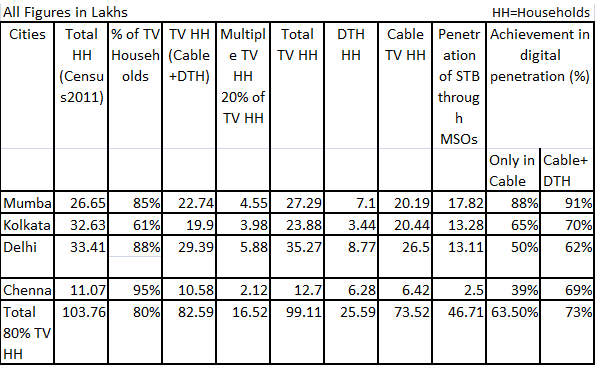
    Well, there are still some issues, but we think the government figures are off the mark. Our figures are as follows:


    Corrected STB Penetration Table -17 September 2012

    ( Includes DTH HH as part of Multiple TV HH not considered by I&B)

    Note:-
    1. Ministry has not included DTH TV HH in multiple TV HH where as it should have done so, being part of the same universe.
    2. Basis of % of TV HH in the Metros is hypothetical. Mechanism of its working out or its source has not been mentioned.


    The time has come to incentivize MSOs, but instead the licences have been cancelled of two of them.


    We are on September 24, and the price that consumers would have to pay is still not out, so things need to be moving faster.


    Broadcasters need to also ensure that there is availability of digital signals in all four metros.


    2. What is your information: are the lower income groups in these cities buying set-top boxes?

    They have been asking many questions. They want to know how much it will really cost them. Remember, some of them don’t even have colour television sets.


    Unfortunately, there is only one group representing consumers in the various taskforce meetings. Consumers would like to know how much it will really cost them.


    There will be an uproar if people don’t get to watch TV from November 1 because of this lack of information.


    3. There is a worry that there will be some piracy in the form of pilferage of signals after November 1…

    Why should there be any such pilferage? The broadcasters can simply stop the analogue signals. The question is: do they want to stop these? Will they fear loss of advertising if according to them digitization is not complete?


    4. What more would you like the government to do to ensure 100% digitization?

    Well, the government needs to do a variety of things.


    First, through the various advertisements, tell consumers very truthfully and clearly that one needs a set-top box for every TV set. And there’s an entertainment tax to be paid per TV set. So in Delhi, a consumer needs to pay Rs 20 for one set-top box and Rs 60 for three, if he or she has three TV sets.


    Second, consumers need to be made aware, that there is electricity consumption of around 18-20 watts per month which would roughly mean an extra spend of Rs 100. Also, they need to be aware that on these vanilla set-top boxes, they can’t get broadband or video on demand. There is no swap scheme and there is no portability currently.


    Third, consumers must also know where are the service centres for these set-top boxes in case the boxes need to be repaired.


    And broadcasters?

    Broadcasters also need to do more. For instance, in the various serials and reality shows, they must get the stars and anchors to talk about the need to buy set-top boxes!


    5. The last mile which is managed by the local cable operators is the key to the implementation of Digitization. Are all cable operators in the four metros about the implementation of the October 31 deadlline?

    Let me reiterate here that all cable operators want digitization. We will be happy to see consumers getting a choice and they will only pay as they watch.


    In fact had there been good availability of set-top boxes, we could have achieved things much faster. Right now, when a cable operator goes to the MSO for boxes on paying money, you don’t get the entire lot of boxes.


    We will be happy to see total transparency. We would like to also see deals between broadcasters and operators signed not on a lumpsum basis but as per the set-top boxes.


  • Jaldi 5 with Supriyo Sinha, VP – Bengali Dailies, ABP

    Supriyo Sinha

    Ebela, the tabloid from Anandabazar Patrika Group, recently launched in Kolkata and Howrah, priced at Rs 2. Supriyo Sinha is positively hopeful about its success. Jaldi 5 with him reveals more about the Bengal market.


    1. Since ABP is the undisputed Bengali daily in the market, why was there a need to launch another Bengali daily?

    ABP is the most iconic group in Eastern part of India. The group has been in the market for almost a century. ABP is, by far, the leading newspaper. A Bengali tabloid is a historic milestone for us. We launched Ebela to address the certain need gap that arose from communicating with Bengali youth, and the Bengali young-at-heart.


    2. Why has the launch been restricted to only in Kolkata and Howrah? How is ABP marketing Ebela?

    We launched in these markets based on market research. The research estimated that the appetite for a tabloid is higher in Kolkata and neighboring regions. The other markets are still traditional when it comes to news consumption and believe in broadsheet.to market the product, we are using a four-pronged approach. We are out-of-home media in a big way to spread awareness. Then there is web promotion to capture the youth on Facebook and Youtube, Television and radio commercials created by Ogilvy, and on-ground events. We are also driving subscription promotions.


    3. Is the advertiser profile for ABP and Ebela the same?

    Yes and no. National brands who wish to target the young-at-heart and local brands with youth as TG have been approaching Ebela. The ad rates for both the products is different.


    4. TOI is entering the market with Eyi Shomoy. Would it imply any strategy shifts for ABP?

    No. There is a core market reason for us to be doing this. TOI has been changing its own marketing and communication strategy in this market because of our strong presence.


    5. What are your expectations from Ebela?

    I dare not speak for the market but I am hoping for a positive response. From the initial print of three lakh copies, we only wish to grow. The readers, and advertisers, are calling it a refreshing and exciting product.