Tag: ISA

  • ISA to host second in webinar series

    By Our Staff


    The Indian Society of Advertisers (ISA), in association with the Free Press Journal and ABP Network, will host the second of the two-part webinar ‘Brands and Consumers: 2021 and Beyond’ on March 3. The knowledge partner for the webinar is Mogae Media and Laqshya is the outdoor partner.

    Said Sunil Kataria, ISA Chairman, said, “The Indian Society of Advertisers (ISA) is an apex body, successfully representing the interests of the advertising fraternity for nearly 70 years. The world has gone through a very difficult COVID period during 2020. This sad event has significantly impacted all brands and consumer behavior. It’s time to review and, more importantly, understand the learnings and the way forward for the industry both in the short term as well as the long term. Over the years, ISA has been organizing knowledge seminars/webinars for the benefit of the ecosystem of advertisers and marketers. Continuing the same, our two-part webinar series focuses on the issue most of us are facing: Brands & Consumers-2021 and Beyond. We bring you leadership views and strategies from across the Manufacturing and the Services sectors.”

    Added Abhishek Karnani, Director, The Free Press Journal, “This initiative will be significant to all advertisers and marketers who want to strategize the future course of actions for their brands.”

  • So 8 out of 10 people trust advertising: ASCI-ISA report

    By A Correspondent


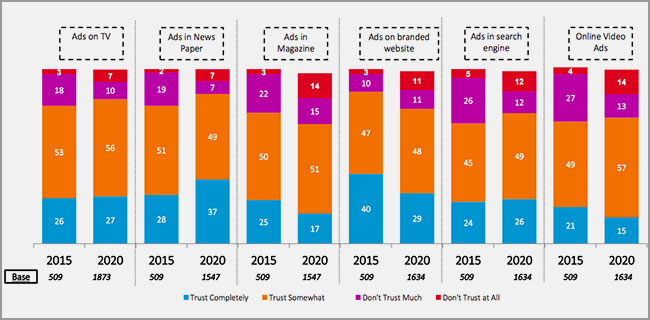
    Eight out of 10 people trust advertising. That’s the basic standout from a study commissioned by the Advertising Standards Council of India (ASCI) and the Indian Society of Advertisers (ISA), and conducted by Nielsen.


    The Trust in Advertising study was conducted with people across age groups in 20 centres in India, including metros, smaller towns and rural areas. The study found that eight out of 10 people trusted advertising messages across media.


    TV (94%) was the most common medium for consumption of advertising, followed by digital (82%), print (77%) and radio (29%). Viewership of TV ads is driven by non-metro markets.  Interestingly, viewership of ads on digital is the same in rural (82%) as it is in metros (83%).


    Prasun Basu
    Prasun Basu

    According to Prasun Basu, Global Head, Strategic Alliances and New Verticals Nielsen, this demonstrates the growing importance and centrality of this medium in the hinterland. ASCI spotted early that the growing consumption of digital content and advertising pointed to a permanent change in consumer behaviour and marketing. Accordingly, it set up robust monitoring mechanisms for digital platforms alongside its monitoring of print and TV advertising. It now scans more than 3,000 digital platforms for misleading messages.


    Advertising seen on traditional media continues to enjoy high trust amongst consumers. Advertising in newspapers (86%) emerged as the most trusted, closely followed by that on TV (83%) and Radio (83%). Text/SMS ads were the least trusted at 52%.


    In terms of shifts, consumers put greater trust in advertisements consumed on TV, print, radio, social media, outdoor and search engines as compared to what they did in a similar survey conducted by Nielsen in 2015, but there is a fall in the percentage of consumers trusting text messages over this period (58% vs. 52%)


    Among sectors, audiences displayed a very high level of trust for advertisements of educational institutions at 82%. This is possibly because culturally, Indians have a strong belief in education as a means to secure their future. Ironically, ASCI finds that a significant portion of misleading ads come from the education sector. ASCI therefore has a high focus on education sector advertising.


    Manisha Kapoor
    Manisha Kapoor

    Said Manisha Kapoor, Secretary General, ASCI: “ASCI’s job of monitoring the education sector is even more crucial, given these findings. In India, the poorest of people prioritize education spends over other necessities. Most educational institutions promise job guarantees or make false claims of being the No 1 or guaranteeing 100% placement without any objective data or evidence. We are doing our best to make sure that such false advertising is removed from the market,”.


    Sunil Kataria
    Sunil Kataria

    Added Sunil Kataria, Chairman of ISA: “Brands are built on the back of long term communication with consumers and audiences. It is in the advertisers’ own self-interest to make sure that all communication is honest and truthful, so consumers can trust advertising messages, and thereby, brands. This study helps advertisers, agencies, media owners and planners understand what works well and introspect on what needs improvement”


    The detailed findings of the study can be accessesd by clicking here


  • Indian Society of Advertisers issues statement on Tanishq ad

    By A Correspondent


    The Indian Society of Advertisers (ISA) has issued a statement on the Tanishq advertisement.

    It says: “Tanishq is an ISA member and ISA supports them. This advertisement had been viewed at Advertising Standards Council of India (ASCI) by an independent panel of multiple stakeholders from industry and society and the panel had not found anything objectionable, indecent or repulsive that could lead to any widespread offence.”

  • What will Brahm say to this at the next AGM?


    He was more than just the Hawkins big boss. A great marketer with a keen sense of (and on) advertising. His contribution to the various industry associations has been huge, and will always be remembered by those who knew him. Brahm Vasudeva passed away late on Friday, July 10. He was Vice Chairman and Managing Director of Hawkins from 1968-84, Chairman and Managing Director from 1984 to 2006 then Non-Executive Chairman. Our ‘Namaste’ to him.


    We carry here tributes by senior industrypersons Arvind Sharma, Ramesh Narayan, Narendra Ambwani and Jayesh Ravindranath.


    Brahm Vasudeva, RIP

    By Arvind Sharma

     

    On July 10 afternoon, many industry WhatsApp groups started sharing the news of Mr Brahm Vasudeva’s passing away. He was eighty-four years old.


    This sad news got me reflecting. About Brahm and about me.


    When I joined the advertising industry in my early 20s, a handful of large consumer marketing companies wielded enormous clout in the industry. That is true to a degree even today. However, what was strikingly different in that era of nascent consumer marketing was the influence a few individual consumer marketers exerted on the industry. They punched far above the weight their revenues or their marketing budgets should have given them. The position they commanded in the industry came from their intellectual caliber.


    Brahm was one such individual.


    He used the might of his intellect to change consumers’ lives for the better. His pressure cookers liberated Indian housewives from hours of sweaty drudgery in the kitchen. He constantly innovated- in products, distribution and marketing. Pressure cookers on EMIs, I’m told, was one his category penetration driving ideas. Of course, he built a very successful business in the process. But what many of us admired him most for were his enduring contributions in moving the industry forward on a number of fronts.


    We live in an era where we get agitated about our leaders bending the truth. And that is the way it should be. But can you imagine an era where there was no way of knowing the truth! Or no agreement on how to go about discovering the truth!!


    Brahm pushed on so many industry fronts to change that.


    As a major voice at the Indian Society of Advertisers, he demanded that media should charge for exactly what it delivered based on precise measurements. Whether the measurement was in terms of column centimeters of ads actually printed or in terms of opportunities to see delivered. His sessions with his agencies with piles of newspapers to measure the exact sizes of ads seemed quirky to many. But his insightful and counter-intuitive-to-many stance that for dependable media measurement, advertisers and advertising agencies must contribute their share of measurement costs has been proven right over time. It is now the bedrock principle underlying two major media measurement institutions in the country- Media Research Users’ Council and Broadcast Audience Research Council. Among others, they provide measurement on two of the most important media in the country- Print and TV.


    While being a champion of freedom of commercial speech, Brahm understood and advocated that as industry consisting of advertisers, ad agencies, media and associated advisory firms, we must self-regulate ourselves and our content. Otherwise somebody else will. He was one of the moving spirits behind creation of the Advertising Standards Council of India. He was actually the pen that wrote ASCI’s code of conduct. In 1985, in mere 3500 words, he wrote the principles that define good advertising. Those principles hold good even today-after 50 years of rapid change.


    The four pillars of these principles are taught in every advertising class in India today


    # Truthfulness and honesty in claims

    # Non-offensiveness to the public

    # Against harmful products & situations

    # Fairness in competition


    Brahm selflessly championed these and many other ideas he believed were good for the industry while he was in office at these institutions. And for decades after that at every possible opportunity. And long after he had physically left these boardrooms, the force of his thinking has continued to guide them with a simple question, repeated often: “What will Brahm say to this at the next AGM?”


    Brahm will not be there anymore at the AGMs of these institutions. And the truth is that he has not been there at most of them for the last few years. But the question, ‘What will Brahm say to this at the next AGM?’ has become such a habit with the industry that it has continued to echo in the boardrooms. It is the industry’s way of internalising the ideas and principles of a man who shaped its past and will continue to influence its future.


    About a decade ago, Brahm started championing the use of ‘Namaste’ in place of a handshake. But then Brahm always had great foresight! He was always ahead of his times!


    Brahm, those of us who knew you personally, will miss you as a friend. As an industry, we will do well to keep your memory alive by continuing to ask ourselves: ‘What will Brahm say to this at the next AGM?’


    Arvind Sharma is a veteran adperson and former Chairman & CEO, Leo Burnett

    ~ ~


    Namaste Brahm!

    By Ramesh Narayan

     

    The Year was 1982. Delhi was hosting the AdAsia 1982.


    I was an aspiring advertising person, attending the Congress to see what advertising was all about, and whether it could offer me a career. And there, one of the things etched in my memory was the final session where Mr Brahm Vasudeva summed up the entire proceedings.


    I was so impressed with his presentation. The way he chose the right points to highlight, his impeccable delivery, the ease with which he held the attention of the audience, it was just perfect.


    And perfection is something I would grow to associate with Brahm.


    I told him about the impression he had made on me and he always chuckled that he was responsible for me getting into advertising.


    Fast forward to an IAA Congress in Cancun. As a rookie, I was using conferences as a place to learn more about my profession. Brahm, for want of any other company, was indulging me. “Nice hotel” I said, nervously. “Yes”. he replied. “Why do you say so?” he  asked me.


    “Large rooms, great view”, I said. And countered: “Why do you like it?”


    “Wooden hangars,” was his laconic reply. And then went on to add: “the little things really matter”.

    Quintessential Brahm, as I was to learn as the years rolled by.


    The IAA was a fledgling association with and managing committee meetings would be held at the Trattoria restaurant. Pradeep Guha was the Hon Secretary and I was the Hon Treasurer, and I was presenting the annual accounts to the small committee which included Brahm. At one point he raised his index finger and I paused and said “Brahm, any doubts?”


    And he replied in his even tone, “Doubts? When Ramesh presents, I have no doubts. Just some clarifications maybe?” A lesson in using the right word at the right time.


    Somehow, Brahm was slightly intimidating to most people. Yet, he was uniformly gracious and kind to me. He even confided in me one evening at the Oberoi (now Trident) that he really didn’t care much for my father (whom he knew earlier) but “you, Ramesh are different”.


    Somehow, I didn’t take offense to that statement because there was something very genuine in his tone and demeanour.


    I learned that perfection in every little thing was important to him. Preparedness for a meeting, or presentation and equally, he valued the intent of a suggestion, so I made it a point when I was President Advertising Club to talk to him before the meeting and explain my point of view. After that, he was a formidable ally.


    And of course, I was tickled pink that he made it a point to publicly announce, every time we met, that the only desk calendar that adorned his table, was the one I sent him.


    Long before Corona, he had decided that Namaste was better than shaking hands.


    Rest well, my friend. Your life was a lesson worth learning from.


    Ramesh Narayan is a veteran adperson and Founder, Canco Advertising


    ~~


    He chose every single word he spoke so patiently

    By Narendra Ambwani


    I used to love his refusal to shake hands and do namaste. So thoughtful an idea well ahead of Corona times. Also I admired the way he would think and chose every single word he spoke so patiently.


    Narendra Ambwani is a veteran corporate leader and coach, and Former Managing Director, Johnson & Johnson

     ~~


    A Man Ahead of His Time

    By Jayesh Ravindranath


    As the person who helmed and ran what was then Pressure Cookers & Appliances Ltd, now renamed as Hawkins Cookers Ltd, Brahm Vasudeva was a legend. There were people who either hated Brahm or adored him. Very few who dealt with him, were in the ‘grey’ area.


    I had the good fortune of working closely with him when I was with Everest Advertising in the 80s. While most people saw him as a difficult man to deal with, I believe I understood what made the man tick, and hence created a rapport and an equation with him.


    He had a phenomenal eye for detail and a great believer in offering high-quality products to his consumers. I learnt a lot from him, and this is what I would like to acknowledge today, about the man and his work.


    Brahm was a stickler for detail and a man who spent copious hours going through every aspect of his business, be it product design, packaging, advertising and communications, media plans, or even the recipes that went into the legendary Hawkins cookbook. The end-product that would reach his consumers was nothing but the best.


    Some examples:

    In the 80s, before the advent of the internet, all communication was through postal mail. Users of Hawkins products would regularly write in to the company, commenting on the recipes Hawkins would offer, or they would send in their own recipes. Brahm would have each and every postcard and inland letter sent to the agency for translation from the respective Indian language to English. This translation would then be reviewed by his team, an appropriate reply drafted in English and sent back to us, the agency. We then got our translators to translate the English to the relevant language on an inland letter, which then got mailed to the person who wrote in! All this clearly at a cost. This was Brahm. He wanted to ensure his customers were engaged positively, and got the best product and service from Hawkins, even though he had to expend a huge resource to do so. I cannot think of any organisation then, that would go to such lengths.


    He ran a full-fledged professional kitchen with properly experienced F&B people, at his Mahim Mumbai service centre. This kitchen was constantly preparing and testing recipes for inclusion in the cookbook. The food prepared was then trialed on housewives who hailed from that particular ethnicity or state of India, to get feedback & approval, before the recipe was published.


    His eye for detail was such that he would spend hours with his technical and engineering team on minute details of the range of cookers, to ensure that the best quality of material was used to make the final product, and that they were tested before being put out to retail. One of the results of such an eye for detail was that the Futura was the only pressure cooker in the world to have been displayed by The Metropolitan Museum of Art, New York. When I saw it there during my visit in 1997, my heart filled with pride!


    Equally, his eye for detail on all advertising that went out was legendary. We would start meetings at his corporate office in Cuffe Parade at 9.30am with an agenda of say 15 items to be covered. By 8pm we would have barely touched 5 or 7, much to the consternation of those around the table, but those 5 or 7 would have been thoroughly discussed and closed.


    I recall one instance where he had asked for a logo unit to be in a particular size on the Futura packaging, which was underway. I took back a layout and Brahm’s sharp eye felt it was not the right size. He fished out his scale and ticked me off for not following his instructions. His next comment to me was – “Young man when I ask you for something please follow my request, as I am paying for this service. If you have another view, or your creative team would like to propose another option, by all means, but do not dishonor my request”. Lesson learnt!


    The other aspect about Brahm was in spite of his reputation for being a task master, he was a fair man. He was also one of the few advertisers who back then paid his agency on time! Unheard of then in India, where clients where notorious for paying two or three months beyond the due date. One instance I would like to highlight. At Everest one day I got a call from my then Chairman Ahmed Ibrahim saying that we were short on funds and INS (Indian Newspapers Society) payments were to be made. In those days, not paying the media would get the agency on the black list. So, I trotted off to Brahm and requested for a payment of that month’s dues, one week ahead of the schedule. Brahm looked me straight in the eye and asked me with a smile though, why he should finance the agency! He made his point, and a few seconds later he called his Finance head Teckchandani to issue the cheque immediately.


    Such was the man, principled, an eye for detail and a businessman and business partner with integrity. A man way ahead of his time.


    Jayesh Ravindranath started his career in advertising in Mumbai in the 80s. After 20 years he moved over to marketing. Now he runs an independent consultancy focusing on business mentoring & strategy, out of Dubai.

  • ISA to host seminar in Mumbai & Delhi

    By A Correspondent


    The Indian Society of Advertisers (ISA) is organizing a session on the ever-debatable subject of client-agency relationship.


    Billions of rupees are spent every year by clients through multiple marcomm agencies. It is vital therefore to have afair and measurable assessment methodology that can not only determine the strengths and opportunities for improvement in these relationships objectively and consistently through clear metrics and benchmarking, but also offera plan for continuous and measurable improvement in the performance and ROI of that relationship. The agency-client relationship is highly interdependent and thus the assessment system must be able to measure the performance of both partners in the relationship to achieve the above. So what is it that can become a challenge to a robust relationship?


    The evening program on “Enhancing Client-Agency relationships for continuous and measurable improvement in their performance” followed by a panel discussion amongst advertiser and agency senior leaders will be held on March 10 in Mumbai and on March 12, 2015 in Delhi.


    The speakers at the event include Jeremy Caplin, CEO of Aprais Limited. He is a senior communications professional with over 25 years of experience in both client side and agency management. He has worked at some of the world’s most high-profile companies with a strong record in measurement and strategic Marketing & Communications. Jeremy has operated as Global, European and Local Marketing Director at Companies such as P&G, Reckitt Benckiser, and monster.com and has been Head of Marketing Solutions at dunnhumby.


  • We can’t be without a measurement system: Hemant Bakshi, ISA Chair & ED, HUL


    What appeared to be a quiet start of the year emerged as an action-packed one as the ghost of the TV measurement scare emerged yet again with the Union Cabinet approving guidelines on television audience measurement issued by the TRAI.  Hemant Bakshi, Executive Director – Home & Personal Care of Hindustan Unilever (HUL) and Chairman, Indian Society of Advertisers (ISA) spoke with Shobhana Nair on how no measurement system is no good for the ecosystem, and the television sector in particular. The ISA, it may be remembered, had opposed the stand of several broadcasters who had unsubscribed from TAM last year. Excerpts from an interview with Mr Bakshi


    The danger of no measurement system hangs on the industry again though the reason is different this time around. How have you thought of handling it as the ISA Chairman?

    Firstly, it has just been announced and we need to get clarification on exactly how it is going to be amended. We are trying to figure that out right now. Meanwhile, ISA’s position on this remains the same that we do need a robust measurement system and I think the guidelines will help us get that. In the short term, we can’t be without a measurement system because ratings are the currency with which we buy television and the absence of the currency will affect the industry. We want to avoid that scenario at any cost.


    Have you discussed the situation with other members of ISA and what is a possible solution that has come out?

    I think we will come to conclusions but, as I said, right now we need to understand the details of the guidelines on how things will pan out, etc. And we are working on it.


    What are your thoughts on the guidelines by TRAI for TV Rating Agencies? Do you think it is a good attempt to create a manipulation-free environment?

    I haven’t seen the guidelines fully, so I don’t want to comment on it.


    BARC has many months before it becomes operational, what is on your agenda to speed up things there?

    BARC has already been working quite well and the progress has been outstanding. We need to keep in mind that to create something of this nature takes time and can’t be done overnight. Having said that, the work on BARC is at a good pace.


    After everyone came to an agreement last year on the need for a television audience measurement, we still have many  sections in the industry against TAM…

    I think we should look ahead and not look back. Going forward, the three bodies (IBF, ISA & AAAI) are working together through BARC to create a ratings system which will be acceptable to everyone. I think we should put all our energies in that.


  • IBF, AAAI, ISA and TAM reach a consensus. Finally

    By A Correspondent


    Representatives of advertisers, media agencies, broadcasters and TAM have finally been able to iron out their differences and agreed to agree on an agreement.
    The media and public will now get to know television viewership in thousands, colloquially referred to as TVT. TVT captures and reflects growth in TV audiences in the country in terms of absolute numbers. TVT will be the sole currency in the public domain.

    In addition four-week TVT rolling average will be provided every week. The rolling average is statistically more stable data on viewership, especially for smaller audiences in niche channels, regional languages, English language programs and news.

    For internal evaluation including planning and buying, %TVR weekly will be available to advertisers and advertising agencies.

    The three constituents have also agreed that TAM will make all future audience measurement changes based on inputs from the joint-industry BARC Technical Committee.

    Commenting on the changes IBF President Man Jit Singh said: “We are delighted to have reached this agreement. We believe it is important for the industry, and from the perspective of our social responsibility, we must reflect both the growing television audience and the data in a more stable and useful manner. We want to thank AAAI and ISA in collaborating and working out a solution acceptable to all constituents”.

    “As three concerned constituents, who believe in working together, we have decided to refer all future currency related changes to the BARC technical committee. I’m glad that now we will have an effective guide and monitor for ratings in the country,” said Hemant Bakshi, Chairman of Media Committee and Managing Committee of the Indian Society of Advertiser.

    “Getting weekly TVR% is important for media planners and buyers to effectively plan and buy TV  and do mid- plan course corrections and post analysis. We are glad that we have been able to agree that the agencies and advertisers will have access to this data as in the past. From tomorrow, we look forward to being able to focus back on our clients businesses and effective planning and buying for their brands,” said Arvind Sharma, President of the Advertising Agencies Association of India.

    A TAM spokesperson has also issued a statement saying: “TAM is happy to receive a common brief from the three Industry Stakeholders (IBF, ISA and AAAI) and will work very closely with them to ensure its smooth roll out.”

  • IBF, AAAI, ISA and TAM reach a consensus. Finally!


    By A Correspondent

    Representatives of advertisers, media agencies, broadcasters and TAM have finally been able to iron out their differences and agreed to agree on an agreement.

    The media and public will now get to know television viewership in thousands, colloquially referred to as TVT. TVT captures and reflects growth in TV audiences in the country in terms of absolute numbers. TVT will be the sole currency in the public domain.

    In addition four-week TVT rolling average will be provided every week. The rolling average is statistically more stable data on viewership, especially for smaller audiences in niche channels, regional languages, English language programs and news.

    For internal evaluation including planning and buying, %TVR weekly will be available to advertisers and advertising agencies.

    The three constituents have also agreed that TAM will make all future audience measurement changes based on inputs from the joint-industry BARC Technical Committee.

    Commenting on the changes IBF President Man Jit Singh said: “We are delighted to have reached this agreement. We believe it is important for the industry, and from the perspective of our social responsibility, we must reflect both the growing television audience and the data in a more stable and useful manner. We want to thank AAAI and ISA in collaborating and working out a solution acceptable to all constituents”.

    “As three concerned constituents, who believe in working together, we have decided to refer all future currency related changes to the BARC technical committee. I’m glad that now we will have an effective guide and monitor for ratings in the country,” said Hemant Bakshi, Chairman of Media Committee and Managing Committee of the Indian Society of Advertiser.

    “Getting weekly TVR% is important for media planners and buyers to effectively plan and buy TV and do mid- plan course corrections and post analysis. We are glad that we have been able to agree that the agencies and advertisers will have access to this data as in the past. From tomorrow, we look forward to being able to focus back on our clients businesses and effective planning and buying for their brands,” said Arvind Sharma, President of the Advertising Agencies Association of India.

    A TAM spokesperson has also issued a statement saying: “TAM is happy to receive a common brief from the three Industry Stakeholders (IBF, ISA and AAAI) and will work very closely with them to ensure its smooth roll out.”

  • MIB bows to news TV pressure, pushes TAM to delay ratings data release

    By A Correspondent


    In what is clearly a case of government interference in the broadcast business, measurement agency TAM Media has been compelled by the Minister Manish Tewari-led Information and Broadcasting Ministry to not release the data for ratings for the last week as well as for around the last two months which it had agreed to not release. The other stakeholders – the IBF, ISA and AAAI – have been mute witness to the decision and chose not to take the government head-on.


    While TAM spokespersons were unavailable for comment, sources tell us that news broadcasters had petitioned TAM to not release data for a while. When TAM sought the advise of other industry stakeholders, they (the other bodies) trashed the plea and chose to go ahead with the release.


    However, it appears the news broadcasters were able to convince the government which used its power to push ahead with the late evening knock.


    Late last night, TAM issued the following statement: “At the request of the I&B Ministry, the Government of India, and in concurrence with IBF, AAAI & ISA, we are delaying the data release to Thursday/Friday.The reason for doing so is that  the Government of India has requested us to withhold release of news channels data by two or three days.  The industry is meeting with the ministry to take a decision. Thank you for your cooperation.”


    While TAM and the other industry bodies are not required to toe the government line, they chose to do so, fearing retribution in the future, an industry observer told MxMIndia.


    News channels are reportedly desirous of a longer ratings-free window. They believe the current processes followed by TAM do not effectively track their viewership. However, advertisers and media agencies want the presence of a measurement currency so that they can effectively spend monies.


  • TAM offers 6 action steps in meeting with ISA & AAAI

    By A Correspondent


    The Indian Society of Advertisers (ISA) and the Advertising Agencies Association of India (AAAI) called a joint meeting on August 16 for TAM to present facts as they are relevant to the users.


    “As key users of audience research data, advertisers and advertising agencies need to know facts directly from the research agency. And if there are challenges at any level in the research, the research agency needs to share its proposed action plan with us,” said Bharat Patel, Chairman-ISA and Arvind Sharma, President-AAAI in a communiqué.


    TAM shared its perspective with ISA and AAAI and outlined six key action steps:

    • Appointment of a security officer and a security agency
    • Expansion in number of meters in the existing 6 top metros
    • A review by the industry of research processes that determine what TAM reports in its weekly reports. And what meter homes are left out of reporting for being data outliers
    • Getting the outlier homes independently audited
    • Faster panel rotation
    • An internal audit team to be put in place as soon as possible


    “We look forward to speedy implementation of the six action steps outlined by TAM. With the formation of Broadcast Audience Research Council-BARC on the anvil, it will be appropriate for us to request BARC to review if these steps are adequate,” added Messrs Patel and Sharma in the statement.