Tag: IRS2017

  • Shailesh Amonkar: #IRS17 – Publishers must think Long Term. Discounting can be their Nemesis!

    By Shailesh Amonkar


    With #IRS2017 now behind us, it is time for publishers to look ahead.


    The IRS has indeed been a shot in the arm for publishers. Apart from pure numbers, the growth trends across the print media as well as inregions, has been really encouraging and would have in the normal course helped publishers to increase both yields as well as revenues.


    However, most publishers charted their own nemesis and months in advance.


    The two key happenings during the preceding months that affected the print media landscape more than the others were undoubtedly, Demonetisation and the GST Bogey.


    The way publishers reacted to these is what is creating a cascading effect on the road ahead for print.


    In November 2016, demonetisation was announced and with no cash in the system, coupled witha decline in consumption of products and services, advertising spends reduced drastically.


    Most publishers including the leaders in most markets dropped their advertising rates to pick up whatever business they could, to ensure profitability. By the first quarter of 2017, the cash crunch eased slowly, with the government pumping in cash as well as the increase in digital wallets and move to online banking etc.


    With the economy looking up, people felt the worst was over. However, the introduction of GST in the second quarter of the year was good enough reason for advertisers and clients to once again reduce spends.


    The net effect of both these key happenings ensured that most publishers reduced their advertising rates to garner revenues so as to achieve targets. The leaders started discounting which left no choice for the rest to follow. The general feedback across publishers is that the revenue growth for the current financial year has been either flat or grown in single digit.


    One needs to understand that during the last four years (which include the demonisation and the GST era), no updated research data was available for planning. Yet most publishers reduced their rates to garner revenues, now with IRS 2017 showing good numbers and growth, will these publishers be able to increase their rates?


    The question that comes to mind is whetherpublishers who have maintained growth or have grown in IRS  2017, would they able to increase their rates and reach at least the level they were operating before demonetisation? The publishers who have declined or lost their position to competition would have a tougher challenge to hold on to the rates they have been operating post-demonetisation


    With revenue pressure and profitability increasing, publishers find themselves at the crossroads. It is very clear that publishers must work to find their long-term solution and not rely only on quick-fix solutions to problems and issues.


    Will they?


    Shailesh Amonkar has over three decades of building and managing sales teams. He has worked with The Times of India and Sakal Media Group in senior positions and is Founder CEO of Kemistry Media Solutions Pvt Ltd and co-founder of Webmag India Pvt. Ltd.


  • Just in case you missed it: The IRS Webcast brought to you by MxMIndia & 24FramesDigital

    The IRS2017 release last week was truly historic. In more ways than one. For one, it was the largest ever audience measurement study globally. Two, it was being released after a long gap. And, three, for the first time ever, it was webcast live.

    Just the webcast alone saw 8,911 page views, which given the size of the industry, is significant. While the real thing is before us (all those who’ve subscribed to the data that is), here’s a link to the webcast which will be on this page till around February 14.

    View on!


  • Print shines in IRS2017


    By Indrani Sen


    The IRS 2017 Topline Report released on January 18, 2018 has reinstated the advertising and marketing industries’ trust in audience research. Kudos must be given to MRUC, RSCI and Nielsen for getting the world’s largest readership survey back on track. IRS 2017 is a definitely a richer version of its predecessors, backed by enlarged sample size, changes in methodology, introduction of new readership metrics and concepts enabling in depth analysis of not just print media but overall media consumption. The strict scrutiny and quality control designed and deployed by the IRS TechCom helped in ensuring the accuracy of the findings.
     

    MRUC however has to revisit the common NCCS definition and the durable based grid as already pointed out by Shripad Kulkarni in “IRS 2017 Top 5 Takeaways” on January 19. With rise in electrification, LPG stove ownership, B&W TV production becoming obsolete and every third home possessing a two-wheeler, it is not surprising that NCCS D/E have been found as “Fast Shrinking”. However, the reality may be different riddled with power cuts and shortage of LPG Gas cylinders, particularly in rural areas. Ownership of colour TV provides the 24X7 entertainment to the entire family at a very low cost through cable operators and DD’s Free Dish. Ownership of two-wheeler is a necessity for a livelihood to many living in Tier 2 and Tier 3 cities. How far the ownership of ceiling fan, LPG stove, two-wheeler and colour TV will help us in the socio-economic classification indicating the disposable income of the house holds should be re-examined. At the upper end, NCCS A1 and A2 seems to be apparently stagnant, however, based on the growth in the number of total households, there has been a few crores growth in the numbers of A1 and A2 households.


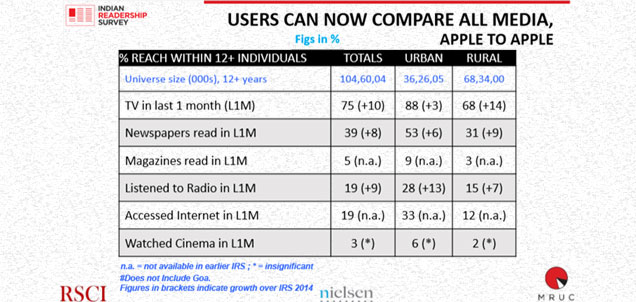
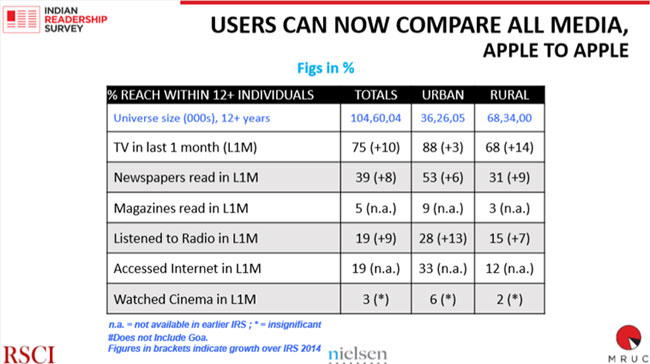
    In spite of the growth in urbanisation, 2/3rd of the almost 30 crores home in India still belong to the rural area. It is encouraging to note that TV reach and Newspapers reach are growing at a faster rate in rural area than in urban area.Again radio reach and newspaper reach are growing at faster rate than TV reach in urban area.

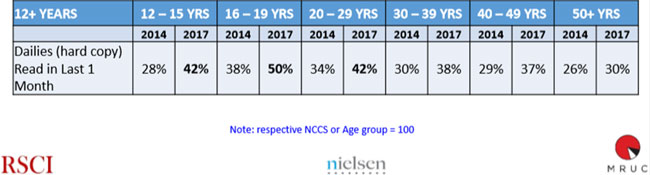
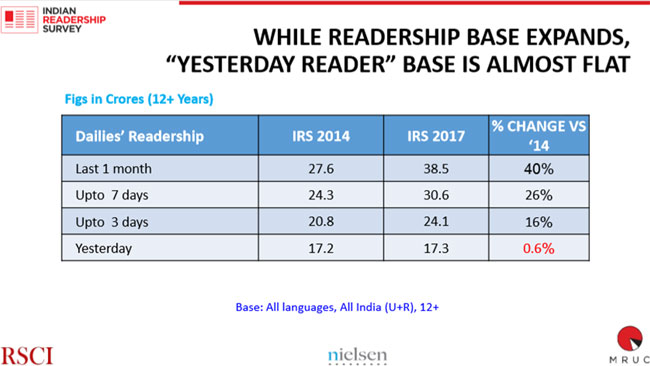
    All these reach figures are calculated on the basis of reach within 12+ individuals in last 1 month, the new readership metrics introduced in IRS 2017. Dailies added 11 crore readers in last three years, of which 4 crores came from urban India and 7 crores from rural India. On the demographic front, the readers among the younger age groups (12-15, 16-19, 20 -29 years) have shown higher growth than the older age groups. With more than 40% of our population below the age of 20 years, this trend is encouraging for the future of Print media.

    The high readership among the younger age group probably explains the stagnation in the yesterday readership against the growth in the other categories, up to 3 days, up to 7 days and last 1 month. Readers below 20 years and in their early twenties may not be regular readers of newspapers due to their pre-occupation with studies and other activities.

    This rise in readership of newspaper among younger age groups is a phenomenon of non-metro Tier 2 and Tier 3 cities and rural areas as we do not see the reflection of this trend among the youth in the metro cities, skewed to English medium and digital media. IRS 2017 has found that newspaper read online is only 26% among NCCS A1, so our educated urban youth probably are engaged with other content on the internet.


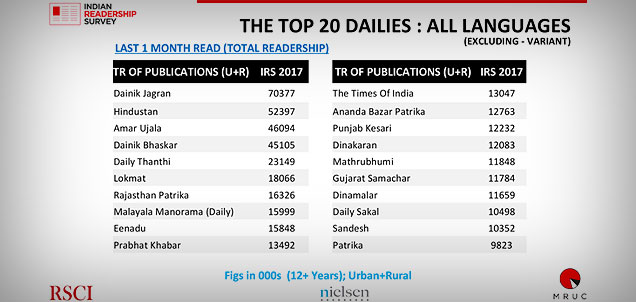
    Except Times of India which ranks 11th,the Top 20 dailies are all in Hindi and other regional languages. From 2014 to 2017 most of the regional languages dailies have grown more than the growth of English dailies (10%). The highest growth has been achieved by Oriya which, from a smaller base, has grown by 83% while Bengali has grown by 9%. Among the South Indian Languages, Telegu has grown by 66%, Tamil 44% and Kannada 37%. Malayalam newspaper market is more saturated and has shown only 19% growth. Marathi has grown by 31% with Gujarati scoring above it with a 45% growth. Hindi has also grown by 45% while Punjabi and Urdu have grown by 51% and 53% respectively from smaller bases.


    Armed with the findings of IRS 2017 and various other studies which show the growth potential of the smaller towns and rural areas, it is high time for the language newspapers to challenge the difference in the advertising rates of English and language newspapers in India. Marketing communication in any regional daily can work effectively when the content is also effectively designed in the same regional language and is not a poor translation from English or Hindi.As our creative agencies have not shown much interest in developing content in regional languages, perhaps the regional language newspapers can explore the option of developing advertising content for their own markets. If journalism can develop so well in regional language, it may not be difficult to develop advertising content and increase profitability in the new era of content marketing.


  • Rejoice! IRS2017 is out!


    By A Correspondent


    There has been much sense of anticipation about IRS2017 since a few months when the finishing touches and validations were being conducted. And when the toplines were unveiled finally in the presence of around 250+ media professionals and over 10,000 others over a live webcast facilitated by MxMIndia and 24FramesDigital, there was a deep sense of relief.


    There were some who were dismay as they didn’t do very well in the basic data that was revealed, there were some others who were wondering why the MRUC and RSCI weren’t rolling out the bubbly.


    So first let’s read the official press release that we were given post the unveiling:

    The Readership Studies Council of India (RSCI) and Media Research Users Council (MRUC) are pleased to announce that the Indian Readership Survey (IRS) 2017 Report has now been released.


    For the record, the IRS 2017 Report covered a full year sample of 320,000 households – the highest ever in the history of any readership study in the world. The large sample size was backed by a meticulously designed methodology, which saw the use of 100% Dual Screen CAPI followed by a tighter scrutiny process via continuous backchecks, accompaniments, use of audio recordings, and third-party field audits. These enhanced levels of Quality Control deployed by the IRS TechCom has ensured veracity of data capture for all quarters. The robustness of capture of media consumption across all media has been significantly enhanced due to the increased sample size and better representation across all pop strata.


    All key stakeholders had been actively engaged by RSCI and MRUC all through the fieldwork period to keep them updated and aligned on the progress.


    Some exciting new features have been included in this round of the IRS.


    Reach analysis across all media types has now been brought to a common platform with the introduction of 1-month penetration numbers for all media types. This will now enable an apples to apples comparison across media types.


    The IRS 2017 Report also offers new readership metrics. Apart from the standard and well-established Average Issue Readership metric, one can now look at data from the perspective of Total Readership (TR), and Readership of publications by time frames of Last 7 days and Last 3 days.  These new metrics have been introduced to provide a true representation of the changing consumption habits among Newspaper readers.


    Another interesting development has been the capture and reporting of readership for the Main issue of Newspapers versus their Variants. Each of them are now reported separately in IRS 2017.


    Commenting on the release of IRS 2017 Report, Ashish Bhasin, Chairman, MRUC and Chairman and CEO – South Asia, Dentsu Aegis Networks, said: “According to the findings of the Report, 39% of Indians (12+ years) read newspapers, and 20% of all newspaper readers in 50 Lakh plus population towns read newspapers online. These numbers most definitely tell us that there is a bright future waiting for the Print industry. I’m also hoping that we will now begin to see advertisers and media agencies taking Print more seriously. Increased readership numbers for newspapers and magazines will pave the way for publishers to increase their revenues, which would in turn help increase the size of Print as a medium.”


    Bhasin further said: “The support we have received from across constituencies for bringing out this Report was phenomenal and it was very pleasing to see the key stakeholders contributing in many ways to improve the study that has been in existence since more than two decades.”


    Noted Shashi Sinha, RSCI Managing Committee Chairman, and CEO, IPG Mediabrands: “I’m delighted to share that the findings of the IRS 2017 Report mirrors the market reality in terms of media reach and the performance of individual media channels be it newspapers, magazines and broadcasters.  The methodology deployed to capture data quarter-on-quarter was the very best for a study of this scale and kind, and the sheer focus on Quality Control makes this Report a reliable one and a real stand out.”


    Said NP Sathyamurthy, Chairman – RSCI Technical Committee and Executive Director, DDB Mudra Group: “The IRS 2017 Report is the outcome of great minds from different streams working together toward a common and shared goal to come out with a research that sets the highest standards globally. Absence of readership data for four years meant that we had to work that much harder and smarter to bring the study back in action and in line with the market truths and expectations.”


    Sathyamurthy further noted: “From 2016, when we began the fieldwork, up till last month when we completed the validations for all four quarters, the journey wasn’t easy, and had its own special twists and turns. Furthermore, we have strengthened the Report with additions such as TR, readership numbers for 7 days and 3 days and the separate reporting of newspaper variants. IRS 2017 marks a new innings for this trusted Industry study.”


    There were murmurs against the return of Total Readership (TR) as a currency. At least two publishers and a former member of the thinktank rubbished the decision of using TR and alleged that it has been done at the behest of some powerful newspapers who want to project a healthy picture for the industry. When a senior functionary associated with IRS2017, he/she retorted that it was the Board’s decision to use TR, and not the whim of an individual.


    Another senior media agency professional told MxMIndia, that there is a crying need for an apples-to-apples comparison being thrown by audience measurement studies.The professional told us about how in the case of television audience measurement too, the metric deployed in public is impressions. Similarly, he/she told us that there is merit in a metric that will help planners make more informed decisions will help the agency fraternity considerably. Meanwhile, an advertiser who MxMIndia spoke with, underscored the need for a realisation that there is need for a good, solid currency for all media. “It’s time media owners realise that we will only put money, when we can be sure of performance… We are not in the business of charity.”


    Indeed.


    Meanwhile, the data is set to roll from the second half of today. However, it will be downloadable only if users agree to a Code of Conduct/Usage. What this Code contains, the heads of RSCI and MRUC didn’t tell us at the launch on Wednesday, but there are indicators that the Code could make it difficult for publishers to fool around much with the way they slice and showcase data.


    IRS 2017 Launch toplines