By Indrani Sen
 The IRS 2017 Topline Report released on January 18, 2018 has reinstated the advertising and marketing industries’ trust in audience research. Kudos must be given to MRUC, RSCI and Nielsen for getting the world’s largest readership survey back on track. IRS 2017 is a definitely a richer version of its predecessors, backed by enlarged sample size, changes in methodology, introduction of new readership metrics and concepts enabling in depth analysis of not just print media but overall media consumption. The strict scrutiny and quality control designed and deployed by the IRS TechCom helped in ensuring the accuracy of the findings.
MRUC however has to revisit the common NCCS definition and the durable based grid as already pointed out by Shripad Kulkarni in “IRS 2017 Top 5 Takeaways†on January 19. With rise in electrification, LPG stove ownership, B&W TV production becoming obsolete and every third home possessing a two-wheeler, it is not surprising that NCCS D/E have been found as “Fast Shrinkingâ€. However, the reality may be different riddled with power cuts and shortage of LPG Gas cylinders, particularly in rural areas. Ownership of colour TV provides the 24X7 entertainment to the entire family at a very low cost through cable operators and DD’s Free Dish. Ownership of two-wheeler is a necessity for a livelihood to many living in Tier 2 and Tier 3 cities. How far the ownership of ceiling fan, LPG stove, two-wheeler and colour TV will help us in the socio-economic classification indicating the disposable income of the house holds should be re-examined. At the upper end, NCCS A1 and A2 seems to be apparently stagnant, however, based on the growth in the number of total households, there has been a few crores growth in the numbers of A1 and A2 households.
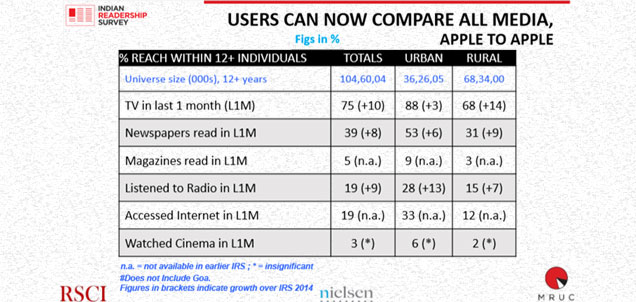
In spite of the growth in urbanisation, 2/3rd of the almost 30 crores home in India still belong to the rural area. It is encouraging to note that TV reach and Newspapers reach are growing at a faster rate in rural area than in urban area.Again radio reach and newspaper reach are growing at faster rate than TV reach in urban area.
All these reach figures are calculated on the basis of reach within 12+ individuals in last 1 month, the new readership metrics introduced in IRS 2017. Dailies added 11 crore readers in last three years, of which 4 crores came from urban India and 7 crores from rural India. On the demographic front, the readers among the younger age groups (12-15, 16-19, 20 -29 years) have shown higher growth than the older age groups. With more than 40% of our population below the age of 20 years, this trend is encouraging for the future of Print media.
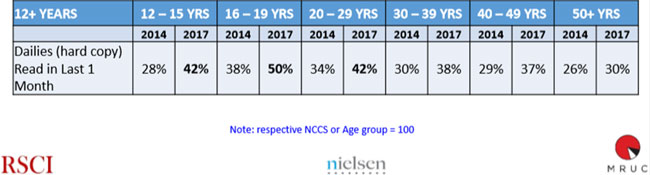
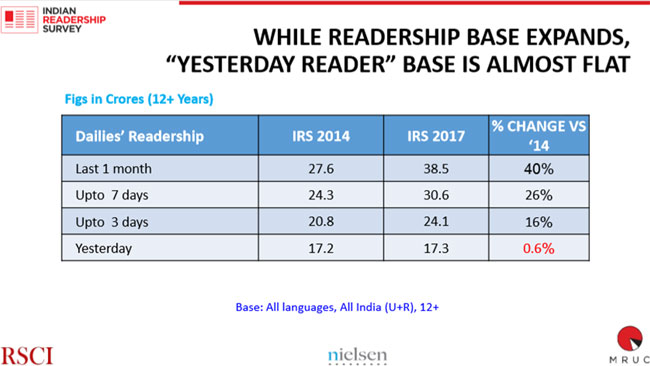
The high readership among the younger age group probably explains the stagnation in the yesterday readership against the growth in the other categories, up to 3 days, up to 7 days and last 1 month. Readers below 20 years and in their early twenties may not be regular readers of newspapers due to their pre-occupation with studies and other activities.
This rise in readership of newspaper among younger age groups is a phenomenon of non-metro Tier 2 and Tier 3 cities and rural areas as we do not see the reflection of this trend among the youth in the metro cities, skewed to English medium and digital media. IRS 2017 has found that newspaper read online is only 26% among NCCS A1, so our educated urban youth probably are engaged with other content on the internet.
Except Times of India which ranks 11th,the Top 20 dailies are all in Hindi and other regional languages. From 2014 to 2017 most of the regional languages dailies have grown more than the growth of English dailies (10%). The highest growth has been achieved by Oriya which, from a smaller base, has grown by 83% while Bengali has grown by 9%. Among the South Indian Languages, Telegu has grown by 66%, Tamil 44% and Kannada 37%. Malayalam newspaper market is more saturated and has shown only 19% growth. Marathi has grown by 31% with Gujarati scoring above it with a 45% growth. Hindi has also grown by 45% while Punjabi and Urdu have grown by 51% and 53% respectively from smaller bases.
Armed with the findings of IRS 2017 and various other studies which show the growth potential of the smaller towns and rural areas, it is high time for the language newspapers to challenge the difference in the advertising rates of English and language newspapers in India. Marketing communication in any regional daily can work effectively when the content is also effectively designed in the same regional language and is not a poor translation from English or Hindi.As our creative agencies have not shown much interest in developing content in regional languages, perhaps the regional language newspapers can explore the option of developing advertising content for their own markets. If journalism can develop so well in regional language, it may not be difficult to develop advertising content and increase profitability in the new era of content marketing.