Tag: Ipsos

  • Digital adspend has reached INR 31.5kcr in 2023

    By Our Staff


    Market research firm Ipsos released ‘The State of Digital Marketing in India 2023 – 24’ report jointly with ET BrandEquity.


    Key Highlights of the Report:

    Digital Advertising Spend – The report indicates that digital advertising spending in India has reached INR 31,500 crore in the fiscal year 2023, with an anticipated surge to INR 41,000 crore by FY 2024. This underscores the growing prominence of digital platforms in advertising strategies.

    Digital advertising spending in India is primarily driven by nine key sectors, with FMCG and e-commerce contributing to over 60% of the total digital spending. E-commerce is the fastest-growing segment, with an increase of 43% (FY 22 vs. FY 23), and FMCG grew by 30%.

    Internet adoption, data analysis and technological advancements are critical drivers of growth for digital advertising.


    Additional insights to look out for:

    Media Share Shift: A significant finding is the projected overtaking of digital    media over television in ad spend share by FY 2024, accounting for about 39% of the total. This shift signifies changing advertiser preferences and the growing audience inclination towards digital platforms.

    Trend projection: Marketers have adapted to the fast-paced change around technology, consumers and business by going digital and adoption, to tap into their key audiences.

    As attention spans keep dwindling, the need for video content to be brief, targeted, and engaging is more crucial than ever. The trend of concise, and powerful advertisements, known as bumper ads is projected to persist

    Influencer marketing will  play a critical role in enhancing brand and customer relationships and driving business growth

    Personalised and customised marketing to gain prominence catalysed by AI & ML

    WhatsApp Business continues to be a rising force in digital marketing, capitalising on its 2.5 billion active users globally and ~500 million in India.


    Said Amit Kumar Gupta, Business Head of The Economic Times Business Verticals, commented on the launch: “The integration of digital media in marketing strategies is evident, yet there’s immense untapped potential. Our report aims to shed light on these trends for business leaders steering digital marketing in their organisations. We believe this report will further open the opportunities that digital platforms offer.”


    Added Deepak H, Partner, Strategy3, Ipsos India: “The digital marketing landscape is rapidly evolving with trends like Generative AI, Influencer Marketing, Machine Learning, and Multi-channel Marketing taking centre stage. This report is instrumental in understanding these changes.”


    Intersesting findings, now let’s see whether the mothership (and industry gospel) The Economic Times uses this data as a reference point in its reports on digital.


  • Ipsos launches AI-powered insights platform

    By Our Staff


    Market research major Ipsos has announced the launch of Ipsos RISE: a platform for modern brand, risk and reputation management. Powered by AI and perfected by Ipsos’ world-class Corporate Reputation and Public Affairs experts, Ipsos RISE (Reputation Intelligence for Strategic Evaluation) is designed to “guide organisations with confidence as they navigate today’s complex and fastmoving corporate risk landscape”.


    Said Lorenzo Larini, CEO of Ipsos North America: “With brands and businesses expected to solve societal wrongs, positively impact their communities, and lead on ESG issues – all while delivering value to shareholders and stakeholders –reputation management has never been more critical or more challenging,” “Combining the speed and efficiency of digital data solutions with the analytical rigor of survey-based research, Ipsos RISE delivers a unique and focused solution for the evolving needs of brand and communications leaders, risk managers, and public affairs teams.”


  • PoV by Pallavi Mathur Lal: It’s time for brands to bring sustainability conversation to consumers

    By Pallavi Mathur Lal


    Sustainability is a complex encompassing term that refers to the ability to maintain resources for use but also for future generations. While it is often associated with natural resources, it includes societal and economic resources. As Sustainability or ESG (Environmental, Societal, Governance) movement gathers steam all over the world, we see many ‘push’ factors for businesses and companies.


    In India, we see many actions of global companies as they follow their global directives as part of the UN Global Compact (2000), to adopt sustainable and socially responsible policies and practices. We see many corporates and businesses, both in public and private sectors, refer to the SDGs (17 UN Sustainable Development Goals formed in 2015) as informing their wider sustainability strategies.


    While Governments, NGOs, and businesses have sustainability mandates, the consumer sphere is still lacking this new infusion of sustainability as a critical focus.


    Sustainability, however, is not easily sold to consumers: In a global survey conducted by Ipsos on consumer attitudes toward sustainability issues, it was found that consumers hold companies and governments responsible for sustainability. They are willing to act but feel that their impact as individuals is limited. This is true if you look at the stats – the responsibility for 71% of global emissions lies with the top 100 companies!

    Brands and businesses, hence, have a crucial role to play in promoting sustainability, as they are major drivers of consumption and resource use. Brands have the window with consumers to communicate directly about their values and benefits. India, however, as a market is not as mature as the Western, more developed markets and so the questions for us are: Are consumers ready for this? Will it help brands to strengthen their relationship with consumers, ultimately moving towards consumers considering, buying, and advocating their brands?

    As per the Ipsos Global Trends survey 2023, in India, 60% of consumers strongly agree that we are headed for environmental disaster unless we change our habits quickly. Even with this realization, we know that sustainability is not an easy sell to consumers – the say-do gap is real. From another BCG Global study we know that while 80% consumers in 8 countries (including India) were concerned about the environment, only 1-7% have paid a premium for sustainable purchases.

    Seeing this hesitation in consumers, brands are also holding back talking about the sustainability benefits for the fear of being perceived as being more expensive and losing consumer approval (and demand). However, in this circle of communication and action, brands need to bring more progressive messaging toward the environment and even the societal action that they take. In this way, they build more value around sustainability.


    What brands can do to establish the right connection?: This is like the chicken and egg situation: Should the brands start talking sustainability first (even when the consumers seem unwilling) or should the consumers start demanding it first and then the brands get into action. Sustainability will come into the conversation sooner than later. There will be some brands which would have started building the connect early and benefiting from it, while other brands will be slower and more reactive.

    In addition, for brands to talk about sustainability and use the right messaging is tricky. Unless brands have sustainability built into their core, into their strategic priority, the messaging can backfire. Consumers are wary of, and call out greenwashing, which can end up harming the reputation of the brand, and examples of Volkswagen in 2015, and of H&M more recently in 2022 are before us.


    So, what can a brand do to establish this right connection with their consumers? Here are some research-backed pointers:

    1. Communicate the Co-Benefit: Sustainability as the key benefit, with a higher price is not going to go down well with the majority. All said and done, we have seen that the mass consumer is not going to pay extra for just a sustainable claim or benefit. Consumers still need to see any product performing well on its functional aspects or cater to them emotionally, with sustainability at best being a co-benefit.

    2. The ‘Push’ doesn’t work: Any ask/ call-to-action that requires a change in set behaviour patterns or a habit is going to be difficult for consumers to adopt. Hence, marketers are looking for ways to make changes in their products and packaging which do not alter or modify the performance of the product, nor does it expect consumers to make substantial changes.

    3. Create the ‘Pull’: An Ipsos meta-analysishas shown that it is important to focus on people, and their problems, rather than just the brand which is providing the sustainability message. No surprises here – consumer-centricity is already a mantra we follow, but this means that we need to dig even deeper into concerns, behaviours, and problems to see how we first highlight the key problem that the consumers are facing. After establishing this, and showing the current non-sustainable practices, a more sustainable solution can be offered by the product or brand.


    Use authentic cues and messaging – Dipping into our cultural heritage, and sustainable practices: The way awareness about the climate crisis is increasing and sustainability conversations are making their way into many aspects of our lives, brands will have no choice but to directly or indirectly cue that they support sustainability, promote some cause, or propagate good practices to stay connected to consumers. Fortunately, we have some particularly good practices in India, from our heritage and cultural roots, that brands can leverage to cue their sustainability leanings.

    :: Living in harmony with nature: Our traditional ways are nature and animal friendly and about peaceful coexistence with them. Some of our religions have us worshipping plants like tulsiand using plants for medicinal purposes and for cooking and flavoring. We also have in our mythology, animals as avatars of gods and goddesses or as mounts, making us sensitive and protective about animals.

    :: Frugal, low wastage, savings ethos: In India, we have an ethos of wasting very little material or food and conserving our resources. Traditionally, we have always saved money for the future. Food wastage is also not in our nature. Worshipping Annapoorna Devi, the goddess of food and nourishment, ensures that we have a respectful relationship with food and food sources.


    Frugality, to some extent, is getting replaced by ‘living life to the fullest’, ‘living for the moment’, YOLO and what have you. However, the frugal mindset does exist in our collective recent memories and can be rekindled by showing the positives associated with the larger good.

    :: Sustainable materials: Our everyday utensils are made of stainless steel and traditionally of brass or copper – unbreakable and non-disposable. This ensures long-lastingness and a one-time investment that pays off for years. Traditionally we have also used banana leaves which can be discarded, are biodegradable, and avoid the use of any cleaning materials. Till even three decades ago, plastic had not made such inroads into our daily lives. We used sustainable materials like paper to wrap things and carry bags. Cloth bags were carried when we left home for shopping and used for bringing back groceries and vegetables. Using earthenware to keep our water cool, was another sustainable way – with refrigerators and ACs being a relatively recent phenomenon.

    :: Sustainable practices: Till some years ago, new clotheswere bought only on birthdays or festivals. Maintaining one’s clothes or other objects around the house (like furniture or upholstery) was a matter of pride and care was taken to preserve them for years. We wore hand-me-downs not only from our own siblings but also cousins and neighbours’ older children. We also had their toys and books. In fact, the ‘pre-loved’ clothing trend is a hark back to the same philosophy. Bathing was from a bucket and not from water-wasting showers.


    With all this context, it seems that brands need to start the conversation on sustainability with consumers already. Consumers understand and are concerned about the Climate, about the environment. The increased conversation – cued directly or indirectly – will help highlight the criticality and will increase the value of a sustainability benefit to the consumers. There are consumers who will appreciate a brand for its progressive portrayals and messaging regarding sustainability, consumers who will bond with brands who start these conversations with honesty and transparency, and consumers who are looking for brands that fit with their own values and ethics.

    Brands also need to look at ways in which their sustainability claims and benefits make the most sense to consumers, by viewing them from a consumer problem-solving perspective. Our recent foray into globalisation and our memories of sustainable practices that we followed not too long ago can become part of these brand-consumer conversations – making them more realistic and relevant to the consumers.


    Pallavi Mathur Lal is Senior Director and Head of the Knowledge Initiative at Ipsos India

     

  • Ipsos research firm acquires We Check

    By Our Staff


    Ipsos, the global market research and consulting firm,  is pleased to announce the acquisition of We Check, a Canadian specialist in Mystery Shopping solutions.


    Said Tracey Conners, We Check CEO: “We Check is proud to join Ipsos. Our complementary skills and expertise in the mystery shopping industry will allow both the business and the experts to excel. Having partnered with Ipsos since 2013, it is the right time in the Canadian market to join forces.”


    Amit Adarkar
    Amit Adarkar

    Added Amit Adarkar, CEO, Ipsos India: “The acquisition of We Check, bolsters our mystery shopping offering in India and provides our clients with a more updated and enhanced channel performance measurement toolkit. As Covid threat wanes and physical retail opens up, we see an increasing need to monitor retail processes and retail execution. As consumers step out more and more, they would expect better experiences at physical retail. Our enhanced channel performance offer will help marketers and retailers as they gear up to welcome consumers in the past pandemic world.”


  • Joblessness is Concern #1 in Urban Indians


    By Our Staff


    Joblessness or Unemployment) is the top concern of Urban Indians in October 2021. For global citizens their top worry is of Poverty and Social Inequality.


    Interestingly, concern around Covid-19 has receded both for global citizens and Urban Indians. It sat on top as the top worry of global citizens (28 markets including India) for 18 months!


    So, what worries Urban Indians? And global citizens?


    Top concerns of Urban Indians included, unemployment (42%), coronavirus (35%), financial & political corruption (30%), poverty and social inequality (26%), crime and violence (24%), education (20%), among others.


    For global citizens, the top concerns included, poverty and social inequality (33%), unemployment (30%), coronavirus (29%), financial and political corruption (29%), crime and violence (27%), etc.


    “Our biggest issue is of joblessness and it remains a major area of concern for most Urban Indians. Job creation and job openings need to keep pace with expectations. Right now, there is a disconnect. But there is this happy tiding in the form of worry around the coronavirus receding which could lead to more return to normalcy and for the job market to look up. Graft and social inequality are other concerns for citizens,” said Amit Adarkar, CEO, Ipsos India.


    Countries in right direction; on wrong track


    The survey shows that majority of Urban Indians (68%) believe India is moving in the right direction. India is 2nd in pecking order in optimism, Saudi Arabia remains most optimistic (83%).


    Global citizens stay circumspect with 64% believing their country is on wrong track. And the markets most downbeat were of Colombia (90%), Peru (83%) and Argentina (82%).


    “The biggest upside of Urban Indians is their never say die attitude. Despite the worries and hardships, they always believe the tide will turn, and it does. They do not give up mid way,” added Adarkar.


    Ipsos’s ‘What Worries the World’ survey is conducted in 28 countries around the world via the Ipsos Online Panel system. As many as 21,516 online interviews were conducted between September 24 to October, 2021 among adults aged 18-74 in the US, South Africa, Turkey, Israel and Canada and age 16-74 in all other countries. Data are weighted to match the profile of the population.


    In 16 of the 28 countries surveyed, internet penetration is sufficiently high to think of the samples as representative of the wider population within the age ranges covered: Argentina, Australia, Belgium, Canada, France, Germany, Hungary, Israel, Italy, Japan, Poland, South Korea, Spain, Sweden, Great Britain, and the United States. The remaining 11 countries surveyed: Brazil, Chile, Colombia, India, Malaysia, Mexico, Netherlands, Russia, Peru, Saudi Arabia, South Africa and Turkey have lower levels of internet penetration and so these samples should instead be considered to represent a more affluent, connected population. These are still a vital social group to understand in these countries, representing an important and emerging middle class.


    The Global score reflects the “Global Country Average”: the average result for all the countries where the survey was conducted. It has not been adjusted to the population size of each country and is not intended to suggest a total result.


  • Ipsos offers tech-based alternatives for MR to offset lockdown challenges

    By A Correspondent


    Ipsos India is turning to technology-based alternatives for seamless execution of client projects in the face of Covid-19 and lockdown restrictions, which have impacted fieldwork on projects.


    Amit Adarkar

    Said Amit Adarkar, CEO, Ipsos India : “India is different from all our other global markets. 95% of our market research work involves talking to people and observing people, in person. With the lockdown and restrictions, in the wake of COVID-19, we are now turning to a wide array of contactless options for talking to people and observing people riding on technology, ” adding : “We are providing online, mobile and telephonic methods as the supplement or replacement to in-person research. These methods either partially or completely eliminate personal contact; and are faster.”


    “Whether online focus groups or interviews, mobile, video based consumer ethnography, mobile app based or online communities – the efficacy of these methodologies have been proven across at least 65 countries that Ipsos operates in. In fact, communities allow for longitudinal understanding of people’s attitudes and behaviors which is of interest for many of our clients in these turbulent times,” explained Adarkar.


  • Achche Din, Finally ?


    So will 2020 mark ‘achche din’ for Indians ? According to the latest global survey by Ipsos titled Predictions 2020 Survey, 92% urban Indians are optimistic that Circa 2020 will be a better year for them, than 2019 and 83 per cent are bullish about  the performance of the global economy in 2020 and predict that it will be on a stronger footing vis-à-vis 2019. China is most optimistic about the performance of the global economy (84%) and is placed a notch higher than India (Philippines is tied in with India at the 2nd spot). Global citizens though are riding on caution and only half of those polled (52%) predict a bumper year for the global economy.


    Predictions captures views of citizens on some of the key issues straddling World Affairs, Society & Culture, Technology and Outlook, to understand from them, how they foresee Circa 2020 would unfold. The survey findings are a mixed bag. There is optimism on the one hand, then we also see some bit of skepticism and concerns too surface around macro issues.


    “The survey provides a panoramic view of what is likely to dominate global events and it is a good opportunity for countries to be mindful of what the citizens are thinking, bang in the beginning of the year and address their concerns and measure up to their expectations,” said Amit Adarkar, CEO, India & APAC Operations Director, Ipsos.


    Outlook 2020


    83% Indians are bullish about the performance of the global economy in 2020, though only half of global citizens echo similar view; 71% urban Indians are confident there will be pay parity for women –paid same as men for the same work (only 44% global citizens are hopeful); 75% urban Indians are confident that Indian sportspersons will up their medal tally in the 2020 Summer Olympics (only 43% global citizens feel their teams will bag more medals in the summer Olympics); further, a whopping 92 per cent of the urban Indians polled are confident that the year 2020 will be better for them, personally, vis-à-vis 2019 (75% global citizens too feel this year will be better).


    Top trends predicted for 2020


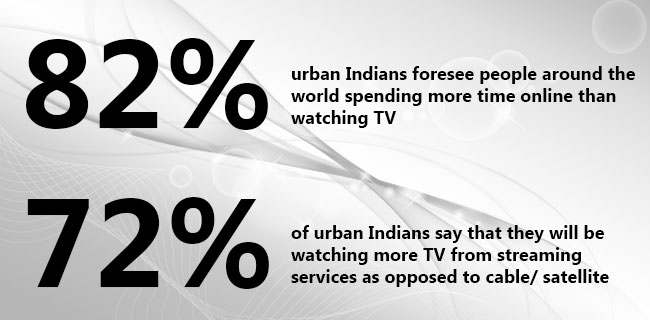
    82% urban Indians foresee people around the world spending more time online than watching TV (78% of the global citizens polled, hold a similar view); at a personal level, 72% of urban Indians say that they will be watching more TV from streaming services as opposed to cable/ satellite or over the air (half of global citizens (50%) too cite similar preference this year). There is over estimation seen for self-driving cars among urban Indians – 61% per cent urban Indians predict, self-driving cars (autonomous vehicles) will be usual sightings on the streets of their cities (only 36% global citizens foresee this happening). Almost half of urban Indians (48%) predict a re-election for Donald Trump as the President of the United States (35% of global citizens too feel the same). 37% urban Indians believe aliens will descend on Earth (only 15% of global citizens believe it will happen so), this year.


    Top concerns of 2020


    Global warming is top concern. 78% urban Indians worry that average global temperatures will further soar in 2020 (77% global citizens too predict the same); 46% urban Indians fear major stock markets around the world to crash in 2020 (35% global citizens too fear); 4 in 10 Indians are apprehensive of a terror strike in 2020 (32% global citizens too); half of urban Indians (52%) dread a natural disaster taking place in 2020, that will impact people in their own town/ city (3 in 10 global citizens too fear); over half of urban Indians (55%) fear large scale public unrest (protests & riots)  taking place in India, in 2020, to rebel against the way the country is being run (56% global citizens too predict unrest in their countries, for poor governance); 69% urban Indians foresee traffic situation in their area to worsen  (58% global citizens have a similar concern around traffic in their area); 4 in 10 Indians (42%) fear one of their online accounts (email, social media or banking) will be hacked in 2020 (37% global citizens have a similar concern).  Half of urban Indians polled (50%) fear feeling lonely most of the time in 2020. Only 3 in 10 global citizens (33%) are likely to feel lonely.


    Personal goals


    90 per cent of urban Indians polled consciously want to make personal goals and resolutions in 2020, to focus on specific things for themselves and for others. Interestingly, 76% of global citizens too want to operate this way, in 2020!  46% urban Indians say they will reduce screen time for social media, this year. 27% global citizens too want to spend less time on social media, this year.


    Reflections – Circa 2019


    Verdict pronounced: 2019 fell short on expectations, for the country as well as for the citizens themselves, at a personal level.

    Year 2019 turned out to be a disastrous year for India, feel 61% of urban Indians polled. 65% of global citizens too feel that 2019 was horrible for their countries.

    Personally too, 2019 did not delight Indians (58%) or global citizens (50%), it was a rocky year for them and their families.


    Methodology


    These are the findings of the Global Advisor Wave predictions survey for 2020.  In total 22,512 interviews were conducted between 26th November–6th December 2019, among adults aged 18-64 years in the US and Canada, and adults aged 16-64 years in all other markets.

    The survey was conducted in 33 markets around the world including India via the Ipsos Online Panel system.


  • Ipsos unveils new identity

    By A Correspondent


    Market and opinion research company Ipsos revealed a new brand identity and campaign that focuses on the companies and organisations’ need for reliable data and knowledge-based decision-making.


    Said Didier Truchot, Ipsos Chairman and CEO: “In our world of rapid change, the need for reliable information to make confident decisions has never been greater. At Ipsos we believe our clients need more than a data supplier, they need a partner who can produce accurate and relevant information and turn it into actionable truth. This is why our passionately curious experts not only provide the most precise measurement, but shape it to provide true understanding of society, markets and people. To do this we use the best of science, technology and know-how and apply the principles of security, simplicity, speed and substance to everything we do. So that our clients can act faster, smarter and bolder.”


  • From ‘Child Focused’ to ‘Me Focused’


    A typical Indian mom conjures up images of sacrificing oneself to the role of motherhood. Cut to Circa 2018, Ipsos study christened ‘Mothering Excellence’ shows that the Indian and Asian mothers are turning ‘Me Focused’ from being ‘Child Focused’ in their quest to be role model moms.


    Ashwini Sirsikar

    Ashwini Sirsikar, Country Service Line Head of Ipsos UU (Qualitative Research division) sees a shift 2018, from 2015, when the study was last undertaken: “With the mom playing a more active and assertive role, she wants to be the best version of herself, in all her roles, including that of being a mom. So, being a good mom is about being her best self. Along with her family’s happiness she is focusing on her own happiness, fulfilment, identity and strengths and this positive mindset is a shift from the conventional role of the mother who always puts the family first.”


    Further the study shows, there is a stronger expression for the need of freedom, experimentation and exploration as moms. The conscious need to make the experience of being a mom enjoyable. We see more digitally savvy moms. They are focusing on developing kids as individuals (in their own right), at the same time looking at a life beyond being a mother and a caregiver. Interestingly, we see a backlash to the pursuit of domination, advantage and competitiveness; the need to have overperforming kids still exists, but the practice of using privilege, money or power is increasingly rejected. A level playing field is desired by all.

    The study provides an insightful overview of the trends and scope around the topic of mothering motivations. The contemporary insights around mothering provide marketers the opportunity to review their market, brand and category strategy and communication, in this context to arrive at the right brand positioning. Ergo, it unravels consumer centric motivations for brand inputs.

    Mothering Excellence is a qualitative study undertaken to understand mothering motivations of Asian Moms and was carried out in 11 Asian markets (India, Japan, China, South Korea, Malaysia, Indonesia, Vietnam, Singapore, Thailand, Taiwan, Philippines). It was a comprehensive study conducted via social listening (we looked at conversations around mothering on social media sites), netnography (where we zoned in on high traffic websites specific to each market, to understand the themes and conversations), spoke to experts like marketers, communicators, nutritionists, pediatricians, counsellors etc. and brainstormed with internal resource of Dimensionalizers (senior qualitative research staff, who are mums themselves). While the foundational work of the study was done in 2015 to derive core motivations and themes, it was reviewed in the fag-end of 2018, to monitor the shift in manifestations and expressions of mothers and their mothering motivations. This study is the update.

    Added Sirsikar: “While the core motivations do not undergo changes easily year on year, we believe the manifestations and expressions are always dynamic and do change and provide us rich inspiration to ensure our engagement with mums stays fresh and contemporary.”


  • Ipsos hires Vivek Gupta as MD

    By A Correspondent


    Vivek Gupta

    Ipsos has hired Vivek Gupta from Kantar to steer its Mumbai business. Gupta will be designated Managing Director and will report to Amit Adarkar, CEO, Ipsos India.


    Gupta’s role will mainly focus on managing and growing all Mumbai-based client relationships, though he will be closely involved in strategy formulation and implementation for other geographies.


    Amit Adarkar

    Said Adarkar: “Donning an archetypical business head’s hat, Gupta will be aggressively going after lucrative, new accounts and servicing existing large accounts with attentiveness and detailing, underscoring Ipsos’ glocal strategy of providing global know how and backing with local depth of knowledge and sectoral experience.”


    Gupta has worked for most part with Kantar and IMRB in different capacities. And has also held positions with GFK, DDB Mudra and Ogilvy & Mather (O&M).


  • Patanjali is #4 in Ipsos’ India’s Most Influential Brands study


    By A Correspondent


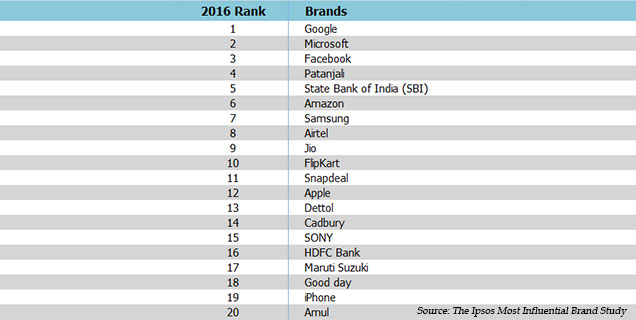
    Global research company Ipsos has unveiled its now annual Top 20 Most Influential Brands in India for 2016.  Google occupies the number one position followed by Microsoft and Facebook at number two and three respectively. Homegrown brands, Patanjali and Jio make an entry into the Top 10 ranked at fourth and ninth place respectively showing the enormous amount of influence that these brands wield in a short span of time. Both brands did not figure in the previous edition of the study.


    Among the Top 10 brands, Flipkart dropped three spots to take the tenth place while Amazon climbed a couple of steps to take the sixth place. Leading bank State Bank of India, which has been on a consolidation mode, move up four ranks to take the fifth place and is the only financial brand in the top 10.


    The Ipsos Most Influential Brand Study evaluates 100-plus brands across 21 countries and involved 36,600 interviews. In India the research covered more than 1,000 Indians online to assess 100+ brands.


    Said Parijat Chakraborty, Executive Director, Ipsos Public Affairs & Loyalty: “The Most Influential Brands are larger than life. They are aspirational. They enhance our lives – make it better. We trust these brands. We connect with them emotionally and cannot imagine our lives without them – they are influential”.


    The goal of the study, notes a communique, is to define and measure influence; to rank brands according to their influence within each country; rank brands according to their influence globally and identify what factors explain or drive the current level of influence for each of the brands at the country level and at the global level.


    Adds a communique:

    “It is important to note that the Ipsos study has measured the biggest, most well-known and/ or highest spending brands only. As a result, the Ipsos Most Influential Brand Study did not look at the entire market.

    “Interestingly, all brands that have featured in the Most Influential Brands List are those that consumer engages with on-a-daily-basis; a constant companion; an extension of consumer – Google, Microsoft, Facebook, Patanjali, State Bank of India, Amazon, Samsung, Airtel, Jio and Flipkart – if we look at the Top 10 list.

    “Next 10 – 11 to 20 too echoes the same story – these brands help the consumer define themselves better –  Snapdeal.com, Apple, Dettol, Cadbury, Sony, HDFC Bank, Maruti Suzuki, Good Day, iPhone and Amul.”

    “It’s impossible for consumers to imagine their lives without these brands.  The formula for success of Influence rides on those 5 pillars of trustworthy, engagement, leading edge, corporate citizenship and presence, “added Chakraborty.


    About the Ipsos Most Influential Brand Study (as per a communique):

    All data was collected via online panels by Ipsos across 21 countries and involved 36,600 interviews. In India the research covered 1,000 Indians online to assess 100+ brands.

    The sample is reflective of population where possible via online methodology. Within each country data is weighted back to either census population or the online age population where the representation of age groups online is skewed to younger population.

    At the Global level, countries are assigned a weight based on GDP, with higher GDP countries having a greater impact on the global influence score.

    A factor analysis was conducted using the 57 statements in the questionnaire and a total of six factors were revealed from this analysis. One of these factors contained 11 statements and was clearly the “Influence” factor. The average score across the 11 statements in the Influence factor was defined as the Influence Score for any given brand. The score was then converted to an index by dividing by the average Influence Score across all brands, multiplied by 100.

    The five remaining factors were used as attributes to help explain what makes each brand influential (as it varies from brand to brand). These five factors are: Leading Edge, Corporate Citizenship, Trustworthiness, Presence, and Engagement.


    What builds influence? How do some brands stand out from the rest? The Ipsos Most Influential Brands study shows there are five key factors that are the building blocks of influence.Trustworthy: Influential brands are trustworthy – consumers trust their message, proposition – that faith leads to consumption, patronage & relationship.

    Engagement: Influential brands engage with consumers across different consumer touchpoints. Consumers love them and want to stay connected. Brands stay relevant and constantly innovate to keep the relationship going.

    Leading Edge: They are model brands – iconic – they don’t toe the line, they are leaders – they stand out and define new paradigms – they grow the category – others emulate them and derive inspiration from them.

    Corporate Citizenship: Influential brands give back to society. Consumers patronize them as they are socially more responsible. It’s built in their ethos. Driven from the top.

    Presence:Influential brands play it big. They have astronomical marketing spends – are visible across consumer touch points with inspiring communications, visuals, adverts that are highly impactful, generating a strong consumer pull. It all hinges on placement, promotion and people.


  • Hansa, Ipsos to jointly bid for IRS in ’13, sign MoU

    By a Correspondent


    Hansa Research and Ipsos have entered into an MOU to jointly bid for the new Indian Readership Survey (IRS) contract that starts with IRS 2013. Hansa Research has been conducting the IRS, the world’s largest continuous readership survey for the last nine years i.e. since IRS 2003. This joint bid will combine Hansa’s extensive experience of readership measurement in the Indian context with Ipsos’ global expertise of conducting readership surveys in 60 countries. Through the joint participation, the two companies expect to make a very strong and forward looking pitch for the new IRS contract.


    Mr Ashok Das, Managing Director, Hansa Research Group said: “We are happy and excited to work with Ipsos on this prestigious project, and hope to bring in a number of new ideas into the IRS.”


    Mr Mick Gordon, CEO of Ipsos inIndiasaid: “We are delighted to be working with Hansa on this very exciting project and we hope we can persuade RSCI that our combination will be a very big plus for the industry. Ipsos measures readership in more than 60 countries around the world and has made a name for itself in introducing many innovations into this specialist area of market research – we were the first to use CAPI and DS-CAPI in readership measurement, for example. We believe we can add significant value to Hansa’s proven expertise and experience on the ground in India.”


    Speaking to MxMIndia, Mr. Suresh Nimbalkar, Senior Vice President, Hansa Research Group Pvt. Ltd said that the reason Hansa decided to join hands with Ipsos was to offerIndiathe best possible IRS. “We want to deliver the best possible product and we are working forward to it. We started people meter, IOS, we have continuously innovated and besides we have had a long standing relation with Ipsos. There is synergy between the two and so we decided to collaborate, rethink all aspects of IRS and offer an even better product (IRS) whether in technology, talent, and so on.”


    Hansa Research is a global full service market research agency headquartered in India, conducting market research in 77 countries with offices in India and US. Over the last few years, Hansa has developed sound mechanisms to reduce fieldwork related issues that has been widely acclaimed by research users for its ability to minimize some long standing industry weaknesses.