Tag: IPL 5

  • Where the economics stand for 4 key stakeholders post IPL’s fifth season

    By Ravi Teja Sharma


    Beyond the brawls and the bustups, there was cricket. And business, which became steadier and better. As millions continued to watch the cricket, IPL 5 strengthened the league’s business credentials.


    Franchises

    Their costs are mostly fixed and they are squeezing more out of each revenue stream. In the humdrum of IPL3, the operative word was ‘valuation’. The then-IPL chief Lalit Modi proudly announced two new franchises, Kochi at $333 million and Pune at $370 million.


    In other words, Pune’s owner, the Sahara group, was paying 3.3 times the priciest original franchise (Mumbai, $112 million), setting a new benchmark for valuing a team.


    More insanity followed: Modi was dismissed by a tweet, Kochi imploded, and Sahara had second thoughts about its $370 million investment. Sanity returned in season five. “Initially, it was more about valuations, not viability,” said Venky Mysore, CEO of the Kolkata team. More than any other season, IPL 5 has been about viability.


    Not of the surviving kind, but of the thriving kind. “For the first time, most of the franchises will be financially better off,” said IPL commissioner Rajeev Shukla.


    “Many have become profitable after IPL 5.” Like Kolkata. “We reduced our combined losses by about 50 per cent in IPL 4,” said Mr Mysore. “This year was equally good or better than last year…we should wipe out the remaining losses.” Chennai and Delhi say they have been profitable since season three, and that this year was better.


    The economics for a franchise are simple. Every franchise incurs two kinds of costs, and both are essentially of a fixed nature: the licence fee and player costs.


    For a metro franchise, the licence fee is around Rs35 crore a year, while the player cost is Rs55 crore. Add sundry expenses, and a franchise is looking at total costs of Rs100-120 crore. On the revenue side, there are essentially three revenue streams.


    The biggest revenue contributor is the ‘central pool’. All the money the BCCI raises by selling broadcasting rights and sponsorship goes into a common pool. The BCCI keeps part of this and distributes the rest among teams.


    With the BCCI negotiating hard with the broadcaster and sponsors, each franchise’s share of the central pool has steadily increased-from Rs29 crore in season one to Rs40 crore in season four.


    “The central payout will increase to Rs 50-60 crore this year,” said Mr Shukla. The franchises have no control over the central pool. They do have control over the other two main revenue streams: ticket sales and sponsorships, from where the good franchises raised, on an average, Rs30 crore and Rs30-40 crore, respectively.


    In both these areas, IPL-V saw the franchises, with one eye on growth and another on the bottom line, pushing new levers. Teams say they increased ticket prices and reduced the number of passes, and consequently made more.


    “Gate collections in season five would have doubled compared to earlier years,” said Rakesh Singh, joint president, India Cements, the South-based cement company that owns the team, without giving specific numbers.


    Amrit Mathur, CEO of the Delhi team, too declined to share numbers, but described ticket sales as “phenomenal”. “We limited passes only to our contractual agreements,” he said. What teams did more was to reach out to the paying fan.


    Kolkata, for example, had 10 cars going around the city and doubling up as ticket counters. The team also did corporate sales to fill up the 80,000-seater Eden Gardens.


    For next year, it is looking to convert some of those seats into hospitality boxes, whose revenue potential is 20 per cent more. Teams earned more from sponsors too by selling advertising on 10 designated spots on a player’s uniform.


    “We expect it (sponsorship revenues) to be 50-75 per cent higher than year one,” said Mr Mathur. Chennai’s strategy was to cut back on sponsors. “We wanted to clear the clutter and charge more instead,” said Mr Singh of the Chennai team, whose sponsors include Aircel, Gulf, LifeOK, Amrapali and Usha.


    Some other nascent revenue streams are gaining ground, like merchandising. “About 10-12 per cent of our revenues this year came from licensing and merchandising,” said Colonel Arvinder Singh, COO of the Punjab team. And the Delhi Daredevils is looking to lend its name to sports bars, the first of which has come up at the Delhi airport.


    For teams owned by corporates, in addition to a tangible payback, there’s also an intangible one for the main business. For example, all the branding on the Bangalore players is from the liquor and airline brands owned by team owner Vijay Mallya.


    “That has been our main priority,” said Russell Adams, vice president-commercial operations for the Bangalore team. Similarly, India Cements has used IPL to drive into markets other than the South.


    Besides the visibility from player jerseys, it has been wooing cement traders in cities in Gujarat, Madhya Pradesh and Rajasthan with a package of an IPL match in Chennai and a pilgrimage to Tirupati.


    “This was a masterstroke for us: to enter a market dominated by biggies like Ultratech,” said Mr Singh. It all contributed towards viability-of the long-term kind. And valuations, today, stand forgotten.


    Broadcaster

    Viewership addition tapered, but it’s still a critical mass watching. There’s pressure on two of the numbers that matter for SET Max. According to TAM, which tracks TV viewership, the number of people who tuned into IPL grew just 0.4 per cent this year, against 12.9-19.8 per cent in the previous ones. And they watched less.


    If they saw 4.5 per cent of all the minutes they could have in the first three years, they saw 3.5 per cent in 2012, the same as in 2011. Or, a TVR (television viewership rating) of 3.5 per cent. That said, even a TVR of 3.5 per cent is top draw, more so if it comes with a reach of 162.9 million.


    “No programme will give the pan-India reach that IPL does for two months,” said Nandini Dias, COO of media-buying house Lodestar Universal. It is why, she added, SET Max commands a 60-70 per cent premium in pricing over another programme with an identical TVR.


    This year, SET Max charged Rs5 lakh per 10 seconds, the same as in 2011 and 150 per cent more than in 2008. “Ratings fell, but we did not drop our price,” said Rohit Gupta, president of Multi Screen Media, which runs SET Max. Mr Gupta declined to disclose revenues, though he admits it is “lower than 2011”.


    A senior official from the channel, not wanting to be named, said revenues from IPL-IV crossed Rs1,000 crore, against Rs800 crore in IPL 3and Rs260 crore in IPL 1. SET Max’s original deal, struck in 2008, was for $1.02 billion (about Rs 4,000 crore) for 10 years.


    This was revised in 2009 to $1.64 billion (Rs 6,560 crore) for nine years. When the number of matches increased from 60 to 74, in 2010, this number increased further, said Mr Gupta, on a “pro-rata basis”. Back-of-the-envelope calculations show the current deal would be for about Rs 8,000 crore and that SET Max needs an average of Rs 1,050 crore a year over the remaining five years to break even.


    “IPL has become a brand that is big enough to sustain for many more years,” said Piyush Pandey, executive chairman of Ogilvy & Mather India. Added Ms Dias: “If IPL remains in the top five programmes through the coming year, it could still command its 60-70 per cent premium.”


    The other broadcaster, Times Internet, which owns the rights for international broadcast, Internet, mobile and valueadded services, and radio, expects to break even this year. According to CEO Rishi Khiani, Times Internet is paying Rs 67 crore a year to BCCI.


    It reached 26 million viewers this year-an increase of 55 per cent over 2011. “If you sell it right, there is an opportunity,” said Mr Khiani.


    Sponsors

    They got their bang, in different ways. For more, they will likely have to pay higher. IPL’s main sponsors only have good things to say about their pricey tie up. The established talk about reaching a wider audience.


    “We were well-known in the north, but now have spread awareness in other parts as well,” said Rajeev Talwar, group ED at DLF, which paid Rs 40 crore a year for the title sponsorship. The fledgling talk about IPL as the main piece of their brand strategy.


    Karbonn Mobiles started in 2009 and tied up with IPL in 2010. Sashin Devsare, ED, said IPL put Karbonn “in the consideration set of a mobile buyer.” Likewise, Volkswagen, which came to India in 2007.


    “We needed to raise brand awareness,” said Lutz Kothe, head of marketing and PR, Volkswagen Passenger Cars. “All these sponsors would have got five times worth exposure for every rupee spent,” said Hiren Pandit, managing partner with media-buying agency Group M.


    “But over a period of time, that exposure becomes a blind spot if there is no other engagement.” For example, Vodafone used ad campaigns to push specific business ideas: ‘happy to help’ in 2008, the Zoozoos in 2009 and 2010, 3G in 2011, and Internet services this year.


    In contrast, DLF was content being the title sponsor and having an on-ground presence. All sponsorship deals are due for renewal.


    “Most were done on an anticipated performance of the league,” said Basabdutta Chowdhury, CEO of Platinum Media, a unit of Madison World. “Now that it has a proven record, BCCI would be looking at higher value.” The season of BCCI hardball is beginning.


    Promoter

    BCCI’s golden goose is IPL and it is making it work overtime. Just how important the IPL is to the entity that runs cricket in India can be gauged from one statistic. In 2010-11, the IPL accounted for 48 per cent of the revenues of the Board of Control for Cricket in India (BCCI).


    Add revenues from the Champions League Twenty20, which owes its existence to the IPL, the figure shoots up to 60 per cent. IPL is BCCI’s golden goose, and the board is making it lay as many eggs as it can.


    This means birthing new revenues streams by adding more dates to a packed cricketing calendar or earning more from existing streams by negotiating hard with those who want a piece of the IPL. Both have yielded smart financial payoffs for the BCCI.


    Thus, in 2009, was born the Champions League, which essentially gives the BCCI and the top four IPL finishers a revenue kicker. The same year, BCCI renegotiated the TV deal with Set MAX and squeezed out 78 per cent more.


    In 2011, it added two teams to the IPL (one has since folded) at a valuation that was about thrice the maximum from the initial lot in 2008. Overall, the number of matches increased, which translated to higher TV and sponsorship revenues.


    The BCCI earned more. So did the franchisees, as the BCCI shares some part of its broadcast and sponsorship revenues with them. BCCI’s ‘surplus’-the equivalent of a corporate net profit-has increased from Rs 11.6 crore in 2008 to Rs 118.8 crore in 2010.


    Numbers for the last two years are not available, though the BCCI had forecast a surplus of Rs 209.9 crore for season four.


    “BCCI revenues have gone up,” is all that Rajeev Shukla, commissioner of IPL and vice-president of BCCI, is willing to disclose. Revenues could increase further as all sponsorship deals are due for renewal now. And even as it says it will address scheduling concerns, the BCCI has allowed all franchisees to play three T20 matches with teams from tier-II cricketing nations like Canada, the US, Netherlands and Ireland.


    “This will spread awareness about IPL and improve the league’s reach next season,” said Mr Shukla. And also improve the BCCI’s financial health.


    Source: The Economic Times
    Copyright © 2012, Bennett, Coleman & Co. Ltd. All Rights Reserved

     

  • Vodafone, Pepsi & Kingfisher most recalled brands in IPL 5: Ormax

    From the MxM Infodesk


    The top recalled brands during IPL 5 are Vodafone, Pepsi, Kingfisher, Volkswagen and Hero, according to the findings released by Ormax Media’s Cricket Advertising Recall & Effectiveness research – Day After Cricket (DAC),


    The last week of IPL 5 however saw Pepsi lead the recall charts, touching a score of 44% on Unaided Recall, the highest achieved by any brand this season.


    Volkswagen and Kingfisher were the only brands which feature among the Top 10 brands in terms of both Unaided Recall and Ad Likeability.


    The Top 3 most liked ads were: Gems – Raho Umarless, Sprite – Raasta Clear Hai and Mazaa – Har Mausam Aam. Interestingly, none of these three campaigns featured a celebrity.


    The most recalled innovation sponsorship asscoation recalled was Karbonn Kamaal Catch. DLF Maximum Sixes and Vodafone Star Of The Match are a distant no. 2 & 3.


    IPL 5 Top 10 Brands Recalled

    Rank

    Brand

    1

    Vodafone

    2

    Pepsi

    3

    Kingfisher

    4

    Volkswagen

    5

    Hero

    6

    Coca-Cola

    7

    DLF

    8

    Idea

    9

    Nokia

    10

    Tata Docomo


    IPL 5 Top 10 Most Liked Campaigns

    Rank

    Brand

    1

    Gems

    2

    Sprite

    3

    Mazaa

    4

    Volkswagen

    5

    Cadbury’s Dairy Milk

    6

    Yatra.com

    7

    Kingfisher

    8

    Mountain Dew

    9

    Lays

    10

    Slice


    Day After Cricket is a consumer based day-after recall study, conducted among IPL viewers across six cities: Mumbai, Delhi, Bangalore, Hyderabad, Chennai and Kolkata. The TG for the study was Males 15-40 years and Females 15-34 years old.


  • Anil Thakraney: The BCCI has to be controlled

    By Anil Thakraney


    Constant readers of this blog might remember my post on IPL 5 when the tamasha had just gone underway. And in that post, I had spelt out various reasons why the tournament doesn’t interest me in the least. Now, I know it isn’t very nice to boast ‘I told you so’. And yet, on this occasion, I feel no hesitation in reporting that I had mentioned at the time that I would be mighty surprised if there was no match fixing going on in this cricket ‘fest’. I also recall saying that for the tabloid media, IPL is a goldmine for sensational stories.


    Don’t know if the India TV guys read my post or not, but their sting operation has confirmed my fears. Good story. The only little grouse I have with the channel is that maybe they went out with the story a bit too soon. Perhaps if they had been more patient and had cared to dig a little harder, they may have nailed some big fish too.


    To be fair, it isn’t entirely BCCI’s fault if some youngsters decide to sell their souls for some extra moolah. Surely the board cannot keep an eye on the activities of every single player. So perhaps we can’t slam only them for this scandal. The real question is this: What will the BCCI do NOW? Their future conduct will determine if they are serious about protecting the credibility of these games. They have to not just impose a life ban on the offenders (if proved guilty), the richie rich cricket board has to draw out powerful anti-corruption mechanisms to make sure the games are run cleanly.


    And this is where the problem lies. How can an organization that’s not answerable to anyone, that has been following dodgy practices as standard operating process all these years, be trusted to run clean and transparent games? Which is why I really think the government, through the sports ministry, must clamp down on their activities. To begin with, they must bring the BCCI under the RTI regime. Of course, this is going to be tough because a whole lot of netas are involved with cricket in India, but it simply has to happen. As long as the BCCI is run like a private party, a personal fiefdom of a chosen few, rats will keep crawling under their glitzy carpet.


    If the latest shameful expose doesn’t trigger massive changes in the functioning of the BCCI, nothing will. And yes, thank god I chose to stay away from the IPL. Imagine wasting so many man hours each day watching this nautanki, only to discover later that some players have been busy cutting private deals with freelance agents. Bollocks, mate!


    * * *


    PS: An interesting billboard created by JWT, London. The National Centre for Domestic Violence, through this interactive billboard, asks people to use their cell phones to drag an abusive man away from his partner. Folks can visit a website featured on the billboard, and click on that to remove the man. Good way to directly involve people on the issue of domestic violence. Wonder when India’s hoardings will get a little imaginative!


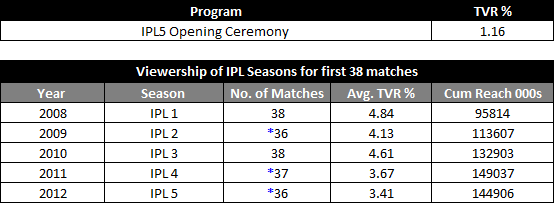
  • IPL 5: 38 matches later, ave TVR touches 3.41

    By A Correspondent


    The ratings for the first 38 of the Indian Premier League (IPL) season 5 continue to be lower than the previous seasons. According to TAM Sports, CS 4+, All India, IPL 5 delivered a TVR of 3.41 per cent in the 36 matches played so far during the tournament. Interestingly, media planners point out that one of the plus points of IPL5 is that it has been consistent in its ratings, which will lead to better ROI for advertisers.


    It may be recalled that first 27 matches of season 5 delivered a TVR of 3.53 per cent and the first 16 matches, a TVR of 3.65 per cent. The inaugural season (IPL1) however continues to remain the highest viewed season with a TVR of a whopping 4.84 per cent. Too much cricket in the past few months,India’s dismal ODI and Test match performance and too many matches in season 5 leading to cricket fatigue are said to be the possible reasons for the low ratings.


    Media planners believe that as the tournament progresses, especially towards the semi-finals and the finals, the ratings are expected to further increase. According to Mr Dinesh Vyas, GM, MEC India: “IPL 5 may have been receiving the lowest TVR as compared to the previous seasons, but it is also the only programme on television which has been delivering consistently. Therefore a TVR of 3.41 per cent for the first 36 matches is a good. In fact, now is the time that we will see more and more people viewing IPL matches and the ratings will only further increase.”


    Mr R Venkata Subramanian, Senior Director-Investments, MPG India was of the view that one of the plus points of season five is its consistency: “There has been consistency in the ratings which is certainly beneficial for advertisers however the numbers continue to be lower than the previous seasons. Despite some really good matches, the numbers have been low, probably because of too many matches leading to cricket fatigue. Nonetheless as the tournament progresses, I do expect the viewership to grow but, I don’t expect a dramatic increase.”


    Source : TAM Sports, Period : First 38 matches of all IPL Seasons, TG : CS 4+ yrs, Market : All India, Channel : MAX


    * In IPL 1 one match (47th) was abandoned due to rain
    * In IPL 2 two matches (7th & 13th)were abandoned due to rain
    * In IPL 4 one match (20th) was abandoned due to rain
    * In IPL 5 two matches (32th & 34th) were abandoned due to rain


  • IPL5 Week 1 TVRs touch new low, media planners say it’s still early days

    By A Correspondent


    Indian Premier League (IPL) season five kick started on April 4 amid speculations and fear that the season would fail to deliver high viewership. The recent TVR figures released by TAM Sports may have just proved the naysayers right.


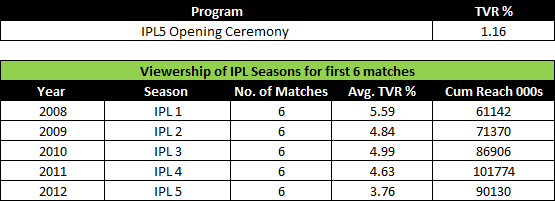
    According to TAM Sports, All India Market, CS 4+ years, IPL5 witnessed an average TVR of 3.76 per cent in the first six matches, which is far lower than the previous IPL seasons. The opening ceremony itself received a mere 1.16 per cent of the average TVR.


    While the IPL season five ratings for the first six matches is the lowest in comparison to previous seasons, the inaugural season (IPL1) continues to remain the highest viewed with a TVR of 5.59 per cent.


    Interestingly, the cumulative reach for the first six matches too have shown a slight decline in season five as compared to season four. The cumulative reach which has been on a rise since the inaugural season of IPL reached its peak in season four and thereafter in season five witnessed a slight decline.


    Mr Venkata Subramanian, Senior Director-Investments, MPG India is of the opinion that not only are the numbers positive but, also that the numbers will increase as the matches become more interesting. “These are initial ratings so the numbers are looking positive. As the matches continue to become more interesting, we can expect the ratings to also go up. Even if the TVR reaches 4.5 or 4.6 per cent, the delivery will be good not only because it is the fifth season but, also because of more number of matches.”


    According to Mr Janardhan Pandey, Associate Vice President, DDB Mudra, some drop in the reach numbers were expected owing to the poor Indian team performance during the last one year and the fatigue of cricket overdose amongst the viewers. However there is no cause for major worry. “I am of view that, as the game seems to be picking up well and with the onset of vacations, the numbers will improve. Also if the games progresses well, the reach numbers towards the second half of the series may be far better than anticipated. So over all it will deliver value, obviously there will always be standard deviation, after all it’s a huge sporting extravaganza.”


    The media planners are of the view that although IPL 5 may not come close to the season one ratings or even cross the season three ratings, nevertheless as the tournament progress the viewership will also increase. What remains to be seen is whether the ratings do improve or will it remain lower than the previous season?


    Source : TAM Sports, Period : Wk 14, 2012, TG : CS 4+ yrs, Market : All India, Channel : MAX

    This data is for First 6 matches of all IPL Seasons

    * In IPL 1 one match (47th) was abandoned due to rain

    * In IPL 2 two matches (7th & 13th)were abandoned due to rain

    * In IPL 4 one match (20th) was abandoned due to rain

  • Debrief: IPL: Chalta hai

    By Anil Thakraney


    Television is abuzz with the oncoming IPL 5 nautanki. And there are a zillion commercials on the air. Before I discuss the ads, can’t help but state that I detest this tournament. I always have and I always will. IPL adds little value to Indian cricket, but deducts a lot. Having got that off my chest, let’s get to the task at hand.


    The idea this time is pretty obvious: IPL brings the entire family together. There is no fresh consumer insight out here, the world and its father already knows that apart from the men in the house, aunties, bhabhies, toddlers and Moti, the dog, also like to watch this tamasha. With no sensational insight, it’s then left to the execution to hold the fort.


    [youtube width=”400″ height=”200″]http://www.youtube.com/watch?v=UXQsIgN_530[/youtube]

    I watched a few films, and must say that in general, the creative fails to shine. There is a little humour, a little emotion, a little slice of life, but on the whole the campaign stays in the average zone. Having said that, one particular commercial did appeal to me, and I found it quite funny. And so that’s the commercial I am linking out here. Also, because I am in a good mood today, I shall rate the entire campaign based on this one ad. It’s about two gents having to bond when they have absolutely nothing in common with each other, and are on a totally different trip. Good one. Haven’t we all been stuck in such situations? Yep, in such a scenario, despite all its shortcomings, indeed the IPL becomes god-sent!


    Rating: (On a scale of 1 to 5): 3. Humour not exploited enough.


  • Sony Max hits a chauka with IPL mauka

    By Rishi Vora


    Sony Max has unveiled a new marketing campaign for IPL season 5.

    A series of four TV ads currently running on air capture the pulse of the audience. The theme ‘Aisa Mauka Aur Kahan Milega’ uses various relations – father-son, friends and also relatives – making the case that IPL brings people together.

    JWT is the creative agency that has conceptualised the campaign.


    Neeraj Vyas, EVP and Business Head, MAX said, “We set out to create a unique piece of communication for a very unique property, which is the DLF IPL. We at MAX are proud to bring our viewers the ‘mauka’ to enjoy DLF IPL 2012 and we are certain that our communication campaign ‘Aisa Mauka Aur Kahan Milega’ will only take the this tournament to greater heights. The films capture the one emotion that binds our country – the undying passion for cricket everywhere.”


    Gaurav Seth, Marketing Head, Sony Max said, “We do a lot of consumer research to gauge the reactions of our audiences. So post IPL 4 we conducted a research with Ormax Media and what we found out was that a lot of people thought IPL was an ‘opportunity’ (mauka, which is the campaign theme) for the whole family to come together (even though they’re not very comfortable together as the ad highlights). Similarly, we found that a lot of kids watch IPL as they have their vacations at that time of the year. Our father-son commercial captures that insight very well, where the son gets a mauka to remind his father that he should go to sleep and not watch IPL as he has office next day…and the commercial where two friends find a mauka to bunk work.”


    The TV campaign started on Feb 23. Besides TV, Sony Max will do Press, Outdoor, Radio, Activation in malls, Digital etc. Print campaign will start as the launch date nears, alongwith Radio.


    “This year you will see a very large amount of noise being created by all stakeholders of the IPL – the franchises and the BCCI. As far as our campaign goes, it’s a complete 360 campaign. We will close our deals with various media service providers next week. I’m sure that IPL will be the most talked about event on TV with all the campaigns running in full swing,” he added.


    The channel has not announced exclusive media partnerships as it aims to broadbase its reach across demographics and geographies in India.


    [youtube width=”320″ height=”200″]http://www.youtube.com/watch?v=ZGgIO6MhwLA[/youtube] [youtube width=”320″ height=”200″]http://www.youtube.com/watch?v=cEjEYmEWhoA[/youtube]
    [youtube width=”320″ height=”200″]http://www.youtube.com/watch?v=UXQsIgN_530[/youtube] [youtube width=”320″ height=”200″]http://www.youtube.com/watch?v=XdDFD08QNpo[/youtube]


  • The Day After Cricket – Ormax survey of viewer recall

    By A Correspondent


    Ormax Media has announced the launch of the 3rd edition of its Cricket Advertising Recall & Effectiveness research – Day After Cricket (DAC), for brands advertising on IPL 5. DAC was launched in 2010 for IPL 3. In 2011, the research was conducted for IPL 4 and the Cricket World Cup.


    Day After Cricket research has two components. The first one involves day-after tracking, available as bi-weekly syndicated reports to advertisers and media agencies over the seven-week long duration of the tournament. This phase of research will be conducted across the six metros, covering more than 2100 IPL viewers over the course of the tournament.


    The second phase of DAC is post-event research customized to the brand’s requirements and target audience. In this phase, the impact of IPL on the brand’s equity will be determined, by measuring the difference in the performance of the brand on key attributes amongst viewers and non-viewers of the tournament. An advertiser can opt for either or both phases of the research, depending on its objectives.


    Speaking about DAC, Shailesh Kapoor, CEO – Ormax Media, said, “From a research perspective, there are two key deliverables in big ticket cricket advertising – Recall & Equity Impact. Recall needs to be monitored to understand if the brand has managed to stand out in the clutter. Equity Impact is the long-term influence of the campaign, measured in a way that nullifies the role of all other media or promotions, thereby isolating the specific impact of IPL on the brand.”