Tag: IPG

  • Sony Pictures acquires rights for Lanka league

    By Our Staff


    Sony Pictures Networks India (SPN) has returned as a broadcast partner for the second edition of Lanka Premier League (LPL). The network has signed an agreement with the official franchise and broadcast holder of LPL – the IPG Group. The agreement between Sony Pictures Networks India and the IPG Group includes the television and digital transmission of the LPL, which is set to be played between December 5, 2021 to December 23, 2021.


    Said Rajesh Kaul, Chief Revenue Officer, Distribution and Head – Sports Business, Sony Pictures Networks India: “The appetite for cricket in India is huge and our aim is to bring the best of international cricketing action to our fans in India. With the onboarding of Lanka Premier League, we want to provide our viewers with some high-energy T20 cricket throughout December. Sri Lankan Cricket has always produced many world class players and the inclusion of top international cricketers like Chris Gayle, Andre Russell and Faf du Plessis among others is contributing to the growth and popularity of Lanka Premier League in the subcontinent. As the league gathers more fans, we want to make sure that no one misses the best of T20 cricket in India on our sports channels.”


    Added Anil Mohan, Founder and CEO of Dubai-based production giant IPG, the official promoter of LPL: “We are ecstatic to welcome Sony Pictures Network as a broadcast partner to the Lanka Premier League once again. Sony Pictures Networks has always been at the forefront of sports broadcasting in India and takes sports to every corner of India. We are confident that Sony will achieve an even higher reach in terms of audience in the upcoming season and we look forward to a long and fruitful association.”


  • Team Dynamic wins communication pitch for BMW

    By Our staff


    IPG has announced that Team Dynamic has been named the integrated communications partner for BMW India. The mandate includes lead creative, digital services and studio production. Team Dynamic is a bespoke IPG solution created for BMW India, with regional resources drawn from across the IPG portfolio.

    Said Simon Bond – SVP, Chief Growth Officer, Interpublic Group: “We continue to be proud of our partnership with BMW, and are excited that we are able to expand our relationship with this iconic brand in India, a key strategic growth market for the premium car segment. Much like the BMW brand, Team Dynamic is committed to the very highest quality.”


  • For Real or Bunkum? Dentsu Aegis Networksays it’s #2 agency group. But industry dismisses claim


    By A Correspondent

    For nearly a year Ashish Bhasin, Chairman and CEO of the Dentsu Aegis Network South Asia, has been saying that he is working towards DAN being the #2 agency network in the country. What Bhasin hasn’t spelt out in so many words on record is that he is looking at making DAN as second only to the WPP group, and displacing IPG, short for the Interpublic Group.

    Earlier today (Wednesday, Feb 15), we received a mail from the corporate communications team at DAN with a communique making the claim. On record, via a communique. This is a claim that has been dismissed by many in the industry who MxMIndia spoke with as one without any basis. MxMIndia hasn’t looked at the numbers directly and we weren’t able to get official numbers to prove or reject the claims.


    List of Companies/Brands within IPG & DAN

    (as per information received from the communications teams of two groups) 

    INTERPUBLIC GROUP (IPG)

    1. Lodestar UM

    2. Initiative

    3. Interactive Avenues

    4. Reprise

    5. Rapport

    6. Ansible

    7. Magna Global

    8. Mullen Lintas

    9 Lowe Lintas

    10. LinOpinion

    11. dCell

    12. LinConsult

    13. LinEngage

    14. GoLinOpnion

    15. LinProdcution

    16. Linteractive

    17. McCann WorldGroup

    18. MRM/McCann

    19. Momentum

    20. McCann Health

    21. Craft

    22. Weber Shandwick

    23. FCB Ulka

    24. FCB Interface

    25. FCB Interactive

    26. FCB Healthcare

    27. FCB Cogito Consulting

    28. FCB Asterii

    29. FCB Aquila

    30. FCB Neon Brand PR


    DENTSU AEGIS NETWORK (DAN)

    1. Carat

    2. Vizeum

    3. Dentsu Media

    4. iProspect

    5. Isobar

    6. WAT Consult

    7. Taproot Dentsu

    8. Dentsu Webchutney

    9. Dentsu Impact

    10. Dentsu One

    11. Posterscope

    12. Brandscope

    13. Ambient

    14. Hyperspace

    15. Milestone Brandcom

    16. The Story Lab

    17. Dentsu India

    18. Fountainhead MKTG

    19. Happy mcgarrybowen

    20. Perfect Relations

    21. Fractal


    But first let’s look at what DAN is claiming. Here are excerpts from the communique:

    Dentsu Aegis Network has entered the top two bracket of the Indian advertising space to become the # 2 Agency Group in India. With this, Dentsu Aegis Network has now overturned for the first time the existing rankings, which have historically been in place for over 80 years in this country.

    Despite being a late entrant in the Indian advertising space, Dentsu Aegis Network today is the fastest growing agency network for three years in a row. The group has steadfastly helmed some of the industry’s most successful acquisitions in the recent years includingthat of Milestone Brandcom, Dentsu Webchutney, Taproot Dentsu, iProspect (Communicate2), WATConsult, Fountainhead MKTG, Perfect Relations, Happy Mcgarrybowen and Fractal Ink. This has, in turn,not only helped it aggressively scale up its operations organically and inorganically in India but also expand itself to a 3000+ people network. It is pertinent to note here that the latest Fractal acquisition has now brought together a team of over 1,000 digital experts inside DAN, the largest in India, including the combined Isobar team and the existing network digital brands iProspect, WATConsult and Dentsu Webchutney.

    Meanwhile, with Posterscope and Milestone Brandcom under its umbrella, Dentsu Aegis Network is not just the leader but a dominant player in the OOH space in India. It is also home to the most sought-after creative agencies of the country, the biggest social media agency in India and has the most comprehensive marketing communication offerings under its unique One P&L philosophy.

    In the past year, Dentsu Aegis Network India took a huge leap with dramatic improvement in scale, making India a key contributor towards Denstu Aegis Network’s global revenue growth. While the business in India grew 300% of the market growth, the network went on to win some of the largest accounts in India, include Mondelez, Maruti (digital and creative), Carlsberg, Nokia, Microsoft, General Motors, British Airways, Allied Blenders, MasterCard, Sony, Hindustan Times, Panasonic and several other key accounts in the past two years. Digital business grew by 250% (industry average 30%) and OOH advertising by over 150% (industry average 6.1%). The network’s turnover growth stands at a 102% (Industry average 11%) while its revenue growth is over 100%.

    This is what Ashish Bhasin, Chairman and CEO Dentsu Aegis Network South Asia, said in the communique:  “We are delighted to have overturned 80 years of history. I stuck my neck out and publicly announced our ambition and my superb team worked hard and smart to deliver what then looked like an impossible target, well ahead of time. We will use the rest of 2017 to further consolidate our position because from here onwards the top slots of this industry are likely to be, more and more, a two-horse race… We have changed the paradigm in our industry and will continue to strive to ensure that we keep raising the bar to global standards as we march towards a Digital India.”

    The worry is that given that since none of the ad agency majors are listed, the numbers aren’t public. Also, the balance sheets filed with the Registrar of Companies are as of March 2016, and so current numbers aren’t official, but only on the basis of what DAN may present.

    Many observers and senior people in the industry we spoke with in the last few weeks and since this morning are wondering why DAN got into the numbers war, when they don’t really matter in advertising since one is looking at the quality of work. It’s almost like mine’s bigger than yours, said one CEO.

    We asked Bhasin on whether he needed to do it all. After all, the industry has taken note of the rise and rise of the Dentsu Aegis Network. It has been winning business steadily (at the time of writing, there is news that the group has also bagged the Maruti Media AOR aggregating around Rs 400 crore), and it’s no longer a poor cousin of the various agencies. Agreed it’s not won big in the media awards or the Effies, but in the creative awards, the agencies have been fairing well. So why make this claim, and get into a tu tu-main main?

    Bhasin says it was necessary as it was an impossible target he had set for himself and this was a celebration of the achievement. The big thing, he said as in the official communique, is that it has changed 80 years of ranking… It was exceedingly difficult, Bhasin told us given that DAN has started out late and with no major base.

    However, industry observers say that if you compare the work and revenues, it’s difficult to believe IPG is lagging behind DAN. The agencies of IPG – in the MullenLoweLintas Group, McCann and FCB Ulka still have big clients. And even factoring in the loss of a Maruti, Mediabrands is ahead of Carat and Dentsu Media.

    In terms of staffing DAN may be ahead given that digital typically is employee-intensive, but that we are told is not consequential.

    Our attempts to interact with the IPG group in India were unsuccessful as the group doesn’t have a collective leadership. However, we did speak informally to some senior to mid-level employees in the group as well as well as some independent observers, and they were dismissive of the claim. Not yet, and not for long is what we were told.

    Clearly, we haven’t heard the last of this war of oneupmanship initiated by Dentsu Aegis Network. The worry is whether in the process the agency business – which is already experiencing some rough weather – will be a loser. And will get used by marketers to be beaten down in margins and profits.


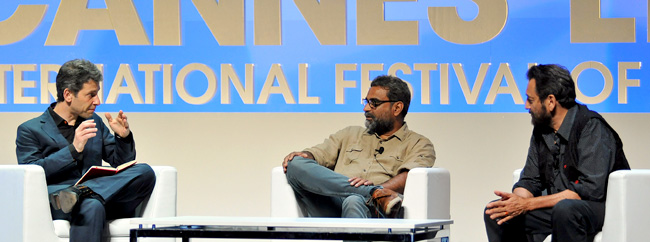
  • India@Cannes: Balki & Shekhar Kapur talk of how to do business in India


    By A Correspondent


    Shekhar Kapur

    One of the most exciting sessions on Day 3 of Cannes Lions 2012 – and not just for Indians – was the one by Lowe + Partners titled Global India. Oscar-nominated film director Shekhar Kapur and filmmaker and Chairman & Chief Creative Officer of Lowe Lintas, R Balki were in discussion with Wired editor David Rowan. On the seminar agenda was a look at the creative heritage of India and its influence on global culture and enterprise. This was the first time that Cannes Lions featured a seminar dedicated to Indian creativity and its global influence.


    Introducing the speakers, IPG Chairman Michael Roth stated that the session at Cannes was an indication of the importance of India in the global economy. Speaking of the growing importance and the shifting focus to India, Mr Balki said, “What has changed over the years is that earlier, India was judged globally. Today, India is the jury, be it the global products or ideas.” Talking about Indian creatives on a global platform he admitted that a lot of things don’t make any sense to the rest of the world. But he also pointed out that brands who have tried to implement global theory, have messed up in India. He said, “Global brands have to come to India selling like a local brand. Any global thought has to be highly ‘Indianised’ to be implemented in India. And, it’s a difficult job.” Mr Balki added, “If you want to know India, watch ‘The Story of India’ by Michael Woods.”


    R Balki

    Furthering Mr Balki’s point of an ‘Indianised’ idea, Mr Kapur remarked that India was a land of imagination. He said, “The West calls us melodramatic, we call it mythical.” He added that any idea to work in India has to be magically ‘Indianised’.


    Speaking on the impact of social media, Mr Kapur agreed that social media was set to change the way we live but not advertising. He also agreed that social media holds an opportunity for India and he said that the new real estate is the social media. He said, “Fifteen per cent of the world’s teenage population will live in India. So there will be a large number of consumers on social media. This will make us an influencing economy, if not a dominant economy.”


    Discussing his views on social media and its impact, Mr Balki remarked that social media currently in India is a one-sided communication, where we are expressing ourselves but not accepting messages. Talking about the Indian economy, Mr Kapur said that Indians needs to move from being job-makers to job-creators.


    Sharing tips for global brands entering India, Mr Balki said, “Stop looking at India as a market and you will succeed. And, let the Indians do the things in India.” Mr Kapur added, “When the West stops looking at India as a market and starts looking at it as a culture, they’ll make it there.”


  • Info explosion has made India smarter: ‘New Realities 3.0’ study

    By Robin Thomas

    The Interpublic  Group (IPG), one of the world’s premier advertising and marketing services companies, has come out with its global ‘New Realities 3.0’ study that provides a unique window into how the Indian consumer is coping with information overload. The study provides insights on the decision-making process of the consumer in today’s era of information explosion. The study also aims to answer the unanswered queries of marketers on whether the information explosion has made consumers smarter or confused, the role of social media in a making consumers more informed, the role of brand advocates and much more.


    The study covered five countries namely, India, China, Brazil, America (US) and Germany. The India leg of the interview was conducted by Draftfcb Ulka’s independent consulting agency, Cogito Consulting. Over 600 online interviews were conducted in each of the five countries between October 26 and November 10, 2011. Some of the findings from the ‘New Realities 3.0’ study reveal that most Indian consumers feel they have grown smarter with the available product information, which is higher than the other countries. Further, the study notes that consumers in India rated a reasonable 7.3/10 when asked whether the available product information made them feel smarter compared to China that showed a rating of just 3.9/10, the US at 6.8/10, Brazil at 6.4/10 and Germany reporting 7.0/10.


    Interestingly, despite consumers in India claiming to feel smarter and not confused or frustrated with the product information available to them, they do not trust the information they see on brands, especially from the manufacturers end. Further, 32 per cent of Indian consumers say they do not trust most of the information they see on brands, whereas 31 per cent say they do not trust information from manufacturers or providers.


    The trust deficit that brands have among Indian consumers is higher than the other four countries, for instance only 11 per cent of Germans say they do not trust any information from brands whereas 22 per cent say they do not trust information from manufacturers or providers. Even Chinese consumers seem to trust information from brands and manufactures as compared to the Indian consumers. 19 per cent of Chinese say they do not trust information from brands whereas 24 per cent Chinese do not trust information from manufacturers or providers. 16 per cent of those interviewed in the US say they do not trust information from brands whereas 15 per cent do not trust information from manufacturers.


    Another interesting finding is that with the exception of Germany, the remaining four countries interviewed – India, China, Brazil and United States have said that product learning is a source of joy and fulfillment. 54 per cent of Indians have said that they enjoy researching the information for buying decision whereas 52 per cent of them say they find the information on brands fulfilling.


    Terry D. Peigh

    The findings have also revealed that most Indians learn product information to build an expertise about a certain product and brand as well as because it helps them stand out in their social circle. 53 per cent of Indians said that the reason they stay informed about certain products is because ‘people value me and my knowledge about certain products’, whereas 52 per cent of them said it helps them enhance their self-esteem.


    In addition to these, the study also revealed that consumers in India and China are most likely to turn into brand advocates and become a media channel and that in India, Brazil and China, especially, social networking sites are a good source for word of mouth information on brand experience.


    As vague and unique as it sounds, MxM India’s Robin Thomas got Mr Terry D. Peigh, Managing Director and Senior Vice President, IPG to relay more outcomes from the study, the role of social networking sites in decision-making capabilities and much more.


    New Realities… is an online study across multiple countries, including India. What is the sample size that was chosen for this study? Who are the respondents i.e. the TG for this study?

    We interviewed 600 people in each country i.e. in India, China, Brazil, United States and Germany. Out of the 600 people sampled, one-third were Gen X, one-third were Gen Y and one-third were boomers. 50 per cent of those polled were men and 50 per cent women.


    What was the key objective of the study? What, according to you, are the learnings for the Indian market, as well as the global market?

    The key objective was to better understand how the consumer has changed because of the new media. We came across the idea years ago as we noticed that the number of information sources available to consumers today has grown exponentially. So we found out if people were confused, frustrated, overwhelmed, and how are consumers viewing the overall experience of absorbing product information and using that information.


    We learnt that consumers have evolved over the years and hence they are not confused or frustrated with the information explosion. Consumers have not only learnt to easily filter or absorb the information but, they have also learnt how to manoeuvre their way through all the multiple choices of product information available to them.


    We have also learnt that surprising number of consumers, especially from India, are now very open, willing and eager to learn about product information as they find a lot of joy and satisfaction in learning about product information. In fact, our research also shows that people in India are most likely to really enjoy research and product information.


    One of the reasons why many in India are willing or open to product information is because they find it of social value as it allows them to have an expertise in certain products. We have also learnt that consumers are aggressively willing to become advocates of brand. Our research also shows that they are now interested in continuing to learn about a product even after they have purchased a product as they want to learn more about the product and advance their knowledge about that product.


    What this reveals is that communication should not stop at the time of sale and that marketers must continue to talk to their consumers even after they have purchased the product. As a result marketers may convert their consumers to brand advocates.


    The study reveals that Information explosion in India has led consumers to become smarter and helped them beat the system – much higher than what the other countries have reported. What are some of the factors that influence the consumer’s decision-making process around a product?

    We see a dominant role of family and friends in a consumers’ decision-making process. Although social media is still small, its role as a channel is growing, but too often social networking sites are limited to ‘likes’ or number of friends which is wrong. It’s too easy to get someone to push the like button or accept a friend request, even though they may really not like the brand or want to be their friend. A research from Australia finds that less than one per cent of friends are actively engaged and want to be truly engaged to the brand. So we keep encouraging our clients to go beyond ‘friends’ or ‘likes’ on a social networking page but, instead seek true engagement.


    As India becomes more tech-savvy, do you anticipate further information explosion to come about that could lead to further increase or decline in consumers who are confused or frustrated with the information?

    We were, in fact, surprised that the confusion or frustration numbers were not higher. My projection, however, is that it (frustration and confusion) will not go up as consumers have learnt the role of technology very quickly. Technology is fast reaching to the lowest common denominator very quickly so, I think people are learning to process information very quickly.


    Will there be a Phase II of the ‘New Realities 3.0’ study?

    Yes. We will soon be out with the second phase of the study in another 18 or 20 months, which will help us understand more trends. In China, for instance, during Phase I and II we have seen dramatic changes in over 18 months. We found that the Chinese were much more inclined to use the internet for product research. In China, the internet was used primarily for entertainment purposes, now it’s used for product information.


    Not surprisingly, consumers in India do not trust brand information especially from the manufacturers. This is not so with other countries, particularly Germany, US and China. How would you explain this? What must brands / marketers in India do to build the trust deficit among their consumers?

    I believe it is because of the newness of the consumer culture in India. In the US, for instance, there has been a mass market of consumer culture for 100 years and the same in Western Europe. I think consumers need to develop trust for their products. Brands must not be afraid to enter into the world of social media and hearing negative comments about one’s brand. There is probably no quicker way to gain trust with the consumer than to actually legitimately and honestly respond to criticism and fix the problem. This, I believe, is one way for brands to gain trust of the consumers.


    With the exception of Germany all other countries seem to enjoy product learning. What makes the consumers in Germany not really enjoy product learning?

    Yes, German people usually do not associate joy from product information. The Germans usually get their joy from music and food


    How has social media changed consumers’ decision-making across the globe? What role do you see social networking sites play in the near future in India?

    The role of social networking sites as a tool for brand advocates will increase. One thing we have noticed in the western world is that the number of people visiting brand pages on social networking sites is on a decline in Europe. This is not the case in India. In the western world a lot of consumers say that they do not visit Facebook for brands, but for friends therefore, it will be interesting to see if it will be any different in the developing economies. Nevertheless brands like Coca-Cola have leveraged social media well by finding ways to reach out to the consumers by engaging in a good conversation and get them to participate in brand activities. Right now the data shows consumers are willing and eager to visit social media to learn about products or brands.


    Even though broadband penetration is still low in India as compared to the US, why are consumers in the US and Germany reluctant in using social media for product research?

    This may be because brands that first started using the social media didn’t do a good job in engaging the consumers. The consumers may have clicked ‘like’ or may have become friends but, the brand may not have received anything else. Brands must, therefore, learn to go beyond the ‘likes’ and adding of friends to adding value in a consumer’s life as the consumer is not accessing social networking sites for brands but for something else. Therefore, in order to leverage the social media, brands need to operate in a different way. Increasingly, many brands are beginning to use social media effectively to engage with their consumers.


    How do you plan to reach the brands or marketers with the study? What can brands or marketers expect from the study?

    This study is important for clients because it is consumer based, is fresh, is in-depth, is broad, it looks at many different segments by product category, by demographic and it is the consumer telling us what he or she is thinking about.