Tag: Interpublic Group

  • Team Dynamic wins communication pitch for BMW

    By Our staff


    IPG has announced that Team Dynamic has been named the integrated communications partner for BMW India. The mandate includes lead creative, digital services and studio production. Team Dynamic is a bespoke IPG solution created for BMW India, with regional resources drawn from across the IPG portfolio.

    Said Simon Bond – SVP, Chief Growth Officer, Interpublic Group: “We continue to be proud of our partnership with BMW, and are excited that we are able to expand our relationship with this iconic brand in India, a key strategic growth market for the premium car segment. Much like the BMW brand, Team Dynamic is committed to the very highest quality.”


  • For Real or Bunkum? Dentsu Aegis Networksays it’s #2 agency group. But industry dismisses claim


    By A Correspondent

    For nearly a year Ashish Bhasin, Chairman and CEO of the Dentsu Aegis Network South Asia, has been saying that he is working towards DAN being the #2 agency network in the country. What Bhasin hasn’t spelt out in so many words on record is that he is looking at making DAN as second only to the WPP group, and displacing IPG, short for the Interpublic Group.

    Earlier today (Wednesday, Feb 15), we received a mail from the corporate communications team at DAN with a communique making the claim. On record, via a communique. This is a claim that has been dismissed by many in the industry who MxMIndia spoke with as one without any basis. MxMIndia hasn’t looked at the numbers directly and we weren’t able to get official numbers to prove or reject the claims.


    List of Companies/Brands within IPG & DAN

    (as per information received from the communications teams of two groups) 

    INTERPUBLIC GROUP (IPG)

    1. Lodestar UM

    2. Initiative

    3. Interactive Avenues

    4. Reprise

    5. Rapport

    6. Ansible

    7. Magna Global

    8. Mullen Lintas

    9 Lowe Lintas

    10. LinOpinion

    11. dCell

    12. LinConsult

    13. LinEngage

    14. GoLinOpnion

    15. LinProdcution

    16. Linteractive

    17. McCann WorldGroup

    18. MRM/McCann

    19. Momentum

    20. McCann Health

    21. Craft

    22. Weber Shandwick

    23. FCB Ulka

    24. FCB Interface

    25. FCB Interactive

    26. FCB Healthcare

    27. FCB Cogito Consulting

    28. FCB Asterii

    29. FCB Aquila

    30. FCB Neon Brand PR


    DENTSU AEGIS NETWORK (DAN)

    1. Carat

    2. Vizeum

    3. Dentsu Media

    4. iProspect

    5. Isobar

    6. WAT Consult

    7. Taproot Dentsu

    8. Dentsu Webchutney

    9. Dentsu Impact

    10. Dentsu One

    11. Posterscope

    12. Brandscope

    13. Ambient

    14. Hyperspace

    15. Milestone Brandcom

    16. The Story Lab

    17. Dentsu India

    18. Fountainhead MKTG

    19. Happy mcgarrybowen

    20. Perfect Relations

    21. Fractal


    But first let’s look at what DAN is claiming. Here are excerpts from the communique:

    Dentsu Aegis Network has entered the top two bracket of the Indian advertising space to become the # 2 Agency Group in India. With this, Dentsu Aegis Network has now overturned for the first time the existing rankings, which have historically been in place for over 80 years in this country.

    Despite being a late entrant in the Indian advertising space, Dentsu Aegis Network today is the fastest growing agency network for three years in a row. The group has steadfastly helmed some of the industry’s most successful acquisitions in the recent years includingthat of Milestone Brandcom, Dentsu Webchutney, Taproot Dentsu, iProspect (Communicate2), WATConsult, Fountainhead MKTG, Perfect Relations, Happy Mcgarrybowen and Fractal Ink. This has, in turn,not only helped it aggressively scale up its operations organically and inorganically in India but also expand itself to a 3000+ people network. It is pertinent to note here that the latest Fractal acquisition has now brought together a team of over 1,000 digital experts inside DAN, the largest in India, including the combined Isobar team and the existing network digital brands iProspect, WATConsult and Dentsu Webchutney.

    Meanwhile, with Posterscope and Milestone Brandcom under its umbrella, Dentsu Aegis Network is not just the leader but a dominant player in the OOH space in India. It is also home to the most sought-after creative agencies of the country, the biggest social media agency in India and has the most comprehensive marketing communication offerings under its unique One P&L philosophy.

    In the past year, Dentsu Aegis Network India took a huge leap with dramatic improvement in scale, making India a key contributor towards Denstu Aegis Network’s global revenue growth. While the business in India grew 300% of the market growth, the network went on to win some of the largest accounts in India, include Mondelez, Maruti (digital and creative), Carlsberg, Nokia, Microsoft, General Motors, British Airways, Allied Blenders, MasterCard, Sony, Hindustan Times, Panasonic and several other key accounts in the past two years. Digital business grew by 250% (industry average 30%) and OOH advertising by over 150% (industry average 6.1%). The network’s turnover growth stands at a 102% (Industry average 11%) while its revenue growth is over 100%.

    This is what Ashish Bhasin, Chairman and CEO Dentsu Aegis Network South Asia, said in the communique:  “We are delighted to have overturned 80 years of history. I stuck my neck out and publicly announced our ambition and my superb team worked hard and smart to deliver what then looked like an impossible target, well ahead of time. We will use the rest of 2017 to further consolidate our position because from here onwards the top slots of this industry are likely to be, more and more, a two-horse race… We have changed the paradigm in our industry and will continue to strive to ensure that we keep raising the bar to global standards as we march towards a Digital India.”

    The worry is that given that since none of the ad agency majors are listed, the numbers aren’t public. Also, the balance sheets filed with the Registrar of Companies are as of March 2016, and so current numbers aren’t official, but only on the basis of what DAN may present.

    Many observers and senior people in the industry we spoke with in the last few weeks and since this morning are wondering why DAN got into the numbers war, when they don’t really matter in advertising since one is looking at the quality of work. It’s almost like mine’s bigger than yours, said one CEO.

    We asked Bhasin on whether he needed to do it all. After all, the industry has taken note of the rise and rise of the Dentsu Aegis Network. It has been winning business steadily (at the time of writing, there is news that the group has also bagged the Maruti Media AOR aggregating around Rs 400 crore), and it’s no longer a poor cousin of the various agencies. Agreed it’s not won big in the media awards or the Effies, but in the creative awards, the agencies have been fairing well. So why make this claim, and get into a tu tu-main main?

    Bhasin says it was necessary as it was an impossible target he had set for himself and this was a celebration of the achievement. The big thing, he said as in the official communique, is that it has changed 80 years of ranking… It was exceedingly difficult, Bhasin told us given that DAN has started out late and with no major base.

    However, industry observers say that if you compare the work and revenues, it’s difficult to believe IPG is lagging behind DAN. The agencies of IPG – in the MullenLoweLintas Group, McCann and FCB Ulka still have big clients. And even factoring in the loss of a Maruti, Mediabrands is ahead of Carat and Dentsu Media.

    In terms of staffing DAN may be ahead given that digital typically is employee-intensive, but that we are told is not consequential.

    Our attempts to interact with the IPG group in India were unsuccessful as the group doesn’t have a collective leadership. However, we did speak informally to some senior to mid-level employees in the group as well as well as some independent observers, and they were dismissive of the claim. Not yet, and not for long is what we were told.

    Clearly, we haven’t heard the last of this war of oneupmanship initiated by Dentsu Aegis Network. The worry is whether in the process the agency business – which is already experiencing some rough weather – will be a loser. And will get used by marketers to be beaten down in margins and profits.


  • The New Trust Imperative


    In Mumbai to conduct a session on the new realities of consumer insights, Terry Peigh, Senior VP and Managing Director, IPG made a presentation on the trust factor. In this report and presentation on which IPG and more specifically Cogito Consulting in India collaborated, Peigh writes about how consumers are changing in their consumption of information. Read on…


    By Terry Peigh

     

    For the past six years, we at IPG have fielded an important piece of global research that looks at the changing nature of consumer decision making. We call this New Realities, as clearly the emergence of many new media channels and new sources of product information have created a new reality in how today’s consumer goes about evaluating a product and making an eventual decision.


    Over this time, we’ve seen a dramatic shift in how consumers view the “consumption” of product information…and the channels they most value in making product decisions.  They’ve evidenced changes in their degree of comfort with new information; their desire for information as a way to gain “social value”; the joy they receive in learning about brands; how information has made them more confident in brand choices; and how they segment in terms of valuing product information.


    But underneath this dramatic growth in valuing product information has emerged a very powerful requirement for that information.  …the demand for total trust.  In this paper, we’ll review how today’s consumer is changing in their consumption of information and lay that up against their pressing need for information that is highly trusted. As part of that, we’ll review the research we’ve recently conducted that attempts to dissect what goes into a trust evaluation by a consumer—exactly what’s considered when a consumer goes about making a decision to trust or not trust.


    In total, we see this information as critically valuable in learning about the ever-changing habits and preferences of today’s consumer, and in designing marketing and marketing communications programs that respond to this new reality.


    The New Realities research.

    In 2009, IPG saw a need to help our clients get a better understanding of exactly how consumers around the world were dealing with the many new channels providing product information.  No longer was it a matter of a consumer learning about a product from just a print ad or a TV commercial.  In a very short period of time, she was also confronted with product information served to her via websites, blogs, numerous social sites, price comparison sites, product comparison sites, mobile platforms…and, oh yes, still (and increasingly!)from her friends down the street. We wanted to know, and to share with our clients, how she was coping with all this new information.  Was the additional product information frustrating? How did it affect her confidence in the product? Did she enjoy this learning? Was she inclined to share what she learned? To what extent did the consumers differ in how they “consumed” this information?


    With these questions in hand, we began the research that year in two countries—US and China.  Since then, we’ve expanded it to several other key countries: Brazil, India, Russia and England.  We now have multiple years of data from these countries and are able to make observations and comparisons among countries, and within a country over time.


    We conducted every wave of the study among 600 people per country, with an equal mix of Gen X, Gen Y and Baby Boomers, equally split men/women.  Working with our research partner, we sampled people from a geographic cross section of the country’s population. (The questionnaire was submitted online, so we need to appreciate that the results obviously reflect the attitudes of a computer-literate audience. But with this audience representing a prime target for many of our clients, we were comfortable with that screen.)


    Attitudes toward information.

    When we present these research results to clients and industry groups, we often begin by asking the audience to provide their opinion on what country ranks highest on a few different measures.  Let’s try it here.


    Among all the countries researched (US, China, Russia, India, Brazil and England), for each statement below which country do you think ranks highest in saying:

    • “information gives me control in my buying decisions”?
    • “I have personal pride in knowing a lot about certain brands”?
    • “I enjoy researching information for buying decisions”?
    • “Brand information and brand reputation matter more these days than ever before”?


    The answers might surprise you (as they often surprise our audience of brand marketers). If you got at least half correct, consider yourself one of the very few!


    It turns out that the Russians are most likely to say that information gives me control in my buying decisions.  The Chinese rank highest in saying they have personal pride from brand knowledge, and in saying brand information and reputation matter more these days.  And the Brazilians are most likely to agree that they enjoy researching information for buying decisions.


    The point being that it has become very difficult (and dangerous)  to use old standards of country groups and cultures when determining what a particular group of people does and does not want when it comes to consuming product information today.


    What we’ve learned.

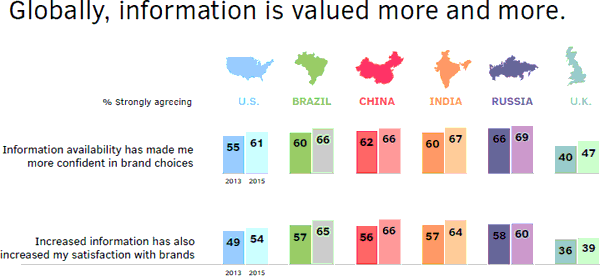
    Clearly, product information is valued more and more by consumers around the world.  As noted in Figure 1, in all countries surveyed their populations strongly agree that information availability has made them more confident in their brand choices, and has increased their satisfaction with brands. And we see all data points increasing over the last two waves of this research (2013 and 2015)


    Figure 1
     

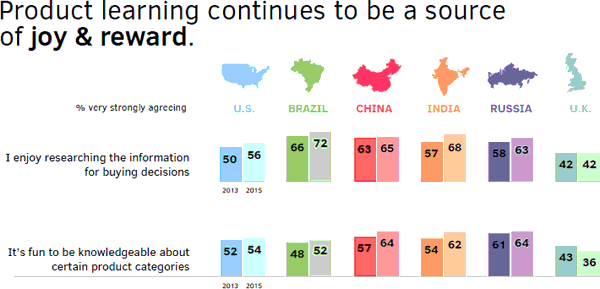
    Importantly, this product learning is a real source of joy and fulfillment around the world. Please see Figure 2.  A very significant segment of the population finds the researching and learning about products to actually be fun, rewarding and enjoyable.  And was seen in Figure 1, this joy and fulfillment has increased in most countries over the last 2 years. (When we look at earlier waves of the research, there is clearly an even longer term increase in these measures).


    Figure 2
     

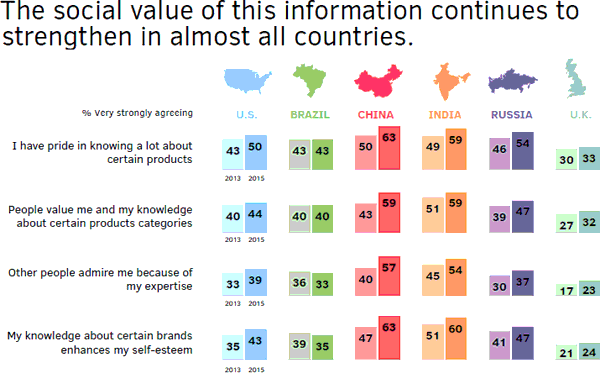
    We have found that much of this enjoyment and fulfillment from product learning is sourced in consumers’ finding social value from that information.  Their knowledge about a category or product gives them “social currency”—information to share with others when discussing various products. In so doing it enhances their sense of self, and self-esteem. Please see figure 3.  (A good example of the longer term growth in this attitude is China, where we’ve seen consumers’ strong agreement on the measure of “people admire me because of my expertise” increase from 25% in 2009, to 57% in 2015!!!)


    All of this data reinforces the need for marketers to aggressively supply consumers with this desired product information, and to do so in such a way as to make it easy for consumers to obtain it, internalize it, enjoy it, and pass it on.  Truly, consumers are one of the most important (and cost effective!!) channels of information a marketer could ever ask for.  They present their brand knowledge to friends and families with enthusiasm, and we know that their words—due to their trusted nature– are usually the most respected and valued by consumers vs. alternative “media” channels. The key question, addressed later in this paper, is how to instill trust in the information provided to the consumers, so she accepts it wholeheartedly, embraces it, and gladly passes it on.


    Figure 3
     

    Luckily for marketers, consumers today often manifest this desire for social currency by becoming active advocates for brands.  As noted in Figure 4, many of the respondents studied in our research have shown growth over the last two years in their desire to actively advocate for brands.  And in countries like China and India, the overall levels of advocacy interest are very high.


    Figure 4
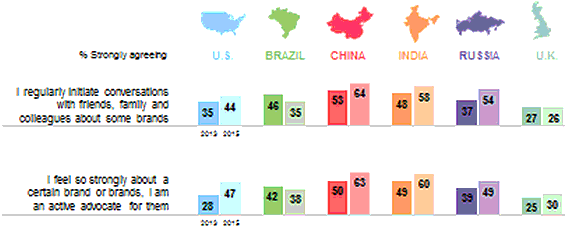
     

    So we’re seeing continued and dramatic growth in consumers wanting more and more information to help with their purchase decisions.  They’re finding the information to be a source of happiness and fulfillment.  For many, it actually provides them with a social currency that positively affects their sense of self and helps pave the way for interaction with friends.  And a great many are more than happy to take that new found brand understanding and actually go so far as to advocate for the brand—to , in essence, become new (inexpensive!!) media channels for the brand!


    But while all of this is pleasing for marketers to hear, today’s consumers worldwide are also putting up a hurdle that the brand information must meet in order for them to gladly accept and act on this product information.  And that hurdle is their growing demand for trust.


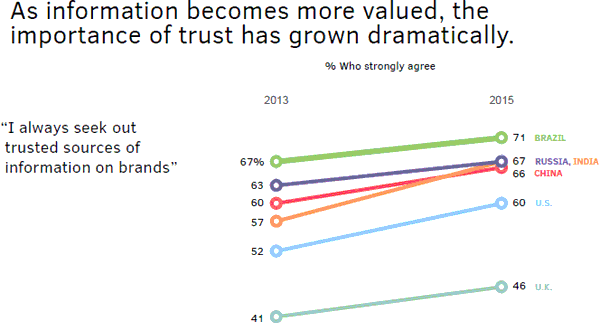
    One of the questions we asked consumers in our New Realities study is to what extent do they always seek out trusted sources of information on brands.  Not only are the absolute levels of “strongly agree” very high for the countries, but these levels have increased since the 2013 study. Figure 5. As noted below, in Brazil, China, India, and Russia, over two thirds of the respondents now strongly agreed that they always seek out trusted sources!


    Figure 5
     

    The New Demands for Trust

    A scan of news stories today across the world points to many many instances where people have lost trust.  We see them losing trust in government, religion, business, and in brands.  A few facts to underscore this development:

    • According to the Edelman Trust Barometer,when consumers around the world were asked about their level ofsatisfaction with the way their government is running their country, the highest scoring country reported only 31% satisfaction.
    • The same study from Edelman notes that two-thirds of the world’s countries have populations that fall into the “distruster” category…and that this level is rising every year.
    • A Cohn & Wolfe study in 2014 indicated that only 3% of Americans, British, Italians, Swedes, French and Spaniards say that “big businesses are very honest and transparent”.  And in Germany, the number is only 1%!!


    And the marketing world is not helping itself when it comes to engendering trust.


    • A MediaBrix/Forbes report indicates that 86% of US internet users feel they have been misled by videos that appeared to be content, but turned out to be sponsored ads
    • In the UK, only 20% of consumers report a high level of confidence in information on social media (Source: YouGov.UK; 2014)
    • And 57% of marketers say that bad behavior by brands on social media is eroding trust in their content (Source: KeepSocialHonest.com/YouGov Survey)


    Marketers have heard for years…and, of course, it’s really is common sense… that having product information trusted by consumers is very important.  We’ve all seen report after report showing the connection between trust and higher purchase intent,stronger repeat purchases, higher share of wallet, a willingness to pay a price premium,and even stronger growth in a brand’s stock price.


    But what we’re seeing now is a dramatic increase in size of the trust hurdle consumers are putting up. If there’s any doubt about the veracity of the information, today’s consumer will turn elsewhere.


    At a global level, Figure 6 shows consumers are becoming more discriminating, and “holding brands to higher standards than ever before.” With the exception of Russia, again we’ve seen solid year-over-year growth in this measure since 2013.


    Figure 6
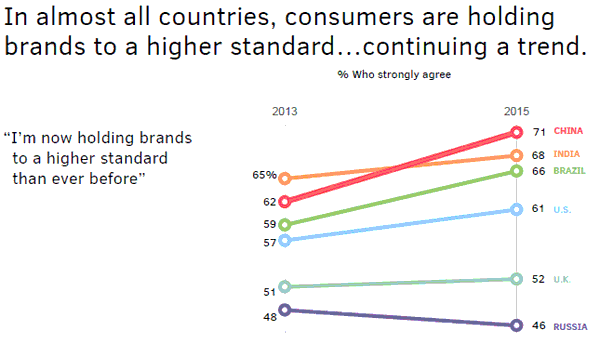
     

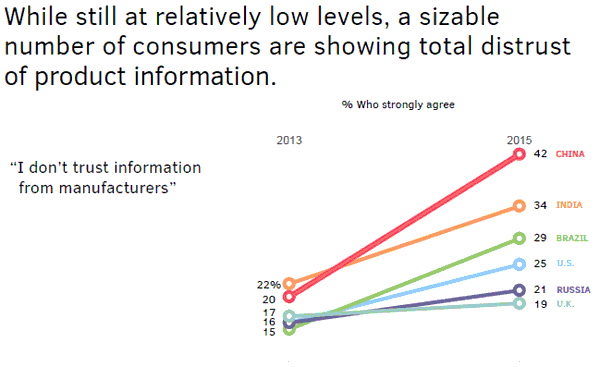
    Figure 7 demonstrates that the demand for a “higher standard” translates to a greater seeking of trusted information on brands.  And we’ve also seen an increase in consumers rejecting manufacturer-led information, with distrust being highest in China, figure 8.


    Figure 7
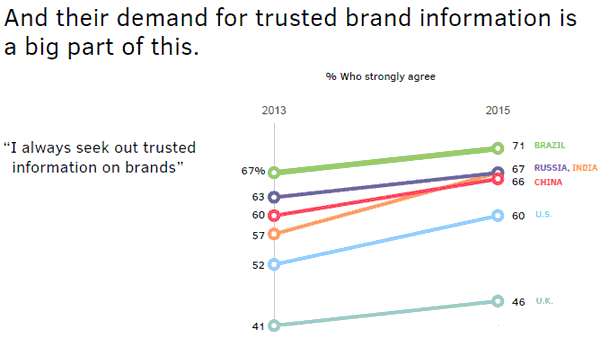
     

    Figure 8
     

    In order to obtain a deeper understanding of this dynamic, we set out to understand which attributes drive brand trust in the minds of today’s consumers. We factor analyzed 30 attributes (e.g. reliability, transparency, responsiveness, innovation, etc.) globally and identified 6 different factors that contribute to trust with varying levels of influence.


    The top two drivers of trust were most closely connected to a manufacturer’s products: product performance and claim truthfulness. Product performance was seen as a function of quality (I’m always confident in the quality of this brand), reliability (This brand always delivers what I expect) and the ability to meet expectations on a consistent basis (I’m never disappointed with this brand). Claim truthfulness was considered a function of a brand’s character (This brand has a character that I respect; can always believe) coupled with a history of producing reliable claims in the past (I can always count on this brand to tell the truth about itself).


    The second, but significantly lower,set of drivers were“innovation” and “customer-centricity”, where innovative is considered a function of product updates (This brand is always up-to-date) and the frequency by which a manufacturer brings such products to market (This brand is a leader/continually innovates). Customer-centricity, seen as slightly less important than innovation and significantly less important than the product-related drivers, stemmed from a brand being seen as putting their consumer’s needs front and center (This brand has great respect for customers/is always looking out for its customers). While seen as viable factors, surprisingly “support for social causes” and “transparency around criticisms” weren’t considered critical drivers of brand trust.


    A few things for brands to consider.

    Product efficacy rules the day. Building things that work (and that consumers have a need for) is a sure-fire way to gain their trust. These days, with the continued increases in available information, consumers are becoming increasingly skeptical. It’s essential to pair good products with claims that accurately represent their effects without setting unfair or unrealistic expectations. Overpromises might get you the first sale, but they’re awfully hard to sustain over the long-term.


    Social responsibility efforts are good (and in some categories and emerging markets, essential) but they can’t make up for product short-comings. Instead of funding expensive yet disconnected CSR efforts, brands might do better looking for ways to harness their product’s power in a participatory, socially responsible fashion. A recent example of this can be seen in Kimberly-Clark’s efforts to remove the cardboard center tubes of its Scott Naturals brand toilet paper, or Crayola launching its Meld N Mold kit allowing kids to recycle old crayons and transform them into new packs of custom-colored crayons.


    While innovation is on the tongues of every TED-talking CEO, consumers are quickly becoming trained to expect fast turnarounds of the latest products. Once seen as the provenance of the Silicon Valley few is now the headline of the many, and while essential to driving revenue, “innovation” seems to come up a little short when driving the trust scores of today’s consumer.


    Time will tell how consumers react to the ever-increasing wealth of information available to them at their fingertips. But one thing’s for certain. A brand will always want consumers to answer affirmatively to the all-important question, “can I trust you?”


    Terry Peigh is Senior Vice President and Managing Director, Interpublic Group


  • IPG Mediabrands to launch online travel fest in India

    By Pritha Dasgupta


    Media agency conglomerate Interpublic Group (IPG) Mediabrands India has joined hands with the travel industry to launch a festival to boost online holiday bookings in the country. The Great Indian Travel Festival, the first such event in India, will start on April 18 and end on April 26. GITF will offer deals and discounts on travel and stay packages for more than 50 holiday destinations within and outside India.


    “Indian consumers will find great value and deals to enjoy their summer holidays. We expect to reach over 3 million users over the course of the nine-day festival,” said Shashi Sinha, CEO of IPG Mediabrands.


    The participants include Google, travel websites Cleartrip, MakeMyTrip, Goibibo, Yatra and Via, and carriers Jet Airways, Indigo, British Airways and Spice-Jet. Tour companies Cox & Kings and Thomas Cook and startups such as Oyo Rooms and Doorstepforex have committed their participation. “While the industry has seen a major uptake in online hotel bookings, there is significant headroom for growth, and initiatives like these can contribute immensely in promoting the sector and contribute to domestic tourism,” said Vikas Agnihotri, industry director, Google India.


    IPG is building and designing the GITF website in-house and will host the participants on the site. Both Google and IPG are selling sponsorships and the proceeds will be spent on marketing the event and promoting the sponsors on the site.


    Source:The Economic Times

    Copyright © 2015, Bennett, Coleman & Co. Ltd. All Rights Reserved

    Licensed to republish


  • Diamonds are wherever…

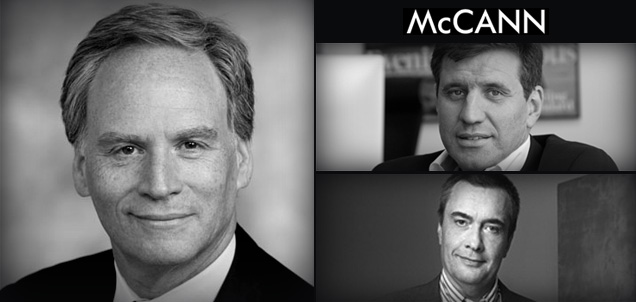
    Left: Harris Diamond, Right top: Gustavo Martinez, Right bottom: Luca Lindner


    By A Correspondent


    Imagine the head of a large Indian PR agency being appointed CEO of his network’s well-known creative agency? You can’t dream of such an eventuality in India, but not so in the United States of America, where public relations hasn’t hit the bottom of the pyramid as it has here in India.


    On Tuesday, November 13, the Interpublic Group announced a series of top management changes at McCann Worldgroup:  Harris Diamond was moved from being Chairman and CEO of IPG’s Constituency Management Group (CMG, which includes Weber Shandwick) to a similar role at McCann Worldgroup, replacing Nick Brien. A new, three-person office of the Chairman has been created which will have Mr Diamond along with Luca Lindner and Gustavo Martinez who have assigned bigger roles with geographic and operational responsibilities.


    McCann Erickson is the dominant unit of McCann Worldgroup which also includes UM, Weber Shandwick, Momentum, MRM, Craft Worldwide, McCann Health and Future Brand.


    Prasoon Joshi

    What does this mean for India? Not much. Except that until Tuesday, Prasoon Joshi as head of McCann in South Asia reported directly to CEO Nick Brien will now relate with Mr Martinez who takes charge of Asia-Pacific in addition to Europe. Mr Diamond told a Campaign Asia journalist that he had been in touch with Mr Joshi.


    Part of the reason why the office of the Chairman has been created is reportedly Mr Diamond’s background of being a Public Relations maven. Widely regarded as among the top 10 PR practitioners in the world, Mr Diamond role at CMG and Weber Shandwick specificially has received several accolades.


    His appointment to McCann is significant as he’s possibly the first true blue Public Relations professional taking charge of a large, global creative advertising company.  For IPG, industry observers say, it’s all about managing a communications firm, keeping costs under control, maintaining  a disciplined organization and most importantly: get in sync with the customer’s future strategy.


    Reasoned a former colleague David Brain: “In the era of enfranchised consumer and stakeholder and when everyone now ‘gets’ the need to engage and change strategy based on the long term needs of stakeholders and consumers, it is PR thinking not advertising thinking that is best placed to succeed.  Note, I’m labeling advertising thinking as the problem, not necessarily advertising agencies.”


    Mr Diamonds work appears cut out. Along with Messrs Lindner and Martinez plus Linus Karlsoon and Daryl Lee, global creative and strategy officers respectively who will take charge of the day-to-day operations of the agency, he needs to first ensure that people do not use ‘ailing’ as a descriptor for McCann Erickson.


    PR Week magazine reports on how in the 11 years that Mr Diamond led Weber Shandwick, he created a “powerhouse that had other shops looking over their shoulders”. The magazine’s website notes: “Contemporaries in the industry said he was a visionary who led his firm to be one of the most successful in the country.”


    Mr Diamond has the reputation of being cost-conscious and Mr Brain has this view: “My top tip for anyone at McCann who will be meeting Harris in the next few days and weeks is make sure you know how to forecast your revenues; make sure you know your cost base; make sure you are intimately connected with your clients and their needs and make sure you do quality work, because he can sniff BS a mile away!”


    Will Harris Diamond shine where Nick Brien didn’t. After all, Mr Brien too came with the reputation of being a successful Universal McCann captain and very customer-focussed. Guess time will tell.


    There are many people watching.  The success of this appointment could well see winds of change blowing across adland and the entire world of marketing communications.


    And to the world of PR professionals in India: fingers crossed. It could well be your time soon!


  • Here for the long haul: Anthony Good

    Anthony Good
    Deepak Khanulkar

    If an agency has been around for almost a quarter of a century in India- and more than 40 years in existence globally – there must be something valuable about its offerings that may be setting it apart from its peers in the business. True to its objective, Good Relations India has been one such agency that has been the bedrock for clients who continue to flock to its doorstep for seeking solutions, however small or complex they may be.


    As part of its continuing efforts to provide the best solutions to its clients, Good Relations has announced the rollout of its CSR initiative – CSR Advisory and CSR Audit, with which it hopes to redefine the way clients approach the function. With Anthony Good, Founder & Chairman, Good Relations and Deepak Kanulkar, CEO, India leading the drive, the company has an imperative plan up its sleeve as they take to the new terrain in India .


    In conversation with Johnson Napier of MxM India, Anthony Good and Deepak Kanulkar delve deep into the need for such a service in India, analyse how the CSR marketplace is currently placed in India and predict what’s in store for the agency in time to come. Excerpts:


    The Good Relations Group boasts a legacy whose origins sprang at a time when the PR industry itself was in its infancy. What was the thought process you went through to come up with an agency that was much ahead of its time?

    Anthony: We were one of the first public independent agencies to start here in India in 1988. Before that the agency took wings in the UK even before you were born. Our claim to fame was for two things: one was that we were the first to float in the London Stock Exchange, making us the only PR company at that time to do so. The reason we got there was because we were pioneers in extending the bricks of the PR service from pure Press Relations. I myself was a journalist and started at the lowest level but it’s funny what you learn as a beginner and when it stands you in good stead. I then spent time doing PR for an airline group and that responsibility led on to a marketing role. When I left to start a PR agency, I realised at that stage that PR even then was moving away from press relations to a broader range of responsibilities. In fact, when we floated Good Relations in the UK we had seven operating subsidiaries. We were also the first agency to own a design firm and have an advertising arm – though not in the conventional sense. Unlike the way things were structured in those days, where many ad agencies owned PR subsidiaries our ad agency was designed to carry forward programmes which were PR programmed.


    Having planted the seeds of ingenuity across several domains, how did your tryst with CSR come about? Also, when did India figure in the scheme of things for the Good Relations group?

    Anthony: One of the domains that has always been high on our radar is the area of social responsibility. Let me illustrate with an example. You may have social issues relating to, for example, water pollution. Now you may need to use advertising as a tool to tell people what you are doing so that they get the message from more than one source. That led us to believe that the future of PR was combining a number of specialist areas so that for any given set of requirements of the clients you could bring together the specialists in those areas. But one may wonder why we didn’t do that when we came to India ? The answer to that I’d say is: India wasn’t ready for it at that point in time. It wasn’t even that way when I originally started Good Relations. We didn’t have seven specialist units then. PR wasn’t ready, even we launched on the London Stock Exchange, but when we floated we had a range of offerings, which meant we could feel like specialists in each of those areas. Now you may say: aren’t these things that companies can do for themselves?


    Exactly. And, also you do have companies that have an in-house CSR facility…

    Anthony: In fact there is a tendency with bigger companies to only do these sort of things (CSR) in-house. Even in a country like Britain, which is in no way near as hierarchal like India, and I say this with a bit of experience – this is my 371st visit to India – and I have learnt that Britain may be hierarchal, but India is the expert at that. If you are not at a decision-making level in an Indian company, you are unlikely to be able to convince the senior management that what you are saying is right. I think it is a dangerous thing to keep all these responsibilities in-house. If you are talking about basic press relations, a large retail store for example, will need to have in-house people who will know the ins and outs of merchandise, stores and management, but when it comes to rather broader issues not only do you need a greater breadth of experience but also you need the ability to say: Mr client, you are wrong!


    When you come to Corporate Social Responsibility, often you will find companies who think that they know what they have to do and what not to do and actually reminding companies of their responsibilities in this area of the importance of developing a reputation into the community relaying a very important message that if you are not at a decision-making level then it may be just as difficult. What we are doing here is very much to duplicate what we did in Britain but also having regard to the particular need of this environment. One must realise that doing the right thing lasts a very long time but doing the wrong thing lasts even longer, maybe forever.


    How would you differentiate CSR from Crisis Management, which is another important function that’s receiving due attention by most agencies?

    Anthony: The two, in a sense, go hand in hand. Being responsible and making companies aware of their need to be seen as part of the community in which they operate, establishing what the needs of the community are and being seen as a source of solutions looking at what they should be doing and what they should not be doing. I remember what someone told me during one of my trips to this country: nothing ever moves upwards in an Indian company. The best advice that one can give to companies looking to come to India is that bit of advice. We know of companies who have tried meeting company ‘x’ for years but nothing comes out of it as things only move downwards. That’s why I feel it is important to have a consultancy relationship, because the top people do listen to consultants. There is a need for specialised professional advice but they are unlikely to think that it will come from within their own business.


    Do you provide consultancy services to any other units of Good Relations across the world?

    Anthony: You must know that Good Relations Group Plc, which we floated in the UK, was acquired by the Lowe Group which was also acquired by the Interpublic Group. And, you may know that there are two big communication companies in the US namely, Omnicom and Interpublic. The Good Relations agency was bought out by one of my friends and refloated as Chime Communications. So I am no longer part of that group, however, we had started GR in India when it was independent. My personal involvement as of now is only with Good Relations in India .


    As you make a dash for floating CSR into India, what has been the attempt in finding out what is it that is desired from this unit in India?

    Deepak: I have been on the client side of the business before I joined Good Relations in 2007 and what I have seen is that whenever it comes to CSR – especially at the ground level – clients start doing CSR initiatives as per the specifications provided by the local panchayats without even due diligence as to what is required in that particular area. This, I feel, is a huge gap. In the sense that the money is being spent but whether it is rightly spent is the question to be asked. In most cases, this used to be the actual ground situation where the money is spent because the sarpanch is saying so. What we plan to do is something different.


    What is the difference you seek to bring with your offering?

    Deepak: We would be offering two services: CSR Advisory and CSR Audit. Where CSR Advisory is concerned, when a company has to set up office in a certain location apart from other branches of engineering, what is also important is social engineering. Where is the location, what is the demographics, breakup of population and so on, it is important to have adequate knowledge of the entire social scenario. There is that gap which I have always seen. I’ve seen it rampantly. I have travelled a lot; I have travelled in interior places and I have seen ground realities. I have travelled to the village where UID card was launched…and I have seen people and I have seen the requirement, there is always a gap between what the company does – although they are spending on CSR -but whether it is effectively benefitting the community and the company nobody knows. So, I think our product which we are offering will bridge this gap. Each rupee has to be spent prudently and each rupee spent has to achieve its objective.


    What about CSR Audit?

    Deepak: The other product is CSR Audit. Now, normally companies do CSR directly or indirectly through the NGOs. The person who is sitting in the HQs is not getting a real picture of what is happening at the ground level. The NGOs are reporting that everything is happening properly; occasionally they send photographs of the activation programmes. But I think that like we have financial audits, there should be an audit from a third-party, not really the CSR company representative or the NGO local catalyst. It has to be done by independent body or agency which will actually go and see what is being implemented and report it back to the management. Normally, it doesn’t get reported in the right frame or the right percentage to the management. I used to work with a couple of MNCs and one thing I have realized is that whenever there used to be someone visiting from, say, Singapore or Hong Kong, it always reminded me of my school inspection days. On that school inspection day, you’ll have everything neat and tidy. Everything will be organised and in place. During inspections, things are taken care of, which isn’t the case otherwise.


    What is the connect you are trying to draw with CSR?

    Deepak: With the above example, the bosses here are showing the super bosses from the APAC region only what they want to see. And if the company is going to have a certain strategy on the basis of what is shown to them then that strategy is definitely going to fail. Because you are not giving them the right picture or a full picture, or maybe both. So, I think for sustainable organizations, we have to look in the mirror and assess ourselves and project the right picture. For a management, be it any strategy, a right picture has to be given. And our products, both the services that we are offering, are actually kind of an outreach program which will give the right picture. And if CSR is about helping the communities around, we have to make sure that it is ‘actually’ helping the companies around. I remember some time back Rahul Gandhi had mentioned that out of Rs100 that is spent on social initiatives, only Rs5 reaches the poor while Rs95 is getting evaporated.


    I think same could or would be happening in the corporate funding front for social products. And this needs to be arrested especially because CSR Bill has taken shape now; companies having a certain slab of turnover and profitability have to spend 2 per cent of that on CSR. I think this is a very big and good move and which is why we are getting into this. It’s because CSR is going to be something which is not a feel-good kind of a thing but something which deals with corporate sustainability. It will be an integral operations issue, it will be related to the DNA of the organization and not something that I am doing because I am liking it or not liking it. This is very important and this is why we are coming up with the two offerings.


    When do the two units flag off?

    Deepak: Right now, as we speak. And the reason we are doing so is because we want this to reach out to the corporate audiences. And of course, this will be available at a cost because this is not a CSR that we are doing. We are doing it as a service which will be chargeable. But there is a proper framework that has been put in place. It is not that services are being launched for the sake of launching. They are being launched after understanding all that I discussed with you and also there is a framework of not only system in process but also of right people. So we have people who are part of NGOs, we have people from the public life – MPs and MLAs who have done a lot of good work at the ground level , we have people from academics who are into CSR… So it’s not something we say that we know everything about it. No. We have taken partners in progress who are experts in the domain of social responsibility. This is broadly what it is.


    Any other USP to expect from your CSR venture?

    Deepak: In terms of specifics, each CSR mandate is going to be unique and the biggest thing which is going to happen is that in each CSR, it will be mandatory for each team to go on a ground visit. We are not going to teach or preach CSR by sitting in AC offices. We are going to roll our sleeves and go and hit the ground and do an audit. And when we are doing a third party audit, we are going to do it independently, so that we get an honest feedback from the beneficiaries. We are not going to go as a part of an NGO or a company because the opinions can be twisted. We are going to go there as independent people and get the real picture.


    Not many PR agencies have a CSR Audit unit which in a sense makes you different from the lot…

    Deepak: People have CSR advisory but I don’t think they have Audit. For this, I have worked on grass root level. And CSR is not something which you can start or launch by sitting here in Mumbai. You have to have the experience of working in the interiors. I have travelled to tribal habitats where a concrete road ends 6kms away from the village. I don’t need packaged water but can have water from the railway station because my system has become immune. So, it’s about your ability to reach out to the grassroots and how many companies will be in the capacity to have this? None. We have in-house team members who have travelled inside-out across many states of India . You need that passion.


    It’s a product that we are offering but one needs to have that passion to have that sympathy and empathy to drive this as a product. We are not developing this as a profit making machine; it is because we feel that if India has to grow, Bharat has to grow. And if Bharat has to grow, we all need to take an inclusive approach. India cannot grow at the cost of Bharat. We are there as messengers of finding the truth at the grass level and getting it on discussion platforms. Until and unless we honestly get it out from Bharat, it will be difficult of India to manage Bharat and Bharat to be part of India . Although, we are a one country but there is a Bharat and an India . And through this product we are attempting to see that Bharat benefits from the money India makes from India and Bharat.


    So for 2012, CSR is going to be a big thing for GRI.

    Deepak: It is a good thing and we are looking at it in a way that a rupee saved is a rupee earned. So it is all about sustainability and it is all about going and ensuring that the rupee spent is spent on right cost.


    How would you rate the growth of your agency in India thus far?

    Deepak: This is my fifth year at GRI. I have seen the slowdown of 2008 and at that point I was very new in the company and I was promoted to head the company. We are in the business of relationships, although everyone wants to make money at the end of the day.

    We did not lose a single client at that particular time which means we have a valuable service to offer. I still remember that there were some clients who were offered same services by competition at 35per cent of our fee. I got a call from a CEO of a company to know how the other company was offering same service at that fee. So I went and met him and quite a few others and told them how they are offering you can ask them, but why and what I am offering is because we are very prudent in terms of taking business. As a company policy we are not into rat race.


    What is it you desire to see becoming of Good Relations in time to come?

    Anthony: We are not in this business for the short term; we are here for the long haul. We have been around for almost 25 years so we must be doing something right. Our effort is to see that the relationship we share is a win-win for both the client and for ourselves. What we intend to do is have an annual fee review which is based on work done on our side and value delivered to our clients. And with inflation making a comeback here, we hope to have an inflation-proof fee which will see us giving the best value to our clients even in dire times. In every business there are two sets of people: those who are there for making a quick buck and those who are there for the long ride. And I can claim that we are very much here for the long run.


  • Info explosion has made India smarter: ‘New Realities 3.0’ study

    By Robin Thomas

    The Interpublic  Group (IPG), one of the world’s premier advertising and marketing services companies, has come out with its global ‘New Realities 3.0’ study that provides a unique window into how the Indian consumer is coping with information overload. The study provides insights on the decision-making process of the consumer in today’s era of information explosion. The study also aims to answer the unanswered queries of marketers on whether the information explosion has made consumers smarter or confused, the role of social media in a making consumers more informed, the role of brand advocates and much more.


    The study covered five countries namely, India, China, Brazil, America (US) and Germany. The India leg of the interview was conducted by Draftfcb Ulka’s independent consulting agency, Cogito Consulting. Over 600 online interviews were conducted in each of the five countries between October 26 and November 10, 2011. Some of the findings from the ‘New Realities 3.0’ study reveal that most Indian consumers feel they have grown smarter with the available product information, which is higher than the other countries. Further, the study notes that consumers in India rated a reasonable 7.3/10 when asked whether the available product information made them feel smarter compared to China that showed a rating of just 3.9/10, the US at 6.8/10, Brazil at 6.4/10 and Germany reporting 7.0/10.


    Interestingly, despite consumers in India claiming to feel smarter and not confused or frustrated with the product information available to them, they do not trust the information they see on brands, especially from the manufacturers end. Further, 32 per cent of Indian consumers say they do not trust most of the information they see on brands, whereas 31 per cent say they do not trust information from manufacturers or providers.


    The trust deficit that brands have among Indian consumers is higher than the other four countries, for instance only 11 per cent of Germans say they do not trust any information from brands whereas 22 per cent say they do not trust information from manufacturers or providers. Even Chinese consumers seem to trust information from brands and manufactures as compared to the Indian consumers. 19 per cent of Chinese say they do not trust information from brands whereas 24 per cent Chinese do not trust information from manufacturers or providers. 16 per cent of those interviewed in the US say they do not trust information from brands whereas 15 per cent do not trust information from manufacturers.


    Another interesting finding is that with the exception of Germany, the remaining four countries interviewed – India, China, Brazil and United States have said that product learning is a source of joy and fulfillment. 54 per cent of Indians have said that they enjoy researching the information for buying decision whereas 52 per cent of them say they find the information on brands fulfilling.


    Terry D. Peigh

    The findings have also revealed that most Indians learn product information to build an expertise about a certain product and brand as well as because it helps them stand out in their social circle. 53 per cent of Indians said that the reason they stay informed about certain products is because ‘people value me and my knowledge about certain products’, whereas 52 per cent of them said it helps them enhance their self-esteem.


    In addition to these, the study also revealed that consumers in India and China are most likely to turn into brand advocates and become a media channel and that in India, Brazil and China, especially, social networking sites are a good source for word of mouth information on brand experience.


    As vague and unique as it sounds, MxM India’s Robin Thomas got Mr Terry D. Peigh, Managing Director and Senior Vice President, IPG to relay more outcomes from the study, the role of social networking sites in decision-making capabilities and much more.


    New Realities… is an online study across multiple countries, including India. What is the sample size that was chosen for this study? Who are the respondents i.e. the TG for this study?

    We interviewed 600 people in each country i.e. in India, China, Brazil, United States and Germany. Out of the 600 people sampled, one-third were Gen X, one-third were Gen Y and one-third were boomers. 50 per cent of those polled were men and 50 per cent women.


    What was the key objective of the study? What, according to you, are the learnings for the Indian market, as well as the global market?

    The key objective was to better understand how the consumer has changed because of the new media. We came across the idea years ago as we noticed that the number of information sources available to consumers today has grown exponentially. So we found out if people were confused, frustrated, overwhelmed, and how are consumers viewing the overall experience of absorbing product information and using that information.


    We learnt that consumers have evolved over the years and hence they are not confused or frustrated with the information explosion. Consumers have not only learnt to easily filter or absorb the information but, they have also learnt how to manoeuvre their way through all the multiple choices of product information available to them.


    We have also learnt that surprising number of consumers, especially from India, are now very open, willing and eager to learn about product information as they find a lot of joy and satisfaction in learning about product information. In fact, our research also shows that people in India are most likely to really enjoy research and product information.


    One of the reasons why many in India are willing or open to product information is because they find it of social value as it allows them to have an expertise in certain products. We have also learnt that consumers are aggressively willing to become advocates of brand. Our research also shows that they are now interested in continuing to learn about a product even after they have purchased a product as they want to learn more about the product and advance their knowledge about that product.


    What this reveals is that communication should not stop at the time of sale and that marketers must continue to talk to their consumers even after they have purchased the product. As a result marketers may convert their consumers to brand advocates.


    The study reveals that Information explosion in India has led consumers to become smarter and helped them beat the system – much higher than what the other countries have reported. What are some of the factors that influence the consumer’s decision-making process around a product?

    We see a dominant role of family and friends in a consumers’ decision-making process. Although social media is still small, its role as a channel is growing, but too often social networking sites are limited to ‘likes’ or number of friends which is wrong. It’s too easy to get someone to push the like button or accept a friend request, even though they may really not like the brand or want to be their friend. A research from Australia finds that less than one per cent of friends are actively engaged and want to be truly engaged to the brand. So we keep encouraging our clients to go beyond ‘friends’ or ‘likes’ on a social networking page but, instead seek true engagement.


    As India becomes more tech-savvy, do you anticipate further information explosion to come about that could lead to further increase or decline in consumers who are confused or frustrated with the information?

    We were, in fact, surprised that the confusion or frustration numbers were not higher. My projection, however, is that it (frustration and confusion) will not go up as consumers have learnt the role of technology very quickly. Technology is fast reaching to the lowest common denominator very quickly so, I think people are learning to process information very quickly.


    Will there be a Phase II of the ‘New Realities 3.0’ study?

    Yes. We will soon be out with the second phase of the study in another 18 or 20 months, which will help us understand more trends. In China, for instance, during Phase I and II we have seen dramatic changes in over 18 months. We found that the Chinese were much more inclined to use the internet for product research. In China, the internet was used primarily for entertainment purposes, now it’s used for product information.


    Not surprisingly, consumers in India do not trust brand information especially from the manufacturers. This is not so with other countries, particularly Germany, US and China. How would you explain this? What must brands / marketers in India do to build the trust deficit among their consumers?

    I believe it is because of the newness of the consumer culture in India. In the US, for instance, there has been a mass market of consumer culture for 100 years and the same in Western Europe. I think consumers need to develop trust for their products. Brands must not be afraid to enter into the world of social media and hearing negative comments about one’s brand. There is probably no quicker way to gain trust with the consumer than to actually legitimately and honestly respond to criticism and fix the problem. This, I believe, is one way for brands to gain trust of the consumers.


    With the exception of Germany all other countries seem to enjoy product learning. What makes the consumers in Germany not really enjoy product learning?

    Yes, German people usually do not associate joy from product information. The Germans usually get their joy from music and food


    How has social media changed consumers’ decision-making across the globe? What role do you see social networking sites play in the near future in India?

    The role of social networking sites as a tool for brand advocates will increase. One thing we have noticed in the western world is that the number of people visiting brand pages on social networking sites is on a decline in Europe. This is not the case in India. In the western world a lot of consumers say that they do not visit Facebook for brands, but for friends therefore, it will be interesting to see if it will be any different in the developing economies. Nevertheless brands like Coca-Cola have leveraged social media well by finding ways to reach out to the consumers by engaging in a good conversation and get them to participate in brand activities. Right now the data shows consumers are willing and eager to visit social media to learn about products or brands.


    Even though broadband penetration is still low in India as compared to the US, why are consumers in the US and Germany reluctant in using social media for product research?

    This may be because brands that first started using the social media didn’t do a good job in engaging the consumers. The consumers may have clicked ‘like’ or may have become friends but, the brand may not have received anything else. Brands must, therefore, learn to go beyond the ‘likes’ and adding of friends to adding value in a consumer’s life as the consumer is not accessing social networking sites for brands but for something else. Therefore, in order to leverage the social media, brands need to operate in a different way. Increasingly, many brands are beginning to use social media effectively to engage with their consumers.


    How do you plan to reach the brands or marketers with the study? What can brands or marketers expect from the study?

    This study is important for clients because it is consumer based, is fresh, is in-depth, is broad, it looks at many different segments by product category, by demographic and it is the consumer telling us what he or she is thinking about.


  • How the WPP and Interpublic Group fared in 2011

    By A Correspondent


    WPP reported record profits of more than $1.45 billion for 2011, up a whopping 43 per cent from the year prior, and the holding company expects to see continued momentum in 2012 due to increased ad spending for the US presidential election and this summer’s Olympic games, according to Ad Age.


    Reported revenue for WPP, the biggest ad holding company in the world and home to creative agencies such as Ogilvy, JWT and media-buying behemoth Group M, was up 11.4 per cent year-over-year to $16.05 billion. However, WPP’s CEO-Executive Director Martin Sorrell is less optimistic about 2013, as there are no big events to bolster ad spend, and political ad dollars will drop off following the election.


    “We think 2012 looks similar to 2011, maybe at a slightly reduced level,” said Mr Sorrell. “But the one big cloud on the horizon we feel the need to address in 2013 is deficit reduction after the US election.”


    WPP said North America performed well, and in Europe the debt crisis is impacting growth, but overall the company said it still fared well in the region thanks to strong growth in the UK and acquisitions in Western Continental Europe.


    The company reported that Austria, Germany, Switzerland and Turkey, all showed strong like-for-like growth for the year, but France and especially Greece, Portugal and Spain remained affected by the Eurozone debt crisis. In 2011, nearly 30 per cent of WPP’s revenue came from Asia Pacific, Latin America, Africa and the Middle East and Central and Eastern Europe.


    The company said that emerging markets in Asia, Latin America, Africa and Eastern Europe represent the highest growth regions for WPP. The company plans to spend between $470 million and $630 million on acquisitions this year, Mr Sorrell said. The focus will remain on small and medium-sized agencies, particularly those in new markets or specialising in digital work, data analytics and technology.


    The past year saw a number digital agency acquisitions, including: F. biz and Gringo in Brazil; Rockfish and Lunchbox in the US; Who Digital in Vietnam; Promo in Russia and A4A in China. The company made a total of 38 acquisitions and 10 investments in 2011.


    The Interpublic Report-Card 2011

    US-based ad holding company Interpublic Group of Cos has reported that it nearly doubled its net income for 2011, up 96 per cent to $551.5 million, up from $281.2 in 2010, according to Ad Age. The company’s annual revenue was up 7.8 per cent, to about $7 billion.


    “Building on a very good 2010 result, we continue to show organic revenue growth that is at or near the top of our peer group,” said Interpublic CEO Michael Roth. “This performance keeps us on track to deliver on our goal of fully competitive profitability in 2014.” Mr Roth added all of the company’s regions grew in terms of organic growth in 2011, except for Europe, which is in the midst of a debt crisis.


    For the full year, continental Europe was down 0.1 per cent. The best region for organic growth last year was Latin America, which was up 17.8 per cent. For the fourth quarter, US organic growth was up 2.2 per cent, Latin American was up 30.4 per cent and Europe was down 3.2 per cent. Interpublic’s digital agencies, MRM, part of the McCann network, Huge and R/GA, significantly contributed to the company’s growth.


    In 2012, the company is targeting 3 per cent organic growth, noting “significant macro uncertainty on the global level.” Interpublic agency networks McCann Erickson and DraftFCB both saw major accounts defect in 2011. McCann Erickson lost Nescafe and other accounts, while DraftFCB lost SC Johnson and is now having to share Miller Lite with Publicis Groupe’s Saatchi & Saatchi.


    Source: The Economic Times

    Copyright © 2012, Bennett, Coleman & Co. Ltd. All Rights Reserved