Tag: Internet

  • IoT नेटवर्क और डिवाइस को कैसे सुरक्षित करें?

    IoT नेटवर्क और डिवाइस को कैसे सुरक्षित करें?

    आईओटी डिवाइस दुनिया भर में लोकप्रिय हो गए हैं, क्योंकि वे दुनिया भर के लाखों लोगों के घरों को जोड़ना जारी रखते हैं। चूंकि आईओटी को इंटरनेट कार्यक्षमता की आवश्यकता होती है, इसलिए उन्हें सुरक्षित करना पहले से कहीं अधिक महत्वपूर्ण है। आईओटी डिवाइस में अक्सर सुरक्षा कमजोरियां हो सकती हैं जिनका फायदा उठाया जा सकता है यदि वे ठीक से सुरक्षित नहीं हैं। तो इस संबंध में, हम आपके आईओटी नेटवर्क और उपकरणों को संभावित सुरक्षा जोखिमों से बचाने के कुछ तरीकों पर चर्चा करेंगे।

    सबसे पहले अपने घर को सुरक्षित करें, आपको अपने दरवाजे को बंद करके और अपने घर को सुरक्षित करके शुरू करना चाहिए। यदि आपका दरवाजा ठीक से बंद नहीं है, तो आप अपने राउटर या नेटवर्क पर किसी भी अन्य डिवाइस को सुरक्षित नहीं कर सकते। अपने घर को ठीक से बंद नहीं करने का मतलब है कि वे आपके घर में प्रवेश कर सकते हैं और आपके घर में किसी भी डिवाइस को नियंत्रित कर सकते हैं। अपने वायरलेस राउटर को सुरक्षित करें अगली चीज जो आपको करनी है वह है अपने वायरलेस राउटर को सुरक्षित करना। आपका वायरलेस राउटर नेटवर्क से जुड़े सभी उपकरणों का प्रवेश द्वार है। प्रबंधन पोर्टल के माध्यम से अपने राउटर को सेट अप करने के बाद, डिफ़ॉल्ट सेटिंग्स बदलें। डिफ़ॉल्ट सेटिंग्स का उपयोग करना जैसे कि वाईफाई पासवर्ड के लिए डिफ़ॉल्ट एसएसआईडी हैकर्स को नेटवर्क तक पहुंचने का एक आसान सुराग देता है।


    डिफ़ॉल्ट सेटिंग्स का उपयोग करने के बजाय, डिफ़ॉल्ट सेटिंग्स के साथ-साथ प्रबंधन पोर्टल का नाम और लॉगिन पासवर्ड बदलें। इस तरह आपका राउटर सुरक्षित रहता है और अनधिकृत पहुंच से सुरक्षित रहता है। डिफ़ॉल्ट क्रेडेंशियल बदलें जैसे ही आप वाईफाई राउटर की डिफ़ॉल्ट सेटिंग्स बदलेंगे, आपको आईओटी डिवाइस के डिफ़ॉल्ट क्रेडेंशियल भी बदलने चाहिए। कई आईओटी डिवाइस डिफ़ॉल्ट यूजरनेम और पासवर्ड के साथ आते हैं, जो अक्सर सार्वजनिक रूप से उपलब्ध होते हैं। ये डिफ़ॉल्ट क्रेडेंशियल एक सुरक्षा जोखिम पैदा करते हैं, क्योंकि हैकर्स आसानी से इनका उपयोग आपके उपकरणों तक पहुंचने के लिए कर सकते हैं। इसलिए, डिफ़ॉल्ट क्रेडेंशियल बदलें और अपने आईओटी उपकरणों तक अनधिकृत पहुंच को रोकने के लिए जहां संभव हो दो-कारक प्रमाणीकरण का उपयोग करें। ऐसे कई आईओटी डिवाइस हैं जो उन सुविधाओं के साथ आते हैं जो एक विशिष्ट उपयोग के लिए आवश्यक नहीं हो सकती हैं, लेकिन यदि उन्हें सक्षम छोड़ा जाता है तो ये आपके नेटवर्क में कमजोरियां पैदा कर सकते हैं। इसलिए, यदि आईओटी डिवाइस में कोई अनावश्यक सुविधाएँ हैं जिनका आप उपयोग नहीं करते हैं जैसे कि यूनिवर्सल प्लग एंड प्ले, तो उन्हें अक्षम करने पर विचार करें। इसके अतिरिक्त, नेटवर्क से जुड़े उपकरणों की संख्या और साथ ही रिमोट एक्सेस सुविधाओं को सीमित करें यदि वे आवश्यक नहीं हैं। मजबूत पासवर्ड का उपयोग करें आपके नेटवर्क पर आईओटी उपकरणों को सुरक्षित करने की बात आने पर मजबूत पासवर्ड का उपयोग करना बहुत आवश्यक है। आजकल, लगभग हर आईओटी डिवाइस को अनधिकृत पहुंच को रोकने के लिए पासवर्ड से सुरक्षित किया जा सकता है। चाहे वह आपका वायरलेस राउटर हो, स्मार्ट टीवी हो, या कोई अन्य आईओटी डिवाइस हो, आपको उन सभी के लिए एक मजबूत पासवर्ड का उपयोग करना चाहिए, जिसमें अक्षरों, वर्णों और प्रतीकों का मिश्रण हो।

    यदि आपको सभी पासवर्ड याद रखने में कठिनाई होती है, तो आप एक पासवर्ड मैनेजर का उपयोग कर सकते हैं जो न केवल मजबूत पासवर्ड सुझा सकता है बल्कि उन्हें आपके लिए संग्रहीत भी कर सकता है। नेटवर्क विभाजन लागू करें नेटवर्क विभाजन एक ऐसी तकनीक है जिसका उपयोग आप अपने नेटवर्क और आईओटी उपकरणों को सुरक्षित करने के लिए कर सकते हैं। नेटवर्क विभाजन में नेटवर्क को छोटे खंडों या सबनेटवर्क में विभाजित करना शामिल है ताकि नेटवर्क पर आईओटी उपकरणों को नेटवर्क से जुड़े अन्य उपकरणों जैसे लैपटॉप, स्मार्टफोन, टैबलेट आदि से अलग किया जा सके। नेटवर्क विभाजन की मदद से, आप किसी भी सुरक्षा खतरे के लिए संवेदनशील डेटा के जोखिम को सीमित कर सकते हैं और नेटवर्क पर अपने प्राथमिक उपकरणों की सुरक्षा कर सकते हैं। डिवाइस गतिविधि की निगरानी करें अंत में, नेटवर्क पर आईओटी उपकरणों की गतिविधि की निगरानी और ट्रैक करें। निगरानी आपको असामान्य व्यवहार का पता लगाने और किसी भी बड़ी समस्या को होने से रोकने में मदद कर सकती है। डिवाइस गतिविधि को ट्रैक करने, ट्रैफ़िक पैटर्न लॉग करने और असामान्य व्यवहार जैसे अनधिकृत पहुंच के लिए अलर्ट सेट करने के लिए नेटवर्क निगरानी टूल का उपयोग करें। तस्वीरें: Pexels.com

  • AdoRoi launches response-led media planning

    By A Correspondent


    Mumbai-based AdoRoi Marketing Science has introduced two new product offerings – Response Led Media Planning and Ad Insertion-to-Sales tracking.


    Amit Nevrekar

    Said Amit Nevrekar, Chief Operating Officer, AdoRoi, “It’s a scientific way to study the effectiveness of the media plan through Response per Spot (RPS) and Cost per Response (CPR)”. Explaining the concept, Mr Neverkar said: “The Ad exposure/ response are identified through unique Ad-Tracking codes for each media vehicles across TV, Print, Radio and Internet.” The response is analysed through a proprietary real time reporting software and Client Dashboard. The main advantage of this methodology is it provides Advertisement Exposure for a particular issue/insertion as against the current Media Vehicle Exposure based on Reach & Frequency model. The responses can further be analysed by media, creative, spot duration, placement, Ad-size, page no etc. The model, according to Mr Nevrekar, is beneficial for brands, which don’t just carry out brand awareness creation exercise but aggressively practise direct marketing for instant conversions through call for action or promotional offers.


    In this method, the dealer panel in PAN India Print campaign is replaced by AdoRoi’s unique Ad-Track tele code per media vehicle, thus saving the effort and also cost per sq cm. When any customer calls for an enquiry, his/her call is directly patched with the nearest dealer basis his Geo-position and the dealer database through our patented technology. Each customer enquiry is provided with a promo-code linked to media vehicle which can be tracked against sale. The responses generated per insertion across media vehicles can be analysed on real-time client dashboard. The learnings can be efficiently used for optimizing the media plan for better ROI by maximizing RPS and minimizing CPR.


  • Star World to showcase Packed to the Rafters digitally ahead of TV launch next week

    By A Correspondent


    Star World is all set to air Packed to the Rafters for the first time in India. Packed to the Rafters’ is an Australian drama series which revolves around the story of the Rafter family, who are fighting different problems of life together.


    To make the show more relatable to the audience, Star World got Karan Johar as the face of its campaign. The channel launched a six week on-air campaign with him. And the channel has unleashed robust print, digital, DTH, cinema, radio and OOH campaign given the launch next week.


    In keeping with the growing importance of the digital platform, the channel will be hosting a Web Premiere across the Star World website (www.starworld.in/PTTR) and other social networking sites to give the viewers an experience of the show before it goes on air. Star World will be taking such initiatives up for key shows to create reach and buzz. The digital premiere will be held today (November 30) before its official launch on the channel on December 4.


    Subsequently, each of the episodes of the show will be available to be streamed and viewed on the Star World web and WAP platforms after it telecast on air. A tie-up with Vodafone will ensure viewers can catch up on the key moments of the show at their convenience.


    Commenting on the show, Rasika Tyagi, Senior VP, English Programming, Star India said, “From our Hindi and Regional GECs, one of the biggest learnings is that viewers seek life lessons from the daily soaps they watch. The issues faced by the Star World audience, the English speaking, urban Indian youth, is quite myriad and they don’t get to see shows which reflect their life on TV. Our audience will be able to resonate with the issues faced by the characters in Packed to the Rafters and emulate the way they resolve the conflicts.”


    Commenting on the digital catch-up service, Rasika Tyagi said, “When we go for consumer home visits, we get a reality check on how content is being viewed by the youth today. They want to watch a show at their convenience – anywhere, at any time. So, we as content providers have to gear up to share our content across platforms, on internet or on mobile.”


  • I-Cube Report: Mobile crucial for rural India to access Net

    By A Correspondent


    There are about 38 million claimed internet users in rural India today. The penetration of claimed internet users in rural India has grown from 2.6 per cent in 2010 to 4.6 per cent in 2012, a CAGR of 73 per cent. On the other hand the penetration of active internet users has grown from 2.13 percent in 2010 to 3.7 percent in 2012. These are some of the findings from the latest I-Cube Report on ‘Internet in Rural India’ which was released by the Internet and Mobile Association of India (IAMAI) and IMRB.


    According to the report, the number of claimed internet users in rural India is expected to reach 45 million by December 2012. The report further states that mobile phones are fast emerging as an important point of internet access in rural India. As of June 2012, there were 3.6 Mn Mobile Internet Users in India, a growth of 7.2 times from 0.5 million in 2010.


    In a prepared statement, Dr Subho Ray, President of IAMAI stated, “This is just the tip of the iceberg, in the next two years, a combination of affordable smart phones, optic fibre backbone and local language content is likely to change the beat all projections of internet growth in rural areas.”


    Anurag Gupta, Founder and MD, DGM India explained the possible impact of a growing rural internet usage on digital advertising. He was also of the view that local language contents, hyper local information etc will lead to higher internet usage in rural India. “Internet penetration is growing in the urban areas and now it is percolating to the rural areas, this is very good news as it bridges the digital divide across the country and empowers dual India with a level playing field of knowledge and information. There will be a growth in digital spends as the users grow, so for the digital advertising industry this is a very heartening sign.”


    Usage of Indian language or local language content is also said to be on the rise. According to the report, the availability of content in local language encourages the rural user to go online and although 79 per cent of the users access content in English, 32 per cent of the users access content in Hindi.


    A whopping 42 per cent of the respondents said they were not aware of internet. This is also one of the reasons for the non-usage of the internet. As more and more people begin to use the internet, infrastructure facilities is also bound to grow. While more initiatives are certainly needed to build the internet infrastructure, evangalising of the medium to the rural masses is equally the need of the hour for further growth of the medium. In addition to this, local language content is also said to play a critical role in order to fuel the growth of internet usage in India.


    Point of Access:

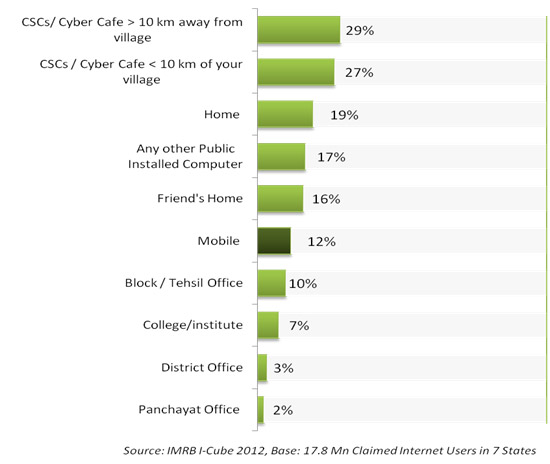
    One of the reasons for the increase in rural internet usage is probably because of the availability of cyber cafes and community service centres. Interestingly, majority of internet users in rural India (i.e. 57 per cent) have access to internet via cyber cafes and community service centres, only 19 per cent are said to have internet access at home and 12 per cent of the internet users access internet through their mobile phones.


    Purpose of Internet Access:

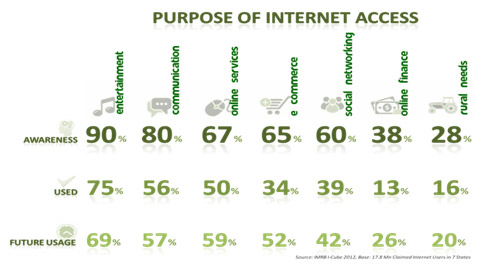
    Entertainment is the primary driver of internet use in rural India. 75 percent of rural users use internet for entertainment while 56 percent use it for communications Users like to access Music, Videos and Photos for entertainment.


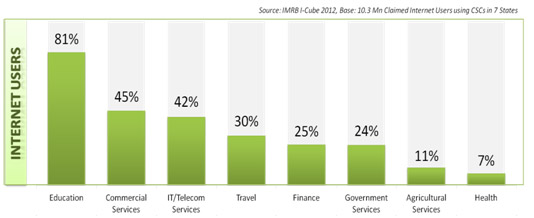
    There is a growing interest amongst the rural constituents seeking information on education. 81 percent of claimed internet users seek information pertaining to school / university and exam centres.


    Primary research is said to have been conducted in line with ‘I-Cube’ reports, an annual syndication of eTechnology Group, IMRB International. The syndicated research is based upon a primary research survey that interviewed about 15000 people from various age groups, across SECs and genders from the states of Assam, Maharashtra, Orissa, Tamil Nadu, Andhra Pradesh, Rajasthan and Uttar Pradesh.


    The Internet and Mobile Association of India (IAMAI) is an association which is said to be representing the entire gamut of digital businesses in India. It was established in 2004 by the leading online publishers. IAMAI is also said to be the only professional industry body representing the online and mobile VAS industry in India.


  • Anchor: 6 reasons why networking sites appeal to Indians

    By Adam Sachs


    1. India is a very young country. It has one of the youngest proportioned demographics in the world, even of the BRIC nations.


    2. There are over 500 million young people in India and all are looking at an opportunity to interact and know others.


    3. More Indian women are going to college and are more educated than ever before. The literacy rates have increased from less than 10 per cent to more than 50 per cent today. With education, comes freedom and the desire to make personal choices for themselves, one of these being who they are going to spend their time with.


    4. The Indian population is one of the fastest growing Internet populations in the world. According to Mckinsey, youngsters in aspiring countries drives the adoption of online services, and the level of their engagement with online activities such as social networking. In fact their online activities often exceed that of their developed country counterparts.


    5. The socio-cultural dynamics around relationships and marriage in India are changing very rapidly. This change is resulting in Indians seeking out solutions which can help them meet like-minded individuals, have fun experiences, and form real-life relationships. They are ready to experiment and meet prospective people outside their community and family circles


    6. Indians are getting married later. There are fewer arranged marriages and far more love marriages. Young adults in India are now interested in having relationships with multiple people before getting married. According to our survey, on average, Indian young adults have 5-6 relationships BEFORE getting married.


    Adam Sachs is CEO, Step Out


  • The Anchor: BG Mahesh on 5 reasons why the future is regional language internet

    By BG Mahesh


    Diversity of India is the main factor:

    Official data related to literacy is 74.04 per cent. Now internet is used only by the upper middle class, slowly penetrating to the huge middle class sector, which is the largest in India. The upper strata of this middle class is moving to the upper middle class category and their aspirations are high.


    The Economy Factor:

    Indian internet penetration will double in coming years. Upper strata of the internet users may not understand Indian language but others, which is the majority, is going to outnumber this upper strata. If the economy grows, middle class internet usage will increase, which will lead to consumption of Indian language content.


    The changing in media consumption:

    One can see the phenomenal growth of Hindi language newspapers circulation during last five years, soon news papers will see stagnation in circulation and readership – users will be depending other media channels like Internet and Television.


    The increasing demand for mobile internet access:

    There are 898 million mobile subscribers in India, 292 million of these living in rural areas. The same data showed that 346 million Indian mobile users had subscribed to data packages. Telecom operators are already activating GPRS by default as they realize their users want mobile internet access. We need to recognize the fact that mobile internet (and possibly desktop internet) is not a luxury anymore but a necessity.


    Regional language internet involves masses:

    Unless there are content and services out there in a language the masses can understand why will they use the internet? Regional languages will bridge this gap. Advertisers are not for or against any language. Once they see there is a huge user base of regional language users, they will jump onto the advertisers’ bandwagon on the language sites.


    BG Mahesh is the Founder & MD of Oneindia.in


  • Internet influences over 50% car buyers: Google

    By A Correspondent


    If you are planning to buy a car, who will you go to for advice? The Internet…family… a car expert? Various people choose various options, but according to a study done by Google India, with over 120 million Indian Internet users, the Internet plays an important role in influencing the decision-making process of India’s growing number of car buyers.


    The offline study conducted by Nielsen on behalf of Google India at car showrooms in eight metros (NCR, Mumbai, Pune, Chennai, Bangalore, Kolkata, Ahmedabad and Kochi) revealed that one in two car buyers conducted research online before arriving at the dealership. The survey also revealed that of those who had researched about their purchase options online, over 50 per cent changed their choice of car brands after uncovering new information on the web.


    Speaking about the study, Rajan Anandan, vice president & managing director, Google India, said: “This offline study substantiates the growing number of auto-related searches we’ve seen on Google Search inIndia. Auto is among the fastest growing vertical in terms of query volumes on Google. Most OEMs have not yet tapped the full potential of the digital medium and we hope this study will help them to understand and engage the Indian consumer online.”


    Respondents reported that they used the web to research and compare prices, watch online videos, find images, do competitive analysis, find dealer contacts and read both expert and user reviews. Most car buyers also rated OEMs website as the most important and trustworthy source of information. Of the 50 per cent respondents who went online, 42 per cent said they used search engine as the first source of information, just behind the opinions of friends and relatives’ (47 per cent).


    However, the auto-makers aren’t affected by the study. Abhishek Gupta, former brand manager at Maruti Suzuki India Limited and business head – North at RPS consulting said that  people might go online for research but final decision depends on what family and friends recommend. “One goes online to get a basic understanding. He might read blogs, reviews or comments to get others point of view but will buy a car which he aspires to purchase or what people close to him tell him to.”


    Voicing the same opinion, a marketing head at the leading Japanese car manufacturer, said: “Maybe Google is correct or maybe they are not. But it’s a fact that one needs to go to a showroom to get a feel and look of the various cars s/he has shortlisted before zeroing in on one.”


    The research was conducted outside the car showrooms of India’s leading OEMs namely: Maruti, Tata Motors, Ford, Chevrolet, Hyundai, Honda & VW. The total sample size for the research was 2,791 respondents. Out of which 93 per cent were males, with 75 per cent of the respondents in the age group of 25-44.


  • Internet as a media has arrived: Hitesh Oberoi

    Hitesh Oberoi is  Chairman- IAMAI and CEO and Managing Director, Info Edge. In conversation with MxMIndia’s Robin Thomas on the sidelines of the IAMAI’s marketing conclave recently, Mr Oberoi spoke about the changing dynamics of internet and mobile in India, the trends to watch out for and much more.

     

    For long we have been referring to internet as a new medium. Would you still regard the internet as a ‘new’ medium?

    I don’t think internet is a new media any more, but a media which has arrived. There are already more than 120 million online users and this number will grow to 400 million in the next three to five years. Therefore, I don’t think internet is a new medium any more nor a medium that can be ignored.


    Has there been a shift in perception over the years among advertisers about the internet and mobile as media vehicles?

    Advertisers are definitely taking the internet a lot more seriously today simply because of the growing number of online and mobile users. With the kind of targeting options and the kind of measurement options, the internet offers have brought more and more advertisers on board. In addition to this, the internet is not only one of the cheapest medium to advertise but, also provides better ROIs to advertisers. So certainly these are some of the factors leading more advertisers to the internet.


    What about a credible measurement system? Why do we lack still one today?

    There are some challenges, there are different methods used by different measurement providers but, I think they realize that internet is getting big in India and are, perhaps, working towards a better measurement system. So very soon we should have a credible measurement system in India.


    What according to you are the opportunities and possible threats or challenges that 3G and 4G services could have for mobile advertising in India?

    As the internet grows faster, people will spend more and more time on the internet. Penetration and the speed of access are the two things needed for bringing in more people to mobile internet. What 3G and 4G will do is, improve the speed of access and when the speed of access increases, a user will be able to download content faster. So, a combination of faster internet on mobile, quick downloads, and good quality content and so on will lead mobile internet to a different level altogether.


    And the lessons that India can learn from their international counterparts on internet and mobile advertising?

    One thing we should be investing in is the internet economy. The truth is that internet is a great medium for consumers, and it is a great medium for small and medium enterprises to build their business. Internet is a great leveler of the two India’s (urban and rural). Just as the telecom revolution which has led to people being empowered, the same could happen on the internet. So, I think the lesson we can learn from the United States and China is that we need to invest more and more in broadband and we need to make it cheap for people, so that many more can get onto the internet.


    Any specific trends to watch out for in the digital media space?

    There will be many more people on the internet five years from now, Indians will spend more time on the internet and probably they will spend most of their time online, therefore, marketers cannot afford to not be online. In fact, a lot more access to internet will take place through mobile phones. So while in this phase, more people are accessing internet through their PC or desktop, the next phase of internet growth will come from mobile. Therefore, marketers need to adapt to these changes accordingly. These changes may take a while but, undoubtedly digital is the way forward.


  • The Anchor: Bruno Goveas lists 5 key trends shaping the internet

    By Bruno Goveas


    1. Hyperconnectivity:

    There is an explosion of devices that are now connecting over to the Internet. We are living in an increasingly “hyperconnected” world where everyone is online 24/7. Markets are evolving and business models are being replaced. Companies are embracing hyperconnectivity as they realize it is the only way to capture new opportunity and meet the emerging needs of their customers or consumers.


    2. Security for Online Businesses:

    With the Internet now an important channel for doing business, it’s not surprising that there is a dramatic increase in the frequency, scale and sophistication of web attacks. Hence, there is a critical need for robust web security that will ensure scalable protection from data theft and downtime, and enable extension of the security perimeter outside the data-centre to deal with distributed threats and ensure adequate protection.


    3. Enterprise Applications are moving to the Cloud:

    With theEnterpriseworkforce becoming increasingly mobile, and businesses expanding into new markets, having suppliers, partners and customers distributed around the world, there is a need to securely deliverEnterpriseapplications anywhere and to anyone, in a cost effective and efficient manner. Businesses are now leveraging the Internet and enabling enterprise application access over the Internet, to effectively reach their employees, customers and partners.


    4. Interactive HD quality entertainment over the Internet is now a reality:

    Consumers are now demanding access to entertainment from any device, anywhere. Hence there is a need to engage audiences with interactive HD quality video over the Internet, solve the challenges of multi-device consumption and provide the highest quality video experience to all devices.


    5. Need for performance with Mobile sites and applications:

    With connected mobile devices now ubiquitous, growing exponentially, and their capabilities having developed and matured, there is a critical need to overcome limitations of accessing content over the mobile network and optimizing the content to ensure optimal and vastly improved user experience on any mobile device.


    Bruno Goveas is Director of Products- Asia Pacific &Japan, at Akamai Technologies


  • Vodafone pushes to access net via phone

    By A Correspondent


    Looking at growth opportunity in using internet on phones, Vodafone is pushing for this aggressively. Data shows that a sizable proportion of internet enabled phone owners do not use internet or have very low minutes of usage. To tackle this issue, Vodafone has come out with a campaign to drive usage and penetration of internet among Vodafone customers by simplifying usage experience and showing the fun possibilities of internet.


    Created by O&M, the campaign proposition is of “internet is fun” to be substantiated by products that make internet fun to use on Vodafone network.


    The brief given to the agency for the campaign is based on the core idea that internet and the mobile phone are ubiquitous in today’s world. The message communicated is to ensure that consumers get easier access to the internet and experience it in a simple and fun manner, on their Vodafone mobile phones. In short – The Internet is fun on Vodafone.


    “This also meant creating services, products and offerings that substantiate our proposition, which you will see unveiled over the IPL. We will be staring the campaign with an execution on the Opera Mini browser available on Vodafone that facilitates faster internet browsing as an added caveat – this campaign was for the IPL. Hence the creative execution needed to be different and have scale to break clutter and standout during IPL 5,” stated an official communique from Vodafone.


    “To deliver the ‘internet is fun on Vodafone’ promise we brought alive the Vodafone internet world in the form of huge, larger than life real games in a setting reminiscent of the Tele Matches. These games are set in a timeless space, with real people playing ridiculous games and generally getting together to have a fun time. And that provided the best metaphor for our proposition.”


    “each offering explains how Vodafone makes the mobile internet experience more fun and was brought to life with its own unique and absolutely fun game played between two teams. To bring out authenticity in the execution, the TVCs are set in a small village nearPragueinCzechoslovakiaand all the props are real and have been constructed for the films. And because the drama is happening in Czech, and english commentator explains the proceedings to the audience,” stated the communique.


    This is an 8 week long campaign. The campaign started with 3 teaser films on April 4 followed by the first TVC which aired on April 8. This is part of the 8 TVC’s on different products from Vodafone that make the internet experience on Vodafone fun. The campaign will be supported with a high decibel 360 media plan using TV, Radio, Print, Outdoor, on Ground and a digital and online plan.


  • The Anchor: Anurag Gupta on 5 things that should change in internet advertising

    By Anurag Gupta


    #1 I would like the internet to be regarded as mainstream media, sooner rather than later. It is inevitable that digital advertising will overtake other media like television in revenues. This has already happened in many other countries and I would like this to happen in India as well. Digital advertising today contributes to as little as 3-4 percent of total media spends; I would like this to zoom to double digits over the next two years.


    #2 Unfortunately since ‘content’ is easily available online and it is free, we are seeing a huge devaluation of the value of content in the online world. I would like online content to get its due from the advertisers. I would like to see the demand for internet media not only driving up pricing, but also create a situation where some internet media companies start selling at premium rates and shed their discount pricing tag.


    #3 Today digital advertising is predominantly sold as ‘performance’ media. I reckon more than 70 percent of all digital advertising happens for performance, and this segment is growing faster than brand advertising spends. While I personally love performance advertising and my company DGM India is at the forefront of delivering ROI to advertisers, I would like to see much more brand budget being allocated to the internet.


    #4 The internet is one of the most measurable advertising media. I would definitely like advertisers to be willing to pay for using cutting edge technology that can monitor and measure their internet spends in a better manner which goes beyond just impressions and clicks. For example, I have routinely seen advertisers who spend large amounts on digital advertising using free tools like Google Analytics when it comes to measurement.


    #5 I would like to see the emergence of global Indian media companies in the digital space operating at the scales of Google, Facebook, Twitter, LinkedIn etc.


    Anurag Gupta is the Managing Director, DGM India Internet Marketing Pvt Ltd.


  • The Impact of Internet in India


    By A Correspondent


    Access to Internet and broadband are widely regarded as catalysts for economic and social development of a country. A number of research studies have demonstrated the positive impact that Internet and broadband penetration have on national income (GDP) as well as its transformative impact on businesses and livelihoods. Internet (among other means of access such a fixed line or mobile) is increasingly viewed as an efficient mechanism for accessing information.


    Several case studies have highlighted the role that information can play in inspiring economic activity and good governance. In this sense, information can be viewed as a public good, access to which yields positive externalities. Internet allows better access to information and hence the existence of ubiquitous information infrastructure becomes a key input to the efficient functioning of markets and government.


    One of the chief tasks of this report is to provide a compelling basis for government intervention in the internet market in general and broadband in particular.


    Scope of study:

    To the best of our knowledge this is the first study that systematically investigates the growth impact of Internet and broadband at a sub-national level. India is ideally placed for such an analysis because it has more diversity within its borders than any other country. Over 1.2 billion people live and work in India in very different circumstances and geographies. Yet critical telecommunications policy is formulated at the national level and applicable across the country. The study would be incomplete if it failed to demonstrate the manner in which Internet and broadband create growth impacts.


    Assessment of internet and broadband impacts – international experiences

    Two broad approaches have been used to measure the economic impacts of broadband and Internet; these are the input-output method and the multivariate regression analysis.


    The former technique relies on input-output matrices to estimate the impact of broadband infrastructure deployment on output and employment generation in a country.


    The latter are largely international cross sectional studies that attempt to gauge the impact of broadband infrastructure on economic activity by establishing a causal link between broadband deployment and economic growth.


    An influential and widely cited study in this genre is the World Bank inquiry into the economic impacts of Information and communication technologies (ICTs) including broadband (Qiang et al 2009). It draws its intellectual inspiration from Roller and Waverman [rW] (1996, 2001), who were the first to quantify the positive impact of investment in telecoms on the economic growth of a country. The research suggests that the contribution of broadband to economic growth is indeed substantial, and may be more profound than comparable narrowband or voice-based ICTs. The study finds that 10 per cent increase in broadband penetration boosts GDP growth by 1.38 per cent in developing countries.


    Many other studies support the growth-dividend hypothesis for broadband. McKinsey & Company found that 10 per cent increase in broadband household penetration delivers a boost to a country’s GDP that ranges from 0.1 – 1.4 per cent. Booz & Company found that 10 per cent higher broadband penetration in a specific year is correlated to 1.5 per cent greater labour productivity growth in the next five years.


    The point of departure for this report is to measure the Internet-growth linkage within the national boundaries using the multivariate regression model.


    Analyzing the growth impact of Internet in India

    India’s teledensity has shown extraordinary growth since private participation was allowed in the sector, rising from less than 1 per cent in 1998 to 61 per cent on September 3, 2010. Several studies have found that the telecommunications infrastructure is one of the significant factors in economic growth, alongside others such as overall investment, education, energy and transportation networks. Despite the rapid growth in mobile penetration rate – an acknowledged driver of growth – India lags behind other countries in Internet and broadband penetration. Based on TRAI data, while there were 687.71 million mobile subscribers as of June 2010, the corresponding numbers for Internet and broadband were 17.9 million and 10.31 million respectively. Net additions in broadband subscribers are merely 0.2 to 0.3 million per month compared to around 15-18 million mobile connections.


    The benefits and externalities associated with greater Internet and broadband penetration are far too significant to wait for the market to deliver these outcomes. India’s federal structure, with some states such as Uttar Pradesh, Maharashtra, and Madhya Pradesh having significantly higher population and geographical area than most European countries, readily lends itself to such analysis.


    Moreover, balanced regional development has always been an objective and therefore studying the impact of telecom’s liberalization across states will provide valuable insights for this policy aim.


    While the rapid spread of mobile telephony has been the most visible demonstration of the benefits of telecom sector liberalization, attention needs to shift to data and Internet. Accordingly, we attempt to answer three questions:


    • What is the impact of Internet penetration on state growth rates?
    • Do less-developed states show a greater impact of Internet penetration?
    • What is the mechanism by which Internet affects growth; and what are the constraints, if any, which limit its impact.


    Our first major finding is the existence of a positive and significant coefficient on Internet. The result shows every 10 per cent increase in Internet subscribers delivers, on average, 1.08 per cent increase in output. Accordingly, Indian states with higher Internet penetration can be expected to grow faster. What it means is, if Bihar had half as many Internet subscribers as Punjab, it would have resulted in an increased growth of 7.02 per cent in state per capita income.


    We also estimate the impact of mobile telecommunication on growth in order to compare it with the growth impact of Internet; the model is the same as used in the 2009 study (ICRIER 2009).


    The coefficient for mobile penetration that 10 per cent increase in mobile penetration delivers, on average 1.5 per cent increase in GDP, is a marginal increase from the earlier estimate of 1.2 per cent in 2009. Given the low Internet penetration levels in India, it is not surprising to find a lower growth dividend for Internet than for mobile (1.08 versus 1.5).


    (Extracts from the report by the Indian Council for Research on International Economic Relations along with the IAMAI and the Government of India’s Department of IT)


    Shruti Pushkarna’s interview with ICRIER’s Rajat Kathuria, who has co-authored the report with Mansi Kedia-Jaju.


    [youtube width=”400″ height=”200″]http://www.youtube.com/watch?v=fzagYBZ19AQ&hd=1[/youtube]

    On the findings of ICRIER study on impact of internet

    The finding of the study is that an increase in internet penetration by about 10 per cent leads to GDP effect of 1.08 per cent, which means that for every increase in internet, we are going to get GDP impact. And this is fairly a large impact but we hope that once internet reaches a critical mass we’ll have even larger impacts.


    Right now internet penetration in India is fairly low, so we haven’t reached what’s called critical mass. But once critical mass is reached, this impact could go up to even 1.5- 1.8 per cent.


    But even at 1.08 per cent, it’s a fairly large impact. So the manner in which internet is beginning to impact India is through small things such as overcoming the constraints of alternate infrastructure, lack of roads, lack of information, and internet is able to breach that gap fairly efficiently and quickly.


    So what internet is doing in India today is allowing small businesses to access information, allowing students to get access to information they never had, allowing doctors to expand the scope of their geographical activities, and if you aggregate all these little impacts that internet is having at the level of entrepreneurs, at the level of individual experts and then at a much higher level, at what it’s doing to a huge retail outlet, to say a WalMart; it improves the supply chain of an entity like WalMart as it improves the efficiency of a farmer or a doctor.


    So internet can have impact across the spectrum of activities, social and economic impacts. And those impacts are beginning to show up in India.


    [youtube width=”400″ height=”200″]http://www.youtube.com/watch?v=eOBMiKpLBM4[/youtube]

    On the recommendation of ICRIER study on impact of internet

    The recommendations of the report are as follows: If you wait for the market to deliver these outcomes, internet will happen, it will eventually happen but it might take a bit too long because private sector is not interested in making such huge investments in the core infrastructure.


    The secretary has recently announced a Rs20,000 crore fund just to lay optical fibre across the country to connect the 250,000 gram panchayats. The private sector is not going to do this because the gestation period is very high and the revenue stream is uncertain.


    But once the government does it, and that’s what we are recommending, the government should shortcircuit this process, otherwise internet and broadband will grow in islands clusters in India. In Gurgaon, Delhi, Ahmedabad and other cities, they will get good internet connectivity and the rest of the country will be deprived.


    In fact, it should be the other way round, we need internet connectivity more in areas where the other infrastructure is weak. So what we are recommending is, short circuit this process, overcome the market failure.


    The government should become a protagonist in investing huge amounts of money upfront and then the private sector will deliver what it does best, create business models around infrastructure.


    [youtube width=”400″ height=”200″]http://www.youtube.com/watch?v=QtjCaItw0lY[/youtube]

    On constraints faced in documenting ICRIER report on impact of internet

    If we had access to more data…one of the constraints we faced in documenting the report is access to information, and if we had better quality information, we could have come up with probably more robust estimates. The estimates would not change maybe but we would have more confidence in the robustness of our estimates if we had improved quality of data access. But that’s something we have to live with in India.


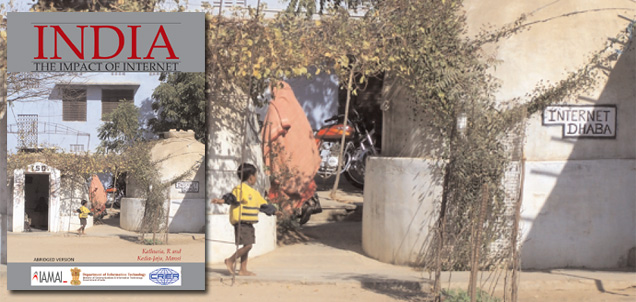
    Image courtesy: cover of ‘The Impact of Internet’.

    Copyright 2011 ICRIER
    All Rights Reserved
    Cover Photograph by Digital Empowerment Foundation