
 Once again, a brand that is a household name has let its users down. Except that the duplicity is remarkable.
A recent report released by Swiss NGO Public Eye and the International Baby Food Action Network (IBFAN) revealed stark differences in the sugar content of Nestle’s baby products across various nations.
The investigation, which evaluated around 150 baby products from different countries, alleges that Nestle’s products in South Asian (including India), African and Latin American markets contain significantly higher sugar levels than those in Europe. Brands like Cerelac and Nido contained more sugar by as much as 2.7 gm per serving in India and 5 gm in Thailand– compared to developed nations in the West.
The medical evidence against sugar is clear. Added sugars should not be given to infants, toddlers or very young children because they don’t need it. They get their sugar from natural sources and lactose in their mother’s milk for the first 24 months of their lives. There is a risk that infants will become addicted to sugary foods, which will impact their health from an early age.
But the same Nestlé’s India operation was ranked joint first in the second India Access to Nutrition Spotlight Index 2020. The index is purported to be an independent national assessment to measure the contribution of India’s largest food and beverage manufacturers toward meeting the health and nutrition needs of Indian consumers.
In its citation, the ranking states that some of Nestlé India’s strengths include its overall nutrition governance and management systems that are comprehensive with a clear accountability structure, its pledge to reduce fat, salt and sugar in its products, its commitment to address the affordability of its nutritious products and its responsible marketing policies.
Would you trust the Access to Nutrition Index?
In Indonesia, Aqua, a bottled water brand made by French consumer goods giant Danone, recently topped a new ranking of Indonesia’s biggest plastic polluters.
Sungai Watch, a Bali-based environmental non-profit that deploys river barriers all over Indonesia to stop plastic debris from leaking into the ocean, studied the trash they had collected. The non-profit audited 537,189 pieces of rubbish collected from 268 river barriers in Bali and East Java last year, and published the data in its 2023 Impact Report.
It found Aqua-branded single-use water bottles to be by far the most commonly littered items, followed by products made by Indonesian consumer goods firms Wings Group and Indofood.
Now, Aqua was the first Indonesian company to be certified by B Lab, a London-headquartered certification scheme which rewards “beneficial corporations”, or B Corps, based on their social and environmental impact. Aqua attained B Corp status in 2018 and was re-certified in 2021. How reliable and authentic would that certification be, in the light of the Sungai Watch report, especially since B Lab has faced scrutiny in recent months for helping companies greenwash their record?
Trust is ever so important to us
Trust is a major determinant in all aspects of our life. We seek it in our families, in our neighbourhoods, in our workplace, in the sporting field. Trust is never absolute but is based on situations, memories, experience, contract, perception, emotions.
From personal relationships, to trade and commerce, politics, society, everything is based on trust.
Trust is a brain’s neural response based on certain stimuli, both internal as well as external as well as certain mnemonic associations developed over years. Trust is vital to any transaction. Without trust there can be no relationship, institution or nation.
The impact of trust goes deep. Gartner studies suggest that 81% of customer are not willing to engage with business or make purchases from brands they do not trust. What’s more, 89% of customers say they would end their relationship with a brand if it violates their trust. According to PwC’s 2023 Trust Survey, 92% of business leaders, 92% of consumers and 94% of employees agree that organisations have a responsibility to manage that trust.
How did we lose trust?
By definition, trust is as human and messy as the very humans who earn it or lose it. Today, there’s a gaping chasm of societal trust – a “trust deficit,” defined as when there is more distrust than trust between two or more people.
One would have thought that the Information Age and the widespread rise of different media would eliminate some of this trust deficit. In truth, it has only amplified the problem. Personal agenda, partisanship and bias have clouded dissemination of news and information.
Opinion has become interchangeable with fact. Fake news, manipulated information (aural, written or video) and coloured views are so common that it is difficult to decipher the real from the unreal. Trust deficit in media explores the lower depths every minute.
According to futurist Alvin Toffler, “We are increasing the sophistication of deception faster than the technology of verification. The consequence of that is the end of truth. The dark side of the information technology explosion is that it will breed a population that believes nothing, and perhaps even more dangerous, a population ready to believe only one ‘truth’ fanatically and willing to kill for it.”
Brands and mistrust
In today’s consumer landscape, trust has become a precious commodity. Scepticism and cynicism are on the rise, leading to a decline in consumer trust across industries. From data breaches to misleading advertising, consumers have become increasingly wary of brands and their intentions. The prevalence of fake reviews is a real problem in the retail world and has further eroded consumer trust. High-profile data breaches and privacy scandals have shaken consumer confidence. Instances where personal data has been mishandled, misused or compromised have resulted in a loss of trust in brands across various sectors.
Trust is lowest among Gen Z consumers, among whom only 28% trust the brands they do business with. A study from Deloitte shows that consumer trust in a brand can decline by as much as 144% when a customer believes a company is using AI.
But iconic brands like Aqua and Nestle regularly show up in annual, high-level trust surveys. While it seems intuitive that large, long-dominant brands with the most customers would also be the most trusted, a study found that many household-name brands fell below benchmark trust scores in many industries (figure 1)—indicating that brand recognition is not synonymous with trust.
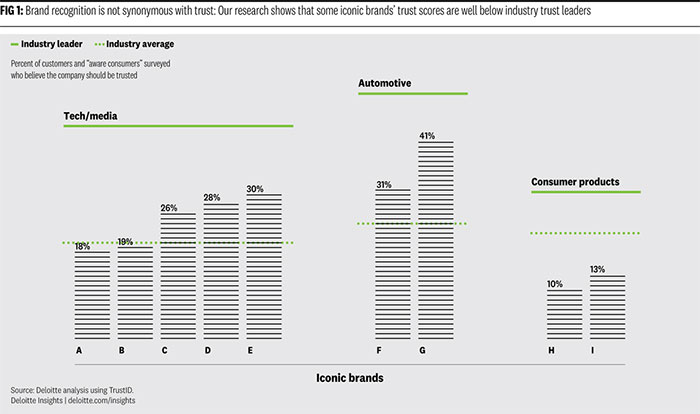
Consumers say that brands’ attempts to engage with them often go wrong when they lack relevance (76 percent) or authenticity (51 percent).
Regaining brand trust
While the erosion of trust in recent years presents challenges, brands can regain confidence by prioritizing transparency, authenticity and accountability.
The need for trust is on the rise. Globally, 71% of people say that it is more important to trust the brands they buy/use today than in the past. (Edelman Trust Barometer 2023).
By valuing customer privacy, being transparent in communications and practices, aligning with genuine social causes, and consistently delivering quality and value, brands can rebuild trust and establish lasting relationships with consumers. In the era of distrust, brands that proactively address these issues will stand out as beacons of trust, gaining a competitive edge and fostering loyalty in the hearts and minds of their customers.
But most importantly, they need to be reminded that consumer is not a moron. They are babies who deserve care, not addiction, a plastic-free world, not beaches and playgrounds littered with bottles.
Kunal Sinha is a senior strategy and foresights executive based in Jakarta, Indonesia. He is the author of several books including The Future of India’s Rural Markets and Raw – Pervasive Creativity in Asia. He writes for MxMIndia every other Monday. His views here are personal.