Tag: innovations

  • @FF12: Day 2: Seamless blending with traditional mediums – a big want!

    By A Correspondent


    After an invigorating day where suggestions and formulas surrounding digital came flying thick and fast, it was time for the mediums of television, advertising, radio, films etc to do some soul-searching and look for solutions to tackle the imminent challenges that digital is bound to bring. The day began with a keynote address by Hernan Lopez, CEO, Fox International, who began by praising the dominance that India had cast on several countries around the world. But he regretted the fact that despite ideas and innovations gaining prominence, one area that sadly lacked innovative ideas and content was television. According to Mr Lopez, the reason for India’s lack of show was due to the fact that Indian talent “operates under price control which equals creative shackles”.


    Mr Lopez continued saying that the Indian television industry is almost totally dependent on advertising revenues – almost $2.6 billion per year – which, coupled with the fact that there is an overabundance of channels and less number of affiliates, meant that broadcasters are in a bind. The way forward according to Mr Lopez was if the price control was done away with. He said that this would make it possible to pay the talent in the industry what it deserves and then it can operate without any constraints to produce the best possible content. Mr Lopez lauded the move to digitisation which would reduce the carriage fees being paid and increase the revenues for the industry.


    In a session moderated by Neeraj Roy of Hungama, Sanket Akerkar, MD of Microsoft India talked about “The converged future – Multiple platforms, technologies & transforming applications for media and entertainment”. The theme of his keynote address was significance and emergence of digitisation. Citing the example of ‘Occupy Wall Street’, Mr. Akerkar said that the consumer lifestyles today are controlling the way conversations happen. The industry has to takes its cues from what the consumers want. According to him, even ads will now be consumed as per the consumers’ choice and the advertisers can’t dictate the place and time for the consumption. Now the people are going to become the content creator and content consumer. The main challenge for the industry is now to seamlessly blend and enable technology to become user-friendly, he said.


    Mr Roy added by saying that technological progress has enabled applications that recognise the customer preferences, be it the Internet or the phone. All the speakers were in agreement that once the digitisation bill comes into effect, the choice of content available to the user will be limitless. As Mr Akerkar said, “the challenge will be to separate content, be it mainstream or user generated into what is relevant and what is not.”


    In another session titled “Innovations in the advertising industry in the digital world”, the panellists focused on why the much sought after medium of digital was rather ignored by advertisers who preferred to seek refuge elsewhere. The panellists comprised Rajan Anandan of Google India, Olivier Fleurot of MSL, Frederic Josue of Havas Media, Vikram Sakhuja of Group M, Kapil Agarwal of UFO Moviez and Varun Gupta of KPMG India. The session was moderated by Rajiv Makhni, Managing Editor, Technology, NDTV.


    Mr Anandan began by stating that India is still an emerging market where web advertising is concerned and it still constitutes just 3 per cent of the overall advertising spends in India – estimated to be around Rs 33,000 crore. The biggest driver of growth in advertising on the web would be through the rise in the number of users of smartphones, which is estimated to touch 100 million users in 4-5 years time. Smartphones alone could boost the growth of web advertising to about 8-10 per cent, he said.


    Mr Josue of Havas was of the view that it would be content that will drive the growth of the medium in the years to come. But the medium will face its share of issues which include multi-tasking across various platforms as an attempt will be have to be made to offer content seamlessly across various mediums, he said. Mr Fleurot began by stating how the marketing and communications industry was witnessing a profound disruption due to the invasion of technology and social media. This, he said, has led to an increased level of competition in the marketplace. The challenge, according to Mr Fleurot, is that clients today are not yet organised for the 21st century as they still prefer to work in silos. But in the case of online, the model of working in silos will disappear as all the other mediums work as a single unit on the internet. Going forward, the two key factors that will determine the growth of this medium, he said, include the speed with which marketers communicate with their users through the digital medium and the transparency with which they operate on the medium.


    Vikram Sakhuja was at his jingoistic best as he began by questioning what the term innovation in advertising actually stood for. “Innovation is a term that is broader than creativity. It is a new way of doing something better,” he said. He outlined the current scenario by stating that technology today is an overestimated medium in the short term but is underestimated for the long term. The problem according to him is that the medium has been underestimated for a long time now and that it was about time the medium leapfrogged ahead of the others – go from the current 3 to 15 percent in the shortest possible timeframe.


    In the session titled “Building sustainable models for niche content” honchos from the broadcast industry such as Paritosh Joshi of Star CJ (session moderator), Smeeta Chakrabarti of NDTV Lifestyle, Monica Tata of Turner International India, Ajay Chacko of A+E Networks I TV 18 JV, Atul Pande of Zee – Sports and Rasika Tyagi of Star India discussed on revenue models to sustain TV content catering to niche audiences and its long-term sustainability. Atul Pande stressed on the need to charge premium to audiences who really are on the lookout for speciality content. Smeeta Chakrabarti said that as a speciality channel one cannot talk about TRPs, rather it is the brand connect that needs to be spoken about as far as ad sales was concerned. Rasika Tyagi on the other hand remarked that the whole idea of measuring a speciality interest channel should be relooked at. “It’s not about how many people are watching you; it’s more about what kind of people are watching you.” She also said that the audiences of niche channels are of such quality that they do not mind paying, and that broadcast companies should look to tap into that opportunity.


    On whether the industry requires a different approach as far as measurement for these channels was concerned, Paritosh Joshi said, “The big challenge with respect to measurement is that we need to find a way to measure both quantity as well as quality. The quality aspect is very critical for a speciality channel.” Monica Tata added, “We need to have a different measurement system to evaluate special interest channels.”


    In the post-lunch session titled “Radio: Innovations in content”, industry veterans discussed at length the innovations that radio was witnessing with regards to content and the enormous innovation opportunities that FM Phase III would allow. The session was moderated by Apurva Purohit, CEO of Radio City and the panellists included Rabe Iyer of Big FM, Abhijit Avasthi of O&M, Bhavna Somaaya, Columnist and Writer and Charles Falzon of Ryerson University.


    Ms Purohit kick-started the session stating that radio currently is in a schizophrenic stage wherein on one hand the medium is witnessing immense growth, it has a huge reach in the country and the FM listenership has also further increased with higher number of mobile phones, while on the other hand the overall ad pie of the medium is at a dismal 4 per cent. She pointed out that in the next two years the industry anticipates another phase of growth which will bring news, sports commentary, multiple frequencies, besides further expansion into towns and cities.


    Speaking about the strengths of radio as a medium to advertise, Mr Avasthi first admitted that out of all the media, it is the toughest to write radio spots. He explained, “The strength of radio I believe is one can conjure up a world in the minds of the listeners. What you hear on radio today is mainly restricted to Bollywood music. There are so many kinds of music still to be explored and so many types of content that can be experimented, and I believe the industry requires some amount of courage to break this format.”


    According to Mr Iyer, although 80 per cent of content on radio is music and 20 per cent on the packaging of music, there has been some innovation in the medium and with the launch of phase III it will bring with it immense opportunities especially on the innovation and differentiation front.


    Key takeaways:

    – Need for television to do away with price control

    – Niche channels to broaden content choice for consumers

    – Post digitisation, consumers will dictate place and time of content consumption

    – Need for significant hike in digital adspends by clients

    – Phase III to steer growth of radio significantly
     

  • Mudra Max OOH drives home HT’s No TV Day message


    By A Correspondent


    Hindustan Times returned with its popular and inclusive initiative on January 28 this year, following its success on January 29, 2011.


    What started as an HT initiative became a people’s movement in Mumbai, making it the only city in the world to have its own special day. Hindustan Times called upon Mumbai to switch off TV and be open to the immense possibilities that their relationships and the city had to offer.


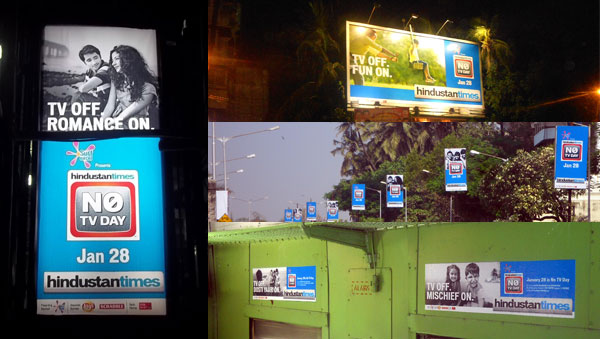
    To drive home the message – TV Off, Mumbai On, Mudra Max-OOH planned and executed an effective OOH media campaign for No TV Day, beginning January 13.


    The agency deployed a wide mix of OOH media, namely billboards, gantries, BQS, DBQS, pole kiosks, in-train branding, bus back/side panels, station branding & domestic airport branding.


    Considering the growing population which prefers air travel these days, a few interesting media vehicles such as cutouts on conveyer belts & standees were deployed at strategic locations inside domestic terminals.


    To break through the clutter, Mudra Max-OOH executed a couple of innovations at marquee sites in Mumbai (Juhu Koliwada & Mahim Causeway).


    Innovation 1: At Mahim Causeway (one of the important congregation points for vehicular traffic in Mumbai), the idea was to create the NTD Facebook homepage on a billboard. There was a daily change in the status, just the way one updates their statuses and the number of growing Facebook fans on the billboard. The status updated continued was for 5 days as a build up towards No TV Day.


    Innovation 2: This was executed at Juhu Koliwada / Juhu Tara Road (one of main arterial roads of Mumbai), since the core essence of NTD is TV Off, Mumbai On, this execution tried to bring that alive on a billboard by showing a father-son having fun on the swings in a park and the copy read ‘TV Off, Fun On’. The swinging movement on the billboard caught a lot of attention and was really talked about.


    Like last year, Hindustan Times organized a plethora of activities on January 28, encouraging Mumbaiites to step out of their homes and explore the city with their family and friends.


    The activities ranged from school painting competition attended by around 34,000 children with their parents, helicopter rides, and exclusive discount deals at more than 400 outlets in the city, heritage rides, dance workshops and many others.


    Across the city, around 250 housing societies registered for the No TV Day Best Society contest. A city specific treasure hunt was organized across three zones in Mumbai (western suburbs, Navi Mumbai andSouth Mumbai). While 1,300 participants raced against time to reach the finishing point, 3 winners were selected in each zone.


    The engagement with Mumbai was sustained in the social media space as well with the HT Mumbai No TV Day Facebook page and a special microsite. In just 3 weeks, 1.5 lakh new fans were added to the No TV Day Facebook community, taking the total strength to 2.5 lakh fans. The Facebook page also generated 6.5 million unique impressions and was the among the top branded Facebook pages inIndiain terms of engagement. On January 28, the strong buzz about the initiative resulted in No TV Day featuring among the top trending topics nationally on Twitter.


    There were various partners, such as Railways, Prince of Wales museum and MTDC, and brands like Surf Excel,Toyota, Lays, Micro Technologies and Scrabble who joined in this initiative.


    Ajay Dang

    Mandeep Malhotra, President, Mudra Max (OOH, Retail, Experiential) said: “NO TV DAY is an annual property built by HT and we were required to create a history connecting the brand with Mumbaikars. Our aim was to establish a property better and louder than the last year’s campaign. In a city dominated by competitors, it was an indispensable task to keep Mumbai ‘On’ for a quality life. We, along with HT, delivered the message effectively and took OOH from the position of a reminder medium to a call for action platform.”


    Ajay Dang, Marketing Head (West and South),HindustanTimes said: “Very few times does an initiative by a brand/ newspaper becomes a people’s movement. Hindustan Times has added an important day in the calendar of Mumbai when the city takes time to reconnect to important relationships be it family and friends or the city that we call home.”


  • FDI in retail can bailout OOH industry: Nabendu Bhattacharyya

    By Nabendu Bhattacharya


    Key milestones for OOH Industry in 2011:

    • Due to service tax ruling the industry came together to discuss standard operating procedures for OOH industry in line with other industries.
    • Marketers demanded more efficiency in OOH planning, creative innovations and 2011 witnessed many innovations in various categories in OOH. We saw various formats introduced in line with the international OOH markets. Street furniture inDelhiand Mumbai put emphasis on format beautifications in terms of aesthetic structures of billboards.
    • We also saw a lot of entrepreneurs entering as OOH specialists; many of them emerged after breaking away from large agency specialists’ space.
    • I would call 2011 a year of growth. It may not have been a great year in terms of huge OOH advertising spends, but OOH stakeholders pursued other categories and managed to convince local clients in the city levels, and few categories even invested more namely, gems – jewellery, real estate, retail, media entertainment, automotive and FMCG.
    • Hence, in adverse conditions the industry grew because of a significant contribution from other advertising categories.


    Five trends to watch out for in 2012:

    • Industry codes of conduct will be effectively introduced in line with IBF and INS.
    • Clients will demand efficiency in the medium, hence OOH stakeholders need to get together to offer planning and research in OOH.
    • Small format mediums will be introduced in line to build government infrastructural projects by the authorities in line with other countries. The government will be more open to look at long-term tenders. Hence, international players may show interest in enteringIndia. The government will bring in greater control over the medium.
    • Technology and innovation will be demanded from agency specialists by marketers.
    • Industry will face a hard time due to the economic slowdown, hence new categories will emerge. If FDI gets through, retail will bail out the OOH industry in a large way.


    Nabendu Bhattacharyya is Founder and Managing Director, Milestone Brandcom.


  • AdAsia: Big Ideas in the Age of Now

    By Akash Raha

    Emerging from the real-timeness of the ‘anytime, anywhere’ economy, the ‘present’ has never been so dominant in the life of business / marketing professionals and consumers. There is a surfeit of ‘so-called’ ideas but there is always a short-supply of the ‘big’ idea that results in creative disruption. Robert Senior, Creative Chairman, Saatchi & Saatchi in the ‘The Pursuit of Big Ideas in the Age of Now’ showcased some of the big ideas that have made a difference and also highlighted the taxonomy of pursuing big ideas.

    The word ‘new’ has lost its significance in today’s world. For the new generation ‘new’ is disposable. New keeps changing every moment and what matters to them is ‘now’. There has been a movement of era of ‘new’ to age of ‘now’. With the change of this era changes the shift from attention to participation, inform to inspire, interruption to interaction, return of investment to return of involvement and local to global.

    It’s a volatile world we live in, and in all spheres – from political to financial. Also, the future is uncertain, complex and ambiguous. In such a scenario, it is very hard to plan for the future, because the future is so dynamic. So the question one asks is, we are uncertain about the future… what do we do next? The creeping in of fear at such a point is inevitable. The creative mind isn’t immune from fear. But the creative mind deals with fear. A creative mind loves problems and loves to solve them. With the problems, also come possibilities of creating newer things, newer ideas, and better ideas. Ideas like these can be the prism of hope. Amazing things can happen when you have ideas and are innovative. The essence is to capture the moment and be creativity.

    Creativity in a way, said Mr Senior, is like science, it’s meant to be experimented with. It has to be tried and tested in order to get to the desired result.

    One of the biggest clichés of the advertising industry, he said, was the concept of ‘Big Idea’. The question one asks is, how big is the idea, and is the idea really that big? There is no such thing as a big or small ideas, it all about having ideas in general and then nurturing them. Anyone can kill an idea, even a moron can. But the essence is to find value in a idea and then make it big. Nurturing a tiny idea into a so-called ‘big idea’ is the key.

    One of the things important in today’s world is speed. The world is moving so fast that by the time you nurture your idea, the time when the idea could be implemented is gone. Hence, speed, agility and being nimble are essential.

    He urged advertisers to believe and trust in the strength of ideas. Ideas that can create a difference, ideas that can make an impact. Talking about the current world scenario, he said it is of the essence that we try and make a difference, however small. It is okay to be a little enraged, a little angry; it is okay to dream and do something crazy. Ideas have a lot to do with emotions, and an upsurge of emotions causes action.

    Talking about the Israel and Palestine issue he gave example of how an idea (a campaign) tried to make a difference in the war-inflicted area. He went on to say that ideas are nice and creating ideas is nice, but the next step is more important. It is important to bring some action to it. It’s good to be enraged and angry with something you feel passionately about. Such anger and resentment often appeals to the heart. “Let’s give some context to the world which is fast losing its plot.” Let our heart work wonders and then we should do something that might not change our world, but do something that our children can be proud of. The speaker brought the power of ideas and connected it with emotions, and touched everyone’s heart.