Tag: Innovation

  • Ritu Midha: Off with the false covers!

    By Ritu Midha


    To begin with a digression, even as I have print on my mind I mentally think ‘Facebook’ alongside. Facebook has succeeded in conditioning many a mind by the simple questions it asks in its status update field. The new kid on the block – changing consumer behaviour with tiny masterstrokes! But this is just an off-the-cuff observation. On my mind at the moment – really – is print.


    What is with the false covers on newspapers! Frankly, now if a newspaper lands on your doorsteps without a false cover – it, err, in a weird sense of way appears nude! Now tell me – if you are 30+, and if I ask you which was the last false newspaper cover that made you take note, and your answer is still Indya.com – Well I already rest my case!


    I am sure there must be plenty of customized research proving that noticeability of products promoted on false covers is higher than that on inside pages… and more! But is RoI (whatever be the measurement) directly in proportion to the monies spent on it? Does noticeability mean higher brand recall? Is yes, then what is all this noise about contextual advertising?


    One, of course, remembers a few print innovations that had nothing to do with false covers, but worked extremely well. Be it product sampling, a car promotion, first creative innovation for a soap with bubbles on the page (it has become mundane now), or experimentation with aroma!


    However, these innovations are increasingly taking a back seat as the false cover syndrome takes over. So much so that on occasion, a newspaper is endowed with not one, but two false covers! If I might add, I would love to understand what spiel do sales guys give for the second false cover to be sold. As effective as the first false cover – but at 50 percent rate? Some research to prove the same would be a big help, please!


    Print, at the moment, is in the danger zone. However much we shout from the rooftop, the fact remains. There is an effort on increasing reach and distribution – focus on smaller towns, and one does hope it works well for the newspaper industry.


    But does it imply that run-of-the-mill advertising in newspapers (including false covers) will become far more effective? At the risk of sounding risque – one needs to check out fake ads to realize what print advertising can be all about!


    It is time print woke up and smelled the coffee! And strove towards creating advertising that is far more effective!! The wow factor has to come back! Indya.com has to cease being the benchmark. The clients have to give right brief, ask right questions and push for right solutions. Let go of the false covers – return to me my newspaper, where the headlines that shocked and surprised stared at me when I picked it up. And I promise to take note of ‘noticeable’ ads in my morning newspaper and all the supplements it comes with.


    Ritu Midha is a senior journalist and web strategist based in Mumbai. She is also Consulting Editor and Editor – Special Projects, MxMIndia.


  • The Anchor: Sandeep Bomble on four ways agencies can attract top talent

    By Sandeep Bomble, founder, Palasa


    1. Money! The obvious five letter word that is expected to shoot up once the above question is fired. Let us first dig and understand the working of an advertising industry. Innovation is the crux of any agency. One must know that every department, be it creative, media, client servicing should possess the ability to compete with latest innovative ideas and ways to explore. But at the same time, a lot of them prefer sticking to the age old methods or ways of going about, and not take the risk of capitalizing energy, money or time by going off the track. And sadly a talent hits a dead end, driving it off. It is here, where a fine bait to attract a great talent lies.


    2. Of course, there can be zillion ways to source talents but, personally I believe, there is only one way an agency can hook a ‘great talent’ in their team and that is ‘The agency has to go Gutsy!’ An agency that has the courage to go bold and brazen in their thoughts and actions, is like a charged magnetic field. It automatically attracts to it unexceptionally talented people. A great talent is hungry and is constantly on a lookout for an agency which is in the position to explore ideas. They believe the agency will do justice to their ideas and will churn out the best from the deepest crevices of their mind. The gutsy agencies act as catalyst to the effervescing minds of ever-fangled talented guns who are ready to venture into a territory that will facilitate their ideas and take them to a next level altogether.


    3. Money is certainly an important part when you look to feed yourself but it is very subjective in this case. It is surprising but true that a great talent will least care about money and not look at it as their first priority. And if one delves deeper into the psychology of these people, one understands the logic behind their motive of not being money minded. They are confident of what shall follow next, once they find their base to breed their creative energies. They are self-assured and positive that visibility through good work only, can win them fame, that’ll get them noticed in the industry. Money and perks are the next obvious that will follow. When a talent believes in agencies good work and ability to take forward the idea, he/ she won’t be bound by any limitations then. Their minds are free to explore realms unexplored. They soar high to think big and different. And an agency should know that investing in a great talent is any day much viable option than having hundred workers with lack of talent.


    4. Today, it’s a pitiful state that a lot of agencies are simply satisfied with their cash registers ringing and look at work through business perspective and are not inclined towards exploring newer ideas; they play ‘safe’. With every passing day one can only hope that an agency dares to hone its powerful magnetic field. We are an industry that has courage to defy the conventional and passion to take a leap of faith in ideas we believe in. And what more can a great talent want than to truly, madly, deeply be in love with an agency that harbours such a principle.


    “Great Talent Will Never Ask For Money”


    Sandeep Bomble is founder, Palasa


  • Don 2 marketing on overdrive


    By Tuhina Anand


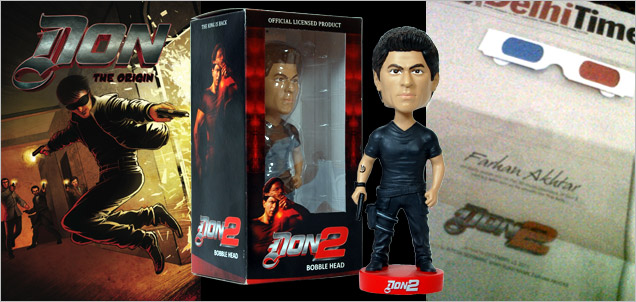
    It’s another SRK release on December 23 and the marketing team for Don 2 is on its feet to get the maximum audience thronging the cinemas to watch the magic of King Khan. The December 19 edition of Bombay, Delhi and Bangalore Times carried a front-page invitation from Farhan Akhtar for the 3D music premiere of the movie on Google +Hangout – with a pair of 3D glasses encouraging people to watch Don 2’s videos in 3D on YouTube. The strategy is to attract audiences as the movie is being released in 2D as well as 3D.


    Priti Shahani, Chief Strategy Officer, Reliance Entertainment, said, “The TOI innovation is a tactical move. For us the strategy for Don 2 has been to partner with marketers and media that reach out to large numbers. We have looked at all platforms that would give us visibility so while our partnership might not be as grand as RaOne, it should reach a large platform.” Don 2 has associated with platform partners and media partners including Sakal, Lokmat and Amar Ujala to reach beyond metros.


    The Don 2 marketing may not be ubiquitous as the blitzkrieg for RaOne, but as Vishal Ramchandani, the Marketing Manager of Excel Entertainment puts it, it has been consistent and concentrated, and peaking at the right time with the movie release slated for this week.


    The marketing effort has been 360-degree including even a comic launch published by Om Books. The comic is on the origin of Don and fills in details on the making of Don, thus acting as a prequel to the sequel. Mr Ramchandani also said that on December 23, two sets of games will be launched, made in collaboration with Gameshastra. These games are compatible on PS3, iPad and Android platforms and are basically shooter games where the player gets to be the Don. The social media presence is taken care of with the Facebook game.


    Mr Ramchandani said, “We have looked at various innovative and interactive ways to connect with the audience. While SRK is a big name, these marketing bursts ensure in keeping the excitement alive. When tickets today are priced around Rs 300-350 in the first week of the launch, there is a need to create urgency to get people to the theatre and these activities help in doing that.”


    Besides the comic and games, there is also a tie-up with Microsoft India where the contest promotes ‘Meet the Don in Berlin’ on various platforms. There is a spin to the Don on the city tours where the hunt is for a Don from each city. This is a positive take on the search for Don. Last week eight cities were toured and more city tours are slated.


    The makers are also relying on the highly popular Don ‘sayings’ and marketing it in a big way. ‘The Don says…’ have been popularized on the 360-degree platform.  These dialogues have also been showcased at cinemas halls and even washrooms, thus trying to catch more eyeballs.


    In terms of merchandise, one can see T-shirts, bobbleheads and Think Tank board games. There are also a few brands present in the movie, though Mr Ramchandani vouches that these associations are not just for the sake of it but is in sync with flow of the story or, as he puts it, “requirement of the script”. Though a number could not be put on the marketing spend, it is estimated to be running into single-digit crores.  Trade pundits suggest that any big ticket movie spends at least Rs 7-8 crore on advertising and marketing.


    Explaining the reason behind marketing even an SRK release, who is a big brand himself, and the need to be promoted aggressively, Ms Shahani said, “Today, the reality is that the shelf life of a movie at best is around 8 weeks and the audience window is even shorter and shrinking. To capture the mind, a brand like SRK helps where like in this movie he stepped out 10 days ago to promote and the impact has been instantaneous. Owning the minds of the audience is impossible today and that’s where marketing and SRK helps.”

  • Mid Day hattrick for AskMe

    By A Correspondent

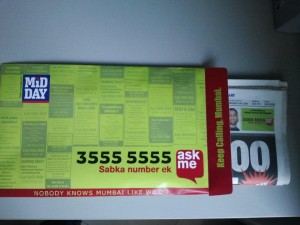
    AskMe was looking at promoting their positioning ‘sabka number ek’ and wanted to generate maximum attention through the promotion. Taking this brief forward, Mid Day created a package for AskMe inside which MiD DAY was wrapped. This package highlighted ‘sabka number ek’ positioning of AskMe along with focus on its features.

    This package was first delivered to Mid Day readers on October 14, 2011. Such was the impact of MiD DAY innovation for AskMe that AskMe implemented the same innovation two more times completing a hattrick for the innovation. Thus a second package was distributed to MiD DAY readers on October 16 and for those who could not grab their Mid Day AskMe package the last two times can grab the third package on October 31.

    Speaking on the innovation, Manajit Ghoshal, MD & CEO, MiD DAY Infomedia Ltd. said, “The effort with this innovation is to stand out and create buzz for our client. This is the third time we doing this innovation within this month which is a testimony to our success at creating hype and packing a punch. The prime motive of the innovation is to communicate in a simple, yet effective manner ensuring call to action. The placement of the number was also very strategic, so as to ensure maximum recall for our readers. Our focus is to adapt to each brand and clients requirement and leverage our strengths to deliver an effective communication platform.”

  • Must make OOH likeable: Daniela Krautsack

    Mainstream advertising is going non-traditional; print media has caught up with viral; it is a manifestation of media in which the logical conclusion seems to be 360° surveillance.

    How does the consumer cope with the futuristic outlook of a media world in which everything seems to be public and nothing is private any more? Does the media industry’s guiding light of ‘branded utility’ justify an unlimited use of hi-tech chips and codes? Who are the consumers that voluntarily jump on the ambient media bandwagon?

    Daniela Krautsack, Media Innovation Strategist, Managing Director, Cows In Jackets, talks about today’s global media trends and visions with a critical eye on their creation, their degree of popularity and their lifespan in an interview with Nibha.


    Q: When did you discover your passion for the non-traditional form of out-of-home media?

    It was about a decade ago when I moved from dreamy but advertising ‘old-school’ in Vienna to London. The company transfer within the MediaCom group offered me three simple things: to watch, listen and learn how international media strategy & co-ordination is done. Today, when I look back, I know how lucky I was. “To be at the right time, at the right place.”

    The ‘Find Your London in Yellow Pages’ campaign got me ‘in touch’ with many new forms of media when I travelled from my home in Belsize Park to work in Soho. From the moment that I walked into the station to the moment I walked into our office door, I was touched by ‘The yellow pages points’.

    The company had advertised on the backside of my ticket and even on the wallet that protected it. The entire train and its seat interior were covered in bright yellow design. Never having experienced transit media in this scope before, I felt intrigued to find out more. That was the moment when my exploration started.


    Q: Does the OOH media industry’s guiding lights of branded utility justify an unlimited use of hi-tech chips and codes?

    I would like to define that term ‘branded utility’ first: it means that brands or ideas are genuinely useful to the people they touch. So, how useful are codes and chips and do they ‘touch’? The integration of codes in OOH media in countries such as Japan where I experienced the use of QR (= quick response; a two-dimensional bar code) and other 2- and 3-dimensional codes years ago has not spread considerably across the world – yet. My experience is that the percentage of mobile phone users that have an application installed which allows reading a QR code, has not even in Japan reached the mass. The use outside of Japan is still insignificantly small in order to consider an OOH campaign that would achieve reasonable results. At present, QR codes can be rated as the best and most effective technology for mobile data capture. What I like about it so much is the thought of reducing OOH media to its core function, the visual transfer of a brand and product image with the focus on “image” rather than “text”. Including a QR code within the design of an advertising campaign that uses billboard or any other ambient OOH form allows a “pull” interaction by the recipient of the message. QR technically allows future billboard designs to use significantly less space to transfer lots of information. If interested in the message, people will connect.

    So, returning to your question: Every way that ‘helps’ the community – and this touches current trends such as “economy of time” symbolizing our aim to efficiently manage time – will be embraced and appreciated. I personally do not fear an unlimited use of this code technology. At the moment companies use codes and chips within their communications strategies predominately to play with people’s curiosity and the media’s enthusiasm and willingness to publish these ‘media-first’s’.


    Q: Who according to you are the consumers that voluntarily jump on the speed media bandwagon?

    I am always quite amused to see how small the number of people is that jump on the media bandwagon. When I visualize this ‘future train’, I only count the number of passengers with two hands. I have just been to a party with a crowd of 20- to 40-year olds, people that you could describe as pretty normal when it comes to adopting trends such as the latest technology and fashion and during a discussion, someone asked: “What is a podcast?” I looked around, astonished to experience this lack of contemporary knowledge. I had to realize that only a handful of people knew that a podcast is a word fusion of the word iPod and broadcast, that it is a digital media file and that podcasts allow you to download or stream content about any topic you care about.

    The consumers who are the clever cookies when it comes to being updated of what’s going on around the world in society, culture and technology are those who jump on. And we don’t necessarily only speak about the ‘young’ crowd. They just adapt easier to new technology because they don’t think about it as much as an older, more experienced media consumer.


    Q: According to you how does the consumer cope with the futuristic outlook of a media world in which everything seems to be public and nothing is private any more? Panopticon or individual freedom of expression?

    When I observe the mood and listen to the opinions of people who share their thoughts about the ‘media’ world we live in, I notice that they appreciate the increased opportunity to express themselves, but they are also aware of being monitored. This place can be visualized as a panopticon. We still have a choice to publically plead for a higher sensibility and reluctance to give out personal data to somebody we do not know. The careless behavior of our society to wildly publish every intimate fact bears a huge risk of violating our private sphere.


    Q: What has been your greatest challenge in ambient media?

    Convincing clients who were very sceptical towards this media form. The other one was the launching of a communications agency, ie  entirely dedicated to ambient media and non-traditional strategies and that too at  a time where taking the risk and trying out new things in communications planning wasn’t fashionable.


    Q: How do you define third place marketing and creativity in the OOH media?

    While ‘first places” represent “the home”, a place that I decorate and feel comfortable living in and ‘second places” the ambience of work, ‘third places’ are landmarks with a core attraction of such extraordinary extent that seeing them is an absolute must; thus talk-of-town organically develops. Third places can be museums, wide-open spaces but also supermarkets and shopping malls. They come to life with light, video projections and special installations. These venues feature an emotionally charged ambience and for which there is no admission fee. Without creativity, I dare to say, a third place doesn’t exist. Creativity is one of the cornerstones of the third place foundation. And OOH media logically benefits from the strength of such an eye-catching place.


    Q: What all factors do you take into account when you make a media strategy, which involves innovation in the ambient media?

    • The objectives of the campaign

    •  The demographics/psychographics, moods and opinions of the target group

    • The brand status

    • The competitors’ activity

    • The creative execution

    • The budget

    • Innovative technologies or never used before ideas, techniques or material

    • A measurement tool / method


    Q: According to you what is the approximate share of ambient media advertising in terms of ad spend when compared to the total ad spend in the OOH media?

    Considering the different definitions of ambient media (in the UK, the media industry does not even use this term anymore, they call it non-traditional OOH or brand experience or shopper marketing or stunt, etc) worldwide, I can only give a rough estimate. I just looked at the OOH share in Austria, the UK, Mexico and India and it is quite similar, roughly between 5.5 percent to 7.6 percent, Mexico showing the smallest share and India the highest OOH share.

    While ambient media is a category still not being monitored in most countries in the world, the UK reports approximately a share of 6 percent. This however does not consider guerilla, ambush and experiential marketing, sampling, promotions and events. It is clear though that this is a category that will continue to grow.


    Q: How do you see the scope of ambient media in South-East Asian countries and Africa and where does India stand among all?

    Overall speaking there is a large potential for ambient media throughout Asia and Africa. Whereas we experience a counter movement by ‘the new’ traditionalist opinion leaders in cities across Europe and the United States that plead and demonstrate for an advertising-free ambience, the outdoor category overall is growing. We are challenged to create OOH media not only in a more visually attractive way but also in one that is considered as a “useful” platform again, e.g. as an information platform that hopefully focuses on core images and incorporates technological measures (e.g. code technology) to allow information to be picked-up when needed. The important model for the future is to position OOH media as “a likeable platform” that interacts with the life of city inhabitants; media to stimulate opinions and thoughts, to inform and to entertain.

    Due to its high level of ambient media activity, Thailand has become a role model for non-traditional media in the Southeast-Asian market. Some of the award winning ambient media campaigns were developed in Bangkok and rolled out across Asia. According to my own observation in India as well as the opinion of local media experts, the potential for ambient media in India is considerable. The biggest challenge for India is not the lack of investment or funds – it is about finding clever solutions to scale ideas across India and the increase execution opportunities outside main metro-cities.