
Tag: influencers

  • Cult of the Influencer CEO


    By  Bhuvi Gupta

    Bhuvi GuptaElon Musk. Anand Mahindra. Manu Kumar Jain. Anuj Sharma. Thomas Edison. Richard Branson. Steve Jobs.


    What do all the above have in common? Well, a lot. They are all CEOs of companies, which have impacted the world via their products either technologically or pricewise. But what they also have in common is a strong personal brand, which was bigger than the company they led, and which helped that company more than a brand ambassador might have. If Edison, Jobs and Branson are anything to go by, what is noteworthy is that while digital has made it easier, carefully crafting and curating personal brands can have immeasurable impact on the company irrespective of how they have being built.
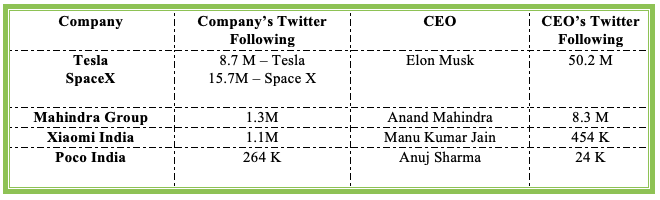
     

    CEOs who have leveraged their personal brand to great effect to help the company have follower counts which compete with their company’s


    The cult of the CEO has always existed. Digital access has made it easier to leverage it even as curating a personal brand remains as difficult. But with the sheer din of marketing messaging and competition for quality talent, companies are missing out if they don’t leverage their CEOs.


    Firstly, because it is such a great source of gathering information from customers, and (junior) employees who communicate actual issues, which often a times get lost in Chinese whispers while going from middle to senior management.


    Secondly, an active and engaged CEO as the face of the brand helps in building trust and credibility over and above celebrity brand endorsers who are endorsing multiple brands and on-hire for the highest bidder. Hence, while celebrities may help build brand awareness, they won’t contribute as much to help target consumers travel down the marketing funnel.


    Thirdly, a responsive CEO makes the company and brand approachable. All consumers want to feel heard and a CEO who is willing to listen to feedback, compliments and complaints makes the audience all the more invested in the product and brand.


    Anand Mahindra explains how much his followers on Twitter have helped him connect to both employees and consumers thereby enabling him to become a Big Brother of sorts to reward good behaviour and correct wrongdoings.


    When the CEO gets feedback so freely it also reduces the need for traditional market research where extrapolated data and inaccurately curated focus groups can often result in wrong takeaways. Hence, a CEO who can remain connected to his audience can greatly help the company’s overall strategy and speed of execution.


    Lastly, an engaged CEO acts as a great tool to build the employer brand. Having a strong personal brand (also crucial to help gain followers in the first place) will help showcase a company’s values and help attract talent which resonates much more than that ‘Great Places to Work’ Badge.


    Using your employees as influencers – Employee Advocacy Programmes


    While all the above reasons have high impact coming from the CEO, in 2021, with a socially connected population all employees have a sphere of influence that collectively can help a company via Employee Advocacy programs.


    Creating a strong brand for a CEO requires the creation of a personal brand backed by a robust content calendar, ORM (Online Reputation Management), PR and public appearances.


    Employees, if guided and empowered with similar tools and content, can become brand evangelists on social media, while also getting positioned as subject matter experts and create stronger personal brands.


    A well-implemented employee advocacy programme raises brand awareness, improves customer satisfaction, saves money in marketing spending, and, ultimately, grows business in much the same way as an Influencer CEO albeit at a micro level.


    It is very interesting to see the power that influence has on consumption. Whether coming from CEOs, celebrities, or content creators, social media in 2021 has made business & marketing come a full circle with influencers  launching their own brands and CEOs are becoming influencers.

  • In a world full of influencers, are celeb-endorsements worth it?


    By Bhuvi Gupta


    Bhuvi GuptaIt was 2015, Diwali had just passed and Snapdeal was one of the three big e-commerce players in India with Bollywood icon Aamir Khan as its brand ambassador. A personal comment by Khan at the Ramnath Goenka Awards event launched the first boycott trend online for Khan-endorsed Snapdeal, whose Play Store ratings plummeted, orders got returned. Despite the official statement released disassociating itself from both the brand ambassador and his views, the damage had been done. Aamir Khan was soon fired from his role as brand ambassador.


    Khan has since learnt his lesson and kept his personal opinions to himself, a dictum closely followed by the other two Khans as well (controversy’s favourite child, Saif Ali Khan not included!). But it was definitely the first time I thought about the wastefulness of celebrity endorsements, a point of view that has only since strengthened.


    Why do brands turn to celebrities?


    The simplest reason for using celebrity endorsers is for the awareness they help generate.  For most mass market brands in crowded marketplaces and high advertising budgets, a celebrity endorser is an easy and sureshot way of getting recall. The Duff& Phelps Celebrity Brand Valuation report which came out last week, showcases the same – despite the decrease in advertising budgets, the brand valuation of the Top 20 celebrities has remained more or less consistent at USD 1 billion. To get the most bang for your buck, a brand is only limited to signing these top 20 celebrities who are neither cheap nor easily available.


    Going any farther down the totem pole, especially when budgets have to be devoted to ensure a purchase decision is made is just not worth it.


    Consumers are also well aware that celebrities do not have any brand loyalty and are not really endorsing the product. This is evident when celebs routinely jump to competitor brands and claim innocence when the brand is found not to meet safety standards.


    Circling back to my initial thought, in 2021, brands no longer need to be dependent on celebrities to drive awareness. A much better option is effective influencer marketing.


    Why Influencer Marketing?


    The biggest differential that influencer marketing has with respect to celebrity-focused advertising is that (the right) influencers are believable, trustworthy and authentic.  An influencer post will typically have much higher quality with longer captions and explanations, and engagement by them in the comments section.


    Hence, when an influencer creates content recommending a product it doesn’t feel like an advertisement but like a close friend sharing a secret about something he or she liked. Hence, a brand endorsement from them really means something and can drive sales conversions.


    Secondly, most influencers have a specific niche and loyal audiences.  Therefore, even though their audience is a lot narrower, it is more focused than a typical celebrity’s audience.


    Thirdly, the influencer marketing industry in India has matured. Influencers are no longer hired purely on the basis of their follower count but also include parameters like average engagement rates and their demographic profile. Hence choosing influencers whether to target a specific geography or a specific interest is easier.


    Fourthly, influencer marketing is accessible. Unlike celebrity endorsements which can only be afforded by brands with deep pockets, a successful influencer campaign can cost as low as a few lakh, if one chooses to use nano-influencers (follower counts of less than 20,000) in their campaign.


    Fifthly, with the influencer marketing industry maturing, Advertising Standards Council of India (ASCI), announced plans to roll out new norms for social media influencers to promote products on the Internet. (Link – https://www.news18.com/news/tech/guidelines-for-influencers-are-incoming-a-few-folks-and-brands-must-be-very-worried-2350469.html) While the guidelines are awaited, once in place, either celebrity endorsement campaigns will reduce drastically or become a lot more cost-effective.


    In conclusion, testimonials and endorsements have been a mainstay in marketing for many years. Influencers combine the best of the word-of-mouth recommendation with the reach of a celebrity to help brands cover the distance between awareness to action in the marketing life cycle. With the influencer industry maturing, brands must move budgets from celebrities to influencers to get the most bang for their buck.

  • India Influence Report 2020 casts positive outlook post Covid-19

    By A Correspondent


    The influencer marketing industry is confident of rebounding once the Covid-19 lockdown is lifted in a phased manner. According to the third edition of the India Influence Report conducted by Zefmo Media, 72 percent of the respondents expressed their confidence in the revival of influencer marketing by leading brands of the country.


    In addition, the survey also revealed that average monthly influencer earning in 2019 crossed INR 5,000 (India Rupees five thousand) in India to become a viable profession for millions of people in the country. However, the outlook for 2020 remains cautious as over 95 percent influencers foresee a dip in earnings due to the Covid-19 impact on the overall industry. The survey insights are especially relevant in the current context as the industry will be grappling with viable options to regain the market once the lockdown is lifted. It also substantiates influencer marketing as a potential vocational avenue for millions of digitally connected and socially active Indians to make an earning while creating meaningful content.


    As part of this annual survey, more than 1500 influencers participated in a nationwide survey to gauge the pulse of the influencer landscape in a world that is under the shadow of lockdown due to the Coronavirus pandemic. However, 83 percent of the influencers have indicated that working from the confines of their homes will not be a constraint in creating new content and will not hinder their ability to improvise since they are not able to venture outdoors. At the same time, 92 percent of the respondents are either already innovating or plan to innovate their content creation strategy in wake of travel and public gathering restrictions across the globe. An overwhelming section of the influencers, about 77 percent have created organic Covid-19 related content in support of the nationwide fight and close to 80 percent of them plan to continue creating content to spread more awareness around the pandemic.


    Said Shudeep Majumdar, Co-founder and CEO of Zefmo Media: “In the third edition of the India Influence Report, we focussed on the influencer community, whereas the first two editions leaned towards the brands. The survey findings clearly tell us that well-thought-out, and co-created content by influencers can boost the quality of content for brands during uncertain times. With the lockdown in force and lack of other marketing channels,  influencers are confident that the brands will lean on them to deliver contextual content to keep audiences engaged amid the COVID-19 crisis. While the influencer earnings in 2020 will be impacted, more number of millennials will find their calling in influencer marketing than anywhere else in the world. This is truly democratization of independent content creation which can be commercially remunerative as well.”


    The influencers also indicated a number of challenges when it came to content creation. A majority of them, about 55 percent, find it tough to shoot and edit photos or videos in the absence of readily available professionals to do the same. Perhaps because of this, almost half of the respondents, about 49 percent are also reskilling themselves in audio and video editing among other skill-sets, thereby reducing their dependency on outsourced professionals. Erratic cellular data network and broadband speed is a major issue faced by 64 percent of the influencers; two out of three respondents citing internet connectivity as a major issue belongs to non-metro areas of the country.


    Above all, due to the lockdown, product reviews have completely stalled, but 47 percent of the influencers have indicated doing reviews of older products or doing more detailed feature reviews to sustain the connection with their followers. As brands will adjust their marketing spends to limit the outflow of cash, 73 percent of the influencers feel that brands will engage them on longer-term contracts rather than one-off paid posts, thus driving economies of scale in addition to the audience connect. In terms of technological adaptations, 58 percent of the influencers have either embarked or are currently evaluating live sessions and webinars on a periodic basis to engage with their audiences in real-time.


    The survey was able to gauge a shift in trend towards the emergence of newer genres of content creation by influencers – 64 percent of the influencers are open to trying out a new genre to keep themselves relevant in the ‘social universe’. The top-ten content genres that are likely to emerge in the current scenario include, (1) health & wellbeing, (2) food & nutrition, (3) comedy & satire, (4) do-it-yourself (DIY), (6) music & dance, (7) training & education, (8) fashion & makeup, (9) career & personal finance, and (10) motivation & mental health.