Tag: inflation

  • Kejriwal’s TOI article: same old same old

    By Ranjona Banerji


    Arvind Kejriwal has reached out to fellow Indians in a plea in The Times of India today. The front page of The Times of India says ‘Team Anna confused, does not know the way forward’. It quotes from an article which Kejriwal has written for the paper. But while the front page report talks about the “apparent” confusion in Team Anna, especially after it has been attacked for going after the Congress while being soft on other parties, Kejriwal’s article is, in fact, the same old same old. He does not talk about the Mumbai debacle; he adds a throwaway line about the BJP and corruption but concentrates the article on the perfidy of the Congress.


    Anna Hazare’s ill-health, he conjectures, had more to do with the bad Lokpal bill presented by the government than anything else. If one can venture an opinion, it is this single-minded insistence on attacking only the Congress which has worked against Team Anna. If it loses media sponsorship, it might find the way forward a tad tough. Kejriwal has asked concerned citizens for ideas on how the movement should proceed. It will be interesting to see those suggestions.


    Meanwhile, Hazare’s health remains a matter of concern, with most newspapers and channels focusing on it. TV continues to target members of the anti-corruption movement. The BJP is not the flavour of the week at the moment and if you do not come out strongly against it, then TV will not forgive you – this week at least. This leaves the leaders of the anti-corruption movement floundering a bit since they have not had their core committee meeting to decide on what to do yet! Till the triumvirate speaks, all are lost!


    * * *


    The Indian traders who were detained/ tortured/ attacked in China got so much play on TV that newspapers have started giving the incident more attention. Of course, newspapers have the advantage of setting aside nationalistic outrage and looking at the larger picture. Which includes: other traders not wanting to stop going to that part of China since stuff there is cheap and China requesting Indian traders to follow their laws! This makes for a much larger and more complicated story.


    * * *


    Inflation is down the newspapers tell us and interest rates may be cut as well. Presumably, this is good news.


    * * *


    Will Friday night and Saturday morning be all about slamming the Indian cricket team for its dismal performance so far in Australia? I’m not a fortune teller but my crystal ball says that heavy weather is approaching for MS Dhoni and company!


  • The MxMIndia LookBacks for 2011


    LookBack 2011 coordinated by Ritu Midha


    By Ritu Midha

    The year 2011 has been full of ups and downs for the global economy. While it started on an optimistic note, the projections have been revised downwards several times since.


    LOOKBACK 2011
    The Year in News Media (Ranjona Banerji)
    Middle India on overdrive (Nielsen report)
    Top TV & Print Spenders
    The Year for GECs
    The Year for News TV
    What creative & media agencies won
    People Movements
    The winnings
    Filmwallahs dominate endorsements
    11 Noteworthy Happenings (Tuhina Anand)

    India was no exception – though it was largely due to the global slowdown – the government’s foot-dragger approach to many a policy, and high inflation rate did not help the matters any.


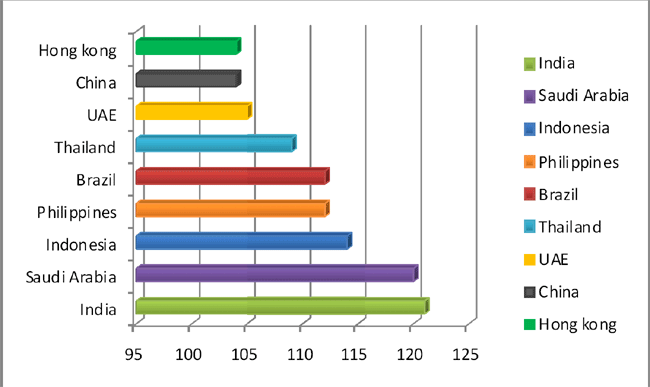
    The slowdown has led to tightened purse strings, however as per a Nielsen report, ‘Global Online Consumer Confidence, Concerns and Spending Intentions – 3rd Quarter, 2011’:  consumer sentiment in India is the most optimistic in the world, for the seventh quarter in a row. (Data Source: Nielsen global consumer online confidence survey, Q3, 2011)


    Click here to download the report from Nielsen website


    As for the economy, in January, World Bank predicted that in the year 2012, India would grow at a pace of 8.7 per cent (and the oft-compared economy, China would grow at a slower pace of 8.4 per cent).


    There is too much water under the bridge since then, and current fiscal is now expected to show growth figures of around 7%, as per Fitch, the credit rating agency.


    However, hope is back for 2012, with credit rating agencies reaffirming India’s ratings in the fag end of 2011.


    Moody’s, in a recently released report, reaffirmed India’s sovereign rating at BAA3. Though it has added that growth downturn is likely to persist for two more quarters.


    As per data released by Fitch in December 2011, the economy is likely to grow by 7.5 per cent in 2012-13. Though, in the current fiscal it is likely to be around 7 per cent.


    Interestingly, the government’s forecast is 7.5 per cent growth in the current fiscal. In its mid-year review released in mid-December, the government revised the growth projection to 7.5 per cent from 9 per cent forecasted in the pre-Budget survey.


    Another good news coming at the end of the year is easing out of food inflation. The index stood at 1.81 per cent in the period up to December10, 2011, while in the previous week it was at 4.35 per cent. The reason behind the improved numbers is the fall in the prices of cereals and vegetables.


    Inflation, till now, has led to a sharp increase in raw material prices, hurting the FMCG companies. As a result, leading FMCG companies like Hindustan Unilever, Procter & Gamble, Reckitt Benckiser, Godrej Consumer Products, Marico and Dabur were compelled to increase their product prices.


    However, according to a report by FICCI, the Indian FMCG market is now expected to grow at rate of 10 per cent (current estimates: Rs 2,600 crore) over the next 10 years and reach a size of Rs 4,13,000 crore by 2015, which would further increase to Rs 6,65,000 crore by 2020. It is good news for media fraternity, as FMCG is their main stay.


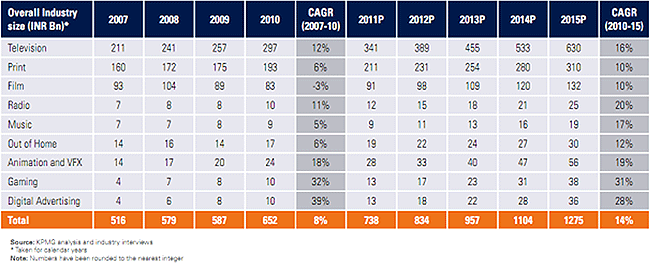
    In this back drop, let us check growth expectations of the media industry. In the beginning of the year, KPMG had predicted that the industry size would grow to Rs 341 billion – an approximate growth of 16 per cent.


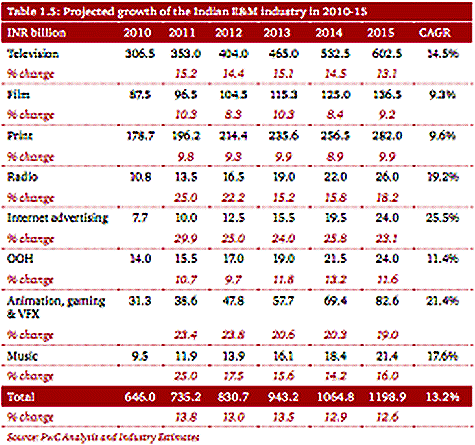
    Meanwhile, as per PricewaterhouseCoopers estimates, the entertainment and media (E&M) industry in 2010 stood at Rs 646 billion as compared to Rs 580.8 billion in 2009.  This was lower than the projected growth rate of 15.1 per cent for last year. The reason for lower growth rate was the decline witnessed in the film segment. The other two key industry segments: television (15.4 per cent growth as compared to 15.6 per cent projected) and print (10.7 per cent as compared to 8.5 per cent projected), showed good growth. As per the estimates, the E&M industry size would have been Rs 735 billion for 2011, but this does not look achievable now.


    In December, both Zenith Optimedia and group M indicated a sluggish growth for 2012 globally.


    As per Zenith Optimedia, global ad spending in major media will grow to $486 billion (4.7 per cent growth). It had earlier predicted a 5.3 per cent growth in 2012. However, Asia Pacific (excluding Japan) is expected to grow by an average 10.4 per cent a year and 33 per cent of the global growth is expected to come from the four Bric markets (Brazil, Russia, India, China).


    Group M, meanwhile expects a 6.4 per cent increase in global ad spending in 2012, As for 2011, it expected to show a 5 per cent increase in ad spends over 2010, to $490 billion.


    As for India, the experts believe that growth rate in 2011 would be in single digits, while Zenith Optimedia prediction of around 11% growth might hold true of 2012.


    Look out for the second part of our yearenders tomorrow

  • Newswatch by Madan Sabnavis: In media showbiz, real figures take a backseat

    By Madan Sabnavis


    Media is not unlike showbiz. Everybody wants to be a part of the action and the media is the vehicle to fame. Given the intense competition, it is but natural that every newspaper wants to be one up and every television channel would like to be the first to flash breaking news. Suddenly, even a standard release from the government becomes breaking news for the first channel that flashes the story. From politics to economics, it is the same story.


    The economic travails that we are facing today have grabbed headlines as well as eyeballs, thanks to the media, which is a powerful tool for conveying an idea, as we have witnessed in 2011.


    The media’s main focus has been on the policymakers and critics, which added zing to otherwise insipid developments. It is not thatIndiais crawling this year. Growth is reasonable, inflation is high, though not unusual as we have had such patterns in the past and the entire hullabaloo on exchange rate is again not really happening for the first time. But all this has come to the fore due to incessant media attention, and in a way, has gotten exaggerated. How fair has this exposure been?


    The interesting fact here has been the prevalence of the same basic laws of economics – demand and supply of such views in the media industry. TV channels have hours dedicated to business and economy. As every economic indicator is supposed to affect the stock market, it merits fixed hours of discussion. There are time spaces to fill in with views which get in the big names. This has led to constant interactions with government officials, policy makers, bureaucrats, ex-bureaucrats, economists, CEOs, CFOs, journalists, academicians, journalists, and so on.


    More importantly everybody wants the top names in the field, though the rather amusing outcome is that we have the same set of 10-20 experts in each of the fields who circulate the same, standard views.


    There is, in a way, nothing really wrong here, but there may have been a tendency to over-react at times as we have started viewing every economic detail on a realtime basis.


    Today, economic data in India comes with lags. There is a two-week lag for wholesale prices, a month for exports, consumer prices and industrial data. The lag becomes almost a quarter for GDP numbers. To top it all, there are revisions which can be quite horrendous, since the experts look like having contradicted themselves as they comment based on the information provided at that particular point of time. Now the broader question is whether we should believe such data.


    Why do we want to minutely dissect such high frequency data when we know that there will be changes subsequently? This is important because all such data and interpretations invariably affect stock market and investment decisions. If all experts say that interest rates will rise, then individuals will shift to bank deposits, just like how mutual funds may become attractive in case the majority view is that the economy is on track and booming.


    With a tendency for over-exposure and the willingness or over-enthusiasm of experts to come online, there may have been a situation of overstating cases. Generally speaking, theory will say that economies do not function in one week or month, but on a cumulative basis during a year. This being the case, in the past we have been looking only at cumulative numbers.


    But today if one channel looks at month-over-month numbers, all have to do it to stay in the race. This means forcing the speakers to comment or give their forecasts which they have to do once they are on the phone or on camera.


    This has led to a proliferation in the numbers being given on each and every economic indicator by the same person in a short span of time, say one month. When queried on reactions to a dismal number, which is actually a tautological question, the answer has to be that the person is dismayed or surprised or shocked or concerned. But actually, they may not really know why the number turned out to be abysmal.


    The official stance always talks of recoveries in the rest of the year while the corporates will always paint a doomsday picture when interest rates have risen. This, in turn, can drive an opinion.


    Things have hence been magnified throughout the media on account of relatively higher frequency of economic releases which still are subject to revisions.


    Unfortunately there has been a tendency for single numbers to be blown up and the complete picture obfuscated to drive home a point. We have not really had any novel solutions offered in this plethora of debates.


    Let us see some of them: We need to have reforms. But did we not have a good economic picture without these reforms in the past? We need to lower interest rates to help industry. Is industry the only sector driving the economy and is this the only constituency that matters? We should stop predatory competition fromChinawhich affects us. But if the product is an import going into your product, would the stance be the same? There is policy paralysis. But this cannot be a solution when the world is going through a slowdown and everyone has to adjust.


    Surprisingly, we do not hear western critics saying that there is policy paralysis in the Eurozone which is holding back growth – there as it is understood that all crisis situations take time to resolve as there are various constituencies involved.


    How then does one evaluate the performance of the media in bringing to the fore the economic crisis that we are living with? There is a plethora of views, with few interpretations. The viewer or reader has to make a choice and often times, by virtue of selection of the commentators or experts, ends up getting confused.


    As the media invariably represents a single view in a market economy, it has helped to bring to the fore the issues, though admittedly, government action is based on a larger public concerns and hence has remained susceptible to media bashing.


    We have not really had workable solutions coming forth in these discussions. But, nonetheless it has helped to stoke a lot of debate and create awareness of issues which hitherto would have been confined to only a certain section of people. To this extent, it is a job well done. What about the experts who keep giving their views relentlessly on the same lines? To quote Oscar Wilde, to be in it is merely a bore. But to be out of it is simply a tragedy. It’s showbiz after all.


    Madan Sabnavis is Chief Economist, CARE Ratings. The views expressed are personal.