Tag: Indian Readership Survey

  • MRUC releases IRS 2019/Q3

    By A Correspondent


    Just last evening young Ramesh was celebrating with his family that his parents would celebrate New Years’ Eve at home with him. He still recalls how the big Independence Day holiday that he was hoping to celebrate got messed thanks to IRS 2019/Q2 being released. But alas, Ramesh’s dream of a holiday are going to be shortlived. Earlier today (December 28), at 5.08am to be precise, our inbox received the all-important communique:


    The Media Research Users Council (MRUC) has announced the release of IRS 2019Q3 data. The 2019Q3 data is a rolling average of the last quarter of IRS 2017 (Q4) and three quarters of IRS 2019 (Q1+Q2+Q3). IRS 2019Q3 fieldwork covers August 2019 through November 2019.


    Notes a communique: “Multimedia consumption is the order of the day with each medium holding on to their loyal consumers. Overall media reach has grown with digital leading the growth trajectory.”


    In view of sample shortfall in Andhra Pradesh, the IRS Technical Committee has decided to release IRS 2019Q3 data excluding AP, as of now. The IRS 2019Q3 data including AP will be released in a fortnight’s time. Comparative analysis until then, at all India level, will not be permissible. While the reporting sample size at all India level (including AP) is 3.30 Lakh Households (Urban: 2.14L Households and Rural: 1.15L Households), without AP, the reported all India sample size will be 3.15Lakh Households (2.05L HH in Urban and 1.09L HH in Rural).


    IRS2019Q3 fieldwork in Jammu and Kashmir was adversely affected because of political and administrative developments in the State (now union territory). In consultation with the IRS Technical Committee, it has been decided to report J&K data  by utilising and projecting the last four quarters of IRS data i.e. Q3+Q4 2017 and Q1+Q2 2019 to the updated universe for the current round of IRS 2019Q3.


    Commenting on the release of IRS 2019Q3 data, Pratap Pawar, Chairman, Sakal Media and Chairman of MRUC said, “IRS being the world’s largest survey not only reflects the ground reality in terms of print readership, but also for other media and product consumption. The stringent field monitoring system, rigorous data validation processes and the overall methodology of IRS ensures the industry gets a robust and reliable data.”

    Added Vikram Sakhuja, Group CEO Madison Media & OOH, Madison World and IRS Technical Committee Chairman: “The IRS is a fascinating barometer of how India consumes Media.  From this round we see that Indians consumption of media continues to grow with digital growing on top of other mediums remaining steady. I would urge all marketers to deep dive into the data. There are fascinating insights about the diversity that is India waiting to be found.”


    Please click here for deck of IRS 2019Q3 Highlights

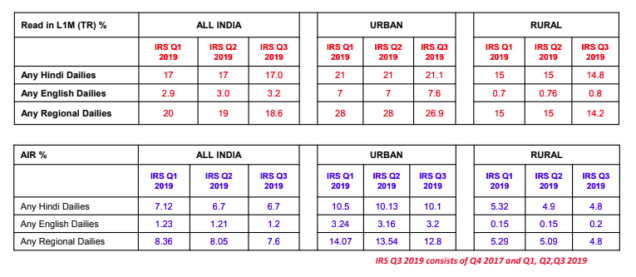
    Some pointers from the all-important AIR and TR slide:

    • English readership grows. Grows or stays steady in most of the country except for Uttarakhand where it has gone down by 1%

    • AIR Hindi dailies All-India is the same vis Q2. Urban has degrown by 0.03%. Rural goes down by 0.01%

    • AIR English dailies vis-a-vis Q2 All-India has degrown by 0.01%. Urban has grown by 0.04% and rural also by 0.05%

    • Any Regional dailies AIR: vis-a-vis Q2 AIR has gone down by 0.09% in All-India. Urban has gone down by 0.06%, and Rural by 0.29%

    • TR Hindi dailies All-India is the same vis Q2. Urban has grown by 0.1%. Rural goes down by 0.2%

    • TR English dailies vis-a-vis Q2 All-India has grown by 0.2%. Urban by as high as 0.6% and rural also by 0.04%

    • Any Regional dailies TR: vis-a-vis Q2 AIR has gone down by 0.4% in All-India. Urban has gone down by 1.1%, and Rural by 0.8%


  • MRUC issues RFP for research agency partner

    By A Correspondent


    MRUC has issued an RFP (Request for Proposal) inviting research partners to pitch for the contract to conduct the Indian Readership Survey. MRUC’s contract with the incumbent agency, Nielsen India, concludes with the release of the last and final quarter of IRS 2019data – Q42019.


    Pratap Pawar

    Said Pratap Pawar, Chairman, MRUC and Chairman of Sakal Media: “We are looking forward to receiving and studying each and every proposal from various research agencies. They will be evaluated basis their understanding on IRS, on meeting our research requirements stated in the RFP and of course what more they can offer beyond our stated requirements.”


    Shashi Sinha

    Added Shashi Sinha, Vice Chairman, MRUC and CEO of IPG Media Brands: “Security enhancements and measures taken to ensure accuracy in data will be some of the key objectives in selecting the new research partner. We will be working closely with industry stakeholders in the selection process and ensure the industry gets the best partner to conduct the world’s largest study – IRS”.


    Vikram Sakhuja

    Said Vikram Sakhuja, Chairman, IRS Technical Committee and Group CEO Media & OOH, Madison: “Over the years we have brought in a lot of automation, technology and controls to ensure that we get valid and reliable data for IRS – India’s most widely used Media establishment study. In this RFP we are looking for an Agency who can give us confidence in their mastery in Fieldwork, and who can impress us on enhancing the controls while minimizing the cost. I wish all participants the very best.”


  • Are our Print Pashas mature enough to accept IRS 2017?


    By Pradyuman Maheshwari


    The Indian print industry is much-pampered. While television should rule in a country with a low literacy rate, it’s the print players who appear to get all the sops. There’s a 5 per cent GST on advertising in print. It’s 18 per cent in other media.

    There is no restriction on advertising volume in print. And there is no government rulings or guidelines for bodies in the business of audience/reader measurement of newspapers and magazines.

    Net-net, it’s a near-free-for-all.

    Now what happens when you leave kids without any control. They can grow to be very independent and confident adults, or can go offtrack. Our print players may not have gone astray, but it wouldn’t be incorrect to say that many of them have acted with loads of immaturity when it comes to readership measurement.

    We aren’t recommending government intervention in monitoring as the broadcasters led by news channels invited upon themselves, but there’s reason for worry given that the Advertising Agencies Association of India and the Indian Society of Advertisers, the two apex bodies of agencies and clients, haven’t flexed their muscles and told newspapers and magazines that if they reject measurement studies, they will not get any ads.

    IRS 2017 is due to be released in the third week of January 2017. While there is no specific date given, this would mean any day starting Monday, Jan 15 to Friday, January 19.

    According to a communique, the “IRS Techcom, RSCI, MRUC along with the Nielsen team have left no stone unturned in their endeavour to provide the industry with a reliable and robust study. The team focussed on enhanced levels of scrutiny adopted via frequent field visits, backchecks, use of GPS tracking devices, audio recordings, and quarterly validations. There was also an encouraging response from media agency personnel who took part in field backchecks and accompaniments. Data validation for all the four fieldwork quarters for IRS 2017 was successfully completed last month.”


    Commenting on the release of the report, Ashish Bhasin, Chairman, MRUC and Chairman and CEO – South Asia, Dentsu Aegis Networks, said: “Absence of IRS data in the past three years or so has impacted our industry in many ways. It was difficult for the agencies to plan without the availability of a comprehensive and reliable study, which provides valuable information on product ownership, demographics, and media consumption habits, across markets. Advertisers and Publishers, in particular, relied heavily on intuition and market perception, leading to loss of opportunity in maximising profitability. We are delighted that the IRS is back and we expect that this will set a new standard for Print Research globally.”


    Pratap Pawar, Vice Chairman, MRUC and Chairman, Sakal Media Group, added, “The print industry has been eagerly awaiting the release of IRS. I would like to thank the stakeholders for having shown tremendous patience and also for providing their unstinted support to the industry study, which was really great to see. Going forward MRUC and the IRS would continue to deliver the best and tread on higher paths of glory.”


    And this is what Shashi Sinha, RSCI Managing Committee Chairman, and CEO, IPG Media Brands, stated: “There is no other readership study in the world other than the IRS that caters to a complex and diverse market like India with a sample as large as 3 lakhs plus households, and with a methodology designed to deliver gold standard research. I believe the RSCI Techcom and the MRUC has put in a lot of effort to perfect the upcoming Report, making it future-ready and synonymous with the market truths.”


    Added NP Sathyamurthy, Chairman – RSCI Technical Committee and Executive Director, DDB Mudra Group: “After months and months of dedication, we have come out with a product that we believe is truly world-class. The IRS has constantly innovated with new technology led solutions to improve veracity of data capture quarter-on-quarter, and the sheer focus on data scrutiny which we deployed makes us believe that the new improved IRS would reap rich dividends for the industry stakeholders.”


    It’s important to read the above quotes at what they are stating and what’s possibly written between the lines:


    So let’s interpret these quotes for you:


    Ashish Bhasin: Lack of measurement data has nailed the industry and resulted in loss of opportunity in maximising profitability of newspapers doing well.

    Pratap Pawar: Thanks for the patience folks, we are back.

    Shashi Sinha: Conducting an IRS is a complex task but we’ve achieved it

    NP Sathyamurthy: It’s new, improved


    Now here’s what the four gentlemen possibly wanted to say, but they couldn’t have in an official communique:


    Bhasin: If you don’t accept IRS 2017 as currency, print players are going to get screwed

    Pawar: Grow up, guys. Accept the data.

    Sinha: We’ve done as well as we can. It’s robust. Now junk it at your own peril

    Sathyamurthy: We’ve taken care to not repeat the mistakes of the past, so please accept the data

    Having tracked readership and audience measurement systems actively for a while, it’s clear that it’s a lose-lose if the print majors rejected IRS 2017.


    According to the grapevine, the going may not be as bad as it was the last time. Care has been taken to plug all possible holes, and ensure that there are no booboos. Also, the data has been validated and is kind-of under control.


    But it’s possible that English newspapers will take a hit given the emergence of digital as a big force. And this could lead to some angst. It’s possible that there will be some reversal of fortunes among some regional players too given that a lot has happened over the last five years.


    Does this mean that there could be litigation and MRUC/RSCI will be taken to court? It would be foolhardy to think there wouldn’t be. And MRUC/RSCI would be well-advised to have their lawyer retainership renewed and ready with her/his arguments.


    ~~


    It’s important to note here the tremendous work done on the establishment of BARC for television measurement in the last three years. That BARC has been a super success despite the stakes being much higher in television is thanks to a variety of factors.


    1. Television is largely professionals-driven. While owners are active, professionals understand the dynamics of the business and do know that what is down can also go up.

    2. The importance of the owners and CEOs to deal with data with maturity. One of the primary reasons for BARC taking off was the presence of Punit Goenka as Chairman. Despite flagship channel being humbled in the first few weeks, Goenka is said to have given the green signal to the launch of BARC. Does MRUC/RSCI have someone who is even close to Punit Goenka in terms of maturity to deal with indifferent data?

    3. A robust technical committee: The BARC techcom is headed by IPG Mediabrands CEO Shashi Sinha, who heads RSCI, the real ‘custodian’ of the IRS. It’s critical for any techcom to be wordly wise as well as firm and able to take along the diverse ecosystem. Sinha managed that fantastically, and the print sector is lucky to have him active on IRS.

    4. A superstrong secretariat. No industry-owned body can be successful if you do not have a secretariat that’s strong and can ward off the nasty (if not evil) forces. In CEO Partho Dasgupta, BARC had that. The next few months will need MRUC CEO Radhesh Uchil to be the same with all the holy cows of the business. And if necessary bare his fangs…


    At MxMIndia, we will monitor the launch of IRS 2017 and also give you the real story post that. But in the interests of the industry and the print sector, we hope we don’t have to do burn the midnight oil post the launch.
  • Exclusive! BARC in talks to buy TAM?


    By A Correspondent


    Entertainment television is all about twists and turn in the fictional serials. Cricket, as you would’ve heard several times over, is a game of glorious uncertainties. So why then should there be surprise over the possibility of BARC buying up TAM.

    Okay, let’s cut the tease. Broadcast Audience Research Council (BARC) has indeed been in discussions to buy the television audience measurement business of TAM, the firm jointly owned by WPP’s Kantar Media Research and Nielsen. And, yes, it’s March 12 today, not April 1.

    According to reasonably reliable sources, there have been a detailed dialogue between the joint industry body-managed BARC and TAM owners Kantar and Nielsen. The talks haven’t concluded yet and the mid-point formula that was suggested by a WPP representative has been reportedly rejected by BARC bosses.

    Both BARC and TAM were unavailable for comment, but from what one learns, BARC was seriously considering the buy.

    So why gobble up TAM when the audience research measurement activity of the measurement body was under question? Well, even as doubts were being raised, there is no denying that broadcasters, advertisers and media agency use TAM as the currency for their buying decisions. Also, as industry analyst told us, TAM comes with a ready 12,000-odd panel, established processes and teams and archival data.

    And from TAM’s point of view, why sell out to BARC? Given that all stakeholders have contributed to the BARC kitty, it’s evident that sooner or later all TAM subscribers will exit the system or want to renegotiate. Given this, it’s best to sell the existing well-oiled measurement machinery to BARC which would find it of use, said the analyst we spoke to earlier.

    TAM has already made it known to subscribers (and the media) that it will continue operations even as there is a significant number (in billings at least) of subscribers who have said they would like to unsubscribe. If TAM continues to exist, there will be several comparisons made with the new measurement system, and those subscribers who may be rated poorly by the BARC system vis-a-vis TAM may quote the latter. This could even lead to advertisers questioning the BARC data and hence cause a confusion in the marketplace.

    As reported on MxMIndia earlier, the ghost of the Indian Readership Survey has raised anxiety levels in the industry. For, MRUC and RSCI, the bodies running IRS are jointly run and owned by various stakeholders in the industry. And despite it being an industry association, print players are up in arms against the new IRS.

    BARC, meanwhile, is said to be only in the discussion with the television audience measurement business of TAM. Other divisions such as the Strategy or S Group which offers advisory service on measurement, AdEx India, RAM for radio audience measurement, Eikona for measurement of earned media and PR activity and TAM Sports, which offers special analysis of sports ROI will not be part of the deal if it goes through.

    So where do things stand now? At the time of writing, the talks have been suspended. But as the date approaches for the launch of the system, and the stakes for both BARC and TAM grow higher, the deal could well be inked. Like on television, be ready for the climax.


  • Ghost of IRS mess may force BARC & TAM to co-exist


    By A Correspondent


    The ghost of the Indian Readership Survey released last year is seeing its impact on the new television audience measurement regime of the Broadcast Audience Research Council. IRS is still in a state of disarray even though stakeholder associations have okayed it.


    Although we are told that the next round of numbers is to be out soon, the industry is still waiting.


    MxMIndia spoke to a variety of folks in broadcast and in media agencies.  While none of them were ready to go on record on the sensitive issue, they are worried about the outcome of the BARC study. And the reason:  the proposed BARC study is dramatically different from what TAM does. So it’s not that the same sample is being studied, also the BARC’s panel is twice that of TAM. “The goalpost has moved. It’s as if the game was being played on clay and now on astro-turf.”


    A senior media planner told MxM that one must remember it’s a statistical exercise and not a census. When asked as to how does one explain the shockingly low readership figures for some publications like BusinessLine or Hitavada in IRS 2013, the planner told us: “It’s a sample survey. The sample was selected scientifically. It’s a matter of chance that those selected didn’t read these two publications. So you can’t fault IRS for this.”


    Hmmm. The third-party revalidation process conducted by veteran researcher Praveen Tripathi and adopted by the IRS determined that the process followed by IRS was okay.  “The problem with audience research is never the process. It’s the fieldwork,” said a senior executive of a research firm which has had some experience in audience measurement.  “Media companies are known to influence these in order to get favourable numbers. This is more easily done with print readership and tougher with television. When you are dealing with human beings and human intervention, you can never say. The problem is compounded because the trade associations refuse to act against erring media entities.”


    So where is the anxiety on BARC?


    The big channels needn’t worry. One hears that the BARC validation process will ensure that if there’s anything astray from the existing, it will be looked into. However, with the number of people sampled having leapfrogged, there is bound to be some change from what TAM dishes out every week presently. The unease amongst broadcasters is whether the change will be as significant as it was in the IRS results? “Yes, be ready for a few surprises. Logically, there should be no validation, because if the process is right and the industry is mature, there is no need for being alarmed. “


    So are we saying that the media industry isn’t mature? “Perhaps,” said the senior planner we spoke to earlier. “The stakes are too high, and in the case of the IRS there was an unfortunate charge that one newspaper group had influenced the field work.” But there is also a view that the MRUC and RSCI, the people associated with the IRS, did not handle the IRS mess-up too well. “You can’t be behaving like cowboys when you are dealing with sensitive stuff like audience measurement. The existence of a media brand is in question with an incorrect survey,” a media-owner had told this writer a few months back. “ MxMIndia is awaiting  a response from the MRUC chairman to a few questions.


    After this report was filed, our attention was drawn to a report in The Economic Times as well as on IndianTelevision.com on the same issue. The ET story indicated that there could be a blackout period post February until BARC ratings start since subscribers may pull the plug on TAM. The IndianTelevision report quotes Zee MD and CEO Punit Goenka saying that IBF has taken no decision to pull out of TAM. The statement assumes significance as Mr Goenka is also BARC chairman and one of the most powerful members of the IBF.


    But what puts the lid on the discussion is an emphatic assertion from TAM (to MxM) that it will not discontinue ratings even after BARC starts transmitting its data.


    “Will you’ll stop when BARC starts,” we asked. “No, we won’t,” the TAM spokesperson told us. The question of course is not of TAM continuing to publish its data, but how many agencies and broadcasters will subscribe to it.


    There have been industry rumours that GroupM, the largest media agency conglomerate in the country, which is owned by WPP which in turn is 50 percent owner of TAM via Kantar Media may still be in favour of TAM’s continuance. Although the FAQs released by BARC have clearly stated that GroupM has committed itself to BARC by investing in monies, there is a belief that the media services conglomerate will maintain a hawk’s eye on BARC.


    The good thing for BARC is that all those leading it are doing it with pragmatism and are wise enough to know where they need to exercise more caution. Also, data has already started flowing in and being assessed by BARC bosses.


    Watch this space for more.


  • Indian Magazine Congress on Feb 24-25 in Delhi

    By A Correspondent


    Even as the magazine trade is reeling under the impact of the new Indian Readership Survey (IRS) findings, publishers from across the business are getting set for the eighth edition of the Indian Magazine Congress on February 24 and 25 in New Delhi. ‘Winning through Innovation’ is the theme of the two-day conference to be held at the India Habitat Centre.


    Apart from representatives of leading publishers, media agencies and advertisers, there is a cross-section of international business and editorial professionals likely to attend. These being: Amy Mangino, International Licensing Manager, Bonnier; Fiona McIntosh, Editor, Grazia; Girish Ramdas, CEO and Co-Founder, Magzter; Mike Greehan, Partner and COO, Cue Ball Media; Mike Lovell, International Director, Licensing, Meredith (tentative); Patric Fuller, Group Publishing Director, Haymarket and Peter Masson, Partner, Bucknull & Masson. Chris Llewellyn, President and CEO, FIPP (the global association of magazine publishers) will also be present. I&B minister Manish Tewari has been invited to be the chief guest of the conference.


  • New IRS study findings to be released next week

    By A Correspondent

    The new Indian Readership Survey findings are scheduled to be released next week.

    It may be remembered that on the basis of a recommendation of  the Readership Studies Council of India (RSCI), the Media Research Users’ Council had awarded the IRS contract to Nielsen. The decision was arrived at after a comprehensive nine month process that began in November 2011, with the formation of the RSCI by its sponsors, the MRUC (Media Research Users’ Council), and ABC (Audit Bureau of Circulation). The RSCI was mandated by the industry to oversee the conduct of a unified Indian Readership Study (IRS), billed as the world’s largest continuous readership study.

    The Technical Committee meeting was held yesterday (Jan 22) and the first findings of the study are scheduled to be released before the month ends, and in all probability on January 28.

    (See also: http://www.mxmindia.com/2013/03/new-improved-irs-hailed-by-industry/)

  • Paritosh Joshi: Ratings & readerships must come with a Statutory Warning

    By Paritosh Joshi


    If you are reading this column with any professional interest, it is safe to assume you have done or been closely involved with one or more of the following things within the last year:

    • Sold media inventory
    • Bought media inventory
    • Planned a media schedule


    In any of these situations you would have to:

    • Define the target audience
    • Use widely used market research to assess and compare impact of the medium or media in consideration
    • Price the medium or media as a buyer or seller or assess its or their value for money for the advertiser’s planned media expenditure


    Inevitably, you would have to deal with television rating points, publication readerships, radio listenerships and the like. That’s where the fun begins.


    With the target audience.


    “Housewives SEC A and B, 5 lakh+ towns, UP,Bihar, Jharkhand”, one might say. “Men and Women, SEC A1, Top 6 metros” another might demand. Or even, “Women, SEC A1+, Mumbai and Delhi”. I have to add I am not inventing these, having heard them as specific asks or offers in situations I have been in close proximity to. To be sure, you could probably assign brands or media to all of them with not much effort. So far so good. It’s what happens next that makes no sense.


    Someone with access to the right research will actually produce numbers purportedly accurate to within a decimal point to size said target audience and the extent to which a medium or combination of media will reach it.


    This is bovine excrement, euphemistically speaking. Why, you ask?


    Because all media research is based on statistical sampling, not a person-by-person census of every reader, viewer or listener of show or medium. Statistical numbers are estimates. They work on the twin ideas that all large populations are distributed according to the Standard Normal Distribution, the good old Bell Curve that we are all familiar with. Put simply, the notion that in any large enough group, there are a few thin people, a few fat people and a lot of people of intermediate weight (thereby making you wonder what happened to all of us in the Media and Entertainment fraternity, or whether there’s also an ABnormal Distribution to explain it). And that if you were to draw an adequately large random sample from this normally distributed population, the sample would retain all the statistical characteristics of the population such as Mean and Standard Distribution.


    It can be shown that the minimum sample size required to ensure that the sample follows the behaviour of the parent population is 30. Samples of smaller size will exhibit asymmetries and other oddities of shape (things statisticians call measures of Skewness but never mind), that make them useless for drawing reasonable conclusions about their parent populations. As the sample available to extrapolate from becomes smaller, the error in extrapolation becomes larger, exponentially larger.


    Thereby bringing us back to the issue of ratings and readerships and such. Take readership and the Indian Readership Survey for a moment. About 67 per cent of India’s population of 1.2 billion, ~160 million households are represented by just over 2.5 lakh respondents. Put another way, every respondent represents nearly 1000 households. Things get even more interesting when you look at television metering.India’s 130 million (your guess is as good as mine on what the actual number is) are represented by ~8,000 meters.  Of course, TAM makes no claim to represent all India, so even if these 8,000 only represented the top 100 cities that have a 2011 population of 128 million or a population above the age of 4 of ~115 million people in over 20 million homes, there would still be only 1 meter in every 2,500 homes. We will get more generous and allow for the fact that TV penetration across the top 100 cities is 70 per cent. In other words out of 20 million total households, there are only 14 million TV homes. Even in this situation there is just 1 metered home in 2,000 TV owning homes.


    You see where this is going?


    As users slice and chop large aggregate populations and search for meaning in the samples that supposedly represent the segments thus generated, the available sample used to do the statistical prediction shrinks to a point where there is no predictive integrity within it. And yet, statistically naive people in every corner of our industry routinely use these frail foundations to build imposing edifices of brand and media transactions and planning.


    Then again, even the Taj Mahal is built on flimsy marshland that may eventually cause it to sink out of sight.


    So here’s the suggested Statutory Warning: “Irresponsible use of audience measurement may lead to impaired business diagnosis”.


    Paritosh Joshi was until recently CEO, Star CJ. He has been a marketer, a mediaperson and a key officebearer on industry bodies. He can reached via the comments board below or his Twitter handle @paritoshZero.


  • Media Matrix: Valuing Audience – Part II

    By Paritosh Joshi


    Remember the 5 weepies that you were forced to watch because of your spouse? The maverick British automobile journalist? The irritatingly intrusive news editor? If you do, we met last week. And even if you don’t, I’m going to try and make this week’s 870 words stand on their own feet.


    We signed off last week wondering about whether audience quality, and not just quantity, could be measured objectively. And whether current systems of audience measurement pay enough attention to measuring audience quality. The questions were tainted by an assertion that “In the relentless focus on audience volume as the prime metric, we have lost sight of audience quality”.


    Why does audience quantity take precedence over any other measure, particularly in a market such asIndia?

    • Almost every product category has low penetration, or in more technical terms, low Category Development Index
    • Marketers’ primary priority is to reach the widest audience to build awareness about their product/category to stimulate demand
    • When width becomes paramount it is easy to see why quantity always wins over quality


    The arrival of satellite television inIndiain the early 1990s was the first intimation of accelerating media proliferation. An unregulated regulatory environment in its early years and limitless viewer demand for exciting, entertaining content fuelled a torrent of channels, and indeed genre innovation which continues unabated over two decades on. Coupled with rising incomes in a domestic consumption fuelled economy and steadily growing literacy, India also saw simultaneous growth in the print media and, with the advent of better telecommunications in the last decade, the ‘new’ or digital media. Making systematic and reasoned choices in this era of abundance was no longer the simple exercise that media planning used to be in the stone age of media scarcity that preceded it.


    Enter- the media agency of record.


    The challenge for advertisers was just this: how to reach the largest audience at the least cost. Inevitably, the agency’s singular task was to stitch up defined audiences across multiple vehicles at the lowest CPT (cost per thousand) or CPRP (cost per rating point). Conversely, advertising sales personnel at all media outlets were under pressure to offer packages that were compared relentlessly on cost almost to the exclusion of everything. The age of quantity had arrived.


    We will leave the hurly-burly of the media market for a moment and look at how audiences are actually measured and how these measurements are consolidated into reports.


    Television measurement involves peoplemeters; devices connected to domestic TV sets that keep track of who watched what, when. These peoplemeters, once installed in a home, track TV consumption around the clock, through the week, across months and years. These days, most have inbuilt communication apparatus that enables them to transmit their observation record to a central server without human intervention. The central facility now consolidates thousands of individual viewer readings into audience ratings, again with little human intervention. Ratings report second by second ebbs and flows in audience aggregates. Cross sections – by second, minute, hour of any other time interval become more important than how a particular individual, or household, or even demographic, spent a day interacting with TV.


    Other media, most prominently print, are measured by large scale media surveys like the Indian Readership Survey or IRS. Thousands of households are contacted across the country to map print, TV, radio, digital and other media consumption along with detailed information on usage of a wide range of consumables, durables and assets (such as personal transport). Here too, the system is geared to deliver cross sections of readership, listenership and so on, rather than examining how an individual, household or defined demographic consumes across media and product categories.


    In days of yore when data tabulation, summarization and analysis was done manually, examining and interpreting research information, whether for  TV or any other media, on a ‘longitudinal’ rather than ‘cross-sectional’ was practically impossible. While individual cases might be studied, purely for anecdotal value, there was no practical way of subjecting, large parts of, or the entire sample itself, to cross-sectional study.


    WithMoore’s Law having given us exponentially growing computing horsepower and data warehousing, this impediment no longer exists. Imagine an individual’s TV consumption across a week. From spiritual or yoga type programs in the early morning, through news and business during the day to action, drama, music, talk and comedy in the evening night, she has a wide range of content on her plate. And when you start looking at her ‘TV timeline’, and start comparing and contrasting it with the thousands of others, you will find others that are rather similar, somewhat similar or rather dissimilar to hers. Simple, least squares type, approaches can scan across timelines to find patterns of behaviour.


    In much the same way, the entire mix of product and media consumption of individuals or households, rather than cross sectional tallies, can also be run on respondent level data in studies like the IRS.


    Shifting attention from cross sections to longitudes or timelines – of moving from a cross-sectional view of audiences to actually understanding how they behave and what they consume across time and place is the difference between understanding audiences as quantitative aggregates or behavioural phenomena.

    Paritosh Joshi was until recently CEO, Star CJ. He has been a marketer, a mediaperson and been a key officebearer on industry bodies. He can reached via his Twitter handle @paritoshZero


  • Hansa, Ipsos to jointly bid for IRS in ’13, sign MoU

    By a Correspondent


    Hansa Research and Ipsos have entered into an MOU to jointly bid for the new Indian Readership Survey (IRS) contract that starts with IRS 2013. Hansa Research has been conducting the IRS, the world’s largest continuous readership survey for the last nine years i.e. since IRS 2003. This joint bid will combine Hansa’s extensive experience of readership measurement in the Indian context with Ipsos’ global expertise of conducting readership surveys in 60 countries. Through the joint participation, the two companies expect to make a very strong and forward looking pitch for the new IRS contract.


    Mr Ashok Das, Managing Director, Hansa Research Group said: “We are happy and excited to work with Ipsos on this prestigious project, and hope to bring in a number of new ideas into the IRS.”


    Mr Mick Gordon, CEO of Ipsos inIndiasaid: “We are delighted to be working with Hansa on this very exciting project and we hope we can persuade RSCI that our combination will be a very big plus for the industry. Ipsos measures readership in more than 60 countries around the world and has made a name for itself in introducing many innovations into this specialist area of market research – we were the first to use CAPI and DS-CAPI in readership measurement, for example. We believe we can add significant value to Hansa’s proven expertise and experience on the ground in India.”


    Speaking to MxMIndia, Mr. Suresh Nimbalkar, Senior Vice President, Hansa Research Group Pvt. Ltd said that the reason Hansa decided to join hands with Ipsos was to offerIndiathe best possible IRS. “We want to deliver the best possible product and we are working forward to it. We started people meter, IOS, we have continuously innovated and besides we have had a long standing relation with Ipsos. There is synergy between the two and so we decided to collaborate, rethink all aspects of IRS and offer an even better product (IRS) whether in technology, talent, and so on.”


    Hansa Research is a global full service market research agency headquartered in India, conducting market research in 77 countries with offices in India and US. Over the last few years, Hansa has developed sound mechanisms to reduce fieldwork related issues that has been widely acclaimed by research users for its ability to minimize some long standing industry weaknesses.