The digital gaming industry in India is currently undergoing rapid changes riding on the mobile revolution and fuelled by investment from big players such as Alibaba, Tencent, Youzu and Nazara. Many startup gaming developers are also lapping up the opportunities and providing the online gamers with new formats of online games and real-time experiences. Industry experts estimate that the number of online game developers has grown 10 times in last eight years from a mere 25 in 2010 to around 250 in 2018.
A decade back, the accessibility to playing online games was not easy as it required downloading and installation of games on consoles and desktop computers. The rising affordability and adoption of smartphone has become one of the important factors contributing to the rise in the number of gamers and success of the online gaming Industry. The new age gaming developers are experimenting with innovative gaming formats backed by blockchain, artificial intelligence and machine learning technology. Action, adventure and puzzle are the popular gaming genres in India with fantasy sports rising at a fast rate supported by emergence of new sports leagues as well as promotion of traditional sports tournaments through online gaming.
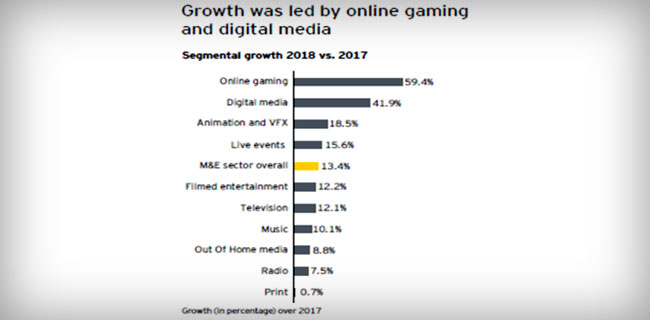
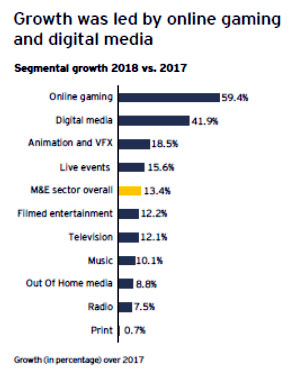
As per the FICCI-EY 2019 report on Indian M&E Industry, the industry growth was from 2017 to 2018 was led by online gaming and digital media as shown in the following chart.
Source: FICCI EY ME Industry Report 2019
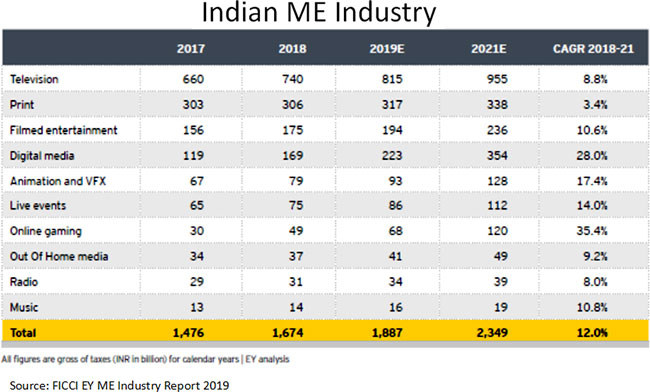
The report further predicts that online gaming will have the highest CAGR (35%) from 2018-2021 and along with the digital media (28%) and in three years both sectors will more than double their value in INR. While digital media is tipped off to overtake filmed entertainment 2019 and print in 2021, online gaming is already bigger than OOH, radio and music and will overtake live events in 2021 and is likely to overtake Animation and VFX by 2022 to rise to the fifth rank in terms of the share of the Indian ME industry pie.
Indian ME Industry Source: FICCI EY ME Industry Report 2019
This trend is going to have a far-reaching impact on the effectiveness and efficiency of the digital media planning which is expected to ride largely on programmatic buying and planning. Many advertisers would like to try out the route of developing exclusive/ branded online games targeted at their audience profile. The Freemium business model, which is currently most commonly used model in the online gaming sector in India, will attract more support from advertisers. Digital Marketing and Media Agencies will explore more innovative ways of exploiting the scope of reach provided by online gaming. After mobile and social media, online gaming will develop as a distinct media channel in the next decade. Online gaming is going to be the new rock star of all online media from 2020.
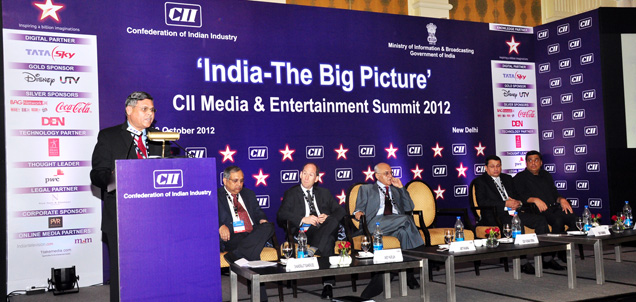
L to R: Uday Kumar Varma, I&B Secretary, Chandrajit Banerjee, DG, CII; Andy Kaplan, President, Worldwide Network, Sony Picture Television; Amit Khanna, Chairman, CII National Committee on M & E and Chairman, Reliance Entertainment; Uday Shankar, CEO, Star India and Ronnie Screwvala, MD, The Walt Disney Co
By Ananya Saha
CII Media and Entertainment Summit 2012, India – The Big Picture discussed critical issues such as cause and effect of market-driven approach in the media and entertainment (M&E) sector, censorship hurdles, and the roadmap for $100 billion Indian M&E industry. The two-day conference saw the who’s who of the sector take a close look at the critical role that M&E plays in India.
“We are drunk on our own volumes: largest number of newspapers in circulation, largest number of television viewers at 400 million, 100 million digital consumers. Digital, in particular, is an indictment of our creative and strategic limitations – we have 600 million mobile screens and yet we do not have a unique content proposition for the medium,” Uday Shankar, CEO, Star India, said in his keynote address, adding, “Our ability to convert that into corresponding value is disappointing.â€
“Media and industry is a globally growing industry – but our participation in that eco-system is zero and India is hardly factored into the global thought process of technology or content,” he added. Similarly, on the domestic front, the industry is yet to fully unlock the potential of the vast Indian market.” The size of India’s Media and Entertainment industry, which includes television, print, radio, digital media, was pegged at $15 billion at the end of 2011. The industry is growing at around 14 percent a year. “At this rate, we will still take 15 years to get to $100 billion. Obviously, we want to get there much faster. The question is: Why and how do we do that?” Mr Shankar quipped.
Ministry of Information and Broadcasting Secretary Uday Kumar Varma, Leader of the opposition in Rajya Sabha Arun Jaitley, The Walt Disney Co MD Ronnie Screwvala, Viacom 18 Media Pvt Ltd CEO Sudhanshu Vats, Sony Picture Television President for the worldwide network Andy Kaplan, News Corp Sr Executive VP David Hill, NDTV Group CEO and Executive Director Vikram Chandra, Times Television Network MD and CEO Sunil Lulla, Sony Entertainment Television CEO Man Jit Singh, Times Group CEO Ravi Dhariwal, Prasar Bharti CEO Jawahar Sircar, eminent journalists such as Nik Gowing, Vir Sanghvi, Vinod Mehta and Aroon Purie shared their views at the summit.
Uday Kumar Varma, Secretary, MIB, recent decision of the government to allow 74 per cent FDI in DTH, IPTV, mobile TV etc. are some of the steps that have been taken in this direction and underscored that those steps would be game changers. He said that many positive steps would be taken in revamping the FM Radio to enhance its reach and content. The empowered Group of Ministers are looking into some of the grey areas in the auction of 839 new FM radio stations across over 290 towns and cities in the country. “We hope to complete the auction of the first tranche of the stations by the end of the financial year,” he added.
Day 1 of the summit saw Arun Jaitley, Leader of the Opposition, Rajya Sabha make a scathing attack on trial by media and said that most often such debates are based on half- truths and imaginations. Nik Gowing, Presenter, BBC World News said, “Media is greatly influenced by technology and speed in which the information travels. Political leaders and corporations have to realize that to become a leader in the technology driven environs, where they would be put to scrutiny not necessarily by the media but also by public at large, through twitters and other social media, was an onerous task.” Vinod Mehta said, “What we require is blending good business practices with news collection and dissemination, which is a formidable task of media industry.” Ravi Dhariwal, CEO, Times Group, said that media is judged by its contemporary relevance and trust it builds with the general public.
Broadband penetration to reach 600 mn by 2020
Speaking on the panel for ‘The Game Changers: Taking M&E industry to $100 bn’, R Chandrasekhar, Secretary, Information Technology and Chairman Telecom Commission said the government is taking proactive steps for enhancing the broadband penetration in the country from the present level of 20 million to 600 million by 2020 so as to cover the entire breadth and length of the country.
“The government is investing Rs 20,000 crore over the next few years for strengthening the broadband network in the country. In its wake, such massive investment will give a boost to the digitization, cloud-based services and convergence to reach out to the common man in the far flung areas,” he said. The government’s role, he stressed, would be that of a facilitator and the last mile movers would be cable and telecom service providers.
Manjit Singh, CEO, Sony Entertainment Television maintained that advertisement and subscription income from media business should be at a 50:50 basis and a business model based on these parameters would help penetration of broadband, inflow of more FDI and the government would stand to gain from realization of more taxes. The ratio of TV advertisement to GDP in India is abysmally poor as compared to developed countries and hoped that the stress on subscription would give a sustainable and healthy revenue stream to the media business. Narayan Rao, Executive Vice-Chairperson, NDTV said, “For the ambitious target to reach 100 bn, the industry needs to recognise three things: advertisers need to recognise that as audiences have grown, and thus, rates also need to grow; the broadcasters need to get rid of carriage fees; and the broadcasters need to look at alternate sources o revenue, which can currently come only from subscription revenues.â€
TGBCL’s MD and CEO Sunil Lulla said the industry needs to dream a collective dream to reach the $100 bn mark. “The industry needs to collaborate, partner and compete for a healthier industry status,” he said. Smitha Jha, Leader, Entertainment & Media practice, PWC India, observed that the game changers in the media industry would be advertisement, subscription and infrastructure and policy framework. In India, she said that the consumer spends only $7 per month as subscription as against US$ 500 in the US. Also, to help industry to achieve the potential, infrastructure has to be toned up, such as rolling out of 3G and 4G coupled with strengthening broadband network.
Policy Conundrum
Rahul Khullar, Chairman, Telecom Regulatory Authority of India (TRAI) stressed on the need for a separate regulator for content and carriage. He also said that the Indian market should not be compared to Western markets and stressed on the fact that India is a price-sensitive market. Harit Nagpal, MD and CEO, Tata Sky pointed out, “We are most heavily taxed business in the industry. We pay close to 30-35 percent as taxes, exclusive of the import duty on set-top boxes.” Agreeing with Mr Nagpal, SN Sharma, CEO of Den Networks said, “Taxation is going through the roof, and ultimately consumers will have to bear the costs.”
Anuj Gandhi, Group CEO, IndiaCast, opined, “As we progress with digitisation, it is important that the issue of carriage fees is sorted out. We need to get the ARPUs right to be on the path to reach $100 bn-industry.” The panel also pointed out how the policies in India have not found the regulation support. Vanita Kohli-Khandekar, Contributing Editor, Business Standard said that tax holidays can do wonders for stabilising the industry. She also pointed out how regulation is required in the areas of cross-media monopoly; how 50-60 percent of media buying is concentrated in the hands of one agency and the ownership of news media.
In response to the worries voiced by the panel, Mr Khullar said that the regulator is aiming at bringing out a white paper on cross-media ownership, which will be done with prior consultation. He also said that as digitisation progresses, the industry should foresee and prepare on changing business models.
Managing M&E in digital era
As digitization takes last steps towards sunset date, issues related to convergence have been taking centre stage at various discussions and forums. The panel on convergence issues chaired Neeraj Roy, MD and CEO, Hungama Digital Media was of the view that consumption and monetising of content, global IT systems, infrastructure and policies that deal with convergence need to be developed to provide clarity to industry players as well as consumers.
Vikram Chandra, Group CEO and ED, NDTV, said, “With convergence and real-time interactivity taking shape, the only question that remains to be answered is how do we monetise the properties.†Vijay Lazarus, President, IMI pointed out how in absence of policy regulations, music became the first victim of technology in the form of piracy. “But then knowing there was no turning back, the music industry also embraced technology,†Mr Lazarus pointed out.
The panel agreed that innovation in convergence will result in monetisation.
The last panel on Sports and Entertainment focused on whether sports broadcasting in India is only about cricket or is there an opportunity much beyond which lies untested and unexplored. “The government, corporations, media and civil society should come forward to support sports beyond cricket with a long term roadmap,” maintained Atul Singh, CEO, Coca Cola India. He also hinted that dependence on one form of sports is not the ideal approach since that would lead to unbalanced growth of sports in the country.
Mr Singh cautioned the corporations not to look for immediate results and dividends from sponsored games other than cricket. David Hill, Senior Executive Vice President, New Corp said, “Sports is predominantly a middle-class indulgence and with India’s middle class touching one billion by 2025, sports will receive a lot of attention in the future.” Referring to the lack of corporate support in India, Harish Thawani, Executive Chairman, Nimbus Communications said that corporates allot adequate budgets for CSR and massive commitment for advertisements but hardly any when it comes to sports.
While there is no doubt that the Indian M&E industry is seeing unprecedented growth, the question is whether the industry will be able to shed policy inhibitions and grow to the $100-billion-stage by 2016.
The Indian M&E industry, with revenues of about 805 billion INR (17.2 billion USD) in 2011, is set to grow robustly over the next few years on the back of steady macro-economic growth, rising spending power and positive demographic indicators. The industry revenues are expected to reach 1,764 billion INR (37.6 billion USD) by 2016, with a CAGR of about 17% from 2012 to 2016, according to India Entertainment and Media Outlook 2012.
According to the study, which was released by CII and PwC during the Media and Entertainment Summit 2012, the television and print segments continue to be the largest contributors to the industry, accounting for 66% of the total revenue. Internet access contributed 14%, up from 11% in 2010. However, the contribution from the print and film segments have reduced marginally, as year-on-year growth rates have been lower than the industry average. The internet access and gaming segments have been the fastest growing, with annual growth rates of 57% and 33%, respectively
The report further lists that the Indian E&M industry has been one of the fastest growing, followed by countries such as China, Russia and Brazil. Going forward, the industry is expected to grow at a CAGR of 17% between 2012 and 2016, to reach a size of 1,764 billion INR. Internet access, advertising and gaming are projected to be the fastest growing avenues, each growing at a CAGR higher than 20%. The revenue from advertising is expected to grow at a CAGR of 13.4% to reach INR 525 billion in 2016, significantly up from INR 279 billion in 2011.
The television segment is expected to retain its position as the largest E&M segment in the country, with an estimated CAGR of 15% till 2016. Given the high penetration of mobile internet in the country, robust growth has been projected in internet access till 2016 (given the current under-penetration), which will overtake the print sector by 2013, in terms of industry revenues, and become the second-largest segment in the Indian E&M industry. The print segment is expected to grow at 9% for the next five years, and claim 17% of market share by 2017.
The report recommends that given the high potential growth, the industry should focus on collaboration and innovation to achieve the target numbers.