Tag: India Today

  • Eclectic NorthEast ties up with India Today Mind Rocks

    By A Correspondent


    Guwahati-based Eclectic Publications has tied up with the India Today group to be the youth partner for its annual youth conference ‘India Today Mind Rocks’. The group’s flagship English magazine Eclectic NorthEast will offer specially discounted passes for the youth from amongst its readers to attend the conference.


    The publishers expect this association will go long way and help youth of the region to discover true potential of this land, notes a communiqué.


    This year’s edition of ‘India Today Mind Rocks’ will be held in New Delhi on September 21 with keynote speakers such as Farhan Akhtar, Kiran Bedi , Chris Gayle , Ranveer Singh , Hard Kaur , Amish Tripathi and Ajay Bijli.


  • Anil Thakraney: Mr Khurshid, you screwed up!

    By Anil Thakraney


    Watching Mr and Mrs Salman Khurshid in action at a press conference on Sunday told me how little even an exalted minister is aware of how to hold a successful press meet. He was responding to accusations of forgery and corruption involving an NGO he heads. Recently, a corporate friend told me that some organizations hold workshops on how to deal with the media. This is a good idea, and our politicians must also organize such training programmes for themselves.


    Khurshid conducted himself so shabbily that as a viewer, one was left wondering if one had erroneously switched into the Bigg Boss mad house. Although I don’t participate in these gigs, here are some commonsense tips on how to hold a successful press meet. And how not to make a bungling fool of yourself, as Khurshid certainly did.


    One, never, never, never lose your cool, no matter how agitated you are in the head, no matter how serious the charges are. Demonstrating anger in a press conference shows you in a very poor light, the public opinion directly goes against you. Always be in control.


    Two, be coherent in your statements, do your homework before you arrive at the meet. You already know the type of questions that will come your way, therefore keep your answers ready and keep them pithy. If you fly off on a tangent (as Khurshid frequently did), it will confuse not just the journalists but the public who will eventually consume the event. And when that happens, the entire purpose of the conference is lost.


    Three, do not be rude with journalists, no matter how provocative the questions are, no matter how aggressive their body language is. Definitely no ‘You there, shut up!’ The moment you speak crassly at a press conference, you have already lost the battle. In Khurshid’s case, he has an axe to grind with the India Today group. But behaving politely with their reporters would have scored the man some easy brownie points.


    Four, never, never have an entourage of chamchas and groupies stand right behind you. This shows you are not confident, and are using your minions as a crutch. This enhances the perception of guilt. Stand in the line of fire all alone. Particularly so if the accusations are personally targeted at you.


    Five, and this is specific to Khurshid (therefore, dear militant feminists, please spare me the knives). Do not invite your missus to sit next to you at a press meet. Even if she happens to be the co-accused. Be a man and deal with the heat on your own. And I say this also because, if your partner happens to be an edgy and a restless soul (which Mrs Khurshid clearly is), she will mess up your show more than it already is.


     Anil Thakraney, Editor-at-Large,MxMIndia, is a senior journalist and commentator based in Mumbai. The views here are his own

  • Paritosh Joshi: _____________ Maketh A Man

    By Paritosh Joshi


    Surely, you are wondering why I chose to leave that first word blank when everyone knows the word that completes the aphorism?


    A Methuselah of our Media & Communications business came by a few years ago, when I was still gainfully employed and not a lily of the field, to talk about the media and their place in our lives. The conversation made an impression on me, abiding enough that I am compelled to develop it in today’s essay.


    Let me rewind to my early memories circa 1968.Kanpurhad no local English newspaper. The Times of India would ship theDelhi‘Dak’ Edition to our mofussil outpost. By the time the (now only of distant memory) Toofan Mail with her imposing steam locomotive growled intoKanpurstation with the precious newspaper, it would already be a day late. The news wasn’t yet stale, mind. After all, the only other source of news and current affairs we had, was the nightly bulletin on All India Radio delivered in the richly textured baritones of Jasdev Singh, Ashok Bajpai and their ilk. I must add that the scratchy Short Wave signals that our prized Murphy radio managed to extract from the ether made listening challenging at the best of times. Barring the most momentous of events and emergencies, the world beyond the nearest 10 kilometers was at least two days away. And it didn’t matter. Life, as we led it then, had little or nothing to do with the world beyond.


    Fast forward to 1977, nearly a whole decade later. We lived inNasikjust 175 kilometers fromBombay. Yes, in those days it was stillBombay.  Here was a city that offered not just one but TWO local (also local language) newspapers, Gavkari and Deshdoot. Times ofIndia,Bombay’s Dak edition would reach us the same day except it probably carried the previous day’s stories. There was still no television inNasik, so we still were served only by the stale newspaper and the highly expurgated radio. Not a lot had changed. Our lives continued to be led in the isolation and serenity of small townIndiaand, quite frankly, we didn’t think we were missing anything.


    Things began to change with the move toBombayin 1980. Suddenly, a television arrived at home. Black & White it may have been and only for a few hours of low fidelity transmission every day. And featuring exciting content such as missing people’s reports and Krishi Darshan, the farmers’ show, only occasionally spiced up with Chitrahar and Chhayageet. From consuming less than an hour’s worth of assorted media (perhaps half an hour each of radio and newspaper), our days now had at least another hour dedicated to TV.


    Television continued to grow. Print began to proliferate, not just in the form of a growing range of magazines, but also as a daily in the form of the afternoon or evening tabloid. Soon there was a Mid-Day fan and an Afternoon aficionado; an India Today enthusiast and a Week loyalist; a Stardust addict and a Filmfare feeder. Between all the diversity now available to them, many consumers were spending several hours a day just consuming all the options they were fond of.


    Cut to 2012. From perhaps 2 or 3 hours of exposure to various media a day, the modern urban Indian probably spends 4 or more hours a day consuming or in some way interacting with one medium or another. And it is no longer just urbanIndiaeither. DTH is available all over the country and a subscriber in the most remote hamlet has to just train its little antenna toward the sky to receive the latest content from around the world, a lot of it for free, in full digital video and Dolby Stereophonic Audio.


    People are defining themselves by the mix of content they consume.


    Can there be a segmentation approach that is based on shared commonalities AND uniquenesses in the way people consume the media?


    Which is why I left that heading blank.


    It really ought to read:


    Media maketh the man!


    Paritosh Joshi was until recently CEO, Star CJ. He has been a marketer, a mediaperson and a key officebearer on industry bodies. He is Strategic Advisor, Ormax Media. He can reached via his Twitter handle @paritoshZero


  • IRS 2012Q1: Hindi readership sways its way towards +ve growth

    By A Correspondent


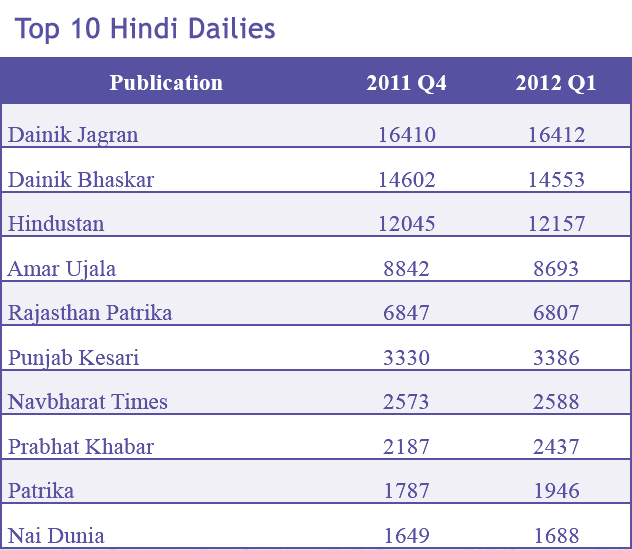
    As a large population of this country continue to swear by the usage of the national language – Hindi, it is no surprise that newspapers and magazines in this language have seen moderate growth in IRS 2012Q1. In the Top 10 Hindi dailies, Dainik Jagran dominates with AIR of 16,412 versus 16,410 that it reported last quarter. At second place is Dainik Bhaskar that recorded an AIR of 14,553 as against 14,602 in 2011Q4.Hindustancomes next with an AIR of 12,157; Amar Ujala at fourth with 8693 and Rajasthan Patrika at fifth with an AIR of 6807. Punjab Kesari has posted positive growth with an AIR of 3,386 compared to 3,330 in the last quarter. Navbharat Times is next with an AIR of 2588. Prabhat Khabar is the best placed with an AIR of 2,437 compared to 2,187 reported last quarter – an 11 per cent growth. Patrika is next at 1,946 (growth of 9 per cent) and Nai Duniya at 1,688.


    (AIR numbers; all figures in ‘000)


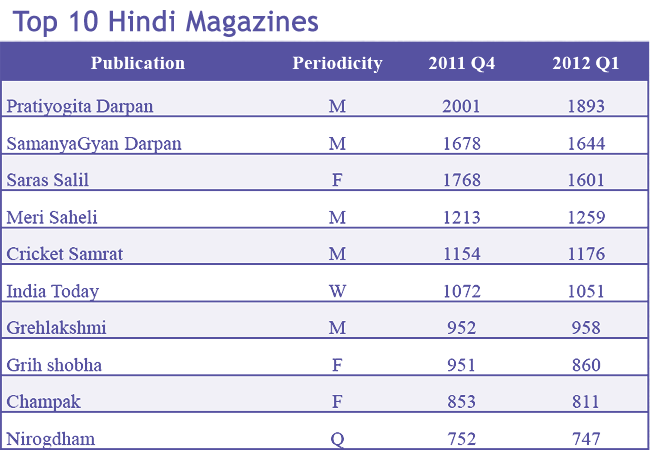
    Among the magazines, there has been a moderate effect that has been witnessed in the Hindi readership. Pratiyogita Darpan has seen a drop of 5.4 per cent with an AIR of 1,893 compared to an AIR of 2,001 in last quarter. SamanyaGyan Darpan has posted an AIR of 1,644 versus 1,678 recorded last quarter. At three is Saras Salil that has seen a big drop with an AIR of 1,601 versus 1,768 recorded last quarter – a drop of 9.5 per cent. Meri Saheli is steady at fourth with an AIR of 1,259 and Cricket Samrat is next with 1,176. India Today is next with 1,051 while Grahlakshmi follows with an AIR of 958. Completing the list is Grihshobha with an AIR of 860, Champak at ninth place with an AIR of 811 and Nirogdham with an AIR of 747.


    (AIR numbers; all figures in ‘000)


    Dinesh Rathore, Vice President, MediaVest Worldwide said: “The population of people who speak Hindi and English is seeing a rise and that explains the overall rise in readership of these language editions. Also, a lot of players are moving out of their markets and launching in other states leading to newer set of readers. Players like Dainik Jagran, Dainik Bhaskar, Rajasthan Patrika are launching in many new states. So this explains the rise in the readership of their papers.”


    Adding inputs, Anamika Mehta of Lodestar UM said: “By launching in newer markets you are creating specialists products to cater to those markets and therefore, language readership will see a rise to an extent. Also, as explosion of business happens in small towns and markets the regional media will follow suit and grow too. That is what we have seen in television too. For SMEs and business houses, print will continue to be an important medium for them.”


  • Stagnancy stages a comeback in IRS 2012Q1


    By A Correspondent


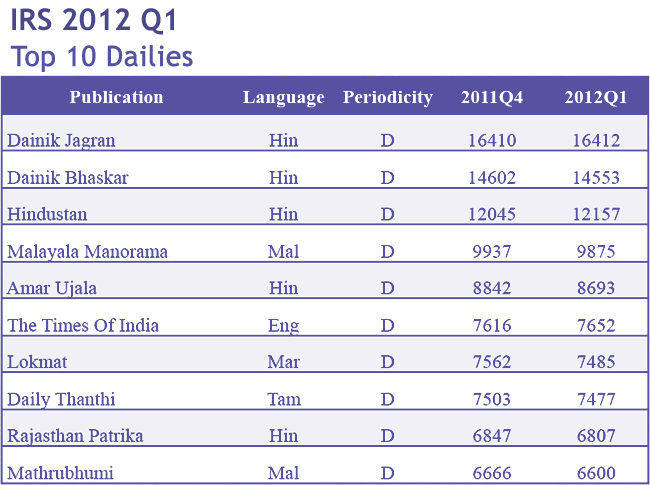
    The IRS 2012 Q1 readership results released by MRUC and Hansa has nothing new to tell but the obvious tale of the apparent rise in numbers of a few publications and the decline in readership of a majority of players. Going by the Average Issue Readership norm, in the Top 10 dailies there has been no change in the pecking order of the top performers but the readership of 7 out of 10 dailies has seen a marginal decline. Of the ten publications, five are Hindi in origin, two are in Malayalam, and one each in Tamil, English and Marathi.


    Emerging a frontrunner once again, Dainik Jagran manages to hold its forte showing slight readership growth with 16,412 in 2012Q1 as against 16,410 that it reported in 2011Q4. At No 2, Dainik Bhaskar has reported numbers totalling 14,553 a decline by 0.33 per cent from 2011Q4 figure of 14,602.Hindustansits comfortably at the third spot having reported a 1 per cent growth of 12,157 as against 12,045 reported in 2011Q4. Malayala Manorama is at the fourth spot with an AIR of 9,875 as against 9,937 in 2011Q4 – a drop of 0.6 per cent. Amar Ujala is next reporting an AIR of 8693 against an AIR of 8842 in 2011Q4 – a drop of 1.7 per cent. The Times of India English edition continues to see growth and comes in sixth with AIR of 7,652 as against 7,616 registered last quarter. Marathi daily Lokmat sees a marginal decline to end 2012Q1 at 7,485 compared to 2011Q4 AIR of 7,562. Tamil daily Daily Thanthi is next with AIR numbers of 7,477 as against 7,503 recorded in 2011Q4. Rajasthan Patrika with 6,807 and Mathrubhumi with 6,600 end the tally occupying the ninth and tenth spot respectively.


    Reacting to the overall trend, Dinesh Rathore, Vice President, MediaVest Worldwide said, “The study hasn’t thrown any new surprises. What is known is that the readership time spent on print is coming down these days, which is even lesser in case of magazines. Newspapers as a habit are not going to die soon but the time spent is surely on a decline. Also, if people were subscribing to more newspapers earlier, they are subscribing to one less now because of the options available on digital.”


    Highlighting her stance on the numbers, Anamika Mehta of Lodestar UM said: “What I infer is that the drop is very marginal. Print will continue to hold its ground in India. With literacy rates going up and the launch of several new products print will continue to drive growth in India . Also, what is seen is that there is a growth of consumption that is happening on the web and moreover, India is a very young country. Almost 60 per cent plus of the population are younger than 35 years. With these audiences the consumption is more on the web than on the physical newspaper. Also, we are seeing a lot of launches by players in the regional markets. So it’s not as bad as it seems.”


    Voicing a similar opinion as given by Mr Rathore, Priti Murthy, National Director – Insights, Maxus said, “I am not surprised by the overall trend that has been thrown up. Why do we read newspapers and magazines, for the sheer content that it provides and content is available faster in other mediums today – definitely digital and to a large extent even TV. I see this trend continuing in the next 3-4 years after which it will reach a saturation point. Also, how much ever tactical initiatives publications engage in to increase circulation, it clearly shows that readership is not going to increase. The time spent in reading newspapers and magazines will continue to see a decline. Also the new generation that is growing up may not grow up on a newspaper alone. They rely on mobile and other AV modes to receive their communication.”


    (AIR numbers; all figures in ‘000)


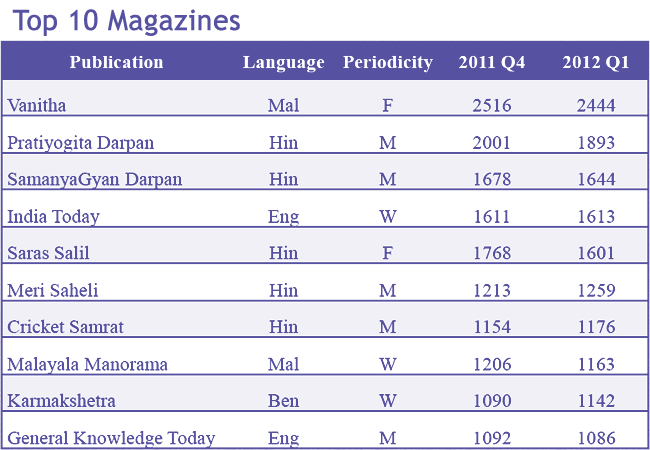
    The downfall story continues with magazines as well with leader Vanitha (Malayalam) reporting an AIR of 2,444 as against 2,516 in 2011Q4 – a decline by 3 per cent. Pratiyogita Darpan too sees a decline of 5.4 per cent having registered an AIR of 1,893 in 2012Q1 as against an AIR of 2001 in 2011Q4. SamanyaGyan Darpan sees a marginal decline with an AIR of 1,644 as against 1,678 reported last quarter. India Today is the topmost English magazine in this list and figures at the fourth spot with 1,613 as against an AIR of 1,611 reported last quarter. Saras Salil is next on the line-up and has reported a big drop of 9.5 per cent registering an AIR of 1601 as against an AIR of 1,768 reported in 2011Q4. Meri Saheli and Cricket Samrat have posted growth with an AIR of 1,259 and 1,176 respectively. Malayalam Manorama at 1,163 has seen a decline of 3.5 per cent while Bengali magazine Karmakshetra has seen a growth in its AIR at 1,142 as against 1,090 in 2011Q4. General Knowledge Today completes the list with an AIR of 1086.


    Throwing light on the trend spotted in magazines, Anamika Mehta said: “In the case of magazines, what we are seeing is that the time spent on magazines is going down but there are a lot of new and niche products being launched. A lot of international players too are coming into this market. So that should give it some scope for growth. But right now I think magazines are in a more worrying state than dailies in India but having said that I do not see the death of the medium coming here anytime soon.”


    (AIR numbers; all figures in ‘000)


  • Anil Thakraney: Bad times looming for editors/content heads

    By Anil Thakraney


    What’s the best way for large advertisers to get some ‘good press’ in the media? Use PR agents? Throw lavish parties? Suck up to the editors? Naaah! All that is old fashioned stuff. Nowadays, at least in India, where the media acquisition laws are weak, the industrialists simply go ahead and buy a large stake in a media house. Thus controlling the content, whether the proprietors would like to accept that or not. Recently, Ambani picked up a substantial stake in the Network 18 group. And now the Birlas have bought into the India Today group. Am quite certain more large industrial houses are eyeing similar acquisitions in the media.


    This is obviously terrible news for content heads. Because their powers get badly curtailed. Of course, the worst case scenario, which means direct intervention in the content agenda, sucks big time… that’s a nightmarish situation. But even the best case scenario sounds pretty depressing. Because that would mean the media house cannot report/write a single word against the shareholding industrial group. And will often be compelled to project them (and all their partners and subsidiaries) in a favourable light. Consider this: If Mukeshbhai gets caught in a scandal, will Rajdeep Sardesai even think of going after the big man? You know the answer.


    I can understand why the corporate world wants to invest in the media. Because it’s a powerful weapon to have in the war chest, and industrialists can leverage business/political deals with its help. The question is: Can we not have tighter laws on media acquisition, like it happens in the western world? Surely the time has come for that.


    As a journalist, what worries me most is the yet another body blow to the freedom of expression. Already the industry has suffered because of paid news, sponsored news and other malpractices. Not to speak of the greater powers bestowed to the marketing department of the media company. And now this! Clearly it’s not a good time to be a journalist in this nation.


    As for moi, I am seriously thinking of shifting back to advertising. The advertisers are calling all the shots anyway. 🙂


    * * *


    PS: Haha. The advertising life depicted accurately and hilariously in pictures. If you belong to the ad world, you will identify with every single situation. I am sure you are living them right now!


    Link: http://thisadvertisinglife.tumblr.com/


    Anil Thakraney is a Mumbai-based commentator and editor. He is also Editor-at-large, MxMIndia. The views expressed here are his own


  • Loss of plurality is worrying: Paranjoy Guha Thakurta

    Paranjoy Guha Thakurta

    By Paranjoy Guha Thakurta


    This sort of an acquisition is part of a growing trend of ‘corporatization’ of the media where big business houses such as the Aditya Birla Group and the Reliance Industries group are investing into existing media groups. Through this process of consolidation, they are also bailing out these groups.


    The Raghav Behl-led Network 18 and Ramoji Rao-led Eenadu are now part of one big conglomerate because Reliance Industries Ltd (RIL) has bailed out both by pumping in a huge amount of money. On paper, it appears as if they are still separate corporate entities, which they are, as per the laws of the land. But the kind of associations they have struck gives an impression that they are now going to work like a conglomerate. Now this is exactly what has happened in the case of Mr Aroon Pourie who heads the India Today group which is also going to be one major conglomerate. So what we are seeing, in that sense, is the ‘cartelization’ of the media. There are cartels being formed, there are oligopolies being formed.


    The recession in the west has led to shrinking of advertising expenditures for the media in India and across the world especially after 2008, and this has had a direct impact on the fortunes of media organizations. So this process of consolidation has got expedited. What this means is that the media in India is going to become less plural, it’s going to be dominated by relatively fewer groups. What you are really seeing is, large corporate groups exercising greater dominance on the media. Now there are two implications.


    Also read:

    AV Birla group buys 27.5% in India Today group


    Birla may use personal money for buy, Mail Today may now launch editions in Mumbai, other metros


    Why media purists needn’t worry about Kumar Mangalam Birla’s 27.5 % in Living Media

    One is, of course, you are finding telecom companies (Mr Aditya Birla also happens to be the head of Idea and Mr Mukesh Ambani’s RIL is a major player in the broadband wireless access space), which are providing you communications, are also now playing an important role in companies that produce content. So the content providers and content distributors are coming together. This, in my opinion, is going to result in a loss of heterogeneity, resulting in a loss of plurality. In a sense, the oligopolies that are going to be formed will also impact the listeners of content, the viewers of content, or the readers of content. The content they get will be less heterogeneous.


    The other part of the story is that these companies are also big advertisers. Therefore, the clout of the advertiser will go up. As I said, the telecom service providers are now becoming important stakeholders in companies that are producing content. So the distributors of content are becoming stakeholders in the producers of content. Similarly what you also see at another level, the companies which are big advertisers are also now becoming the owners of the media. So in my opinion, these trends towards ‘cartelization’, or the formation of these giant corporate conglomerates is not going to lead to greater plurality as far as the consumers of content are concerned.


    The numbers of TV channels and newspapers and websites often give you a very deceptive kind of a picture and the capital is a classic example of that.Delhiis the only city in the world with 16 English language daily newspapers. This gives you a misleading picture, that readers of English dailies inDelhihave a huge choice. But the fact of the matter is that two newspapers, The Times of India and Hindustan Times would account for well over three-fourths of the total market of all English daily newspapers. And if you add to that Economic Times, then these three publications put together would account for more than 80 per cent of the total circulation of all English newspapers in India. So, in terms of numbers it looks good, but if you look at the structure of the market, you see few dominant players.


    In India, unlike in other countries of the world, like US, UK or Australia, there are no cross-media restrictions. In other countries, there are both vertical as well as horizontal restrictions. Vertical restrictions mean that the content producer and the content distributor are different companies/groups. In India, the same guys who are producing content are also distributing the content. You have the DMK controlling the distribution channel and also producing the television channel; you have Zee News producing news and also controlling Dish TV. There are clear conflicts of interest that arise if your distributor and the provider are the same. That’s only one part of the story.


    The other is what is called horizontal cross media restrictions. That means, the same company dominates all forms of the media, like print, radio, TV, in the same geographical area. In our country we don’t have any legal restrictions on cross media holdings. As far as the media is concerned, the group concept or the conglomerate concept does not operate in our country. So you have Bennett Coleman Ltd which brings out various print publications, and then you have Times Global Broadcasting which brings out the television content. These two companies happen to be controlled by the same set of people. But because the legal restrictions that exist in India apply to individual entities and not to conglomerates, effectively you have no cross-media restriction.


    Speaking of editorial content, editors will not publish or broadcast anything that would go against the interest of the corporate that controls; these would become subtle forms of censorship and control. For instance, Living Media which includes, Aaj Tak, India Today, Headlines Today and Mail Today, these publications or these broadcasters are unlikely to publish anything negative that could affect the business interests of the Aditya Birla Group. So that could be an eminent danger, that degrees of freedom that editors and content providers would enjoy, would get curtailed not just because of the pattern of ownership but also because the owners of major conglomerates are also major advertisers.


    Even if on paper, the editors have the autonomy and independence to publish what they like, there could be subtle forms of censorship wherein editors would feel constrained or would think twice before publishing any story that could in any way go against the interest of the promoters of the company that control these media conglomerates.


    I am optimistic about the future of media in India but I am also concerned about the fact there is loss of heterogeneity, loss of choices to the consumer.


    (As told to Shruti Pushkarna)


    Paranjoy Guha Thakurta is a senior journalist, editor and broadcaster based in New Delhi.

     

  • Birla may use personal money for buy, Mail Today may now launch editions in Mumbai, other metros

    The Aditya Birla group investments may help India Today invest in launching editions of its newspaper Mail Today in Mumbai and other metros.


    By A Corresdpondent


    Kumar Mangalam Birla, chairman of Aditya Birla Group, has bought a 27.5% stake in Aroon Purie-controlled Living Media India, the publisher and owner of India Today magazine and Aaj Tak television channel. Mr Birla will use his personal money to invest in the New Delhi-based group, which straddles the entire media chain, from television to magazines to tabloids.


    A statement from the metals-to-retail group said Birla has agreed to join the Living Media group as a financial investor. It did not specify the price for the deal or the valuation.


    However, investment bankers close to the transaction said the deal has been finalised for Rs 600-700 crore, valuing the media group at Rs 2,400-2,800 crore. Mumbai-based investment bank Ambit Corp was the advisor to the deal.


    This is the second big investment by an industrialist in the media space. In January, affiliates of Reliance Industries agreed to buy a large stake in the companies of Raghav Bahl, the promoter of Network18 and owner of channels such as CNBC-TV18 and CNN-IBN. The investment was worth over Rs 1,500 crore.


    TV Today is listed on the stock exchanges, but it is not clear whether Birla’s personal investment companies will now have to make an open offer to buy 26% from public shareholders.


    The financial investment also marks the realisation of Kumar Mangalam Birla’s cherished dream of owning a media company. “The media sector is a sunrise sector from an investment point of view. I believe that Living Media India offers one of the best opportunities for growth and value creation,” Birla said in a release.


    Birla made an unsuccessful entry into the entertainment space by launching a movie and TV production company, Applause Entertainment, in 2003. The company, which produced the acclaimed movie Black , was closed down in 2009 after the downturn in the entertainment industry sparked off by the global recession.


    Living Media will use the cash from the deal to expand its presence in media. It may now look at launching its New Delhi-based tabloid, Mail Today, in other metros, including Mumbai, according to persons close to the company.


    Source:The Economic Times

    Copyright © 2012, Bennett, Coleman & Co. Ltd. All Rights Reserved

  • AV Birla group buys 27.5% in India Today group

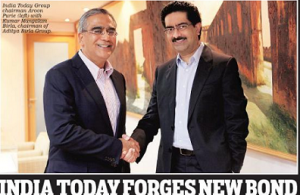
    A Mail Today news article with Aroon Purie with Kumar Mangalam Birla in the photograph

    By A Correspondent

    The Aditya Birla group has announced a financial investment of 27.5% in Living Media India (better known as the India Today group).

    The move has been confirmed by a way of a communique to the stock exchanges. Says Kumar Managalam Birla, chairman, Aditya Birla group, “The media sector is a sunrise sector from an investment point of view. I believe that Living Media India offers one of the best opportunities for growth and value creation.”

    Comments Mr Aroon Purie, chairman of the India Today group, “I am delighted to partner with the Aditya Birla group to aggressively address the current and futre potential of the Indian media business which is at a tipping point. The Aditya Birla group with its strong leadership global footprint, diversified business interests and its shared values of integrity, commitment and social responsibility make it a perfect fit with the India Today group.”

    The transaction is of course subject to the statutory approvals.

  • Mail Today launches in London

    By A Correspondent


    The large population of Indian descent in and around London have reason to cheer. Mail Today, a product of the joint venture of London’s Daily Mail and the India Today group, has announced its entry to London. The paper had launched in New Delhi four-and-a-half-years ago and Chandigarh more recently.


    “Targeting the large south Asian population in London, Mail Today wants to connect with the diaspora by bringing the best of Indian news packaged in a modern avatar,” Aroon Purie, Editor-in-Chief of the paper, wrote in the e-edition of the newspaper.


    British citizens of Indian descent as well as the growing number of Indian nationals studying or working in England have reason to cheer given the India Today group’s pre-eminence and of course Daily Mail’s local leadership.


  • Ashish Bagga is INS president

    By A Correspondent

    Mr Ashish Bagga, Chief Executive Officer of the India Today group, is the new president of the Indian Newspaper Society for the year 2011-12. This was announced at the 72nd annual general meeting of the apex association of newspapers took place in Bengaluru today.

    Mr Bagga succeeded Mr Kundan Vyas of Mumbai’s Janmabhoomi Group. Meanwhile Mr K N Tilak Kumar of Prajavani is the new deputy president, a position that Mr Bagga occupied in 2010-11. Mr Ravindra Kumar of Aj Samaj is Vice President.

    A little about Mr Bagga (information culled from AdAsia 2011 website)

    Mr Bagga has been associated with the Indian media business for over 25 years. Other than the India Today group, he has also worked Hindustan Times as Director (Marketing). Immediately before re-joining India Today in 2001, Mr Bagga did a short stint as President & CEO with Business Standard for the paper’s e-initiative in association with Financial Times, London. Bagga has forged strong partnerships with several leading international media brands for the India Today group. He has been awarded a publishing scholarship by the Publisher’s Association of the United Kingdom through which he also worked with The Daily Telegraph in London in London.

    Mr Bagga is a Physics Honours graduate and an MBA and was also awarded the prestigious British Chevening Scholarship in 2003. He is exceedingly active in various industry bodies.