Tag: India Digital Summit

  • Yashwant Deshmukh highlights ISEC role in digital world

    At the IAMAI’s India Digital Summit 2024 held earlier this week in Mumbai, the Indian Socio-Economic Classification (ISEC) was much discussed. Central to this initiative is the COTN survey by senior researcher and founder-CEO/Editor of CVoter, Yashwant Deshmukh who is CEO, Dataeye Asia aimed at tracking consumer sentiments across the nation especially in digital consumption. To be conducted year-round in 11 Indian languages and commissioned by a leading media house.

    The survey helps CMOs with two essential batteries: the COTN Economic Battery and the COTN Product Battery. The first COTN survey report is scheduled to be released this month (March 2024). Additionally, this will be the first ISEC-aligned initiative, the survey will introduce a media consumption tracker. More details on what COTN is all about is awaited, and this report will be updated thereafter.

    The conversation led by Yashwant underscored the imperative for CMOs to embrace the transformative power of data analytics and new segmentation in navigating India’s dynamic media landscape. As evidenced by the early adoption of digital media in regions like Bihar and Uttar Pradesh, traditional media consumption patterns are in the midst of transformation.  Deciphering and understanding India’s growth in the digital space requires advanced survey methods due to the complexity and dynamism of the Indian consumer landscape.

    The summit highlighted ISEC’s potential with the debut of this study.

  • IDS24: Optimising campaign impact is key challenge

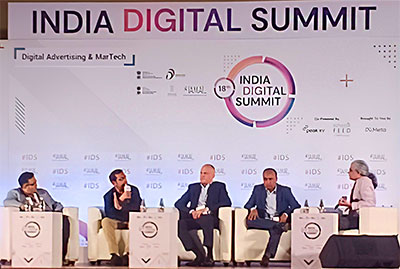
    At the IAMAI’s India Digital Summit 2024 held in Mumbai earlier this week, a panel discussed the challenge for digital marketers lies in navigating personalisation and measurement in a post-cookies era. Those on the panel included Shuvadip Banerjee, Chief Digital Marketing Officer, ITC; Shashank Srivastava, Senior Executive Officer, Maruti Suzuki India; Arnaud Frade, President, Commercial – (Asia), Nielsen and Mohit Joshi, Chief Executive Officer, Havas Media Network India. The session was moderated by Vivek Malhotra, Group Chief Marketing Officer and Chief Operating Officer – Consumer Revenue, India Today Group.

    Highlights of what the panelists said:

    Srivastava: “In earlier times, this understanding of the customer relied on sampling, market research, and analysis of demographics and psychographics. However, the abundance of data and advanced technologies now allow for a significantly more personalised approach to customer insights. Maruti Suzuki’s sustained market dominance, holding approximately 45% market share over four decades, stems from aligning with evolving consumer behaviours and processes. Extensively researched, the car purchasing journey involves 26 touchpoints, 24 of which Maruti Suzuki has seamlessly digitised. Aspects like test drives and delivery are transitioning to digital.”

    Frade: “Technological advancement also generates vast amounts of data, which must be leveraged more effectively. The challenge lies in obtaining precise, high-quality data that empowers marketers, brand owners, and other stakeholders to make informed decisions. In this rapidly evolving landscape, understanding the changing dynamics of the shopper journey is paramount. The proliferation of mobile technology and diverse forms of commerce has fundamentally altered how consumers engage with brands. We are witnessing a transition from discrete ‘moments of truth’ to a continuous journey, where decision-making occurs at various touchpoints. Marketers must excel not only at the final interaction but throughout the entire marketing funnel.”

    Banerjee: “The marketing landscape has evolved, with real-time multi-touch attribution and market mix models becoming commonplace, aiding investment allocation. Despite lacking a unified media measurement standard, metrics like scroll depth on owned assets and engagement within communities offer insights into consumer behaviour. Additionally, distinguishing between always-on and start-stop campaigns and measuring baseline improvements helps gauge campaign effectiveness. Despite the abundance of data, the challenge lies in harnessing it effectively to inform decision-making and optimise campaign impact across different funnel stages and mediums.”

    Joshi: “At Havas, we’re addressing this challenge of misinterpreting data head-on. We aim to refine our approach to a market mix model and ensure clients receive accurate input-output assessments. While data is invaluable, we must ensure it guides us in the right direction. By striking a balance between bottom-of-the-funnel optimisation and top-of-the-funnel investment, we can sustainably drive acquisition and growth. The key is to navigate the complexities of data and maximise its potential to drive client success.”

  • IAMAI study estimates accelerated growth for B2B Digital Solutions biz

    By A Correspondent


    According to a report titled ‘B2B Digital Services Landscape in India-Impact on MSMEs’, by the Internet and Mobile Association of India [IAMAI] and IndiaMart, Indian B2B Digital services market, which is currently pegged at USD 5.6 billion is being driven by the rise of internet penetration in the country and growth of startups focused on servicing the B2B segment. In 2017 the share of B2B in the overall startup base was ~40 per cent. The report finds that India is a strong growth market for B2B digital solutions and is envisioned to be a USD ~29 billion market by 2023 growing at a CAGR of 39 per cent.


    The report was launched at the India Digital Summit by Dinesh Agarwal, Founder of IndiaMart. According to the report, MSMEs contribute ~38 per cent to the GDP in FY18 and are rising beneficiaries of the growth of the digital services. The report further finds that the current estimated revenue of Digital Services that can be attributed to MSMEs is 25per cent. Digital services are gaining 1.4 to 1.6 USD billion revenue from MSME’s, and this is primarily on account of significant segment of client base that they form for marketplaces and listing platforms.


    The estimated impact of digital services on MSME will grow from USD ~ 18 billion in FY18 to USD ~68 billion by FY23 growing at a CAGR of ~30per cent, the report notes.


    Adds a communique on the report: “Going forward, other digital services that are expected to see increasing participation of MSMEs are fintech and SaaS. Fintech, led by digital payments and lending is transforming the way MSMEs transact; enabling digital credit assessment, easy loan application process and collection and settlement dashboarding. Lending and payments have already created a market base of ~1 million MSMEs. The segment is growing at a significant rate of 60per cent to 70per cent and would form a USD 9.5 billion+ market. SaaS is also a rising digital service that has begun penetrating into MSME sector and has created a base of ~0.3 million enterprises. It has enabled easy to adopt, cloud-based implementation of ERP and CRM for enterprises on pay per use basis. Hence, they have been successful in breaking the adoption barrier by bringing down the implementation costs. Currently, SaaS is a USD 0.9 Billion market but is growing at a strong rate of ~26per cent year on year.”


    The report however points out that increasing adoption of digital services among the MSMEs will require them to circumvent the challenges of talent, mindset and digital awareness. Digital service players have an opportunity to create solutions that are easy to comprehend and use thus making the need for talent redundant. Government initiatives in partnership with private players to encourage digitization of MSMEs are bound to grow awareness and create a mindset shift.