Tag: IMRB International

  • Indrani Sen: Radio Rumblings & Selling without Currency

    By Indrani Sen


    Currently radio is the fastest growing traditional medium in India. Why the Radio Industry is not feeling the need for a valid media currency after investing a whopping Rs 3,000 crore (including the migration fees) in the Phase III of FM Radio expansion? Why is RAM, our only syndicated radio listenership study, limited to only four cities since 2007 when six years back in 2009 (after the Phase II auction), 91 cities formed our Private FM Radio Network? How can the Radio channels be so indifferent to RAM that some of them have stopped subscribing to it? As per the FICCI KPMG 2015 report, radio revenue will increase from Rs 1,960 crore in 2015 to Rs 3,950 crore in 2019. Are the advertisers buying radio time blindfold or is there a hidden card which is helping radio stations to sell effectively without the help of a regular currency?


    What is ailing our Radio Audience Measurement studies?  We had a good start in radio research in late 1990s. The advertising industry felt the need of radio listenership measurement even before the advent of private FM channels and the pressure which mounted on AIR resulted in Audience Research Unit starting its Radio Programme Listenership (RPL) ratings in 1998. In early 2000, MRUC started Indian Listenership Track (ILT) in partnership with AC Nielsen ORG- MARG based on yesterday’s listenership (YDL) which is also referred as Day After Recall (DAR).  MRUC commissioned a research to evaluate which of the two radio research methodologies (between DAR and Diary) was the most robust in Indian context and the Diary Method scored above DAR.  ILT was discontinued after 2006 as TAM announced the launch of RAM from 2007.


    A joint service between IMRB International and Nielsen Media Research, RAM is an independent division of TAM Media Research and provides listenership data based on the Diary Method on a weekly basis. RAM started with a lot of promise in Mumbai, Delhi and Bengaluru in 2007. Kolkata was soon added as the fourth city. The panel size of 600-plus individuals each in Bengaluru, Delhi, Mumbai and Kolkata has been static over the years though new listening devices have been included in the diaries.


    RAM was criticised soon after the first ratings were released for using the 2005 NRS universe estimate without proper corrective measures. The universe estimate was finally corrected in 2011 (two years after Phase II auction) showing huge growth in population in all the four cities. Certain demographic distributions based on the new universe estimates and other findings were also challenged by radio industry experts. Large FM radio organisations found that they had to invest in independent research to understand the behaviour of the listeners in the markets beyond the four RAM cities. They chose to rely on their own research across all markets and began unsubscribing to RAM. The limitations of RAM drove some of the advertisers to conduct their own research to understand the efficacy of radio as a medium for their target audience and they stopped using RAM.  It became a Catch-22 situation.


    The exodus of FM Channels from RAM resulted in lack of financial support to the syndicated research. Apathy of the radio industry is the reason for RAM getting stuck to only four cities over eight years though they announced periodically their intention to add on more cities. It is probably too late now to revive and revamp the syndicated radio listenership research in its present format.  A new audience metrics needs to be set up in India based on a proper sampling structure for covering the entire FM Radio network (AIR and Private) and providing useful information to the radio and advertising industry.


    The Association of Radio Operators in India (AROI) should collaborate with BARC for setting up the structure of the radio audience research. BARC has been set up with the intention of providing measurement of “Broadcast Audience” including both TV and Radio. After setting up the TV audience measurement system successfully, BARC needs to focus on radio audience measurement system.  AROI would have to ensure complete support by the radio industry to the new avatar of the syndicated listenership study.


    The question which needs to be addressed is can the radio industry afford a large scale sophisticated radio listenership study based on audio meters? As per the FICCI-KPMG 2015 report, against industry size of 543.2 INR billion for TV and 284.5 INR billion for Print, the size of the radio industry is miniscule at only 19.6 INR billion. It is obvious that unless advertisers and media agencies actively support the syndicated research on radio listenership study, it would not be financially feasible.


    A number of media planners are now using IRS data for preliminary analysis of penetration of FM Radio in their target audience and selection of radio channels. However, the analysis often cannot be conducted due to inadequate sample size in the selected target audience. While MRUC is planning the new IRS, can they examine the scope of providing additional information on penetration of FM radio as a medium?


    Meantime, regardless of the coverage provided by RAM, the FM radio industry continues to thrive and grow at a compound annual growth rate of 18% (FICCI-KPMG Report, 2015). What is the secret of the success of this medium? Radio operators in India are today selling radio time based on a 360 degree approach which is helping in the growth of radio advertising.  No deal happens without ground activation and digital support through mobile texts and social media interactions. Often TV or Print or OOH support from the same media house is also solicited through FM Channels.


    The advertisers are satisfied as they have an indirect measure of the radio listenership through social media sites and the success of activation programmes are reflected in the sales graph. Recently, in a media seminar conducted by Calcutta Media Institute in Kolkata on October 9 and 10, 2015, Jimmy Tangree of 91.9 Friends FM said “We also do radio” while moderating a panel discussion.  He explained that no radio show happens today without the digital/ social connection. This is the hidden card behind the success of the medium and explains how the radio industry is successfully marketing radio time without the support of a regular media currency.

     

  • Meanwhile, TAM, IMRB launch combined TV + Internet audience measurement

    By A Correspondent


    TAM Media Research and IMRB International have jointly announced the launch of a cross-media consumption behaviour data service. Called ‘TeleWeb Audience Measurement’, it is being billed as the first ever service available in the Indian media industry. This new service will provide data and analytics on the consumption of content across TV and Online platforms like desktop and mobile websites, YouTube and even apps for devices like phones and tablets. TeleWeb Audience Measurement was officially launched on Tuesday and the service has started with a sample across six metros and will be reported on a monthly basis.


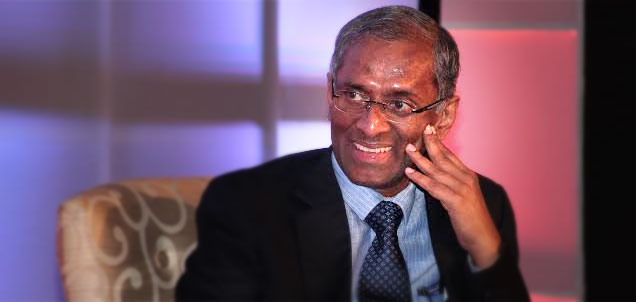
    L V Krishnan

    Commenting on the launch, L V Krishnan, CEO, TAM Media Research, said, “Content consumption has been transitioning across media platforms, especially television and online. Hence, understanding cross=media consumption patterns at one go and planning advertising investments was imperative. This is what makes TeleWeb Audience Measurement the most awaited service for the Indian Media Industry. It is a win-win situation for both the mediums as it will create mutual pull of advertising investments.”


    Highlighting the value that TeleWeb Audience Measurement would bring to the Industry, Hemant Mehta, Senior Vice President, IMRB International said, “We are delighted to partner TAM Media and bring to the industry the first measurement of two screens. With content increasingly becoming platform agnostic, we believe this is an important step in measuring the total reach across platforms. Besides providing the content owners an understanding of the size and profile of their audiences across Digital and TV, the TeleWeb Audience Measurement service will also help advertisers identify new, interesting and cost efficient communication opportunities. For Digital publishers with video content, TeleWeb Audience Measurement would help in benchmarking themselves   vis-à-vis TV channels”.


    It may be noted that TAM is a joint venture of Kantar Media and Nielsen. IMRB is part of Kantar Media, which is fully owned by WPP.


    Presently, WAM’s five-year-old internet panel-based audience measurement platform tracks usage behaviour amongst active internet users in India and has a sample size of 6075 respondents across six metros (Mumbai, Delhi, Kolkata, Bengaluru, Chennai and Hyderabad) which will be fused with TAM viewership data of 10936 individuals from the same  6 Metro Markets (across 2500-odd panels). WAM tracks URLs surfed from user machines and mobile handsets to provide a complete view of consumption habits of audiences across digital properties.


    The WAM data from six metros above will be fused with the TAM TV Viewing data from the same markets. The fused output will be made available through a Client Software Interface called Video Xpress.


  • K Ramkrishnan appointed GM at IMRB Kantar World Panel

    By A Correspondent


    IMRB International, a leading market research firm announced the appointment of K Ramkrishnan (Ramki) as General Manager of IMRB Kantar Worldpanel business.


    Ramki has over 20 years of experience in Consumer marketing, Product/ Brand management, Sales and Strategy development. He joins IMRB from Future Lifestyle Fashions Limited where he was President – Marketing. In the past, he has headed the Marketing function at Café Coffee Day, Lenovo, TTK Services and TVS Motors.


    Commenting on the appointment Hemant Mehta, SVP, Media & Retail, IMRB International said, “With over 20 years of experience in Consumer marketing, Product/ Brand management, Sales and Strategy development, Ramki brings to the organisation valuable expertise in conceptualizing long term strategies, managing innovation and brand development based on consumer insights. As the portfolio of services from IMRB | Kantar Worldpanel expands, I am sure that Ramki’s experience will be a tremendous asset to us and our clients.”


    K Ramkrishnan

    Talking about the move, K Ramkrishnan said: “I am delighted to be part of IMRB Kantar World Panel. I am very excited to drive the Panel service at a time when a lot of change is being seen in the way consumers consume – the changing consumption patterns, the growth of e-commerce, changing media landscape and the rapid inroads made by technology in the consumers lives.  I hope to be able to see and present insights in a way that would be more focused on offering solutions to the marketers, having been one myself all these years. I guess being on this side of the table will help me appreciate better the needs of the marketers and help them craft appropriate strategies for addressing their business issues.”


    Ramki holds B.Tech degree in Chemical Engineering-AC Techfrom Anna University, Chennai. He has received his MBA from Bharatidasan Institute of Management, Tiruchirappalli.


  • Thomas Pulliyel, Mr IMRB


    Thomas Pulliyel, long-time President of IMRB International, retires today (August 31). The IIM Calcutta graduate began his career with the Operations Research Group and first joined IMRB in 1981 as Manager for Overseas Projects, and a decade later, became Senior Vice President. In 1992, he moved out to Research International India as Country Manger, but was back at IMRB in September 2000 for a second stint. Friends, colleagues and even business rivals fondly remember the ‘strong and silent’ Pulliyel, and how he took the organisation to new heights.


    Dorab Sopariwala

    The Al-Futtaim group had asked IMRB to set up a market research unit for them. Thomas spent a year there and I spent the first and the last month. So that’s how I came to know Thomas; you needed to get to know him a bit, before he would open up to you. We were trying to see how we would run this company, and it was only through extensive discussions, that we could work. He would come back in the evening and work till eight pm. I don’t know how we managed for food and such. — Dorab Sopariwala, Consultant and Advisor to NDTV


    Sunil Karve

    I could trust Thomas very much. He is very straight and there are no lies or false claims with him. He helps you along even if you make mistakes, and is always there to support you. When he started Research International in 1992, nobody knew about it. It was a tough and challenging task for him at the time because there was IMRB and MARG, which were the biggies out there, along with MRS and others. I think that he built up an extremely good team, and the work ethics and output were the main reasons for the success of RI. — Sunil Karve, Partner at Autumn Leaves, Innovation and LLP, Varenyam Consulting


    Partha Rakshit

    I still remember the first Board meeting I had with Thomas. Everybody says that he is a man of few words. I found that this was, indeed, his way, but he could also be very firm. I can tell you that if Thomas has got something into his head, you cannot convince him to change his mind. It’s quite difficult to do that. But I think he was a great partner to work with. I think we got on pretty well, and I think of the time when even though we were fierce competitors on the outside, we had a fantastic relationship. — Partha Rakshit, Proprietor, Partha Rakshit Associates, and former MD for South Asia, The Nielsen Company


    Colvyn Harris

    I think the values of IMRB are the values of Thomas. When you think of Thomas, he is a strong, silent type of person. The leadership values of IMRB and the way Thomas conducted himself for the IMRB company, is what has kept the company where it currently is. — Colvyn Harris, Executive Director of Global Growth and Client Development at J Walter Thompson Company??


    Eric Salama

    Thomas has given all the freedom to his people to make their own decisions and even guided some of them over the years. He was always incredibly protective of IMRB – the company, the brand and the people within. He had a paternal instinct towards people and is incredibly patient. Incredibly also, he took both failure and success in his stride. I knew Thomas when he was at Research International, and he has been the heart of an industry that has grown [around him]. I can think of so many clients, so many competitors and so many colleagues who have worked for IMRB at one stage or another. As a talent magnet and a talent machine, IMRB has produced some of the most special people in the industry. Not just one or two people, but at scale, and Thomas has been at the heart of all that. — Eric Salama, CEO of Kantar Media


    Preeti Reddy

    It is always easier to take over a company which is not making money; where everybody hates the boss and hate each other. Fortunately, we are a growing company where everybody loves Thomas and he is a legend, so you can understand how much harder Thomas has made it [to hate the boss]. I would say that it is a huge legacy. Thomas has nurtured it for 15 years, but it is a 45-year legacy. IMRB has defined the industry and you have heard everybody talk about that. In a sense, it is actually giving the industry credibility. So it is a privilege to carry that legacy forward. I think that he epitomises the values of IMRB and, again, many people have said that. I think IMRB is what Thomas is, and he has been a mentor to not just me, but so many people. I’m hoping he will continue to be somebody whom we can turn to, in good times and bad, in the years to come. — Preeti Reddy, SVP & President-designate, IMRB International


    This story first appeared in dna of brands dated August 31


  • Rural India outperforms Urban India in Social Media Usage


    By A Correspondent


    Usage of Social Media in Rural India has grown by an impressive 100 percent during the last one year with 25 million users being recorded in rural India. On the other hand, Urban India registered a relatively lower growth of 35 percent with the total number of users at 118 million as on April 2015. According to the Social Media in India 2014 report by the Internet and Mobile Association of India [IAMAI] and IMRB International, there are 143 million social media users in India as on April 2015.


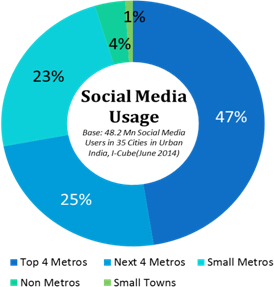
    The report also finds that the top 4 Metros continue to account for almost half of the Social Media users in Urban India.


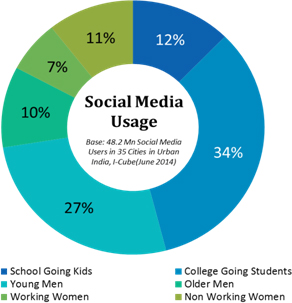
    According to the latest report, the largest segment accessing Social Media consists of the College Going Students with 34 per cent followed by Young Men at 27 per cent School going children constitute 12 per cent of the social media users. College Going Students and Young Men still form the 60 per cent of the Social Media users in Urban India.


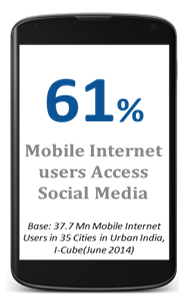
    The report further finds that 61 per cent of these users access Social Media on their mobile device. The fact that almost two thirds of the users are already accessing social media through their mobile is a promising sign. With the expected increase in mobile traffic the number of users accessing social media on mobile is only bound to increase.


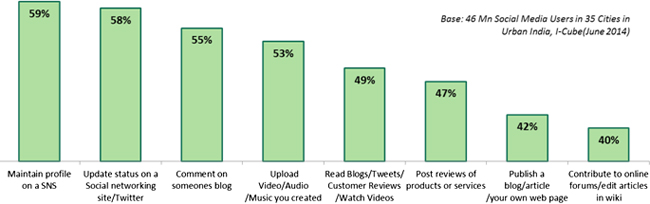
    According to the report, maintaining a profile on social networking sites are a top activity of users followed by updating status.  Commenting on a blog site is the third most popular activity among users in social networking sites.


  • Digital growth takes a 53% leap over last year


    By A Correspondent


    There was always talk of digital surging ahead of the others in its quest to be the fastest growing medium. But never was this trend more visible than in 2014-15 where a host of e-commerce players put up some never-seen-before action and beat industry expectations on the parameter of growth and excitement.


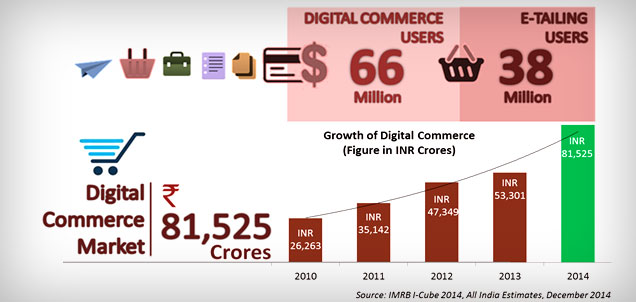
    According to the latest Digital Commerce Report by IAMAI and IMRB International, the digital commerce market was valued at INR 81,525 crores by the end of December 2014, and registered a growth of 53 per cent over 2013. The report further states that the industry is estimated to grow further at a rate of 33 per cent and cross INR one lakh crores by the end of 2015.


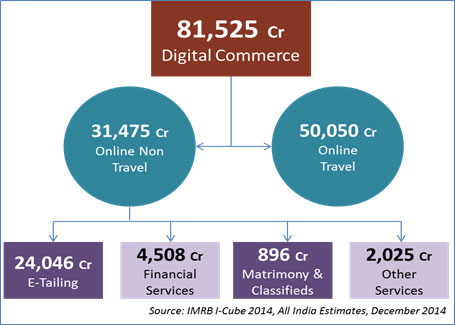
    The report also finds that online travel comprised a majority 61 per cent of the whole Digital Commerce pie. Significantly, e-Tailing has grown by around 1.4 times over 2013 and constitute nearly 29 per cent of the overall share.


    According to the findings of the report, Mobiles & mobile phone accessories contribute the most, i.e., 41 per cent (INR 9,936 crores) to the e-Tailing segment followed by apparels, footwear & personal items which contribute 20 per cent (INR 4,699 crores). Consumer Durables along with Kitchen Appliances contribute another 14 per cent (INR 3,404 crores). Out of the remaining 25 per cent, Laptops/Net Books/Tablets, Home Furnishings and Books contribute another INR 2,780 crores, INR 1,059 crores and INR 648 crores respectively.


    The report also finds that 45 per cent of the Online Shoppers prefer Cash on Delivery as a mode of payment. 21 per cent prefer payment through Debit Card and 16 per cent via Credit Card. The other modes of payment include Internet Banking (10 per cent) and other payment modes viz. prepaid cash cards, mobile wallets etc (8 per cent).


    According to the report, the Financial services market has grown at a CAGR of 20 per cent since 2010. In December 2014, this market was valued at INR 4,508 crores. The Classifieds markets have seen a significant growth and are valued at INR 896 crores by Dec 2014.


    Other online services market has grown with a CAGR of 73 per cent since 2010 and was valued at INR 2,025 crores by December 2014. This segment includes emerging service categories like Online Entertainment Ticketing, Online Commuting, Online Food and grocery Delivery. Online Food Delivery market has seen the maximum growth (40 per cent) over the last year in this segment and it is now valued at INR 350 crores by the end of 2014.


  • India to have 155 mn mobile internet users by March 2014: IAMAI-IMRB

    By A Correspondent


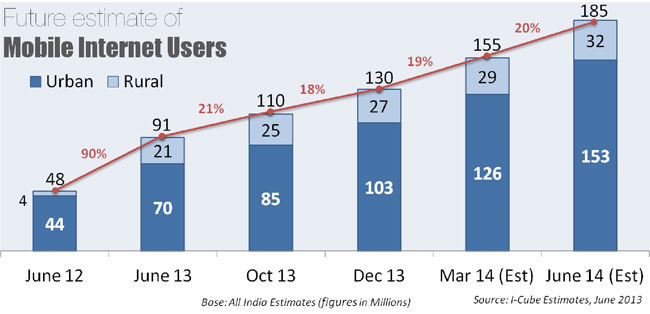
    The number of mobile internet users is going to reach 155 million in India by the end of March 2014 and 185 million by June 2014 maintaining a Q-o-Q growth of 20%, according to the ‘Mobile Internet In India 2013’ report released by the Internet & Mobile Association Of India (IAMAI) and IMRB International. The report states that by end-December 2013, the number of mobile internet users would be 130 million. The number of mobile internet users in October 2013 was 110 million with 85 million users from Urban India and the rest 25 million from Rural India.


    According to the report, Urban India will continue to account for a large percentage of the mobile internet users across the country and is expected to reach 126 million by March 2014 and touch 153 million users by June 2014. Significantly, a drastic growth was witnessed in the number of users of mobile internet in Rural India and will register an impressive 50% growth to reach 32 million by June 2014.


    The report further finds that across both Urban and Rural India, over 50% of the active internet users are accessing internet on their mobile, apart from other sources. This is a clear indication that there has been a huge uptake in consumption of this mobile internet medium.


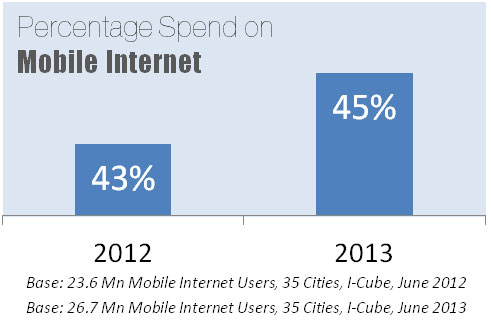
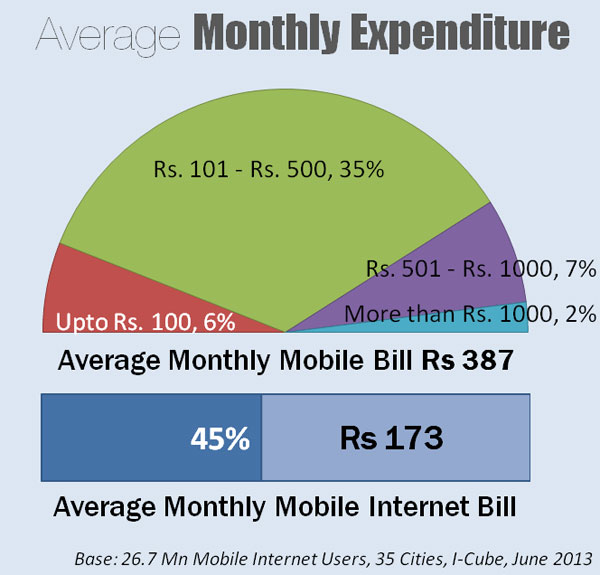
    The report also finds that ARPU has dropped to Rs 387 from Rs 460 in 2012. However, what is worth noting is that the percentage amount spent on Mobile Internet has gone up to 45% from 43% in 2012. This is a clear indication that more and more people prefer communicating over the phone rather than using the traditional media.


    According to the report, 35% of mobile internet users are spending between Rs 100 and 500 monthly on their phone expenses. 9% are spending over Rs 500 and just 6% of the users are spending less than Rs 100 every month.


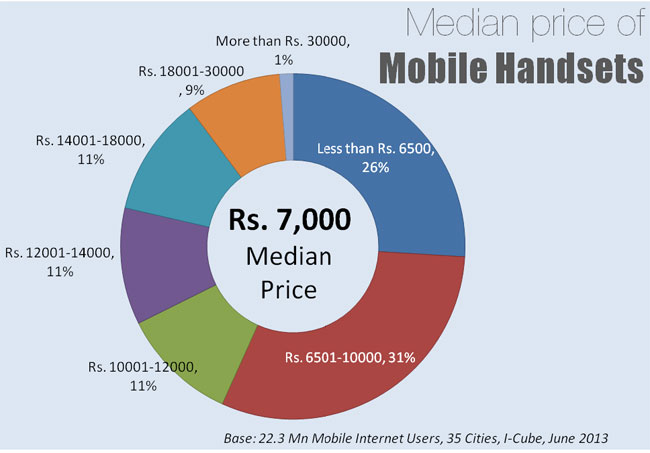
    The IAMAI report also finds that the median price of a handset has fallen from Rs 8,250 in 2012 to Rs 7,000 in 2013. This is attributed to the reducing prices of phones with advanced features. More and more manufacturers are trying to target the ‘Value for Money’ segment by offering more features at lower prices.


  • Aaj Tak Care Awards are good news for society: Aroon Purie

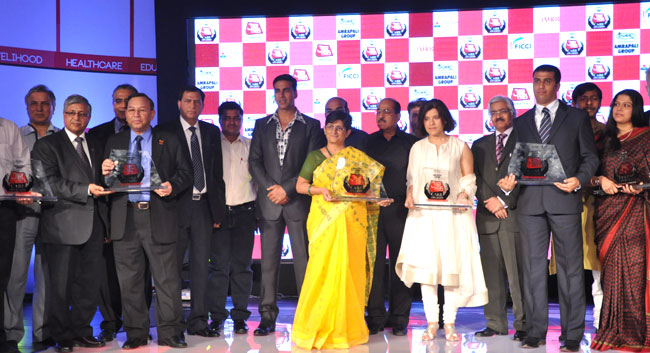
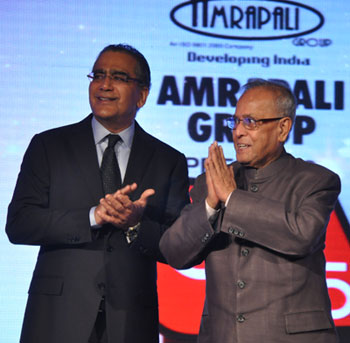
    Bollywood Star Akshay Kumar & Aroon Purie, Chairman & Editor-n-Chief, India Today Group with winners of Aaj Tak Care Awards


    By Shruti Pushkarna


    Mr.Aroon Purie, Editor-in-Chief, India Today Group with Finance Minister Pranab Mukherjee at the Aaj Tak Care Awards

    TV Today Network’s Hindi news channel Aaj Tak hosted the first edition of Aaj Tak Care Awards on June 6 at the Taj Palace Hotel inNew Delhi. The awards seek to honour corporate entities who have contributed towards inclusive and sustainable development keeping in mind the society as the focal point.


    Finance Minister Pranab Mukherjee graced the event as the chief guest and felicitated the winners at the awards ceremony. Bollywood actor Akshay Kumar, who launched the Aaj Tak Care awards anthem, was also present at the awards ceremony.


    Inaugurating the awards ceremony, Aroon Purie, Chairman & Editor-in-Chief, India Today Group said: “The industry realises it must make more than just profit; that it must give back to the society. TV News channels have been accused of concentrating only on what’s wrong with the society, so these awards are ‘good news’.”


    Speaking at the event, Mr Pranab Mukherjee urged the corporate sector to build CSR in a big way into their business: “You need to give back to the society. We need more Nandan Nilekanis to join the cause. CorporateIndiahas to help with new ideas to deal with some of the prevailing socio-economic issues. We need to work together towards a better future.”


    Aaj Tak Care Awards were given away in five different categories, Education, Empowerment, Environment, Healthcare and Livelihood. Leading research agency, IMRB International filtered entries for participation in these awards based on parameters like replicability, sustainability, people participation and innovativeness. In the second phase, Federation of Indian Chambers of Commerce (FICCI), with their expertise in various sectors, partnered to further shortlist the companies. They compared and evaluated the CSR initiatives of all entries and nominated the final 40 companies for the second phase. The third and last phase of the Aaj Tak Care Awards was the selection process by the jury where eminent personalities debated and arrived at a list of final 12 winners.


    The Jury was chaired by Mr Gurcharan Das, Chairman, author & management consultant. Other jury members included, Prof Dipankar Gupta, noted sociologist; Mr Arun Kapur, Executive Director, Learn Today; Mr Sandeep Pandey, social activist; Mr Rajender Singh, environmentalist & chairman, Tarun Bhagat Sangh; Dr Ashok Seth, Chairman of Fortis Group of Hospitals (Cardiovascular Sciences & Cardiology Council); Mr Sandeep Chachra, Executive Director, Action Aid India.


    Commenting on the awards, Joy Chakraborthy, CEO, TV Today Network said: “The Aaj Tak Care Awards is an endeavour by the TV Today network to recognize and honour the real champions of corporateIndiawho have positively impacted the society. We looked at companies who have gone beyond their corporate objectives of growth and profitability, and laid an emphasis on the improvement of the society as their larger objective.”


    List of winners in all five categories:

    Education

    Amway India Enterprises Pvt. Ltd

    PVR Limited


    Environment

    Suzlon Energy Limited

    ONGC

    Dabur India Ltd


    Healthcare

    Eli Lilly & Company

    JK Lakshmi Cement Ltd

    Standard Chartered


    Empowerment

    Gitanjali Gems

    Microsoft Corporation


    Livelihood

    Bharat Petroleum Corporation Limited (BPCL)

    First Source Solutions Ltd