Tag: Imagine

  • Shailesh Kapoor: Hindi GECs: There’s Space For More… &More

    By Shailesh Kapoor


    March 2 saw the launch of &TV, the second mainstream GEC from the Zee stable (not counting the highly differentiated Zindagi and the rerun-based Zee Anmol). The first ratings yesterday confirmed that the channel has managed to make its presence felt within its first week. It launched at 42 GRPs, making it one of the best channel launches in the last decade, close on the heels of Colors, Life OK and Imagine.


    The ratings universe has widened since 2008. &TV’s 42 GRPs would easily have been 55+ in a pre-LC1 environment, in which other GECs mentioned above launched. Also, the ratings are based on five-and-a-half days of content, which means a natural growth next week is expected anyway. We should see the channel comfortably crossing the 50-mark next week, and with a sizeable reach potential still untapped, it may be looking at the century over the next quarter.


    What interested me even more was to see if &TV got its initial numbers from other GECs or if it could grow the category. The top six GECs lost only 21 GRPs this week combined, which &TV got exactly half its viewership by growing the category. Its early days yet, but one could safely assume that in a more stable state, at least 30% of &TV’s ratings would be category growth, which could mean that channel would have managed to grow the already dominant Hindi GEC category by 3-5% by the time it crosses the 100 GRP mark.


    Yet, there has been persistent talk around there being no space available for one more Hindi GEC. Every time someone comes up with the idea of launching a new Hindi GEC, promoters or investors treat the thought with immense skepticism.


    It’s not a surprising response, however. You won’t expect most investors to be core GEC viewers themselves, and from the outside, it would indeed seem that all the GECs are essentially dishing out similar programming. I have voiced my concerns regarding lack of innovation on the GECs over the last two years, but lack of variety has never been an issue. The consumers see genres and sub-genres in what the non-viewers can just pass off as “daily soaps” or “saas-bahu serials”.


    Identifying strategic need gaps in the Hindi GEC space can be a tough ask today. But tapping the right genres and creating new sub-genres within them can indeed push the category viewership ahead. The size of investment may also be a deterrent, but for someone with deep pockets, a well-planned GEC business has a far lower risk than, say, a news or a niche channel today.


    The rise-and-fall stories of 9X and Imagine have often been used as an example of how a GEC business is high on risk. But there have been the success stories in Colors and Life OK too, the former a lot more significant than the latter. I hope the early success of &TV encourages more GEC launches. Sound business models can ensure good profitability at even 80-120 GRP levels.


  • Rough roads ahead for M&E, but not everyone’s complaining


    By Johnson Napier with Tuhina Anand, Shruti Pushkarna, Meghna Sharma and Shubhangi Mehta


    Not many in the business arena would want to relive the harsh moments of 2008-09, which saw the economy at its most downward. While the phase did see a few corporate entities engage in a growth spree of daredevilry proportions, most brands were put to the ultimate test of surviving the slowdown odds or risk folding up business. The phase was, as most experts would agree, the toughest that had hit the Indian shores in a long time. And that there wouldn’t be anything harsher than that in a long time to come.


    But then that phase was a thing of the past and if one has to assess the current scenario, there is a sentiment of adversity that’s staging a strong comeback yet again. Given the spate of hurdles facing the economy like rising inflation, hike in petroleum prices, falling value of rupee and global uncertainty, the question doing the rounds is whether the current economic crisis is putting as much strain on the industry as it did in 2008-09? And, importantly, will the gloom see the growth numbers nosedive to lower levels than what was originally anticipated for 2012-13?


    To recap the growth numbers that was predicted for the media industry for 2012, Mindshare’s annual report – ‘This Year, Next Year: Indian Media Forecasts’ – had projected net revenue for 2012 at Rs37,397 crore, slated to grow at 12 per cent over 2011. This was somewhat close to the kind of growth that was witnessed in 2011, which stood at 12.8 per cent. But with the current crisis refusing to die down and with the sector already moving at a slow pace since January this year, the growth figures may see a marginal fall or remain stagnant.


    Sectoral evaluation

    Providing his outlook, Sujay Ghosh, Senior Vice President, DDBMudra South said that there is indeed a slowdown being felt across sectors. “There is a slowdown across several sectors like retail, apparel, real estate to name a few. As it happens with every slowdown, consumer spending gets concentrated on essentials and indulgences get affected. So, footfalls have shrunk and “like to like” buying has also come down. And with the petrol price hike, things will worsen further.”

     

    Divya Gupta

    Sharing a similar sentiment, Divya Gupta, CEO, Dentsu India said that there is a slowdown being witnessed in certain sectors, but then there are others that are doing business as usual.


    When analysed further across sectors, the buzzword that’s doing the rounds is “caution”. Expressing such a trend in the domain of television, Ravikumar Gilganchi, VP, Sales, Kasthuri TV shared that in the last two months there has been an increased demand from the advertisers on returns and they have become very rigid on spending: “The dip would be around 15-20 per cent. However, I would like to believe that this is a short-term scenario and by June things would bounce back to normal.” His reason being that since it’s just the start of the financial year many would still be getting their budgets approved and hence, June is when the action would begin.

     

    Sujay Ghosh

    He further shared: “For the first rung channels, there is not much choice for advertisers and they will go with whatever price is being quoted with not much negotiation as they would want that channel to be part of their media plan. They would start negotiating hard with second rung channels where there are many options available.”


    And it’s not just broadcasters who are feeling the heat. Production houses that play an integral part in the broadcast business too are seeing a rough patch. Hemal Thakkar, Director, Playtime Creations, whose show ‘Ruk Jana Nahi’ airs on Star Plus said, “This time economic slowdown has brought inflation with it which is the biggest cause of concern. This has led to a spike in manufacturing cost of product and budget limitation puts everyone in a spot. Interest costs too have shot up in last two years and so it triples the burden of execution in limited budget.”

     

    Hemal Thakkar

    But Rahul Kumar Tewary from Swastik Productions Pvt Ltd  whose show Navya airs on Star Plus thinks there is also an opportunity in all this: “The economic downturn has affected the industry as can be seen with the shutdown of channels like Imagine, but it hasn’t made any impact on the major players. The TV industry is on track for major growth as per the industry reports.” According to him, there are unlimited opportunities in the media space as it is a growing industry.


    Another sector that may see a saturated growth pattern is print, which is the second favourite with the brands after television. Alok Sanwal, Project Head & Editor, Inext, expressed concern as he said, “Largely, there is a note of caution for each one of us and this phenomenon is something that a lot of ad agencies had predicted from the beginning of the year for us. If we look at the larger advertising scenario, it was not good even last year. As of now things have been fine for most publications, including us. I feel each one of us have to be sceptical of how things would shape up in the second and third quarter of 2012-13.”

     

    Rahul Kumar

    As for the larger players, Sanwal feels that there is a word of caution there and the trend is utilitarian, by which he means, it is extremely sales driven: “So to that level, I think, it is a challenge for them. At the end, revenues may continue to grow but the larger challenge would be how to control expenses or optimise investments.”


    R Rajmohan, publisher, Open said: “What we are seeing now is worrisome but the print industry has been witnessing a slump from January this year onwards. The range varies across newspapers and magazines and in some cases it is much more than 20 per cent drop in revenues. The market sentiments have not been positive for a long time and this has led to people curtailing their ad spends on a large scale.” As for the brands, he feels they are playing the game of caution. “They will only spend where they see a genuine need. As for the genre, I feel the lifestyle magazines would continue to do well while the others may not do so well. But the scenario may change with the onset of the festival season. Till then it is wait and watch.”


    But there are those who believe that the scenario is not as bad for the sector and that it is on track for recording modest growth. Krishna Prasad, Editor, Outlook said: “I don’t know if the sentiment is as gloomy as it looks. If you look at the papers and magazines, there are so many sectors that are still promoting ads in them. The media, per se, has been witnessing tremendous action with so many new channels being launched and so many acquisitions and takeovers being the order of the day. So from a macro view, the economic gloom is not really taking a toll on our industry. But that does not mean all our problems are over, far from that. Oil prices are shooting through the roof, the value of rupee is falling further and all these factors will make our growth a challenge. We will have to see how things pan out in a couple of months from now.”


    He added: “Brands are being careful with their spends. Even big brands are treading cautiously and are not going overboard, unless required. We will have to wait and see what the forthcoming months will unfold for the print industry.”


    Agreeing with him, Mr Ghosh said that there are indeed pressures being felt by the clients as well: “There are client pressures in terms of numbers and therefore the client expects us to value add…in terms of strategic thinking on how to get more share of wallet. So our involvement with the client has gone up significantly. Similarly, the clients are concentrating on trying to get more out of their spends from everywhere.”


    He further stated: “I think the spends will remain constant or probably fall a little but nothing drastic will happen. Because the clients have been through it earlier and are experienced enough in not going overboard with expenses…especially with hiring, inventories and so on. So they won’t have to cut down much on marketing spends or any other spends for that matter.”


    Need for self-introspection

    KV Sridhar

    Always the one to be bridging the gap between the client and the consumer, the advertising agencies too are approaching the gloom with a note of caution. Providing his outlook, KV Sridhar, NCD, Leo Burnett, said: “If the industry is affected, the agency is affected and all this is caused by our internal issues more than the external issues. There are three pointers to this. First, advertisers do cost cutting and there are agencies available that are ready to work at lesser prices, this in turn affects the complete industry. Second, there are inefficient government policies, where the government is neither affected nor concerned about the sky-scraping inflation. And third, it’s the fact that we are all a part of a global family as an advertising fraternity. Keeping all this in mind we can still expect a double digit growth, the issue being that growth is also not enough for us, we are always aiming for more.”

     

    Agnello Dias

    Agnello Dias of Taproot India spoke on behalf of small and independent agencies when he said: “Ours is a small and independent agency, and hence personally, I do not think that agencies like us get affected by slowdown. It’s actually the bigger agencies having clients who play a part in the rise and fall of the economy of the country who get affected by the slowdown.”


    Representing the industry as president of AAAI and also the Executive Director – India Operations of Draftfcb Ulka Group, Nagesh Alai too feels that the current slowdown is affecting the advertising industry: “The advertising industry, to a considerable extent, is linked to the fortunes of the country’s economy/GDP. The recalibration of GDP growth to under 7 per cent, the high inflation, the high interest rates, falling FDI inflows and share portfolio pullouts, the plunging rupee, lowered credit rating, policy paralysis at the government et al have significantly heightened concerns in the business world and that is reflected in poor business confidence.” According to him, while a few sectors like FMCG seem a bit more confident, most other sectors are seeing a softening and are seeing revenue and profit pressures.


    Suggesting the possible solution that agencies could adapt, he said: “Overall, it’s going to be quite a challenging 2012. Most agencies will be affected and may have to relook at their numbers. Having said that, it is better to accept the situation as a business cycle and weather it with prudence and caution. It’s certainly not gloom and doom. My sense is that this time around, it is entirely up to us to rescue the situation and the sooner we do it, the better it will be for everybody. I only hope that the incumbent government gets out of paralysis and inaction and takes some positive steps in the interest of our economy and its people, if they are hoping to win at the 2014 general elections.”


    Though a relatively small domain, Out of Home too is seeing the effects of the slowdown. Sunder Hemrajani, MD, Times OOH highlighted the trend as he said: “After the last slowdown which happened in 2008-09, when the industry actually declined, subsequently the industry had two good years, 2010-11 and virtually 2011-12. The last year, 2011-12 started well for the industry, in the first half from April to September, the (Out of Home) industry saw good double digit growth rates. The slowdown started in November and carried on right upto March and April this year. So overall, you had a situation where the industry grew at about 8 per cent but first half was significantly better than the second half.”


    According to Mr Hemrajani, what has happened is the whole environment, and this is true not just of OOH but all media segments, has become very uncertain. “As a result of that uncertainty you find that people are holding on, clients are not making long term commitments. Earlier one used to get an annual deal or a six months deal, but now they have become three months and one month…so the level of commitment is becoming more short-term rather than long-term. Secondly, the pricing…it’s becoming difficult to increase prices and in some segments the prices have declined as well.”


    But the situation is not as bad for Rajan Mehta, Founder and CEO, LiveMedia. He said, “Contrary to the current economic situation, our business is growing quarter on quarter. Possibly because it’s new and hasn’t hit saturation as yet and also because it is very well targeted and hence cost effective. We are seeing that marketers for whom we were not a priority medium earlier are beginning to consider us as their media budgets have been reduced. They say ‘necessity is the mother of invention’ and therefore it is in these hard times that when advertisers are being challenged to get a bang for their buck that they are discovering and adopting mediums like LiveMedia.”


    Adding his thoughts, Haresh Nayak, MD, Posterscope Group India said, “From trade point of view we are seeing trends as close to 2008 and clearly non occupancy has gone up resulting in loss of business. This coinciding with monsoon which is supposed to be the lean period for OOH has brought down business and according to our estimates the non-occupancy has gone to 50 per cent. Though we implemented 18 campaigns last month, we are seeing a trend of quick availability and ease in implementing large campaigns due to slowdown.”


    With the rupee showing slow signs of recovery and with petroleum prices expected to be hiked further in the coming months, the M&E industry will have to look at alternative strategies to see itself emerge stronger from the economic broil. It may help that the mediums of digital, radio and so on are putting up a strong show, especially digital that is scheduled to grow in excess of 30 per cent. Radio, too, could make merry with the stage set for phase 3 rollout, providing them alternate streams for revenue generation. For now, players are opting to tread on the cautious route and one will have to wait a couple of quarters before the fate of the sector could be ascertained.



  • Anil Thakraney: Lack of imagination

    By Anil Thakraney


    Even a kid will tell you that there are just toooo many TV channels inIndia. Both, entertainment and news. And even as talks of a shake-out have been doing the rounds for years, more channels are waiting to start operations! Like everything else inIndia, it’s a mad house out there.


    Quite obviously, there can be place for only so many brands. The advertising pie is limited, and it cannot be shared by so many hungry mouths. And in the Indian context, a vast majority of a channel’s revenues come from advertising and not through subscriptions. In such a scenario, Imagine’s closure does not surprise me at all… in fact, I wonder what took them so long.


    As for the many other struggling channels, they are fortunate to be run by very deep pocketed suits. But those deep pockets, like Turner’s, will dry up at some point. It’s a matter of time.


    Imagine came on to the scene in 2008, when the Hindi GECs market was already divided between Star, Zee and Sony. Each had already established itself, and all three channels enjoyed viewer loyalty. To break into this extremely capital intensive and crowded house, Imagine’s only chance was to unleash kickass, totally offbeat programming. ‘Shock and awe’ ought to have been the mantra. 2008 was also the time when the nation had begun showing early signs of tiring of Ekta’s traditional saas bahu sagas, and there was a huge opportunity for Imagine to be the game changer that the market wanted.


    Alas, it was not to be. Imagine’s fictional shows were completely me-too, and most of their reality stuff was a huge disaster. ‘Swayamwar’ was perhaps the only ‘hatke’ programme, but in the GECs biz model, reality shows and movies are, at best, jam servings, laid out to entice viewers to the bread and butter fiction shows. And if the latter is a thakela and done-to-death fare, the channel is sunk. Which is exactly what happened with Imagine.


    Make no mistake about this: Imagine’s problem wasn’t funds or staying power or distribution or even talent. It was very simply this: Lack of imagination.


    * * *


    PS: This is a memo Shri David Ogilvy sent out to his employees way back in 1982.


    On how to write. It’s fantastic. You will notice that his suggestions, in this day and age of micro blogging and short attention spans, are more valid than ever before.


    Link: http://www.listsofnote.com/2012/02/how-to-write.html


  • So why did Turner stop Imagine(ing)?


    By Team MxMIndia


    Just when the Hindi general entertainment space was getting interesting with the top 3-4 players all coming within sneezing distance of each other in the numbers game, the industry was jolted by news of the closure of Imagine, which given its pedigree, was launched with much fanfare not many moons ago. From shock to sadness and even rage (at least on the social media) admirers and naysayers were seen on an overdrive trying to piece the chain of events that had led to the downfall of the channel that was seeing red for some time now.


    This was in stark contrast to the kind of emotions that were flying thick and fast exactly a year ago, when Turner General Entertainment was merged into its parent company Turner Broadcasting System Asia Pacific, Inc. The emotions then were almost similar to what the channel heads were going through when they flagged off the channel more than four years ago, making it one of the most loud and admirable launches of the time. While anticipation and expectations were riding high on the faces of each and every member of the team at launch, the same was the scenario during the merger exercise last year as the company was probably taking a last shot in reviving the fortunes of the network to see themselves battle against the competent lot at the top. But all that was not to be as tribes from the world of media and outside woke up to the news of the channel shutting down yesterday.


    Siddharth Jain

    Replying to questions put forth by MxM India (read interview),  Siddharth Jain, Managing Director- South Asia, Turner International India Private Limited put it out right and straight as he said: “This is a carefully considered business decision based on performance of the channel. We invested substantially and put all possible resources behind Imagine TV throughout. As in any other business, the investments were directly linked to reaching a certain performance benchmark. However, in the two years Imagine did not grow or perform as per expectations and as a result, Turner made the carefully-considered decision to cease operations of the channel.”


    Mr Jain is probably being modest in quoting that the channel did not perform as per expectations in the past two years, but the writing was on the wall in the first three months of 2011 itself, when the channel failed to get the viewers and advertisers excited with its most expensive property that cost the company in excess of Rs50 crore to produce. ‘Zor ka Jhatka’, hosted by Shah Rukh Khan, failed to get the desired ratings and didn’t do much to push the channel in the top league as was expected. In fact, in an interaction with the media before the show went live, an exuberant Sameer Nair had vouched that the show along with a few others would catapult Imagine among the top 3 in the Hindi GEC space. Wishful as he was, that was not to be. Its failure forced the thinktank at Turner to come up with steps to plug the loopholes, even if it meant changing its course altogether.


    Sameer Nair

    Thus in April 2011, Turner announced the merger of Turner General Entertainment into its parent company Turner Broadcasting System Asia Pacific, Inc. This was followed by the formation of a special committee comprising various Turner officials such as Monica Tata and others along with officials from Turner General Entertainment Network including Sameer Nair and Harsh Rohatgi with the intention of charting out a long-term course for the channel. This move was even vindicated by Steve Marcopoto, President, Turner Broadcasting System Asia Pacific (TBSAP), who went on to explain the need for such a proposal, which was to assess its performance and chart a long-term course for Imagine. But just when the merger was announced, Sameer Nair did the unthinkable by announcing his decision to exit the company.


    In an interaction with MxMIndia Editor-at-Large Anil Thakraney, Sameer Nair was quite upfront about the reason for his decision to move on: “I was used to operating independently. After Turner took over, one had to integrate into the Turner system. And this made me just a department head. And so I left.”


    Expressing concern towards the chain of events that led to the closure of the channel he said, “I am quite shocked and disappointed to hear that they’ve decided to shut the channel down. They (Turner) seemed to be quite gung ho about Imagine, and I thought they were going full steam ahead. There is a lot of investment and a number of jobs at stake.”


    Mr Nair’s exit from Imagine was followed by a few other key exits and the network’s failure to find a suitable replacement. Even attempts to vow the audiences by launching a slew of reality and mythological shows didn’t do much for the channel as it still figured in the #6/7 slot amongst its peers in the space.


    In fact, even as recently as 2-3 months ago, the channel was going all out with its promotional activities as it announced the launch of new shows. But that too has been brought to a halt as Mr Jain explained: “We cease all business operations of Imagine TV. The closure is a complicated process as we are ensuring fulfillment of all our business commitments to advertisers, distributors, production houses and other partners.”


    The news came as a rude shock to producers, some of whom were in the midst of production schedule (see story: Rude Shock for Producers & Performers). Rajan Shahi who had launched ‘Jamuna Paar’ on Imagine just a little over a month ago, refused to comment on it saying “it would be too premature”. Other producers like Siddharth Tewary, the Sagars who had ‘Chandragupta Maurya’ and ‘Dwarkadheesh’ aired during primetime were incommunicado as they grappled with the sudden turn of events.


    JD Majethia

    JD Majethia who had launched two shows, ‘Jassuben Jayantilal Ki Joint Family’ and ‘Ek Packet Umeed’ four years ago said: “It’s sad and shocking. It was a channel which with the entry of Vikas Behl at the helm of things looked poised for bigger things, a turnaround but that was not to be. It’s a huge setback for producers and for those who work on a per day basis. A daily show means a minimum of 100 people associated with it in various capacities and with Imagine closing down, it spells doom for them. All that talent and labour goes down the drain. It’s a loss of about Rs200 crores worth of yearly business for Imagine and the industry on the whole.”


    Veteran producer Dheeraj Kumar of Creative Eye Productions said: “It was an overnight decision but it could have been done a bit smoothly. I am hopeful that Turner with its huge umbrella of channels would give us a chance of providing content to them. I am optimistic.”


    Programming propaganda

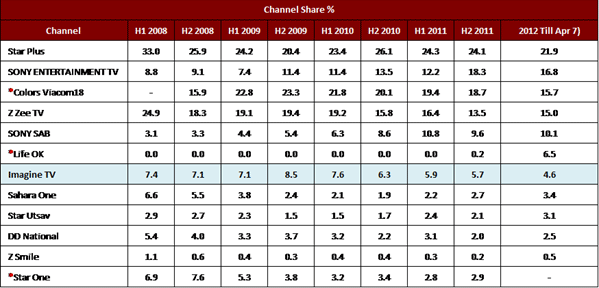
    Ever the one to influence viewers and attract the attention of the advertisers too, content was one of the biggest setbacks for the channel, going by the buzz emanating from experts. While the start for the Imagine was glorious, as it did manage to attract sizeable channel share (see chart below) and even break into the 150+ GRP mark at some point, it was an experience that was shortlived. The maximum channel share that the channel attained was 8.5 in H2 2009.


    Source: TAM Media Research / TG: CS 4+ yrs / Market: HSM / Period: H1 (Jan-Jun) & H2 (Jul-Dec) 2008, 2009, 2010, 2011 till April 7, 2012


    Mohit Joshi
    Divya Radhakrishnan
    Karthik Lakshminarayan
    Pankaj Krishna

    Explaining the implications, Mohit Joshi, Managing Director, MPG said, “The General Entertainment domain is very competitive and each channel is constantly improving content and production. The viewer has many options today and hence has become more ruthless with the channel choice. In spite of a great start, Imagine lost it mid-way. In an attempt to gain viewership and numbers, it resorted to telecasting shows like Rakhi Ka Swayamvar, Rakhi Ka Insaaf and so on. Though these shows could have given a short-term boost in numbers, in the long run, viewers didn’t find the content appealing enough. Also these shows dented the channel image by giving it a ‘sleazy’ tag – which is not acceptable in the GEC domain.”


    Divya Radhakrishnan, Founder, Helios Media, said, “GEC is a highly competitive segment and the cost of running a GEC is very high. Imagine had reached a level of stagnation especially in the last six months, however shutting down was not expected.”


    Karthik Lakshminarayan, COO, Crest, said: “Imagine had the brand heritage of NDTV and Turner. I think it was sheer bad luck that they eluded that one show which could give them success like Kyunki did for Star, Saat Phere did for Zee, Ballika Vadhu for Colors and Bade Acche Lagte Hain is doing now for Sony. For a GEC to break even it takes 4-5 years so one needs to stay invested for a long period to see the returns, hence the move is a surprise.” In fact, he has a surprising statement to make: “Their overnight decision has caught us unawares and our media plan needs a quick revision. We had spots to go on air on the channel as we talk. I think now those spots are up for grabs and may the best player win.”


    Blame customer pull, not distribution!

    There are primarily two ways of impacting Channel Trials – namely Consumer Pull led by content affinity, and Broadcaster Push led by Distribution initiatives, explains Mr Pankaj Krishna, Founder and Managing Director, Chrome Data Analytics & Media (see Analysis: How Imagine lost due to consumer pull, not distribution. “Going by Chrome OTS numbers (Opportunity To See – percentage of households that have access to a channel) – Imagine TV has clearly been in the league of the top GECs with an OTS of 95% across HSM.”


    According to Mr Krishna, “consumer pull clubbed with Strategic Distribution Planning has a huge impact on the overall performance of a channel”. “Over the years, Imagine lost out on factors contributing to the former.”


    Staff shocked

    It was Terrible Thursday for the staff at Imagine. They had no clue of the closure, even as they had faced yet another week of dismal ratings from TAM. Said Jain on the fate of the staff: “Turner will retain some employees for a transition period and some others are being offered permanent roles within other Turner channels to fill current vacancies. For the other Imagine employees getting impacted, Turner has set up an HR outplacement service which will provide advice on how to write a better CV, interviewing techniques and other job hunting skills. We will also introduce the employees to recruitment consultants, HR professionals from other media organizations and facilitate their new job search. Our focus is to ensure the closure is executed in a fair and appropriate manner for all of them and in full compliance with all legal requirements, employment terms and company policies. We will use our best endeavours to make this as smooth a transition as possible for them.”


    There has been much dismay in the brodcast fraternity too. Colors CEO Raj Nayak in fact made a clarion call to the industry via Twitter: “To all my friends in the TV business. Let’s try & accommodate our friends from Imagine wherever we have vacancies in our system.”


    Way ahead

    The move does spell a warning for other broadcast majors to sit up and take notice. Let’s not forget examples of a few channels that had to shut shop midway including Star One, Zee Next, 9x and Real for lack of vision and programming blunder.


    Ashish Pherwani

    As Ashish Pherwani of E&Y writes in his analysis for MxMIndia (when is it right for a channel to pull the plug): “Over the last decade or so, most unsuccessful channels which have tried ‘overhauls’ and ‘makeovers’ that have failed to achieve their objectives within six to eight months, have eventually shut down their operations.” According to him, for a channel to succeed, “the only asset it has is viewership. Channels which operate without a robust management team, a unique market position, and a defined target audience, won’t be able to garner sustained and loyal viewership. If channel management is able to make these three aspects fit seamlessly together, chances are the channel will succeed as a business, else, it would make business sense to pull the plug!”


    Turner may probably pay heed to Pherwani’s suggestions if it ever were to take another swipe at launching a Hindi general enterainment cahnnel  channel. Going by its past track record where it teamed up with Alva Brothers to launch Real and proceeded by acquiring Imagine from NDTV, chances are that the network may already be on the prowl hunting for its next prospect. Until then, the network seems content to bask in the laurels of its sister channels that have been showing good growth in the genres they operate in.


    Written by Johnson Napier with inputs from Anil Thakraney, Ashish Pherwani, Pankaj Krishna, Kshama Rao, Tuhina Anand and Robin Thomas


  • I am shocked and disappointed: Sameer Nair

    By Anil Thakraney


    Sameer Nair, whose baby Imagine channel was, is quite surprised by its sudden demise. Mr Nair founded Imagine in 2007 in partnership with NDTV, and ran it for four years. He quit last year after Turner bought the channel from NDTV.


    Speaking to MxMIndia, he said: “I am quite shocked and disappointed to hear that they’ve decided to shut the channel down. They (Turner) seemed to be quite gung ho about Imagine, and I thought they were going full steam ahead. There is a lot of investment and a number of jobs at stake.”


    When asked what in his view may have gone wrong with Imagine, Mr Nair said GECs is a very difficult segment and it needs deep pockets and a determination to go the long haul. And that he thought Turner had the muscle power to go the distance. Talking about his own stint at the channel, he said: “We had some successes and some failures. It was a tough market, we faced economic difficulties. And GECs is a tough space to be in, it’s a very competitive category. We were the first to re-create the Ramayana and we launched ‘Rakhi Ka Swayamwar’, a show like that had never been done before. I think we did some good work.”


    And what were the reasons behind his own departure from the channel? Mr Nair’s response is pretty frank. “I was used to operating independently. After Turner took over, one had to integrate into the Turner system. And this made me just a department head. And so I left.”


    Mr Nair says he’s currently working on some exciting projects but will reveal details once it all falls into place.


  • Rude shock for producers and performers

    By Kshama Rao


    Producers woke up to a rude shock on Thursday  to the news of Imagine shutting shop. If IPL wasn’t enough, then the closing down of a TV channel meant further doom for the producers.


    JD Majethia

    Turner Broadcasting System Asia Pacific Inc. (Turner) dashed off a letter that to the producers and the media about Imagine being wound up with immediate effect, so much so that shootings had to be abruptly cancelled on Thursday as the TV giant didn’t want the channel to spend on even one day of shooting!


    While the industry is still reeling from the news, the worst affected are the producers whose shows were running on the channel. Rajan Shahi, who had launched Jamuna Paar on Imagine just a little over a month ago, refused to comment: “It would be too premature”. Other producers like Siddharth Tewary, the Sagars who had Chandragupta Maurya and Dwarkadheesh running on primetime were incommunicado as they grappled with the sudden turn of events.


    JD Majethia had launched two shows, Jassuben Jayantilal Ki Joint Family and Ek Packet Umeed four years ago (on January 21, 2008) when former Star TV honcho Sameer Nair had spearheaded NDTV Imagine amidst much fanfare. He said: “It’s sad and shocking. It was a channel, which with the entry of Vivek Behl at the helm of things, looked poised for bigger things, a turnaround but that was not to be. It’s a huge setback for producers and for those who work on a per day basis. A daily show means a minimum of 100 people associated with it in various capacities and with Imagine closing down, it spells doom for them. All that talent and labour goes down the drain. It’s a loss of about Rs200 crore worth of yearly business for Imagine and the industry on the whole.”


    Mr Majethia said that it was the channel’s “unclear philosophy” that did it in. When they started out, the mantra they had adopted was positive, light hearted, happy programming but then Colors launched with its emphasis on “high drama” and Imagine started floundering. The channel lost its focus, couldn’t make shows that could connect with the masses and hence lost the plot. “But as I said, things had begun to look up with the entry of Vivek,” he added.


    Another producer, on the condition of anonymity, who had worked for Imagine said it was the haphazard way of doing things and not following a clear brief that cut the Imagine story short.


    Veteran producer Dheeraj Kumar of Creative Eye Productions however played down the whole thing. His show Sawaare Sabke Sapne Preeto which was launched a year back was going strong and he said: “Just like how you get surprises in life, this too was a surprise for us. I wouldn’t call it a shock. I guess these things happen. You think, Turner wouldn’t have thought before taking this decision. Yes, it was overnight and could have done a bit smoothly with advance intimation but it’s alright, I have no complaints as we have had a good creative collaboration with them. Personally, I am not worried about my workers because we are a big production company and they would be absorbed in some or the other project. I am hopeful that Turner with its huge umbrella of channels would give us a chance of providing content to them. I am optimistic.”


    Aasiya Qazi, an actress who made a debut with Ekta Kapoor’s Bandini which ran for over a year and followed it with Deeya and Tony Singh’s Dharam Patni that was pulled off air in January is “shocked”. “It was the channel that gave me a chance to start in this industry. It gave me two shows, so yes, I am definitely shocked. I don’t know what happened and whoever I have spoken to are equally clueless. I didn’t even know why Dharam Patni was pulled off air abruptly a couple of months back. I feel sad for the artistes and the crew of the new shows like Jamuna Paar that had gone on air a couple of months ago. It’s demoralising for them,” she says.


    Vishal Karwal, who plays the title role of Dwarkadheesh in the Sagars’ ambitious mythological on Lord Krishna, is both “happy and sad. I was happy because I wanted to come back to Mumbai. I have been shooting inBarodafor the show from Mondays to Fridays and it had begun to get to me. I was in talks with the producers to let me go to Mumbai. I am sad for the workers whose bread and butter depend on these daily shows. They don’t earn more than Rs10-15,000 a month where as for actors like us, we can still survive.”


    He terms the sudden development as “unprofessional and devoid of professional ethics. The channel hasn’t been doing well for a while now and even the new channel Life OK overtook it in the numbers game.”


    Sources in the industry said the producers whose shows were largely affected won’t comment on this considering their dues are yet to be cleared. Worst hit are the Sagars whose two shows, both mythologicals and lavish productions, Dwarkadheesh and Chandragupta Maurya and others like Shahi who had barely launched a new show with a massive set.


    A source said: “One wrong word in the media and they run the risk of not getting their dues. They have already been hit badly so any press statement could jeopardise their equation with the channel.”


    So it’s wait and watch for now.


    Kshama Rao is a senior journalist tracking the television trade for over 15 years.

  • Mediaah! What did Turner imagine a GEC wud do?

    By Pradyuman Maheshwari


    I am as shocked and upset as Sameer Nair about Turner’s closure. Very few in the organisation of the move until Thursday mid-morning when the staff was called for a meeting to be informed of the closure.


    Remember, it’s a ceasing of business operations and not a suspension. There could of course be a revival at some day in future, but as of now the chances of that are 0%. Turner isn’t suggesting anything. In fact the staff has either been served notice or accommodated elsewhere in the system – either permanently or temporarily.


    But the moot question is: why did Imagine fail? Why did it not garner enough ratings? And was it wise for Turner to buy the channel from NDTV?


    In an interview to MxMIndia, managing director for South Asia Siddharth Jain says it was a carefully considered decision to acquire Imagine. If the window it gave the channel to success was so short, guess it was an unwise move. Remember in Sameer Nair, Turner had possibly one of the best brains in Indian broadcast.


    And as the former Star India CEO rightly maintained, it needed just one great programme for the channel to come alive. Sadly, that never happened. Zor Ka Jhatka with Shah Rukh Khan was a huge flop draining Turner upwards of Rs 50 crore. The Turner bosses weren’t willing to wait for Sameer Nair to make yet another big attempt to win the ratings game. His wings were clipped and that in many ways was the beginning of the end. In May 2011, Sameer quit and wasn’t replaced.


    Mind you, this has been Turner’s second attempt at running a general entertainment channel. While some of its other channels are doing well, Real – a product of its jv with Alva Brothers – was a disaster. Imagine, under NDTV, was promising and that’s essentially because of Sameer Nair and team. Agreed even SAB outpaced it in channel shares, but that’s essentially because of an improper strategy. But SAB’s story is special. In fact had it not been the endless reruns of CID, SAB would’ve been ahead of Sony too!


    If this was the decision that they were going to take (and Imagine was indeed going nowhere in terms of ratings), my belief is that the team at Turner did a disservice to its stakeholders. They should’ve pulled the plug the moment Sameer quit last year.


    The move has folks in tellyland worried. If a foreign network (hence assumed with deep pockets), like Turner can turn off the tap for them, so can anyone else, they say. Turner has assured the trade that its interests will be taken care of and the signals aren’t off yet, but it does impact many lives. As it does for the employees of Imagine.


    We’re sure they’ll get placed soon. But this jhatka was I think a bit too zor ka.


    Buzz me if you have a story to tell. Confidentiality assured. There are various ways you can reach me:

    pradyumanm[at]mxmindia.com, BBM 23050B5D, Gtalk pradyumanm@gmail.com, Twitter @pmahesh and of course the mobile: 98338 76278.


    Disclaimer: Although he is CEO and Editor-in-Chief of this site, Pradyuman Maheshwari’s views in Mediaah! are not necessarily those of the rest of the team and MxMIndia.com. And decidedly not those of the sales team 🙂


  • Sad! Turner shuts Imagine TV

    Turner Broadcasting System Asia Pacific, Inc. (Turner) today announced the decision to cease business operations of its Hindi general entertainment channel ‘Imagine TV’, together with its international feed ‘Imagine Dil Se’.

     

    A communique from Turner Network signed by Siddharth Jain, Managing Director, South Asia, said Imagine TV has “not performed and grown as per expectations”. “While some programmes delivered satisfactory ratings, overall the channel was unable to achieve the ratings consistency needed to sustain the business and support continued investment. As a result, Turner made the carefully considered decision to cease operations of the channel.”


    “We are grateful to the Imagine team, which includes some of the most talented and creative people in the Indian media industry. We will use our best endeavors to make this as smooth a transition as possible for them, ” he continues.


    ” The company remains committed to future investments and long-term participation in India. As one of the largest global media companies operating in India, Turner has enjoyed a successful track record in delivering high-quality, compelling and entertaining content to our local audiences over the course of three decades. We currently operate some of the strongest media brands in India, including HBO, CNN, Cartoon Network, POGO, WB, TCM and Boomerang. We will continue to be leaders in the media and entertainment industry and to explore expansion opportunities in this important market.


    *Please stand by for more *


  • Peter Mukerjea: Rupert & Son

    By Peter Mukerjea


    So, it’s finally happened that James, or JRM as he is known within the company, has stepped down. I’d said that he should (see Firstpost.com article) and for whatever it’s worth, I’m glad that he has.


    Enough has been written and no doubt more will be written about the rights and wrongs of the people involved in the entire phone hacking case and we will never know who will finally go to jail for the crimes that are alleged to have been committed.


    But that would be looking back and surely it’s much more fun looking forward and trying to gauge what’s about to happen next. If Rupert is true to his word, JRM will now be spending more time on international operations and on the TV business at large . Now that leads me to suggest that he should for Newscorp’s sake spend at least 75% of his time in India looking at new business opportunities that exist in the country. STAR experienced it’s highest ever growth in it’s business under JRM’s watch when he was the CEO in Asia. That’s not a coincidence, I can assure you. Conversely, STAR experienced it’s lowest growth when JRM left the Asia region and handed it over to pixies in Hong Kong who had no clue about India. For example, the lady who was given the baton by JRM had never visited India ever in her life. Strange decision, it has to be said.


    JRM, on the other hand, was a respected executive and was seen as a path-breaking scion of his father. And the fact that not everyone loved him was simply par for the course and to be expected. He was effective in reshaping STAR’s fortunes and turning a loss making company into a profitable one.


    Incidentally I continue to believe that none of the new channels that popped up in 2007/8 would have happened if Rupert had not taken his eye off Asia but he moved JRM to London to run SKY and with that opened up the gates for newcomers. Some channels failed to make the grade – 9X & Imagine for example, and others did well – Colors & 9XM for instance, but none of these should ever have been allowed to get started given the complete dominance that STAR had on the market. And all the people that went to run these channels, including myself , were almost all from STAR.


    Since then STAR has held up well, although after a wobbly start. Credit for which should be given wholly to JRM for giving autonomy to the current leadership in managing their business and most importantly cutting them loose from the Hong Kong intermediary, which was rightly cut to size.


    JRM’s big opportunity is now to push ahead with developing a range of new TV and other media products for the India market and enable it to grow speedily to create a very clear leadership position with plenty of blue sky space between the No1 and the rest. And only he can make that happen by physically being there and making the big decisions which would otherwise be lost in power point presentations between numerous layers of management.


    This would in turn spur ZEE and Sony and MTV and the rest to do the same and compete with each other and with the pace that STAR would have set for them. This will then collectively turbo-charge and accelerate the industry as a whole and taking full advantage of the economic growth that the country is experiencing. The next 10 years for the media business in India will be huge and despite the slowdown in the global economy the pace of growth will be better than almost anywhere else in the world.


    JRM once said “let’s make the best use of a crisis” or words to that effect and I think this is a crisis that has presented itself for just that opportunity. He has moved to New York from London but may be he should have a home in Mumbai too and really shake up the market. There’s tons to do with a very exciting future for a 40-year-old – like JRM, which regular or even above average executives will simply not be able to take full advantage of. They can at best take limited risk, if at all – but JRM can and he should.


    Will he or won’t he? Or will he slip in and out of the country quietly, once very few months and leave the big opportunity to the pixies once again? If he ends up doing that he will have missed a great opportunity to grow the business and also to get himself back up and be recognised as being one of the best TV executives in the world. After all, he is the son of Rupert.


    Although it started as a fortnightly column, Peter Mukerjea’s Media Mullings will now appear regularly on MxMIndia, but with no definite frequency.


  • Saurabh Tewari on life after Imagine

    By Dhara Salla

    Imagine TV’s Head of Programming-Fiction Mr Saurabh Tewari has quit Imagine to start his own venture ‘Nautanki films’ with Abhinav Shukla along with BAG films and Media Ltd. He discloses his plans to MxM in an exclusive conversation. On talking about the stakes that BAG films hold, Mr Tewari said, “It is highly confidential, but I can say that BAG has bought decent percentage of stakes in the company and would back up with a lot of funding activities.”

    The operation of Nautanki films starts this October in which they will start the pre-production for the two films they are working on, one is a rom-com and other is a social thriller. The films will hit the floor in January 2012, and parallel to this are some TV projects.

    The first thing that Mr Tewari plans to do in this new venture is, “Make a wish list for the stars to cast in the films.” On a long term basis he reveals, “We want to develop a parallel business model for films with path breaking concepts. We would finance a film with a budget of Rs 2-2.5 crore to film makers and provide a platform to create that pool of talent which still needs to be discovered like Anuraag Kashyup films.”

    On a lighter note, while discussing about the name ‘Nautanki films’ he laughs and says, “In our internal discussions we thought the name should be striking, which we use in our daily lives and which gives a very earthy feeling and not an English Corporate name so that everyone could remember it easily. That would help in branding our company.”

    Saurabh Tewari had joined Imagine TV of Turner General Entertainment Networks India Pvt. Ltd as Head of Programming – Fiction, a year ago with over a decade of experience in the media and entertainment industry. He was the brain behind unconventional shows like Gunahon Ka Devta, Chandragupt Maurya, Baba Aiso Varr Dhoondo, Preeto, Dwarkadheesh, Uttaran, Balika Vadhu, Laagi Tujhse Lagan, Bhagyavidhata. Prior to his move to Imagine TV, he was Associate Vice President and Creative Director at Colors.