Tag: IIMA

  • IIMA-BCG table joint study ‘AI in India – A Strategic Necessity’

    By Our Staff


    BCG X, the AI, and Digital Transformation unit of the Boston Consulting Group (BCG) and The Brij Disa Centre for Data Science and Artificial Intelligence (CDSA) at the Indian Institute of Management Ahmedabad (IIMA), a global management Institute, have collaborated to release a comprehensive report titled “AI in India: A Strategic Necessity” on the AI readiness levels of Indian businesses.


    The report findings are based on the study of 130 companies from the Banking, Financial Services, and Insurance (BFSI), Consumer Goods (CG), and Industrial Goods (IG) sectors along with extensive interviews and surveys conducted on CXO’s of large-sized, medium, and small organisations. The study objectively and wholistically measures the ability of a company to leverage AI to drive its strategic objectives and enhance its financial and operational performance.


    The report was released today, at the IIMA campus by Professor Bharat Bhasker, Director, IIMA, Professor Ankur Sinha, Professor Anindya Chakrabarti, Co-Chairs of the Brij Disa Centre for Data Science and Artificial Intelligence,  Professor Arindam Mukherjee, Debjit Ghatak, IIMA alumnus and General Manager, Brij Disa Center for Data Science and AI, Sumit Sarawgi, Managing Director and Senior Partner, BCG, Deep Narayan Mukherjee, Vice President – Data Science, Rajat Mathur, Partner, BCG , all co-authors of the report from IIM A and BCG respectively.


    Releasing the study, Professor Bharat Bhasker, Director of IIMA, said: “India is poised to enter into a digital revolution where successful AI adoption by our industry can be a crucial determinant of India’s competitiveness globally. Successful adoption of AI could add up to 1.4 percentage points annually to real GDP growth of India. From the perspective of corporates, successful adoption of AI is expected to add over a five-year period, INR 1.5-2.5 trillion in incremental pre-tax profit for the top 500 Indian companies alone. This presents an incredible opportunity for the Indian industry and our companies can leverage the widespread internet access and cost -effective labour to move ahead and align themselves to the global AI maturity standards. I am confident that the joint study by the Brij Disa Centre IIM A and BCG, will have significant implications for policymakers as well as industry lenders to foster a conducive ecosystem for the adoption of AI by Indian organisations, and their success in translating it into business performance.”


    The report emphasizes the significance of achieving an advanced level of AI maturity for success in today’s business landscape. Sumit Sarawgi, Managing Director & Senior Partner, BCG commented, “Investments into AI could deliver extraordinary returns but success hinges on deploying AI at scale. An organisation wide commitment is required in successful AI driven transformation of the organisation. The reason being success from AI adoption, algorithms drive approximately 10% of the success, while data and technology infrastructure adds a further 20%. The remaining 70% hinges on people, processes, and business transformation.”


    The report provides key insights into India’s corporate AI landscape and roadmaps in AI adoption. The study reveals that select Indian BFSI companies (particularly banks and new-age NBFCs) have very high AI Maturity, on par with global frontrunners. It divides companies into four groups based on their maturity level— Leaders, Steady Followers, Leapfroggers and Laggards. 11% of companies in the set were adjudged Leaders, that now face a stiff challenge from the Leapfroggers (9% of the companies) who started their AI-driven transformation journey late but have improved sharply in AI Maturity in the last three years, converging with the Leaders on most aspects of AI Maturity. However, the concern emerged with Laggards, about 2/3rds of the companies, that have some exposure and investment in AI in their Technology, Data and Analytical capabilities.


    The report offers actionable guidance for companies with mid-level AI maturity to progress towards global best-in-class AI maturity levels. For leaders in AI adoption, the report focuses on exploring the next frontiers of AI excellence. Research shows that AI investments augmenting end-user value and topline growth could drive significant economic and wage expansion. The opportunity is India’s for the taking—the challenge is now to turn the enormous potential of AI into reality.

     

  • Second edition of ‘I Lead’ survey alunched

    By Our Staff


    We have our views on the Women’s Chamber of Commerce and Industry but must say that its PR & Digital Marketing National Council, one of the 150-plus Councils the association has, is superactive. The Council has launched the second edition of the ‘I Lead’ Women Leadership Survey. The Advertising Agencies Association of India (AAAI) and Public Relations Consultants Association of India (PRCAI) have joined hands with WICCI to support this survey, notes a communique


    Prof Akshaya Vijaylakshmi, Associate Professor, Marketing, Indian Institute of Management Ahmedabad (IIMA), has been onboarded as Knowledge Partner for the initiative. Said Prof Vijaylakshmi: “We talk about how it takes a village to raise a child but what we also need is an organization to come together to help a mother not just stay at work but also succeed and grow in the firm. This is just one example. The ‘I Lead’ Women Leadership Survey by WICCI aims to get a wholesome understanding of what organizations are doing to help women thrive. This survey is the much needed roadmap that we need for the future.”


    Announcing the launch of the survey, Kavita Lakhani, National President of WICCI PR & Digital Marketing Council said, “It is a known fact that gender equality is key to unlocking greater chances for women to prosper at leadership positions. Through the ‘I Lead’ Women Leadership Survey, we will attempt to understand from CXOs of communications firms firstly on how much they believe in providing equal opportunities, equal respect and equal empowerment.  Secondly what is their formula for an equal future – specific programmes, partnerships and policies within their organization – all designed to support women and to break down any barriers to recruitment, retention, development and leadership.” The  survey can be taken on mobile.  The survey link www.enswype.com.


  • Being Emotionally Stupid about Logos & Structures


    By Sanjeev Kotnala


    Sanjeev KotnalaIt is a late realisation. I have been stupid and emotionally biased like a classical armchair activist while commenting on IIMA’s attempt to redevelop old structures. How silly and self-centred I was! My alma mater, ‘The Indian Institute of Management, Ahmedabad’, planned demolishing or replacing old Loui Khan-designed dorms with a new structure. At that time, it was painful for me to think of the campus without those beauties. But have they not outlived their extended life and could no longer be restrengthened? In fact, they were safety hazards.
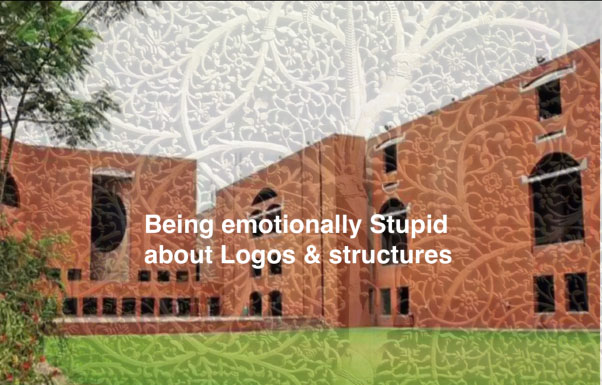
     

    There was a suggestion, and I endorsed it. Why not make the new structure keeping the old façade. Simple solution. Quite stupid, really. The old dorms were designed in a different era, when student’s and institute’s needs, desires and ambitions were different. The students and faculty were happy walking on Stanford Ramp, climbing Harvard Steps or crisscrossing the Loui Khan Plaza. With time, the new campus developed. It was a concrete structure. It used the current technology and newly defined dreams, aspirations, and needs of the students, faculty, and the institute.


    The alumni and faculty lobby were against the change. For the alumni, it is the famed pallu of Indian mothers. They deservingly draw much strength from the established imagery of IIMA and thus change is simply unacceptable.  Why get emotional about such things. Why can’t we accept that things will not be the same?


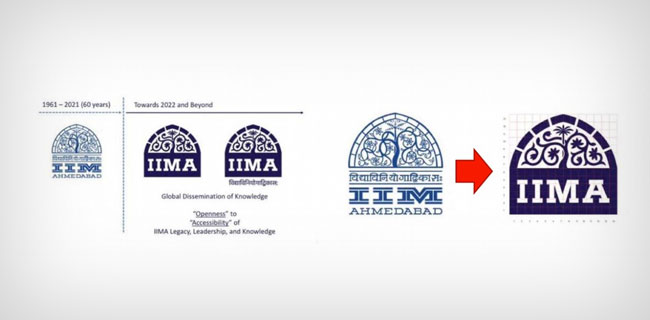
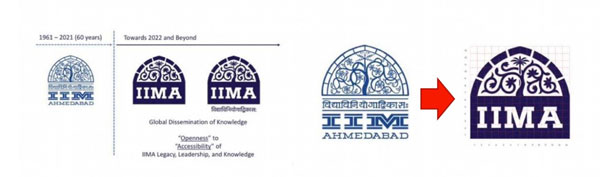
    The story is repeating itself with a proposed logo change. Most brands have undergone logo changes to revitalise and contemporarise and to reflect the changing world culture. Many of the alumni who are raising their voice against the IIMA logo change have changed logos across products and services in their professional life. But the IIMA logo is the Holy Cow! It has a different emotional connection and recognised worldwide. In truth, the association is with IIMA, the name. and outside academics, the jaali and the Sanskrit words under the current logo may not be well-established.


    The voices are questioning a lack of inclusiveness and transparency. How can they forget that management and marketing by nature is non-democratic? Someone must stick the neck out, take a call and move on. Logo and identity change need not be an all-inclusive process, and every stakeholder need not be engaged and involved.


    I would like to think that IIMA Board has followed the process. And if that is right, the rest of us should live with the decision and move-on. The institute for long has been in the news for unwanted reasons.


    Management, including marketing, is all about taking an open-eyed conscious decision with the available information and moving on. No one knows if the decision will be right or wrong.  And the voices can also not guarantee that their decision would be the right one.


    Some stakeholders are hell bent on stopping institute from taking decisions and I find no difference between them and the opposition in national politics or the farmers at the Delhi border. The agenda is simple, oppose whatever is done.


    Change is a constant, biases are permanent, and evolution is part of the process. But no, the voices forget it all. They show great lapse of rational and logical thinking the institute is known for.


    I suggest let’s move on. If there is a constructive, positive suggestion or recommendation, table it at the proper forum but be willing to accept the decision, even if it goes against them.

    I, for one, refuse to continue evaluating with emotional bias.  I realise I am not even a close stakeholder. After commenting the last time, I have not even tried to find out the status.


    The realisation was complete last Saturday. The class of ’87, IIM Ahmedabad, met online to discuss 35th reunion at the alma mater. I realised,the reunion is about memories and meeting friends. The institute is a small but integral part of it. It does not matter where the reunion happens if the batchmates enjoy their togetherness. There is nothing great about reunion at the institute. Why get emotionally drained at the not-so-well-kept dorms? Why experience the alienating concrete campus at IIMA? Why wander around like in an open zoo with hardly anyone knowing you?


    The truth is, we stick to groups made of memories. The institute is just the foundation of such groups.  If you understand ‘Na mano Toh Pathar – Mano Toh Bhagwan’, you will understand the utter nuisance and emotional stupidity in case of the Loui Khan designed dorms and the logo.

    ………………………………..


    Personally speaking– I find there is no need to change the logo. The new proposed one (as shared in WhatsApp group) are chunkier and lack the grace. There is no need to have different logo for national and international markets.