Tag: icc

  • Digital 2 Sports to broadcast of Live Audio Commentary for ICC Men’s T20

    By Our Staff


    Digital 2 Sports will be globally broadcasting the audio digital commentary for the ICC Men’s T20 World Cup 2021 across its social media destinations on YouTube, Twitter, Facebook and others.


    Said Ajay Sethi, Co-Founder Digital 2 Sports:  “We are thrilled to continue our digital audio broadcast for the ICC’s major live events with various content and tech innovations to bring in a unique proposition for cricket commentary. The commentary feed for ICC’s Men T20 World Cup 2021 will provide outstanding global reach, insightful cricket commentary and we hope to cater to all cricket fans and beyond by providing world-class coverage and enhanced engagement with various leading cricket experts as well as biggest influencers of the country.”


  • Leagues Over Legacy: The Future of Cricket


    By Shailesh Kapoor


    Shailesh KapoorIt’s been a bizarre cricket week. A Test match that didn’t last even two full days. The shortest Test match ever since World War II. Test cricket needs exciting games like tone at Gabba. It needs higher batting run rates to attract more audience. It needs innovations like pink-ball, day-night Tests. But a Test that gets done in about 10 hours is no advertisement for a format that’s meant to last four days, if not five. After that spectacular Australia series, this one runs the risk of becoming a tad farcical, though India’s qualification to the World Test Championship finals will mask that conversation fairly quickly.

    The much-hyped Narendra Modi Stadium was inaugurated less than two days ago. Its first-ever Test may have seen India on the right side of the result, but it hasn’t flattered the cricketing media. The venue, however, has its hands full. There’s another Test and then five T20s, all at the same stadium.

    Which brings me to the itinerary of this England tour. When the T20 format was first introduced about 15 years ago, a solitary match on a tour was all it merited. Over time, that one match became two matches, but Tests and ODIs remained the primary competitive formats for nation vs. nation cricket.

    But times have changed. IPL is a huge hit, finding new benchmarks of success with each passing season. Attention spans have dropped anyway. A three-hour format is well-suited to the times, and highly inclusive compared to the other two formats.

    But this co-existence of cricketing formats also reflects upon the crossroads cricket administrators, including ICC, find themselves at. It seems they want to keep all three formats alive, and nurture them with nearly-equal priority. For a sport that’s primarily restricted to a dozen nation, a strategy that doesn’t make a conscious choice cannot be a growth strategy.

    In my opinion, ICC and its national affiliates are trying to avoid the unavoidable. They are only buying time by keeping all three formats alive. Of the three, the Test format is fairly secure. It’s the niche, connoisseur-endorsed format that can doesn’t need to make much money, as long as it can broadly earn for itself. But it’s the 50-overs format that could have been retired a while ago. It’s an in-between thing that achieves nothing in particular, except keeping a legacy going.

    From a broadcast perspective, one would expect the leagues to get stronger with each passing year. Australia’s Big Bash League (BBL) can do well with some Indian players, as its quality of play and telecast makes it one of the most watchable cricket tournaments across the world. The match timings are not India-friendly, but weekends double-headers can take care of that, if India (read BCCI) decides to play a more active role in BBL, say from a talent pool perspective.

    Other leagues, like those from Pakistan, Bangladesh, West Indies, England and Sri Lanka, are in initials stages of building some traction among the T20 audience base. But it’s almost certain that this is the direction the viewership will move to, over the next decade.

    All that is still a thing of the future, though. The next season of IPL is fast approaching, and one can sense that a blockbuster is in the offing again. So, brace yourself for the most popular cricketing gala, even as a rather bizarre International series plays out before it.


  • GoDaddy announces partnership with ICC Cricket World Cup

    By A Correspondent


    GoDaddy has announced its partnership with the International Cricket Council (ICC) as the official sponsor of the ICC Men’s Cricket World Cup 2019. GoDaddy will be the global platform of the ICC Men’s Cricket World Cup to drive even greater awareness, amongst tournament viewers and cricket enthusiasts, about the benefits for small business owners and entrepreneurs of creating a powerful online identity to help their ventures grow.


    Commenting on the partnership, Nikhil Arora, Managing Director and Vice President, GoDaddy India said: “The Cricket World Cup tournament is a platform that offers a convergence of players, fans and communities. It is one of the world’s biggest phenomena, bringing people together across the globe, and is a perfect place for us to create awareness about the ease and affordability of GoDaddy’s online product and service offerings. We aim to use our partnership with ICC to engage with cricket enthusiasts from all over the world, educating them about the benefits of online adoption.” He also added that, “Cricket in India is a favourite sport. It is viewed in every nook and corner of our country, giving GoDaddy an opportunity to reach our audiences, including in the Tier II & III cities, helping entrepreneurs and small business owners bring their ideas to life online.”

  • Ridhima Lulla joins Indian Chamber of Commerce as Western India M&E Head

    By A Correspondent


    Leading body of business and industryThe Indian Chamber of Commerce (ICC), has appointed Eros Group’s Chief Content Officer Ridhima Lulla as Head of the Western India Expert Committee in Media & Entertainment.


    Commenting on the appointment, Lulla said: “I am humbled and happy to join The Indian Chamber of Commerce board. The media and entertainment landscape in India is currently in a very exciting phase and I believe that the coming years are going to be crucial in how the world looks at the Indian M&E industry. At ICC, my aim will be to elevate the ecosystem with creative and collaborative thinking along with other worthy members on the board.”


  • Banking on Cricket!


    By Ravi Teja Sharma


    The Chinese seem to have big designs for cricket even though they don’t have a national team for the sport. After Chinese mobile handset maker Vivo signed a two-year title sponsorship deal with Indian Premier League (IPL), replacing PepsiCo, its fierce competitor Oppo, which is part of the same parent company BBK Electronics, is close to signing a four-year, about $34 million (Rs 225 crore, approx) global partnership deal with the International Cricket Council (ICC).


    The only other time Oppo was involved with cricket was as the title sponsor for the 2014 edition of Champions League T20 tournament.


    Japanese car maker Nissan Motor Company had last month signed an eight-year, $10 million-a-year global partnership deal with the ICC, which was its first significant venture into cricket.


    The deal with Oppo is expected to be worth about $8.5 million a year for four years.


    In response to an email questionnaire, an ICC spokesman said: “We have no comments to make on this at this stage.” An email questionnaire sent to Oppo Mobiles did not elicit any response till the time of going to press.


    Several brands have in the past used cricket as a platform to build their presence over the years.


    Basabdatta Chowdhury, chief executive at Platinum Media, part of Madison Media Group, said that instead of going the discount route and fighting a price war, these Chinese companies are actually trying to build a brand through cricket, which is an investment.


    “When you are targeting male audiences, which is what 70 per cent of mobile audience still is, nothing works like cricket. They are investing in building the brand. It is very encouraging that Chinese are also investing in building brands,” Chowdhury said. When Samsung came to India, it invested in cricket in the late 1990s and early 2000s to build its brand that yielded rich dividends, she said.


    More recently, ecommerce platform Paytm bagged the title sponsorship rights of the Board of Control for Cricket in India (BCCI) till 2019 by committing to pay Rs 203 crore, or Rs 2.42 crore a match. Incidentally, Paytm, too, has a Chinese investor — Jack Ma’s Alibaba Group holds around 20 per cent in it.


    Brand consultant Harish Bijoor said Chinese brands today want to be relevant, original and innovate for the entire world at large. “Cricket is a game and sport that attracts the largest amount of eyeballs in India and in the Indian diaspora spread all across the world. It makes sense for Oppo and Vivo to dominate cricket — in the global game played in whites as well as in colours, and also in the IPL format,” he said.


    Both Oppo and Vivo are relatively new brands but are stepping up their presence in the country. Vivo had recently said it will spend Rs 100 crore a year on advertising and marketing to leverage the deal with IPL. This is over and above the Rs 150-160 crore that it is estimated to have committed for the two-year IPL deal with the BCCI.


    Other Chinese companies such as Baidu, Alibaba Group and Tencent Holdings are also keen on India and are looking at Indian startups to invest in.


    Source:The Economic Times

    Copyright © 2015, Bennett, Coleman & Co. Ltd. All Rights Reserved

    Licensed to republish

  • Is the form of Dhoni & Co keeping advertisers at bay?


    By A Correspondent


    Is the Indian team’s cricketing form a worry for advertisers? We spoke to a few sports marketing specialists and this is their analysis: While the likelihood of India entering the quarter-finals is very high,    let’s take a close at look at the India fixtures and the time at which each of them is going to be aired (all timings in Indian Standard Time).


    Sun, Feb 15 v/s Pakistan, 9am

    Sun, Feb 22 v/s South Africa, 9am

    Sat, Feb 28, v/s UAE, 12 noon

    Fri, Mar 06  v/s West Indies, 12 noon

    Tue, Mar 10  v/s Ireland, 6.30am

    Sat, Mar 14  v/s Zimbabwe, 6.30am


    The first two matches will have much bearing on how India fares in the Cup. While the UAE and Ireland matches are India’s unless there is a major upset, the West Indies and Zimbabwe could not be taken too lightly. The last two matches start at 6.30am on Tuesday and Saturday so could see a beating in viewership and Feb 28 is Budget Day and will clash with Finance Arun Jaitley’s speech.


    And this is how the last seven fixtures are scheduled:

    Quarter-finals 1-3 March 18-20, 9am

    Quarter-final 4 March 21, 6.30am

    Semi-final 1 March 24, 6.30am

    Semi-final 2 March 26, 9am

    Final: March 29, 9am


    The likelihood of India reaching the quarter-finals is a near-certainty unless there are some major upsets, the likes of which we have seen in the group. But India has to play really badly to make way for the UAE, Ireland and Zimbabwe in the final four.


    Is India in really bad form? Could the performance of Dhoni & Co in the recent past have been caused due to some experimenting with the mix of the team?


    So what explains the lukewarm interest in the Cup? That’s more because every advertiser and media agency wants to beat the broadcaster on ad rates, which some advertisers told us was on the higher side. The later you sign up, the better the negotiations.


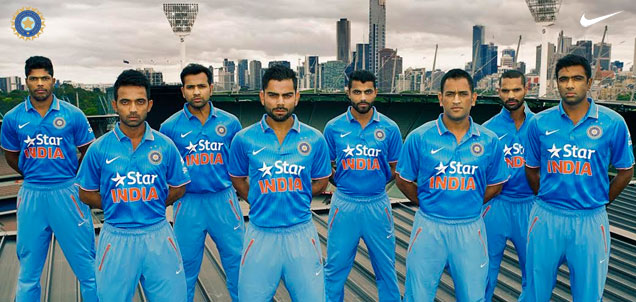
    Image: Nike publicity material of the unveiling of tge One Day International kit that the Indian Cricket team was to starting January 18 in Australia


    Rs 25 lakh for 10 seconds?!
     

    Ads get expensive as Star India seeks Rs 25 lakh for 10-sec slots during India-Pak ICC World Cup tie


    By Ravi Teja Sharma & Pritha Mitra Dasgupta


    Diehard cricket fans will remember the memorable India-Pakistan battles of the past World Cups. The tense standoff in Bangalore in 1996 when Ajay Jadeja went on a rampage and Venkatesh Prasad showed Aamir Sohail the way to the pavilion after sending his stumps clattering; that glorious Saturday seven years later in Centurion Park when fiery Shoaib Akhtar’s missiles were smacked by Sachin Tendulkar to all parts of the stadium, in the process delivering a huge win for India and a big confidence boost after a demoralising loss to Australia early in the tournament.


    This World Cup, the old enemies meet again. Not in the final as many fans would hope for or in the semi-finals like in 2011, but in the opening league match on February 15.


    Well ahead of that epic India-Pakistan encounter, a different kind of a battle is being fought behind the scenes. On one side are the advertisers who want to exploit the big viewership numbers that this match promises to deliver, and sitting tight on the other is Star India, the official broadcaster, who wants to milk the match by jacking up the advertising rates.


    More than 70 brands, including some regional brands and first-time advertisers, have booked slots for the game, which is 50% more than the count for 2011 World Cup final, said a spokesperson for Star India. At Rs 25 lakh per 10 seconds, this is going to be the most expensive advertising opportunity ever in cricket, but one that not many advertisers would want to miss. The match will see Amitabh Bachchan making his debut as commentator.


    Star India had sold the match between the two nations in the 2011 edition – the semi-finals – at Rs 20 lakh per 10 seconds but the final between India and Sri Lanka had come close to Rs 25 lakh per 10 seconds. “From a business and brand perspective, very few events can match the potential of an India-Pakistan match. I can understand paying a premium for this match, but Rs 25 lakh is too steep,” said Basabdatta Chowdhuri, chief executive at Platinum Media, which is part of the Madison Media Group.


    Media planners and agencies contest that number. According to them, Star has sold around 75% of its inventory for the India-Pakistan match and about 70% for the entire World Cup so far.


    Clearly, Star India is going for the kill, seeking Rs 25 lakh per 10 seconds from those who want to advertise across all its feeds during this match, according to people in the know. But top advertisers and media planners say they would rather wait and watch, as they feel prices will dip closer to the game


    Speaking on the condition of anonymity, a senior executive at a large advertiser said there is enough inventory available at the moment and they are waiting for rates, even for the India-Pakistan match, to correct closer to the tournament beginning


    A spokesperson for Star India said the ad slots for the match have been sold out much in advance.


    “No other game of cricket draws as much passion, emotion and following as an India versus Pakistan World Cup game,” he said.


    The channel has packaged the India-Pakistan match in several ways. There are advertisers who have bought combined airtimes across several matches, including the most talked-about match. For them, though, the average airtime rate is working out to between Rs  4.5 lakh and Rs 5 lakh per 10 seconds. Floating inventory for the match, however, have been categorised and priced according to the feeds.


    An advertiser that wants all the feeds including English, Hindi, South Indian feeds and high definition will have to pay Rs 25 lakh per 10 seconds. This means an advertising spot of 30-40 seconds would cost anywhere between Rs 75 lakh and Rs 1 crore. If an advertiser wants only English and HD feed, then it will have to pay Rs16-18 lakh per 10 seconds.


    “This is by far the highest rate that has ever been charged for a cricket match by a channel and I think it is a huge risk for advertisers,” said a top GroupM official, who didn’t wished to be named.


    Another media planner from the Dentsu Aegis Network said it doesn’t make sense for an advertiser to pay this kind of money when there is enough cricket happening in the country with both ICC and IPL matches.


    According to Indranil Das Blah, chief operating officer of sports management firm Kwan, this is undoubtedly the most high-profile match of this World Cup. “I don’t know if the ad rates are justified or not, but it can’t get bigger than this and no advertisers would risk missing it,” said Blah.


    For the larger World Cup, though, Star has signed up the likes of Sony, Airtel, Gaana.com, Hero and Karbonn as sponsors, alongside Maruti, Nestle, Raymonds, Marico, Pidilite, Yepme-.com and Paytm. To cater to a wider audience, it is broadcasting the tournament in Tamil, Malayalam, Kannada and Bengali alongside Hindi and English that it hopes will bring in a large number of new advertisers to the World Cup as it will become more affordable for smaller advertisers.


    But media planners say there is some level of concern around the Indian team’s performance as well and also the timing of the matches, but these concerns will not matter if India begin the World Cup journey with a big win over Pakistan.


  • Star bags ICC broadcast for 2015-23 for India, Mid-East

    By A Correspondent


    The International Cricket Council (ICC) on Sunday announced jointly awarding audio-visual rights for ICC Events from 2015 to 2023 to Star India and Star Middle East.


    The decision was made by the ICC Business Corporation (IBC) Board, ICC’s commercial arm, during a meeting at the ICC headquarters in Dubai on Sunday. The decision followed a robust tender, bidding and evaluation process, which started in July 2014. During the process, which involved two rounds of bidding, the ICC received 17 competitive bids from various broadcasters across different territories for its audio-visual rights.


    While the final value of the rights fee agreed will not be disclosed, it is significantly in excess of the ICC’s previous commercial deals, notes the release. In 2006, the rights were sold to ESPN-Star reportedly for $1.1 billion. The figure for the 2015-2023 rights is rumoured to be in the region of $2 billion. The current cycle has seen ESPN Star Sports hold the audio-visual rights until the contract expires at the end of next year’s ICC Cricket World Cup 2015.


    Included in the new eight-year period are 18 ICC tournaments*, including two ICC Cricket World Cups (2019 and 2023), two ICC Champions Trophy tournaments (2017 and 2021) and two ICC World Twenty20 tournaments (2016 and 2020).


    Commenting on the decision to name Star India and Star Middle East as its successful bidders, ICC Chairman N  Srinivasan said: “We are delighted that our partnership with the Star group has extended to the next cycle of ICC Events. This illustrates the strong relationship we have built in the current cycle and the value we have delivered since 2007.  This commitment for the next eight years will ensure greater stability for ICC Members as well as increased funding for developing and established countries. Emerging nations will have access to the largest funding resource in the history of the game and the Board has fully endorsed this framework as the best means of safeguarding the future of the sport.


    Uday Shankar

    Uday Shankar, CEO, Star India, said: “We are delighted and honoured to extend our partnership with ICC. This is a tribute to Star’s commitment and ICC’s trust in our ability to take the great game of cricket to the next level. Star will constantly attempt to reinvent the viewer experience to make cricket bigger and bigger.”


    Giles Clarke, Chairman of IBC’s Finance and Commercial Affairs Committee, said: “This innovative and exciting partnership will underpin the long-term financial health of the global game and provide real stability for all our Members. It will help the ICC and our Members to grow participation in areas such as the women’s game where there have been great strides made as well as supporting the emerging nations. This deal benefits all ICC Members and will allow them to improve their competitiveness and public interest in a targeted and sustainable way.


    “This is a momentous day for world cricket which highlights the great commercial attractiveness of our sport and the ever increasing levels of interest in our outstanding world-class events.


    “The partnership will also guarantee increased promotion and marketing of the game in key markets across the globe.”


    ICC Chief Executive David Richardson said: “This agreement guarantees more money for all our Members, thereby underpinning the growth and development of the game.


    “Star has been an excellent partner for the ICC during the current rights cycle, promoting and supporting ICC Events and cricket in general in the sub-continent, and I am pleased that we now have a chance to build on that success over the next eight years on a global level.”


    ICC Events 2015-2023

    *The following ICC Events are included in the audio-visual rights packages:


    ICC major global events:

    ICC World Twenty20 2016 – India

    ICC Champions Trophy 2017 – England and Wales
    ICC Cricket World Cup 2019 – England and Wales
    ICC World Twenty20 2020 – Australia
    ICC Champions Trophy 2021 – India
    ICC Cricket World Cup 2023 – India


    ICC qualifying events:

    ICC World Twenty20 Qualifier 2015 – Ireland and Scotland
    ICC Cricket World Cup Qualifier 2018 – Bangladesh
    ICC World Twenty20 Qualifier 2019 – TBC
    ICC Cricket World Cup Qualifier 2022 – Zimbabwe


    Other ICC events:

    ICC U19 Cricket World Cup 2016 – Bangladesh
    ICC Women’s World Cup 2017 – England and Wales
    ICC U19 Cricket World Cup 2018 – New Zealand
    ICC Women’s World Twenty20 2018 – West Indies
    ICC U19 Cricket World Cup 2020 – South Africa
    ICC Women’s World Cup 2021 – New Zealand
    ICC U19 Cricket World Cup 2022 – West Indies
    ICC Women’s World Twenty20 2022 – South Africa


    The agreement with Star India and Star Middle East does not include host broadcast production rights, which the ICC has decided to reserve along with a host of other rights. The sales process for ICC’s reserved rights will be announced in due course.


  • Battle of the Story: Casting critical eye on Media

    By Ananya Saha


    The media is playing more important role in our society today. As social and traditional media continue to permeate our lives, industry veterans recently got together at a conference organized by the Indian Chamber of Commerce to discuss the role of media, convergence, new media, and new technology. As Rajiv Mundhra, President, ICC, pointed out, “New media has become a tool for social change.”


    The panel comprising of Jawhar Sircar, CEO, Prasar Bharati; Subhash Chandra, Chairman, ZEE and Essel Group; Sunil Lulla, MD and CEO, Times Television Network; Anuradha Prasad, Chairperson, BAG Films and Media Ltd; Anshuman Tewari, Chief of National Bureau, Dainik Jagran talked about how media only portrays reality as shaped by people. While agreeing that in the “heat-of-the-moment”, the news channels do forget their responsibility towards the nation and compromise national security such as the 26/11, according to Mr Chandra, the Indian media has acted responsibly. He further said, “There are people who are history-sheeters and are running news channels. This is a cause of concern.


    Sunil Lulla

    Concurring, Mr Lulla said, “With the mushrooming of news channels, it was the broadcasters themselves who got together to say that we need to set standards. Since that idea got criticized by journalists, we asked the journalists to form the guidelines under the committee headed by Late Justice Verma. NBSA was thus formed. And with the passing years, the guidebook is only getting thicker.” He further said, “We are all for responsible content. For instance, no other business carries 72 messages in a day giving information of redressal authorities.” The panel coherently agreed that they were united in the cause of bringing responsible content to its audience.


    Mr Sircar said, “It is important that the media takes note of what it is doing. If the fourth estate caves in, we will see an eruption of public angst, which will defy the constitution.”


    Uday Kumar Varma

    Uday Kumar Varma, Secretary, MIB, talked about how technology is enabling advances in the broadcast sector. He spoke about the three challenges that the sector is facing, “Digitization is the best thing to happen to the broadcasting sector in the last 20 years. And the first challenge is that all digitization is aimed at, is achieved.” He said that till digitization sees complete transparency, issue of carriage fees is not solved, and till revenue sharing is equitable, the process of digitization cannot be called complete. The second challenge, according to him is the question of monopolies. He said, “There have been certain developments that have disturbed the equilibrium. Problems that arise because of lack of policy have to be addressed. Cross-media regulation, which can be horizontal or vertical, has to be addressed as well.”


    The third and the last challenge he shared was about the TV rating system. He said, “the current rating system is far from satisfactory. The bottomline features of a television rating system should be put in place.”


  • Radio stations (except AIR & BIG FM) can’t commercially exploit T20 World Cup: ICC

    By A Correspondent


    Radio stations and brands planning to commercially exploit the T20 World Cup that starts in Sri Lanka next week (Sept 18-Oct 7) need to beware.


    According to an official communication sent by the International Cricket Council (ICC) to the Association of Radio Operators for India, the exclusive rights holders for radio/audio stream services across all mediums, including the internet in India are BIG FM and All India Radio (AIR).


    The biggest rider is that “member agencies (of Association of Radio Operators) may not undertake any unlicensed commercial exploitation or selective commercialization of ICC Proprietary Content through third party sponsorship and presentation of the same”.


    A point in the statement reads, “Other than International Management Group (IMG) and its licensees, BIG FM and AIR, no entity operating or making available radio/audio stream services is entitled to use ICC Names, ICC Marks and ICC Proprietary Content, claim official association or commercially associate in any other way, either expressly or impliedly, including through marketing promotions, contests, advertising, score updates or other commercial activity (including by monetizing any of the ICC Proprietary Content), with the ICC or the ICC World Twenty20 Sri Lanka 2012.’


    It further states, ‘Should your member agencies fail to adhere to the above, the ICC will engage with them to bring to their attention the permissible parameters of activity and work with them to resolve the matter. However, should such activities persist, your member agencies will be deemed to have knowingly breached the exclusive rights granted by the ICC to IMG and its licensees, BIG FM and AIR, and the ICC will have no other option but to initiate further action, including legal recourse.’


    Lauding the initiative, Tarun Katial, CEO, Reliance Broadcast Network said, “In an extremely encouraging move, ICC has decided to come down on anyone misusing content to offer packages to advertisers. As radio partners, we look forward to offer consumers the best possible entertainment package with exclusive and highly engaging content, while offering marketers an approved and ethical platform by which they can reach out to their audiences.”


    Strict action against channels which do not adhere to the stipulations laid down by the governing body will be taken this year.


    A source close to the development said that the ICC diktat doesn’t mind score updates interspersed in the programming, but radio stations can’t get these get sponsored.