Tag: ICC World Cup

  • The Rise & Rise of the IPL

    The Rise & Rise of the IPL

    Source: www.iplt20.com


    Shailesh KapoorThe 17th edition of the Indian Premier League kicks off tonight. To say that it’s the biggest media event in India by some margin will be stating the obvious. The gap between IPL and other big-ticket properties has only grown wider over the last decade.

    The stature of IPL is reflected in our new report, titled The Ormax Sports Audience Report: 2024. The sampling of IPL in the 612 million audience base of cricket in India is higher than that of the ICC World Cup, by a good six percentage points. The list of most-recalled sporting franchises in India (across sports) sees a clean sweep, with the 10 IPL teams taking the top 10 positions, ahead of Manchester United and Patna Pirates, which are the most-recalled leagues in football and kabaddi respectively.

    In its first few years, IPL faced its share of controversies. But in its second phase, the league has been able to put cricket first, and that has helped it move away from the erstwhile imagery of a flippant brand, towards building credibility as a talent platform. This shift is fundamental in nature, and has held IPL in good stead.

    IPL is now a way of life for those in the media industry. Till not too many years ago, there was a lot of chatter about how GECs should dodge the IPL googly. Now, everyone has a playbook of sorts, and it’s not a topic to lose sleep over, anymore.

    This year’s IPL will be held amid the political fervor around the General Elections. News-wise, IPL will play second fiddle. But in terms of monetisation and viewership, it will continue to stay at the top. The stronger franchises are profitable now, and BCCI continues to get richer with each edition. Yet, there’s ample room for growth, as fan bases are continuing to build, especially for franchises that have made late entries, or taken their time to get going.

    This year’s IPL will also see younger captains across most teams. The average age of the 10 captains this year is 30 years, which is three years younger than the 33 years average age in IPL 2023. The old guard is passing the baton to the new, and that’s always a good thing, especially in a talent platform like IPL.

    Amid all the excitement, the biggest highlight of this IPL is going to be the return of Rishabh Pant. The actor survived a near-fatal road accident in December 2022, and his incredible recovery over the last 14 months has been a miraculous one. How National Cricket Academy has helped Pant get back to match readiness against all odds is perhaps the best example of BCCI money being put to great use.

    Pant is leading the Delhi Capitals side, and their first match is scheduled for tomorrow afternoon, at Mohali. We can expect a roaring reception to a special talent, who first got noticed via the IPL itself, before making it big at the international stage. I won’t be surprised if he makes this IPL his very own, to announce a comeback we have all been waiting for. Game on!

  • Yu & Hardik Pandya unveil new TVC campaign

    By Our Staff


    Consumer foods brand Yu released a series of new commercials featuring brand ambassador Hardik Pandya. Channelling the brand’s zero-preservative chef-crafted instant food philosophy, the TVC campaign invites consumers to #CheerWithYu’s diverse offerings and furthers the idea of #AbNoCompromise.


    Founders Bharat Bhalla and Varun Kapur jointly said: “Carrying forward the spirit of the ICC World Cup and the festive season, we are excited to launch our new commercials with Hardik. They capture the modern approach of the brand together with Hardik’s cheerful personality perfectly. We are ready to rise and conquer with Yu and its culinary revolution.”


  • Will persons with disabilities enjoy the ICC World Cup coverage?

    Photograph source: Official X account of the International Cricket Council (@ICC)


    By Shruti Pushkarna


    Shruti PushkarnaAlmost eight years ago, I quit journalism (and the media) to work towards raising awareness and advocating for the equal rights of persons with disabilities. Having acquired experience and knowledge in this domain, a column on ‘Media and Disability’ seemed like a much-needed and a natural outcome of my passion for both these subjects, mainstream news and inclusion of persons with disabilities into the mainstream of things.


    But it was much earlier when my two interests converged for the first time. As a budding journalist, I curated a video story around the Blind Cricket World Cup. This was also the first time, I viewed disability from an equal and empowering lens. When I met with the Founder of the World Blind Cricket Council, George Abraham, and the players as well as their coach, disability didn’t feature in our conversations at all. The only reference pertained to the technique used by this set of players with varying degrees of vision impairment. The modified version is played with a larger than standard cricket ball, filled with ball bearings to make sound that is audible to the players. Bowling is underarm and the team is divided into totally blind, partially sighted and partially sighted with slightly better vision players.


    Other than that, there is similar enthusiasm and energy in the stadium, and the same passion for the religion called cricket. While producing this report on Blind Cricket, I experienced sports as an equaliser. Disability, and in this case, blindness took a backseat. As I witnessed the visually impaired players run between the wickets, the stereotype of a man in dark glasses begging on the street vanished into thin air. The focus shifted to the sporting skill, the game, team spirit and the zest of the players.


    I also discovered that blind and visually impaired people, like most Indians, not only followed cricket on the radio and television, but also pursued sporting interests in football, chess, tennis, athletics and more. In fact, that’s true for persons with other disabilities too, something I have realised in more recent interactions, during the course of my work.


    Haven’t you ever encountered someone in the bar or on the plane, who displays similar fandom for Novak Djokovic or M S Dhoni? Haven’t you ever hit off with a stranger in a party who analyses and critiques a game with calculated precision?


    We all have. And this person could well be a person with disability. Physical and/or mental limitation to perform certain activities doesn’t take away the desire to follow a sport. But it does limit the way in which one consumes or accesses the sporting event.


    Most of us have been following the Asian Games being held in Hangzhou, China. At the time of writing, the Indian contingent has bagged more than 80 medals, taking the country ranking to number four. And the biggest of all sporting delights, the ICC Men’s Cricket World Cup starts today in Ahmedabad.


    Just like you and me, there are millions of disabled fans, cheering for their favourite players, hoping to see Rohit Sharma’s boys bring home the trophy after a decade. Are you still wondering if people who are blind, deaf, or on the autism spectrum, or any other disability follow these tournaments?


    The answer is yes. The real question however is whether they can experience the game, process the information being relayed and check the updated score and tally, seamlessly.  Unfortunately, not.


    Television broadcast as well as online streaming of matches is heavy on visual production. Our screens are loaded with visuals, graphics, ticker, lower thirds et cetera giving out different pieces of information. A blind viewer experiences the game through audio commentary, which many a times omits voicing the information displayed on screen. Very often, when a new player enters the field, the name is announced through a graphic overlay on the match visual. Another example of inaccessibility of the gaming coverage is the analysis graphs or the field markings that appear on screen, again as an overlay. As for checking the latest score online, most websites open a pop-up with an update which is inaccessible to persons with vision impairment who use screen reading software to decipher details on digital platforms.


    Similarly, deaf viewers miss out on the content consumption experience due to the absence of closed captioning or sign language interpretation. And this after the Ministry of Information and Broadcasting came up with accessibility standards for hearing impaired on TV channels in 2021.


    While there is a whole visual effects industry that thrives on the graphic content of live events, like sports and music, we remain ignorant of the needs and challenges of diverse communities. For instance, a person on the autism spectrum or someone with dyslexia, or any other learning disability may find it disconcerting to consume jarring, colourful, and dynamic infographics and text on screen.


    With the onset of OTT platforms in addition to the numerous private channels, outreach to a wider audience seems obvious. But clearly channels of mass media fail to communicate to a sizeable majority of the Indian population.


    This is a problem facing not just the 2.68 crore disabled population but also an increasingly large percentage of seniors who acquire age-related disabilities that hamper their normal ways of functioning (read consumption). As per a recent report in The Hindu, senior citizens (above 60) will constitute around 12.5% of the total population by 2030.


    So, what do we do? Who do we hold accountable? And more importantly, who bears the cost of ensuring accessibility for all? Is it the channel partner or the streaming partner, or the event organiser, or the production company? And is inclusion reliant on a government mandate, which doesn’t really extend to private entities in effect?


    There aren’t any simple answers here. What is needed is perhaps a debate and discussion to work out a solution that minimises exclusive coverage. And a solution that makes business sense to reach an untapped audience which has quantified market worth.


    Sporting events are also a perfect opportunity for brands and advertisers to promote their products/ services. Here’s an inclusive ad of Tide detergent that featured in the Super Bowl in 2021. It has descriptive audio and closed captioning for the visually and hearing impaired audience. With 385 million blind and visually impaired people in the world, and around 466 million people with hearing loss, can brands really afford to overlook such a large target group?


    Streaming platforms like Netflix, Apple TV and Amazon Prime Video have consciously added accessibility features like audio descriptions, subtitles, and closed captions for their disabled audience. For the elderly, Netflix also has the option to increase the size of the subtitles, so they can read despite failing vision. These OTT websites and mobile applications are also designed keeping accessibility for screen reader users in mind. Of course, platforms like Sony LIV and Disney Hotstar remain inaccessible but with easy technological innovations available, one hopes that soon all streaming services will offer equal viewing experience to diverse audiences.


    Wondering why MxMIndia publishes a disability advocacy column? Well, we strongly feel that the media can dramatically transform the world for persons with disabilities. This series attempts to help bring forth issues that the media must champion to create a truly inclusive and accessible India. Writing  this column is Shruti Pushkarna, a former journalist and now a disability inclusion advocate based in New Delhi. Her views here are personal. To access the archives of her 80-odd columns, please visit: https://www.mxmindia.com/category/ columns/shruti-pushkarna/


    If you have a view on the issues raise or would like to align with MxMIndia on this cause, write to us at editor [at] mxmindia.com.


  • Thums Up unleashes its next campaign

    By Our Staff


    Thums Up unveils the next chapter of its association with ICC Men’s Cricket World Cup through the launch of the campaign ‘Thums Up Utha, India India Macha’.


    The campaign features Ravindra Jadeja, Jasprit Bumrah, Mohammed Siraj, and the captain Rohit Sharma in a film that is centred around – ‘making India believe in Team India’.


    Commenting on the launch of the next chapter of ICC World Cup Campaign, Arnab Roy, Vice President, Marketing Coca-Cola India, and South West Asia said: “Thums Up’s partnership with the ICC Men’s Cricket World Cup aims to empower fans and voice their opinions. Our collaboration with King Khan and the cricket icons of the country further cements our dedication to elevate fan engagement and showcases our unwavering support for Team India to bring the World Cup back home. We will do this through tech led, real time responses from expert panels and credible influencers that encourage everyone to keep rooting for our team.”


    Added Sukesh Nayak, Chief Creative Officer, Ogilvy India: “The adversary isn’t always external; at times, it’s our own doubt, becoming our greatest adversary. To overcome this, we must summon our inner beliefs. This World Cup, Thums Up gets SRK voicing and symbolizing the inner conflict on ‘Will India win this World Cup.?’


    As the ICC World Cup inches closer, Thums Up’s commitment to celebrating players resilience and creating unforgettable moments for fans remains steadfast, setting the stage for a truly Toofani World Cup.”


  • Indian sports sponsorship crosses Rs 9000 crore benchmark, notes GroupM’s ESP Properties

    By A Correspondent


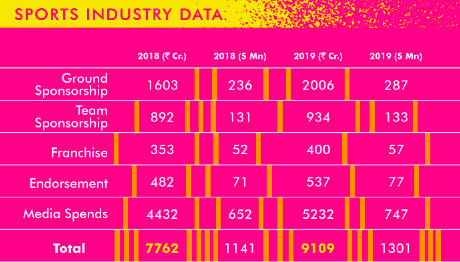
    ESP Properties, the entertainment and sports division of GroupM India, released the 2020 report on sports sponsorship in India. Overall growth in sports sponsorship at a healthy 17 per cent where the sports sponsorship Industry crossed the INR 9000 crore mark in 2019.


    The 2019 was the year for cricket and dominated the sports advertising sector unanimously. IPL and ICC World Cup gave a push in both, on-ground sponsorship and media spends. On-ground sponsorship grew by 25 per cent, for the first time, crossing INR 2000 crore mark. Overall industry upsurge was INR 1347 crore of which INR 800 crore was contributed by media spends alone growing at 18 per cent.


    Said Vinit Karnik – Business Head, ESP Properties: “Indian sports industry is on an upward trajectory breaking new grounds year-on-year. While cricket proved its dominance in 2019, overall the last 5 years the industry has doubled its size. If we look further, we can see a strong CAGR of 12.8 per cent in the business of sports over the last 10 years, making it one of the strong pillars of the Indian economy. With the sports industry growing at 17 per cent in 2019, the momentum on sports with added thrust from the government provides a holistic opportunity for the sector. Initiatives like Khelo India and Fit India movement are drivers towards making India a truly sporting nation.”


    Added Prasanth Kumar, CEO of GroupM South Asia: “Over the last decade, we have witnessed the growth of sports leagues and their gaining popularity across the country. The sports industry has been growing and has witnessed a significant upward shift in the overall ad spends. The passion and excitement that’s involved in this platform have only strengthened. We see more and diverse audience indulging with this platform. Many innovations and leverage of assets in this space are powerful opportunities. As we are unfolding another decade, we see this space to be providing powerful thrust for greater brand stories.”


    The non-cricketing space was dominated by women athletes. Badminton queen P V Sindhu was the leading non-cricketing athlete in 2019 in terms of brand endorsements. While Sindhu added four brands to her portfolio, the most notable one among them was her tie-up with VISA that made her the first Indian athlete to endorse the financial services brand.


  • The ICC World Cup of Brands 2019


    By Avik Chattopadhyay

     

    Cricket is possibly the only thing that binds India on this date. A few others like the National Anthem, the Constitution and the Flag are going through their phases of revisionism and identity-crisis. Bollywood has never been a unifier! If you feel offended, ask the movie-goer in Chennai and Cochin for the right perspective.

    So, when the ICC One-Day Cricket World Cup happens, every brand wants to ride the bandwagon. Either directly as ICC sponsors and partners or with the media vehicle Star Sports. In either case, paying top money for primetime. We were pitted against England as the favourites to win the cup, so eyeballs would be guaranteed till the 12th of July.

    The biggest sponsors of this world cup were Kohli and Dhoni.

    Kohli was on air for Uber, Shyam Steel, Google Duo and Nuvoco Vista.

    MSD for Dream 11, SRMB Steel, Orient LED, MasterCard and Bharat Matrimony.

    Pardon me if I have missed out any more.

    Through the tournament I just hoped some guy with a sense of humour would announce, “This match is brought to you by Nissan, Oppo, Coca-Cola, MRF, Virat Kohli and MS Dhoni.” But that moment never came.

    Instead, India stopped at the semis.

    And so did most of the eyeballs.

    Now that the nation is at relative peace and debating only about ICC rules and New Zealand being short-circuited [almost patronisingly], here is a good time to look at how the brands on the b[r]andwagon fared. My assessment basically from the multitude of products and services that spent oodles of money on television over the 48 matches…into 3 sets of the good, the bad and the ridiculous. They are in no ranking order, hence the alphabetical order.


    The Good 5


    Coca-Cola – adorable communication featuring Paresh Rawal and Ranbeer Kapoor. Simple story, brilliantly told. Though one might argue the open invitation to gulp down gallons of aerated sugar water, the sheer quality of the campaign pardons the sin. “Chaar saal dete hain world cup waale…” should go on to become an iconic quip over time.


    Dream 11 – in the 5 WhatsApp groups I am part of, there were at least a dozen individuals hooked on to this site. Old and middle aged people, mind you, leading otherwise responsible family and corporate lives, indulging in betting! Obviously, the communication, simple and compelling enough, made the most of the occasion. MSD kept well here…no byes and drops.


    Google Search – while the Google Duo communication was quite flaky, the one by Search was bang on! Again, like Dream 11, made the most of the occasion.


    Swiggy – they had started off during the IPL, but the excellent campaign continued through the world cup. The brilliant tie-ins with various cricketing situations through the commentary brought a smile on millions’ faces I am sure. They had quite a few stories on air but my favourite one is the “Batsmen are taking a risk here…” featuring the two old friends ordering quesadilla and lasagne!


    Uber – very tactical and topical but well communicated and that is why it is in my list of the Good 5. Virat played well, on all types of pitches, in all conditions. Disarming and to the point. Only I could not understand playing the ad on the final. But that is for another day and under another subject…


    The Bad 5 – these are brands that spent a lot of money on advertising that did not work, according to me, for various reasons, specific to each.


    Fogg – we know that “Fagg chal raha hai” but why? There was no new story…nothing on the occasion of the world cup. They are smart communicators, hence I was sure disappointed when they spent a lot of money rehashing their IPL messaging. And I just wish we stop playing up the anti-Pakistan bit any more. What is innocent fun at one time can become laboured if stretched beyond relevance.


    Kamla Pasand – this one really shook me up by the scruff of my neck. The dream of 130 crore people! Give me a break please. I expect such talk in Parliament, not for a sport catering to the middle class and above. And all that flag waving? Nope, does not work. Being a ‘pan masala’ does not help things. Do not try to be Amul or Tata Tea. To communicate like them you need to switch businesses.


    MasterCard – okay, so you got a couple new stories to tell, but do you need two celebrities to drive home your message? Also, too many messages I thought, with none clearly registering [in my mind at least, in spite of being a MasterCard user]. Visa did a much better job with a single story being driven home.


    Oppo – you are the sponsor of the Indian team and the ICC and this is all that you do…bring a pretty girl close to a prettier bird?! Did you think that just your name appearing on shirts, grounds and backdrops would do the job? Nope, according to me. That was just your name that millions saw across the cricket playing world, not your brand. Lost a big chance of doing something truly relevant and memorable.


    Pepsi – I know, I know…they were not on television but so what…they did spend a lot of money trying to out-do Coke. They thought they did this super clever “digital” campaign forcing the grand old lady Charulata Patel do weird poses with her fingers. You think that’s swag? Take a good swig!


    The Ridiculous 5 – these are the jewels that I have not figured out why they were there in the first place! I am sure they still do not have the answer themselves.


    Apollo Tyres – just because MRF is there? Huh? You think that is reason enough? “Ambush marketing” in the age of AI and ML!! Sad. Please think up a better reason. It’s a nice, feel-good ad, but totally wasted on this platform. Therefore, money well wasted.


    Bharat Matrimony – we know young immature couples do propose at the cricket ground or in flights taking them to one, but you really want to talk about all this just because MSD is your brand ambassador? This is no way to “maximise” presence and squeeze the last bit from your lemon. Lemon!


    Nissan – you are one of the world’s most respected brands and this is what you do? Make an SUV reverse into the crease, create an android hand and smash a metallic ball? Seriously? Katayama-san would commit hara-kiri on this!


    Orient LED – I was a kid once so let’s get this straight – kids do not study during summer vacations and when a world cup is on…any world cup. Period. So, stop the preaching on whether the LED light flickers or not. That’s when exams come up. Okay?


    Shyam Steel – every time I saw yet one more ad of the most loving couple in the cricketing world, I cried. For I wanted it to end as soon as it started and the only way out was to look away or quickly check WhatsApp messages. Need I say more?


    Avik Chattopadhyay is a senior brand and business strategist based in Gurugram. This is the first in a new series of columns he will write for MxMIndia.

  • Star Sports launches Bengali channel, SS1 Bangla

    By A Correspondent


    Star Sports has announced the launch of Star Sports1 Bangla, a dedicated sports channel for Bengalis. The channel launch is in line with Star Sports’ commitment to foster a multi-sports culture in the country while bringing fans closer to the sporting ecosystem. However, even though Star Sport has affirmed its commitment to sports in Bengali, a communique has an unnamed spokesperson while there are a few other sporting luminaries who have been named.


    So here’s what the ‘spokesperson’ has said: “West Bengal is a unique market with high affinity to language content and very distinctive viewing habits. Nuances of the game and local flavour add to a fan’s viewing experience and builds a local affinity for sports in the region. With the VIVO IPL, followed by the ICC World Cup this year – it is indeed a ‘Summer of Cricket’ on Star Sports, and with Star Sports 1 Bangla, we have taken one more step towards treating fans to a customised and acquainted exposure”.


    Hmmm. Another step would possibly be by naming names in communiques in the future.


  • More ads go digital as ICC World Cup action shifts to sites, apps

    By Vijaya Rathore & Ravi Teja Sharma


    The morning and working hour timings of matches in the ongoing cricket World Cup have made millions of sport lovers follow the action on dedicated websites, apps and social media, prompting several big and small brands to latch on to digital advertising like never before.


    Brands across industries, including Lufthansa, Accenture, Tissot and Hero are looking to catch the on-the-move consumer on a variety of platforms including official broadcaster Star India’s starsports.com, social media sites, cricket portals and apps such as Hotstar.


    “Some of our clients have looked at digital very seriously. Hero, for instance, has bet heavily on digital and it is really doing well for the brand,” said Praseed Prasad, national director for digital trading at media buying firm GroupM India. Another client of his, Pepsi Lays, has chosen to do more on the digital side and only advertise on television during select matches in the World Cup this year.


    A spokesperson for Star India says they have seen an exponential growth in consumption online. This World Cup, Star has got around 35-40 advertisers, including Lufthansa, Accenture, CarTrade, Tissot and Hero for its online platforms, with about 20% of those exclusively on the digital medium. “Revenues from digital will be significant this time,” the person said.


    Hero is the co-presenting sponsor of the World Cup 2015 digital. “The medium has seen exponential growth in terms of traffic,” a Hero MotoCorp spokesperson said. It is the lead sponsor on the property with branding/inventory in terms of video inventory, logo presence, banner ads, special sections such as replay and match insights, and has also launched a dedicated app, Hero Super Skipper, the spokesperson said. “This association is a strategic move, owing to a perceptible shift in viewership patterns in favour of digital medium.” The India-Pakistan match at the beginning of the tournament, for example, got over 25 million views on Star’s digital platforms, the highest in the world for a single game.


    Firms such as DishTV have created fresh campaigns around the World Cup. “Most digital campaigns are either in the form of graphics or extension of TV campaigns but we created one especially for the digital medium and that has helped us reach the young consumers, the millennials,” said Salil Kapoor, COO of DishTV.


    He said the interactive nature of the digital space helps consumers to make purchases by routing them to the firm’s call centres if they wish to. Also, a television ad campaign costs at least 3-4 times more than a digital campaign, Kapoor said. DishTV has shot a campaign with brand ambassador Shah Rukh Khan to promote their HD channels during this world cup.


    Digital adoption by brands is on the rise with large companies now allocating significant spends to this medium. “From about 2-3% of a large company’s marketing budget, digital is now in double digits,” says Ahmed Naqvi, CEO at digital and social media agency Gozoop.


    Source:The Economic Times

    Copyright © 2015, Bennett, Coleman & Co. Ltd.

    All Rights Reserved, Licensed to republish


  • DDB MudraMax-Experiential creates signature bat for LG

    By A Correspondent


    Being the official sponsor of the ICC World Cup 2015, LG wanted to rejig the zeal of cricket amongst the Indians before the inception of the World Cup 2015 season.


    Moreover, a big ticket event like ICC World Cup 2015 needed a bigger show; a larger-than-life spectacle to further raise the cricket supporters. Hence, DDB Mudra Max- Experiential came up with the idea of the ‘signature bat’ campaign.


    A gigantic bat was created for the cricket lovers to write their wishes for their favorite teams. Further the bat was stalled at strategic locations across Hyderabad, Mumbai, Delhi, Gurgaon and Noida along with the ICC World Cup Cricket Trophy which was kept on display for the spectators.


    The bat amazed the audience with its sheer size and overwhelmed them with the thought of getting an opportunity to send personal good wishes and messages to their favourite team. The original World Cup trophy being on display brought back the nostalgia of winning the World Cup last time and geared up the audience to cheer India to win it back this year.


    The campaign was well received as more than 2, 500 audiences from across cities signed on the bats and wished their team. The zeal multiplied with the presence of famous Indian cricketer VirendraSehwag who addressed his fans at Gurgaon & Noida.


    Niladri Datta, Head- Corporate Marketing, LG Electronics India said: “We are extremely proud to be the official global partners of ICC for all these years and to be a part of 2015’s biggest sporting spectacle, the ICC Cricket World Cup 2015. Indians are one of the biggest followers of Cricket across the world and it gives us immense pleasure and delight to offer our consumers and Cricket lovers an opportunity to experience the trophy in person and share their good wishes with the Indian team through the Big Bat ceremony arranged across five cities. With this activity, LG brought the game closer to the cricket fans and gave them a platform to share their wishes directly to their favorite team.”


    Mandeep Malhotra, President, DDB Mudra Max quoted, “Cricket still remains the one unified religion of our country. Making the signature bat for seeking well wishes for the teams across the country was a brilliant idea, requiring operational excellence. We are glad that our campaign garnered lot of awareness and buzz right before the World Cup 2015. I believe that this campaign was quite instrumental to set the momentum rolling for the cricket season.”


  • Is the form of Dhoni & Co keeping advertisers at bay?


    By A Correspondent


    Is the Indian team’s cricketing form a worry for advertisers? We spoke to a few sports marketing specialists and this is their analysis: While the likelihood of India entering the quarter-finals is very high,    let’s take a close at look at the India fixtures and the time at which each of them is going to be aired (all timings in Indian Standard Time).


    Sun, Feb 15 v/s Pakistan, 9am

    Sun, Feb 22 v/s South Africa, 9am

    Sat, Feb 28, v/s UAE, 12 noon

    Fri, Mar 06  v/s West Indies, 12 noon

    Tue, Mar 10  v/s Ireland, 6.30am

    Sat, Mar 14  v/s Zimbabwe, 6.30am


    The first two matches will have much bearing on how India fares in the Cup. While the UAE and Ireland matches are India’s unless there is a major upset, the West Indies and Zimbabwe could not be taken too lightly. The last two matches start at 6.30am on Tuesday and Saturday so could see a beating in viewership and Feb 28 is Budget Day and will clash with Finance Arun Jaitley’s speech.


    And this is how the last seven fixtures are scheduled:

    Quarter-finals 1-3 March 18-20, 9am

    Quarter-final 4 March 21, 6.30am

    Semi-final 1 March 24, 6.30am

    Semi-final 2 March 26, 9am

    Final: March 29, 9am


    The likelihood of India reaching the quarter-finals is a near-certainty unless there are some major upsets, the likes of which we have seen in the group. But India has to play really badly to make way for the UAE, Ireland and Zimbabwe in the final four.


    Is India in really bad form? Could the performance of Dhoni & Co in the recent past have been caused due to some experimenting with the mix of the team?


    So what explains the lukewarm interest in the Cup? That’s more because every advertiser and media agency wants to beat the broadcaster on ad rates, which some advertisers told us was on the higher side. The later you sign up, the better the negotiations.


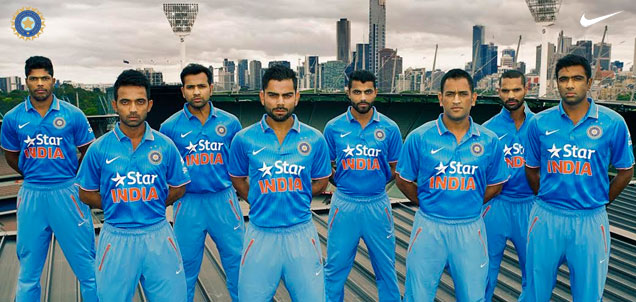
    Image: Nike publicity material of the unveiling of tge One Day International kit that the Indian Cricket team was to starting January 18 in Australia


    Rs 25 lakh for 10 seconds?!
     

    Ads get expensive as Star India seeks Rs 25 lakh for 10-sec slots during India-Pak ICC World Cup tie


    By Ravi Teja Sharma & Pritha Mitra Dasgupta


    Diehard cricket fans will remember the memorable India-Pakistan battles of the past World Cups. The tense standoff in Bangalore in 1996 when Ajay Jadeja went on a rampage and Venkatesh Prasad showed Aamir Sohail the way to the pavilion after sending his stumps clattering; that glorious Saturday seven years later in Centurion Park when fiery Shoaib Akhtar’s missiles were smacked by Sachin Tendulkar to all parts of the stadium, in the process delivering a huge win for India and a big confidence boost after a demoralising loss to Australia early in the tournament.


    This World Cup, the old enemies meet again. Not in the final as many fans would hope for or in the semi-finals like in 2011, but in the opening league match on February 15.


    Well ahead of that epic India-Pakistan encounter, a different kind of a battle is being fought behind the scenes. On one side are the advertisers who want to exploit the big viewership numbers that this match promises to deliver, and sitting tight on the other is Star India, the official broadcaster, who wants to milk the match by jacking up the advertising rates.


    More than 70 brands, including some regional brands and first-time advertisers, have booked slots for the game, which is 50% more than the count for 2011 World Cup final, said a spokesperson for Star India. At Rs 25 lakh per 10 seconds, this is going to be the most expensive advertising opportunity ever in cricket, but one that not many advertisers would want to miss. The match will see Amitabh Bachchan making his debut as commentator.


    Star India had sold the match between the two nations in the 2011 edition – the semi-finals – at Rs 20 lakh per 10 seconds but the final between India and Sri Lanka had come close to Rs 25 lakh per 10 seconds. “From a business and brand perspective, very few events can match the potential of an India-Pakistan match. I can understand paying a premium for this match, but Rs 25 lakh is too steep,” said Basabdatta Chowdhuri, chief executive at Platinum Media, which is part of the Madison Media Group.


    Media planners and agencies contest that number. According to them, Star has sold around 75% of its inventory for the India-Pakistan match and about 70% for the entire World Cup so far.


    Clearly, Star India is going for the kill, seeking Rs 25 lakh per 10 seconds from those who want to advertise across all its feeds during this match, according to people in the know. But top advertisers and media planners say they would rather wait and watch, as they feel prices will dip closer to the game


    Speaking on the condition of anonymity, a senior executive at a large advertiser said there is enough inventory available at the moment and they are waiting for rates, even for the India-Pakistan match, to correct closer to the tournament beginning


    A spokesperson for Star India said the ad slots for the match have been sold out much in advance.


    “No other game of cricket draws as much passion, emotion and following as an India versus Pakistan World Cup game,” he said.


    The channel has packaged the India-Pakistan match in several ways. There are advertisers who have bought combined airtimes across several matches, including the most talked-about match. For them, though, the average airtime rate is working out to between Rs  4.5 lakh and Rs 5 lakh per 10 seconds. Floating inventory for the match, however, have been categorised and priced according to the feeds.


    An advertiser that wants all the feeds including English, Hindi, South Indian feeds and high definition will have to pay Rs 25 lakh per 10 seconds. This means an advertising spot of 30-40 seconds would cost anywhere between Rs 75 lakh and Rs 1 crore. If an advertiser wants only English and HD feed, then it will have to pay Rs16-18 lakh per 10 seconds.


    “This is by far the highest rate that has ever been charged for a cricket match by a channel and I think it is a huge risk for advertisers,” said a top GroupM official, who didn’t wished to be named.


    Another media planner from the Dentsu Aegis Network said it doesn’t make sense for an advertiser to pay this kind of money when there is enough cricket happening in the country with both ICC and IPL matches.


    According to Indranil Das Blah, chief operating officer of sports management firm Kwan, this is undoubtedly the most high-profile match of this World Cup. “I don’t know if the ad rates are justified or not, but it can’t get bigger than this and no advertisers would risk missing it,” said Blah.


    For the larger World Cup, though, Star has signed up the likes of Sony, Airtel, Gaana.com, Hero and Karbonn as sponsors, alongside Maruti, Nestle, Raymonds, Marico, Pidilite, Yepme-.com and Paytm. To cater to a wider audience, it is broadcasting the tournament in Tamil, Malayalam, Kannada and Bengali alongside Hindi and English that it hopes will bring in a large number of new advertisers to the World Cup as it will become more affordable for smaller advertisers.


    But media planners say there is some level of concern around the Indian team’s performance as well and also the timing of the matches, but these concerns will not matter if India begin the World Cup journey with a big win over Pakistan.


  • Wizcraft begins ops in Singapore

    By A Correspondent


    Widely renowned for their brand activation and events, Wizcraft International Entertainment Ltd has opened their international base in Singapore. The Singapore office will service the Asia-Pacific region and offer clientele a complete spectrum of brand activation and event management services covering ground, digital, display and brand property creation.


    Wizcraft has been in the forefront of some of the largest events and entertainment spectaculars, including the ICC World Cup’s Opening ceremony in Dhaka, Bangladesh, cricket-activation in Sri Lanka and the closing of the ICC World Cup in India; the Opening and Closing ceremonies of the Commonwealth Games in New Delhi, 50 Years of Indian Independence, the 30 Years of Mauritian Independence, the 10 years of the South African Freedom Struggle, the National Games Opening and Closing ceremonies, the Oman Tattoo showcase of the armed services of the Sultanate of Oman, the Handover ceremony of the Commonwealth Games in Melbourne, and  The Unforgettable Tour (Indian Cinema’s biggest concert that travelled across Toronto, Trinidad, LA, San Francisco, Houston, Atlantic City, Chicago, New York and London bringing together the greatest icons of the Indian Film Industry). Over two decades, Wizcraft has etched its mark in history.


    Wizcraft has focused its brand management skills, creativity and marketing acumen to create market leader event brands such as the International Indian Film Academy Awards and Weekend (IIFA), the Global Indian Music Academy Awards (GiMA), the Green Globe Awards and the Kingdom of Dreams, a destination that offers a unique experience of theatre, cuisine, arts, crafts and folk performers.


    Sabbas Joseph, Director, Wizcraft International Entertainment Ltd. said: “Wizcraft has always serviced global brands across the region. We are certain that our team being closer to the centre of decision-making for the APAC region will ensure that we can influence the market trends positively and create partnerships that will deliver brand messaging across the region.”


    Andre Timmins, Director, Wizcraft International Entertainment Ltd. said: “Wizcraft has taken significant leaps in terms of growth in the last decade and this reflects in the scale and magnitude of the events that we have done. Asia represents significant growth opportunities for Wizcraft and a globally connected city like Singapore is the best step to further expand the Wizcraft empire. This establishment will be an important growth market for our unique offerings over the years.”


    Ajay Rao, Vice President, South East Asia & Pacific Region, Wizcraft International Entertainment Ltd. said: “We look forward to leveraging our worldwide experience to deliver integrated services of International quality and range to consumers in Singapore. Being a cosmopolitan city-state Singapore has highly skilled resources and offers a conducive environment to creative and knowledge-driven industries. We look forward to our associations here and also plan to add to our service offerings as demand grows”


    Established in 1988, Wizcraft International Entertainment Ltd is now India’s leading Communication and Entertainment Company, integrating strategy, creativity and technology to provide Interactive Entertainment & Event Solutions to a global audience. The pioneer of many extravagant and mesmerizing events, Wizcraft has been instrumental in shaping the event management industry in India.