Tag: I&B

  • BARC to resume individual news channel ratings

    By Our Staff


    BARC India, and the industry at large, have welcomeed the Ministry of I&B’s directive to resume the release of data for individual News channels. The data will be released as per the Augmented Data Reporting Standards for News and Special Interest genres.


    Notes a communique: “BARC India is currently working towards ensuring the seamless release of individual news channel data and intends to commence release with effect from our reporting Week 10, 2022. As per our reporting cycle, this data will be released to the market on Thursday, 17th March 2022. We have communicated the same to our clients and stakeholders.


    “The Augmented Standards entail the reporting of audience estimates for News and Special Interest genre channels on a 4-week rolling average basis, which would be released regularly every week along with the estimates for all other channels. All viewership data will be published on the same YUMI platform that all our subscribers use.


    “In the weeks leading up to the resumption of news channels ratings, BARC India will be reaching out to its constituents to sufficiently inform and educate them about the details of the Augmented Data Reporting Standards.


    “With the active support of the Technical Committee members, all our stakeholders and industry experts, we believe we have a statistically sound and effective solution which helps augment the robustness of the data and reporting, which we had set out to do. This would be another significant step taken by BARC India to ensure a strong currency for advertisers and media organisations.”


  • Welcome, Prakash Javadekar. But has Modi missed a trick by not combining I&B with telecom?

    By Your Editor

    The suspense over portfolio allocation ended earlier today with the announcement via a Rashtrapati Bhawan communique. While one needs to figure why some people were chosen (or not chosen) for a few key ministries, there is a new master for the media sector – the information and broadcasting ministry: Prakash Javadekar. The other important ministry for the media – telecom – sees Ravi Shankar Prasad continuing in office.

    Although it requires some lateral thinking, one would’ve thought that given the mandate the new government has won and the Prime Minister’s penchant for going out-of-the-box, we would’ve had a single minister for telecom, and information and broadcasting. There’s a lot more to IT than the internet and social media, and it could well be looked at by another minister, if at all.


    However, that’s not been done. And we are back to one minister for I&B and another for communications, IT and electronics. Sad, given that telecom is driving media in a big way, and in order that the digital economy grows, it’s important that there is integrated attention.


    Be that as it may, let’s welcome back Prakash Javdekar to the I&B Ministry. He’s affable and has had some experience in I&B (May-November 2014) and a few years as a member of the Press Council of India. Javadekar is liked by most people and can be a consensus-builder.


    There is loads happening in the media – especially on the digital front – and the minister would be required to step in and take a progressive approach to tackling things.


    Will he? Won’t he? We’ll know for sure soon enough.

  • MediaSENse by Indrani Sen: To cap it all

    By Indrani Sen


    During the last month, the News Broadcasters Association (NBA) and others sought adjournment of the court case challenging the advertising cap of 12 minutes per hour twice in the Delhi High Court. The hearing scheduled on September 8 was first adjourned to September 23 on the ground that lawyers were on strike, which again got adjourned to November 27 on the ground that the matter was under discussion with the Information and Broadcasting Ministry (I&B). The earlier order by Supreme Court that the Telecom Regulatory Authority of India (TRAI) will not take any legal action against any channel violating the norms will stay put till the Delhi High Court case is heard and resolved. As per the reports published by the TRAI on a quarterly basis, very few channels are adhering to the limits set by TRAI.

    Based on consumer complaints, TRAI has been trying to regulate the quantity of commercials on TV channels since 2012. When the regulation on Ad Cap was announced in 2013, ( http://www.thehindu.com/   August 18, 2013).  Manish Tewari, I&B Minister in the UPA government said in an interview “TRAI should introspect and reconsider its current stance till carriage fees don’t mitigate further and subscriber revenue doesn’t stabilize for the sake of the healthy growth of the industry.”  Subsequently, Prakash Javadekar, the first I&B Minister in the BJP Government  indicated to media that the government was considering an amendment that free-to-air (FTA) channels should be exempt from the restriction of the 12 minutes ad-cap, while for pay channels the existing limit of 12 minutes per hour of advertisements would continue. (http://www.livemint.com/ October 8, 2014). After Arun Jaitley took over as I&B Minister, he made a statement that there should be no ad cap in the print or electronic media, but did not give any such instruction to the Ministry. (http://www.indiantelevision.com/ )

    While the I&B Ministry and TRAI are mulling over the issue, it would be informative to do a quick look around the world and survey the norms related to ‘TV Ad Caps’ practised in developed countries. In Europe, the Audiovisual Media Services (AVMS) sets the regulatory framework setting a limit for all channels of 12 minutes on the amount of advertising shown in one hour.  The similar rules which apply in the UK, are set out in the Code on the Scheduling and Amount of Advertising (COSTA) prepared by Ofcom, Independent regulator and competition authority for the UK communications industries. With our colonial hangover, we seem to have adopted the regulation prevailing in UK.

    The Australian model is very interesting. The Australian Communication and Media Authority (ACMA) categorises the time bands into two slots and stipulates that on the main channels, commercial television licensees may schedule

    1) Average 13 minutes per hour of non-programme matter between 6pm and midnight; and

    2) Average 15 minutes per hour on non-programme matter at other times.

    However, the maximum that can be scheduled in any given hour is:

    1) 15 minutes from 6pm to midnight – with no more than 14 minutes scheduled in any four of those hours; and

    2) 16 Minutes at other times.

    The definition of non-programme matter includes paid advertising but excludes short programme promotions and pop-up programme promotions in the middle of programmes. Additional allowance is given during election periods to accommodate the broadcast of ‘political matter’. Since 2014, the leading channels have been lobbying with the government for raising the bar to 20 minutes of non-programme matter every hour. The pros and cons of the same are still being debated.

    Canada had the stipulation of ad cap of 12 minutes per hour based on individual licence agreements till 2007. In May, 2007, CTRC (Canadian Radio-television and Telecommunications Commission) announced a phased relaxation of the rule bringing the free to air conventional TV channels more closely in line with their counterparts in US. So, from 2009, there is no cap on the quantity of commercials per hour on the free to air Canadian channels while the specialty pay channels are still subject to the ad cap of 12 minutes per hour.

    American TV hour-long programmes typically run for 42 to 43 minutes, leaving 17 to 18 minutes per hour for commercials. Federal Communications Commission (FCC) has a special regulation for controlling loud commercials, but has not introduced any cap on the quantity of time used for the commercials per hour. In 2014, a new study from Nielsen, the ratings measurement firm of US, showed that the number of commercials had grown steadily over 2009 to 2013. In 2009, the broadcast networks averaged 13 minutes and 25 seconds of commercial time per hour which grew to 14 minutes and 15 seconds in 2013. The growth was more significant on cable television. A typical American home had 189 channels to choose from yet only watched 17.5 on a regular basis. That figure was the same in 2009, when the average home received 129 channels. According to Nielsen, use of shorter commercials became more common (http://www.latimes.com/entertainment   May 16, 2014). Recently, I read online that Viacom is planning to find out if they can get more value for TV commercials by running fewer them on the network. (http://variety.com/2015/tv/news/viacom-primetime-tv-advertising-cuts-1201598646/  September 21, 2015).

    Ad clutter has been a major hindrance for TV viewing over many years. To cap it all, now an exodus of consumers from TV to streaming video, mobile devices, etc. have started across the world. On TV, appointment viewing has been changing to scattered delayed viewing. Our TV channels, who are fighting against the TRAI regulation on ad cap for protecting their revenue, should remember that their ratings followed by revenue may be better protected with less time devoted to ad breaks.

    The  I&B Ministry and TRAI should consider the scope of adopting the Australian model with variable options across different time bands including additional allowance during Central and State elections. As we have almost 50 percent of our licensed channels in the news genre, the news and non-news can also be put in two different buckets apart from the FTA and Pay channels. In my view, we need to come out of the practice of holding UK as the role model and look around for better alternatives while framing our media rules and regulations.

    Indrani Sen is a veteran media agency and marketing services professional. She is currently an Independent Consultant and Adjunct Faculty, Media Management at Symbiosis Institute of Media & Communication, Pune. This column MediaSENse will appear fortnightly. The views expressed here are her own.


  • Uday Shankar to be next I&B minister?

    By A Special Conespondent


    New Delhi, April 1, 2014: With a new government imminent at the Centre, there have been murmurs in Shastri Bhavan on who the new information and broadcasting ministry will be.

    There is of course a concern on who will be the new Prime Minister, especially if the BJP doesn’t cross the 200 seat mark and has to compromise on a PM other than Narendra Modi.


    Uday Shankar

    Be that as it may, there’s one name that’s turning out to be a consensus if the NDA or Third Front dispensations come to power. And that’s the name of Uday Shankar, CEO, Star India. In fact it is learnt that even the UPA returns to power, he will be the candidate.

    A former journalist and Editor, Mr Shankar was head of news at Aaj Tak and later CEO of Star News. Even now, he’s often invited to panel discussions and seminars discussing issues concerning journalism.

    Given that he’s fully aware of issues concerning I&B as CEO of Star India and very active on various industry bodies, Mr Shankar may well be the new I&B minister, sources say. For more details on the story, please click here.


  • I&B ministry asks DTH operators to pay Rs 2,000 crore

    By Vijaya Rathore


    The information and broadcasting ministry has asked six DTH operators, including market leaders Tata Sky and Dish TV, to pay over Rs 2,000 crore, which the ministry said they collectively owe to the government in lieu of the licence fee.


    The ministry sent demand notices on Friday to Tata Sky, Dish TV, Sun Direct, Airtel Digital TV, Reliance Digital TV and Videocon D2H, asking them to pay up the sum within 15 days. This followed a ministry-ordered independent audit of the accounts of the six operators.


    “The ministry has given 15 days to all the operators to make the payment,” a person familiar with the development said. The calculation has been made on the basis of the gross revenue of each operator.


    The time period for calculating the arrears is from the day the licences were issued to each of them. “The I&B ministry sought the opinion of the law ministry before sending out the notices,” this person said.


    The issue relating to licence fee payment has been going on between the ministry and the operators for a few years now. The Telecom Disputes Settlement and Appellate Tribunal (TDSAT) had in an 2010 order said that DTH operators should pay 10% of their adjusted gross revenue as licence fee.


    The ministry had taken the matter to the Supreme Court where the case is pending.


    Source:The Economic Times

    Copyright © 2014, Bennett, Coleman & Co. Ltd. All Rights Reserved

    Licensed to republish


  • Pre-poll sop? I&B ministry grants interim 19% hike in DAVP rates of print media

    By A Correspondent


    You will not read this interpretation in any newspaper. Nor will any news channel discuss this in its various panel discussions. Perhaps social media may. But you never know. For, it’s seen as a sop to newspapers ahead of the elections – the rest of the State elections to be held this month and next and the 2014 general elections. The Ministry of Information and Broadcasting has granted an interim hike of 19 percent in DAVP rates for the print media with effect from October 15, 2013.


    The rate card decided by the 6th Rate Structure Committee (RSC) was valid till October 14 and even though a 7th RSC was constituted by the MIB on May 31, 2013, the recommendations haven’t come in so far. According to a communiqué, the ministry has received a number of representation from various stakeholders and DAVP for grant of immediate interim relief in the Print Media Rate Card of DAVP pending revision of rate card on the basis of recommendations of 7th RSC.


    Accordingly, a proposal for grant of an interim hike was considered by the MIB in consultation with Ministry of Finance and the Election Commission of India. All stakeholders have been to cooperate with the Rate Structure Committee so that its recommendations may be finalized at the earliest.


  • I&B consultative committee discusses Leveson Report and implications for India

    By A Correspondent


    Manish Tewari

    Minister for Information & Broadcasting Manish Tewari chaired a meeting of the Consultative Committee of the Ministry. The meeting discussed the Leveson Report and its relevance / implications in the Indian milieu. A presentation on the Leveson Report and its relevance and implications in the Indian context was made before the members.


    Welcoming the members, Manish Tewari said that in the last two decades, the media landscape has undergone an exponential transformation. In both the Indian and the global context, certain structural paradoxes emerged, which required the focus of concerned, conscientious and committed stakeholders of the public discourse. While there were diverse interests in play in the media space the challenge was always to find the golden mean so that the concerns of different stakeholders could be taken into account. Mr Tewari added that the Leveson Report was being discussed before the Committee so that the issues raised could be debated and discussed and the implications in the Indian context could be analysed. While the Government had always supported the ‘Self Regulation’ mechanism in the media domain, of late, a need had also been felt even amongst the stakeholders that a model statutory underpinning the self regulation framework may be looked at. The Leveson Report was an example of a model that had been conceived in the British context after due deliberations and debate. He further stated that the endeavor would now be to also compare other similar models around the world and understand the implications and applications better juxtaposed against the Indian context.


    While appreciating the initiative of the ministry in discussing the broad features of the report, Members of the Committee emphasized that discussions should be broadbased accounting for changes across the media space which included the broadcasting and new media also. Members also emphasized that while the current model was very country specific, an attempt ought to be made to discuss the matter with all critical stakeholders accounting for the diversity in the media space. Members also mentioned that the roadmap for the public broadcaster with regard to the regulatory mechanism could also be looked into so as to ensure a comprehensive analysis of the process. Members also felt that in order to ensure a roadmap for the future, it was necessary to outline institutional mechanisms which took into account the changes that were in the offing in the different media segments.


    Members who attended the meeting included Dr Anup Kumar Saha, Dr Sanjay Jaiswal, Shatrughan Sinha, Ramya Divya Spandana, Ahmad Saeed Malihabadi, Barun Mukherji, Bharat Kumar Raut, M P Achuthan, Mohammed Adeeb and Pyarimohan Mohapatra.


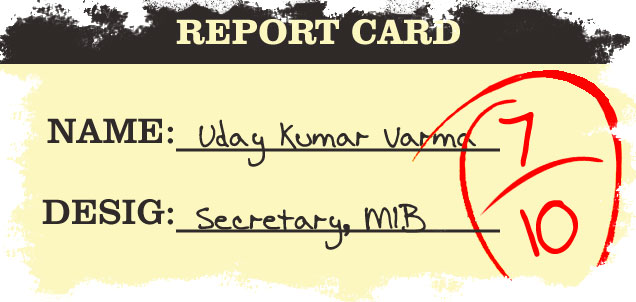
  • Mediaah! Report Card on Uday Kumar Varma’s tenure as I&B Secretary: 7/10


    By Pradyuman Maheshwari


    Uday Kumar Varma

    In October 2011, when Uday Kumar Varma had just been appointed Secretary in the Information and Broadcasting ministry there was much hope from the ace bureaucrat. He didn’t just have sound experience in the administration, but he also had spent a good time in the MIB.


    So he would be plug-and-play given the little time he would need to learn the nuances of the ministry.


    However, it’s one thing to be Special Secretary and another to be ‘the’ Secretary, especially when you know your stint is going to last two-odd years and you will be retiring after the tenure.


    MxMIndia had carried an article as a part of the Anchor with the headline: 5 Things the New I&B Secretary Uday Kumar Varma must do (see link: http://www.mxmindia.com/2011/10/the-anchor-5-things-new-ib-secretary-uday-kumar-varma-must-do/).


    There was a five-point tasklist. Here are the headlines:

    #1 Ensure new digitization announcement is implemented on time.

    #2 Must let self-regulators rule.

    #3 Should ensure paid contentwallahs are punished.

    #4 Push for news on FM Radio.

    #5 Empower government media – Doordarshan and All India Radio.


    I am not going to factor in #2, 3 and 5 here, because in a two-year stint there’s not much that you can expect any Secretary to achieve.


    Phase 3 of the FM radio regime has still not taken off and one can’t see independent news happening in a hurry on FM radio. It requires someone who believes in the medim to push these through with missionary zeal in what’s clearly a non-priority sector.


    Varmaji made the regular noise on self-regulation, measurement and paid content, the kind one expects from a Secretary.


    But it’s with digitization that the former Secretary has received the maximum bouquets and brickbats. At the outset, he deserves all the credit for digitization finally seeing the light of day. When the minister changed less than a week before first phase was scheduled to happen,  it was Shri Varma and his team’s conviction that ensured it takes place.


    But what happened before Phase 1 of digitization was effected was deplorable. The readiness numbers that the ministry declared were in sharp variance with the ground reality.


    It was Varma & Co’s resolve and understanding that the hiccups are inevitable is what led to the digitization been effected. Phase 2 was also pushed through, with its own share of problems, but by then the Secretary knew that it’s not switch-off-switch-on game. Every phase will have its own sub-phases.


    Had it been just the effecting of digitization, Varma would’ve got an 11 on 10, but the fact that the initial process had its share of big problems and that one had huge expectations from him given his knowledge of the functioning of the ministry, we give him a score of 7/10.


  • MIB asks TRAI view on Central/State govt entry in cable

    By A Correspondent


    The Ministry of I&B has sought the recommendation of Telecom Regulatory Authority of India (TRAI) regarding the entry of central / state governments and their entities into the broadcasting sector.


    The ministry made this reference recently as the issue of granting permission to a state government or its organs to run cable TV networks has been drawing its attention from time to time with particular reference to the TRAI recommendations restricting such entities to enter into broadcasting and distribution activities. The ministry has received also requests from central government ministry and from several state governments in the past, a communique said.


    The ministry has sought the views of TRAI regarding the entry of the following entities in the broadcasting sector:


    (i) Central Government Ministries and Departments / Central Government owned companies / Central Government undertakings / Joint venture of the Central Government and the private sector / Central Government funded entities.


    (ii) State Government Departments/ State Government owned companies / State Government Undertakings / Joint venture of the State Government and the private sector / State Government funded entities.


    In its recommendations on “Issues relating to entry of certain entities into Broadcasting and Distribution activities” dated November 12, 2008, the TRAI was of the view that a state government and its organs may not be permitted to enter into broadcasting and distribution activities.


    As per extant policy guidelines for uplinking and downlinking of television channels, an applicant seeking permission to set up an uplinking Hub / Teleport or Uplink/downlink a TV Channel should be a company registered in India under the Companies Act,1956 irrespective of its management control. This assumes significance in view of significant growth in the broadcasting sector wherein the number of TV channels and cable connections in India have grown exponentially.


  • The Anchor: 5 reasons why Digitization may not happen even by Oct 31

    By Pradyuman Maheshwari


    It was unfortunate to see broadcasters forced to change their business projections and content strategies when digitization was less than a month away from the scheduled dates in June. And, now, the information one seems to be getting from the ground in the four metros is that the October 31 deadline also may not be met with.


    1. Momentum is lost: TAM CEO LV Krishnan said this in an interview to me last week. The urgency to go in for set-top boxes and the momentum that existed in April and May has been lost.

    2. The masses will wait and watch. Making it mandatory for cable operators and MSOs responsible for giving info is of no use. It’s the public – you and me – who have to be motivated enough to buy the box and go digital.  Don’t be surprised if the conversions fail  to pick up till the last week…

    3. Analogue will not vanish in the lower strata: TAM may not measure these homes in the four metros, but that’s not really a concern for lakhs of families who can’t afford a set-top box and the revised tariff.And just as it’s impossible to control petty crime, I don’t think the government will be able to nab the pirates in the metros.

    4. Old set-tops offer < 500 channels: Remember, the true pleasures of digitization will be felt only when you can watch those obscure television channels… Jewelry Television, may be. Or Create, a channel that shows D-I-Y and assorted instructional programming. Regrettably, many of those who embraced digital early own set-top boxes that may not be able to accommodate 500 without a tweak

    5. MIB must lead from the front: Any significant process for change must be led from the front and with the minister, her deputies and the secretariat on the ground. Are they doing it? No visible signs yet.


  • Registered papers in India is 82,237, Hindi & Eng lead in no of print entities

    By A Correspondent


    The press registrar, T Jayaraj, Registrar of Newspapers for India (RNI), presented the 55th annual report ‘Press in India’ 2010-11 to Uday Kumar Varma, Secretary, Ministry of Information & Broadcasting (I&B).


    Speaking on the occasion, Mr Varma said that the annual report was a compendium of interesting data containing status of print media in the country. He also suggested that based on the previous years’ trends, a comparative analysis of different newspapers in circulation, their growth over a period of time and further comparative statements could be presented through graphs in the next year’s annual report. This would add value to the report, thereby becoming an important reference point for key stakeholders in the industry.


    The Annual Report highlighted key trends for the Indian press in 2010-11. The analysis provided a broad overview about the general trend of the Indian press based on the number and claimed circulation of newspapers.


    The total number of registered newspapers stood at 82,237. The number of new newspapers registered during 2010-11 stood at 4853. The percentage of growth for registered publications over the previous year was 6.25 per cent.


    The RNI approved 13,229 titles for the year 2010. The largest number of newspapers and periodicals registered in any Indian language was in Hindi at 32,793. English had the second largest number of newspapers and periodicals which was 11,478. The total circulation of newspapers stood at 32,92,04,841 as against 30,88,16,563 copies in 2009-10. The number of annual statements received in RNI for the year 2010-11 was 14,508 against 13,134 in 2009-10 registering an increase of 10.46 per cent.


    As per data from the annual statements, the highest number of newspapers were published in Hindi (7,910), followed by English (1,406), Urdu (938), Gujarati (761), Telugu (603), Marathi (521), Bengali (472), Tamil (272), Oriya (245), Kannada (200) and Malayalam (192).


    In terms of circulation, Hindi newspapers continued to lead with 15,54,94,770 copies followed by English with 5,53,70,184 copies. Urdu press had a figure of 2,16,39,230 copies.


    The report is a statutory requirement under Section 19 G of the PRB Act, 1867. It is an analysis of the Indian Press which focuses mainly on circulation as claimed by the newspapers. It also carries different chapters viz ownership of newspapers, analysis of daily newspapers, language wise study of the press and analysis of registered newspapers. The source of information of the report is the annual statements submitted by the publishers of newspapers and periodicals in accordance with 19 D of the Act.