
Tag: I&B Minister

  • Tarun Katial: What the new government (and MIB) must do for Radio


    By Tarun Katial


    1. Foreign Direct Investment (FDI) in Radio Broadcast Sector

    Key Issues:

    :: The current FDI limit in the radio broadcast sector is restricted to 26%.


    :: In respect of television broadcasting sector, the FDI limits are as below:


    Non-news content – FDI is permitted up to 100%; and

    News & current affairs content – FDI has been restricted to 26%.


    TRAI Recommendation:

    :: TRAI on August 22, 2013 recommended that FDI limit for radio sector should be enhanced to 49%.


    Requests:

    :: There should be parity in the FDI limits for the television and radio broadcast industry.


    :: For FM radio broadcasters airing news & current affairs, the FDI limit should be increased to 49%.


    :: For all other FM radio broadcasters airing non-news content, the FDI limit should be increased to 100%.


    2. Deferred payment mechanism for Non refundable One time Entry Fee (NOTEF) and Migration Fee

    Key Issues:

    :: Based on current guidelines the migration fee payable by existing players to migrate to new regime and NOTEF by successful Phase 3 bidders has to be paid upfront and in full.


    :: It is estimated that the FM radio broadcasting sector will require additional capital investment of Rs. 3,000 crores or more for meeting the outgo on account of migration fees, Phase 3 auction license fees and capex for the creation of infrastructure.


    :: This additional capital investment of Rs. 3,000 Crores amounts to 200% of the annual revenue of the radio industry.


    :: The telecom industry which is much larger than the Radio Industry and which has an annual turnover of Rs. 3,00,000 Crores has already been allowed a deferred payment mechanism for the recent spectrum auction in 1800MHZ and 900 MHZ Bands. It is pertinent to note here that the total spectrum fee in the auctions was Rs. 61,000 Crores, which when compared to the annual turnover of Rs. 3,00,000 Crores,  amounted to only 20% of their annual revenue.


    Request:

    :: On the lines of the recent spectrum auction polices for Telecom, we request a deferred payment mechanism for the migration fee and NOTEF as under:

    Upfront – 25%

    Moratorium – 2 years

    Balance payment – Annually over the license period


    3. Migration of Phase 2  to Phase 3 regime

    Key Issue:

    :: With licences of Phase 2 expiring from March 2015, the migration to Phase 3 is the critical concern of the Radio industry.


    TRAI Recommendation:

    :: TRAI on February 20, 2014 recommended that the policy of migration of existing operators to Phase 3.


    Request:

    :: We request that the Government accept TRAI’s recommendations and announce the migration policy at the earliest.


    4. Channel Spacing

    Key Issues:

    :: Limited number of FM channels available in various cities and high license price makes it difficult to shift the focus away from mainstream film music. Consequently there is lack of content plurality thereby affecting radio listenership.


    :: The additional capacity could provide a platform for special focus genres, regional/folk content, dedicated channels for sports and news, etc.


    TRAI Recommendation:

    :: TRAI on April 19, 2012 recommended that it is technically feasible to reduce the channel spacing to 400 KHz from the current 800 KHz and thereby, double the number frequencies in A/A+ and B category cities.


    Requests:

    :: TRAI’s recommendation of reducing channel spacing from 800 KHz to 400 KHz should be accepted.


    :: The government should announce immediately the proposed number of additional frequencies that can be auctioned in A/A+ and B category cities and the associated time frame for their auctions.


    :: This will enable industry players and incumbents to take informed decisions during Phase 3 bidding.


    5. Reserve price for cities undergoing auction for the first time in Phase 3

    Key Issues:

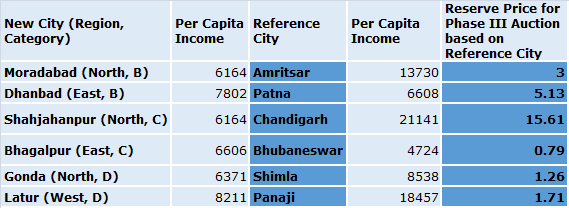
    :: In Phase 3, 228 cities (707 frequencies) out of a total of 294 cities will be undergoing auction for the first time. The Ministry has proposed the following methodology to calculate reserve price for cities undergoing auctions for the first time as under:

    >> Highest bid price received during FM Phase 2 for that category of cities in that region.

    >> In case the benchmark from Phase 2 for a particular region is not available, then the lowest of the highest bid received in other regions for that category of cities may be taken as the reserve price


    The table shows the reserve price in some of the cities based on the rules provided in Phase 3 guidelines:
    Ministry of Information and Broadcasting; Census 2011


    :: In view of the table above, it is unreasonable to expect, that the price set for Chandigarh, a C category city in North region and the city which received the highest bid of Rs. 15.61 Crores during Phase 2 auctions with per capita income of Rs. 21,141, is a fair reserve price for Shahjahanpur with per capita income of only Rs. 6,164.


    :: Similarly, the reserve prices for most other fresh cities look unreasonable. For instance, Moradabad a B category city in North region with a per capita income of Rs. 6,164 cannot be compared with Amritsar, which received the highest bid of Rs. 3 Crores and which has a per capita income of Rs. 21,141.


    TRAI Recommendation:

    :: TRAI on February 20, 2014 recommended that the methodology for determining the reserve price for fresh cities in Phase 3 should be reconsidered.


    Request:

    :: In case of cities going for auction for the first time, the reserve price should be ‘Average bid across all regions in the country for the same category of city’. This will eliminate any outliers and e-auction will allow fair price discovery of each city.


    6. Expedite Empanelment with DAVP (Directorate of Advertising & Visual Publicity) of some radio stations

    Key Issues:

    :: The revision of DAVP rates for FM has been pending since last 3 years


    :: Empanelment of radio station of some radio broadcasters, which is pending since 2008.


    Requests:

    :: DAVP rates/policy be revised appropriately based on the growth of FM listenership across India


    :: Expedite empanelment of radio station of some radio broadcasters to ensure fair allocation of funds by DAVP.

     

  • MxM Mondays: Expectations from Manish Tewari, the new I&B Minister


    It’s a week since Manish Tewari took charge as I&B Minister… just two days before the sunset date of Phase I of digitization. The foremost challenge he faces is overseeing and implementing the digitization process. While the digitization numbers as posted by the MIB look impressive, it remains to be seen if the challenging ground realities are met. Another task at hand would be to let the broadcast industry flourish.


    MxMIndia spoke to industry captains about their expectations from the new I&B Minister.


    Ravi Dhariwal

    Ravi Dhariwal, CEO – Publishing, BCCL

    I just wish that the new minister on board would help media industry in India grow and become more relevant – whether it is print or television. The minister should create an enabling environment where we, as a media fraternity, can serve the country in best traditions.


    Man Jit Singh, President, Indian Broadcasting Foundation and CEO, Multi Screen Media

    Man Jit Singh

    I have a three-pronged expectation list from the minister. I believe he has the same priorities as us when it comes to the process of digitization. We hope that the digitization process is smooth and continuous for him. And the second phase is also rolled out soon. I expect the new minister to support us in making sure there are no pirated signals or disruptive systems.


    The new I&B minister, as we know, supports self-regulation. As broadcasters, we believe self-regulation, and we look for his continuous support.


    The last and the most important thing is the issue of Price Control that was put in place in 2003. There was meant to be a sunset date for the price control, which has not happened till date. It has been too long that broadcasters have been following it. Now, it is the time that market forces decide the price.


    KVL Narayan Rao, President, News Broadcasters Association and Executive Vice-Chairman, NDTV Group

    KVL Narayan Rao

    I would not go so far as to call it expectation but a belief that he will continue to take forward the good policies that previous I&B minister, Ms Ambika Soni, had initiated. There are three things that Mr Manish Tewari should aim at: digitization being the first one. He should uphold the price for carriage fees and support self-regulation. He should support the industry from the perspective of unreasonable levels of taxation – whether it is direct or indirect service tax. We hope that the next Bill that he presents talks about these issues.


    Mr Tewari is a democrat, and will probably look at the whole picture and then make decisions.


    Ashok Mansukhani

    Ashok Mansukhani, President, MSO Alliance

    Basically, three things: the first thing – the first phase of digitization needs his personal interest to stabilize it. It requires political direction to put it on the right path, especially since the process of digitization has to happen through state governments. I don’t think the minister should leave it to bureaucracy alone.


    The second thing is that the second phase of digitization is too near the first stage, which is March. And, I think, at this moment it is a mirage to think that we can achieve that target on 31st March because the stabilization of the first phase of digitization is not dependent on a press note. It is the dependent on the acceptance of digitization by the consumer. Now the consumer is at least a month away from understanding what digitization means, what it will cost him and what the benefits are. This is a learning process and the process will take some time, and therefore, I think phase two – even though everyone will say it is non-negotiable – in my view, it will have to be pushed back by six months.


    The third step is that Mr Manish Tewari needs to very carefully look at the fact that you cannot regulate a multimedia delivery that India has in the form of cable, DTH, mobile TV and IPTV through the Cable Act. The Cable Act is fine as far as cable is concerned. We need to work towards an Electronic Media Management Act. Basically, this Act would function on the basis of self-regulation but which has a safety net of autonomous public authority that Supreme Court asked in 1992 for the Cricket Judgement in which SC had said that airwaves are neither private property nor government property but it is public property. And public property is best protected by an autonomous authority. In 1992, only cable and broadcasters were present but in 2012 you have four technologies and who knows if fifth one will come through 4G.


    The way I would like to see it that the last thing the Minister needs to do is that everybody somehow managed to do Phase I of digitization without getting any incentive from the government. But I think that what happened in the last week or first 10 days to the run up to sunset date was the sudden realisation that the much-beloved Census figures itself showed that 50% of people in India are poor. If that is so and in any case MSOs were giving a subsidy of nearly Rs 1000, Rs 500 is also proving too much for this really poor class. Someway has to be found to lower the burden on slum areas as much as possible. And one way to do it is what TRAI had wanted to do in 2010, which is to say that if you are a digital infrastructure provider, you will be treated on equal footing as other infrastructure providers and given a tax holiday for seven years so that whatever you invest now, you are able to then recover it in form of low taxes over the next seven years. Also, there has to be some form of set top subsidy scheme, which is not just borne by cable but is also borne by broadcasters in form of lower prices and government in the form of duty reduction.


    If digitization be his main objective, then apart from that he has to ensure that everybody is kept on a level-playing field. He made some statements in the beginning about it but he is silent in the last four days. So, I think that I am really looking for is more sane and more stable approach to digitization and a level-playing field, which is technology-proof for the future.


    Roop Sharma

    Roop Sharma, President, Cable Operators Federation of India

    We expect him to treat all stakeholders in the digitization process equally. He should understand the realities. The new minister should work in tandem with the ground realities of digitization. Mr Manish Tewari should listen to all stakeholders, and take into consideration the problem and hiccups that each state and stakeholder is undergoing in this process.