
Tag: IAMAI-KPMG report

  • India Shining for Mobile Internet


    By A Correspondent


    India is projected to have 23.6 crore mobile internet users by 2016, and this will leapfrog to 31.44 crore by 2017. This was reavealed in a report by the IAMAI & KPMG “India On The Go – Mobile Internet Vision Report 2015”.


    The report also points out that India will have over 50 crore internet users by 2017. As of June 2015, internet users in India stood at over 35 crore. According to the report, 2G user base in India is projected to decline in the coming years as more and more customers are expected to migrate from 2G to 3G. The 3G user base in India is rapidly gaining market and is projected to grow at a CAGR of 61.3 per cent from 2013-17. There were approximately 8.2 crore 3G subscribers in India by the end of year 2014 and the number is projected to reach 28.4 crore by end of year 2017.


    Commenting on the release of the IAMAI-KPMG report, Ashvin Vellody, Partner – Management Consulting, KPMG in India said, “With more than 30 crore internet users, India has the second largest internet user base in the world. But the internet penetration at 19 per cent (approx) is poor and limits the potential. The next wave of growth in penetration of internet will driven by adoption of mobile internet. The mobile internet growth story would be written by the large population in the hinterland and meaningful and compelling content/ use cases would enable adoption of mobile internet.” He further stated, “It is imperative to connect Indians through internet of which the mobile internet will play a key role since reliable accessibility will be the killer app that will bind the internet ecosystem together, increase adoption and enable innovation in business models around voice and data services.”


    Speaking at the launch, Dr Subho Ray – President IAMAI reiterated that growth in the internet space will come from the non-metro and rural areas. He said, “While the urban market has not reached its saturation point, it will be non – metros and rural India that will be driving internet growth in India. And this is where mobile internet will be playing a pivotal role. The advent of low cost smartphones coupled with low mobile tariffs has empowered consumers in the hinterland to use data connectivity and we will seeing more usage of internet from these areas in the months to come.”


    As per the Report, rural India is steadily moving towards a more Internet friendly and exploratory mind-set. As of 2014, the Active Internet User (AIU) base in rural India was 6.7 per cent of the overall rural population of 90.5 crore and accounted for 61 million users. 4.4 per cent of the total rural population used a mobile device to access the Internet; a figure that stood at a meagre 0.4 per cent in the year 2012.


    The Report has found that the rural growth story in the coming years will likely be written by 2G technologies. 3G and 4G may continue to be primarily an urban phenomenon for the next few years. Increased Internet enabled device penetration, decreasing handset prices and data plans tariffs are helping to create a suitable environment for a rapid growth of Mobile Internet in India, with rural India set to take the lead. As of June 2014, nearly 50% of the AIU in rural areas accessed Internet using mobile phones, Community Service Centers (CSC) and Cyber Cafes. 38% of the Active Internet Users use Mobile phone as the main access point.

     

  • Inventory-based e-com needs FDI: IAMAI-KPMG report

    An IAMAI-KPMG report “e-Commerce: Rhetoric, Reality and Opportunity” released on Tuesday has recommended that inventory-based e-commerce be opened to foreign direct investment (FDI). FDI in this format of e-retail is currently not allowed.


    The report has suggested that disallowing FDI in this form of e-commerce is a curious policy not followed by many countries including US, China, Australia, Sri Lanka and Pakistan.


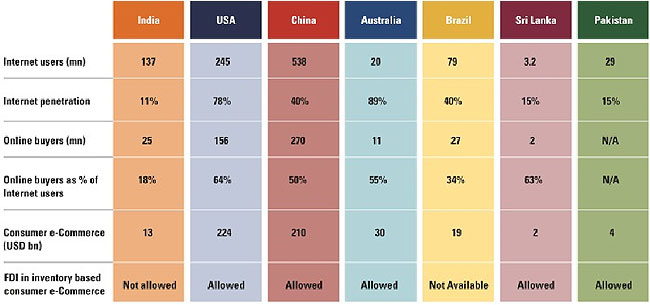
    The report has established a direct co-relation between internet users, online buyers, value of e-commerce and openness to FDI in inventory-based e-commerce. The report found that India was the only one among a list of developed and developing economies that did not allow FDI in inventory based e-commerce.


    The result of this policy may have a direct bearing on a) slowdown in the growth of internet users; b) proportionately low online buyers; and c) shrinking of the e-commerce business.


    In the US, there are 245 million internet users and 156 million online buyers, while China has 538 million internet users with 270 million online buyers. Closer home, Sri Lanka, with 3.2 million internet users, has 2 million online buyers and Australia, which is a similar economy to India, has 20 million internet users with 11 million online buyers. Unfortunately, India, which is the 3rd largest in the world with 137 million internet users, has mere 25 million online buyers. It is evident that internet usage will grow much slower than expected if we do not increase online buyers.


    Further, the report finds that online buyers and the size of consumer e-commerce industry are high in countries where FDI in inventory based e-commerce business is allowed. In the US, the size of the consumer e-commerce industry is US$224 billion, while in China, it is US$210 billion. In Sri Lanka, it is US$2 billion, while the size of the consumer e-commerce industry in Australia is US$30 billion. In India, with 25 million online buyers, the size of the industry is a mere US$13 billion. This co-relation is clear from the chart as collated in the report.


    Salient Features Of e-Commerce in India, USA, China, Australia, Brazil, Sri Lanka and Pakistan

    Source: Internet World Stats (2013); eMarketer (2013); Forrester McKinsey Global Institute (2013); Digital-Commerce, IAMAI-IMRB (2013); e-Commerce Disruption: A Global Theme, Morgan Stanley (2013)


    Dr. Subho Ray

    Commenting on the findings, Dr Subho Ray, President, IAMAI, said “On a larger canvas, we believe that inventory based e-commerce needs deep and sustained investments on technology and other back end operations, marketing and brand building areas where domestic investment is not forthcoming. Opening up of inventory based e-commerce would also take care of the current anomaly where FDI in multi-brand retail is allowed up to 51% whereas it is not allowed on inventory based e-commerce business.”


    The report also makes other important recommendations such as more investments in innovation and customer servicing on part of the industry. According to the report, several issues exist on the demand side, supply side and government and regulatory side that need to be addressed to ensure rapid progress of e-Commerce industry in India. The relevant stakeholders would need to focus on some key solution areas to positively impact the e-Commerce industry and to put it on a transformational growth trajectory. These key solution focus areas have been identified as: a) Developing and building human capital; b) Adopting effective business practices; c) Strengthening the technology backbone; and d) Building a favorable yet controlled regulatory environment.