Tag: IAMAI-IMRB

  • Internet users set to cross 500mn by June 2018: IAMAI-IMRB


    By A Correspondent


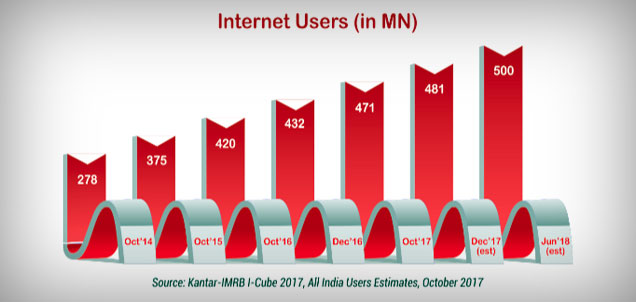
    The number of internet users in India was estimated to be 481 million in December 2017, a growth of 11.34% over December 2016 estimated figures. The number of internet users is expected to reach 500 million by June 2018, according to a report ‘Internet in India 2017’, published jointly by the Internet and Mobile Association of India & Kantar IMRB, today. According to the report, as on December 2017, the overall internet penetration is 35% of total population.


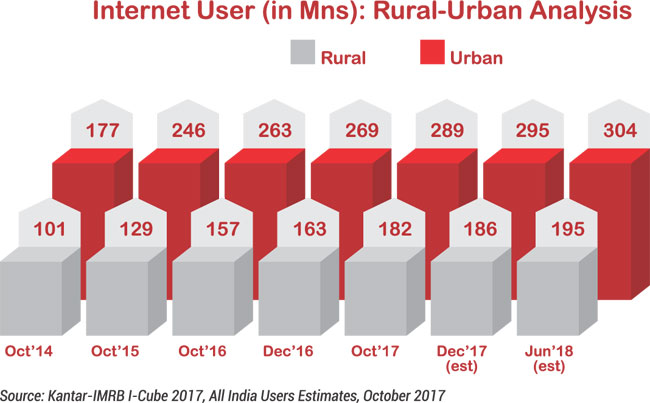
    According to the findings of the report, Urban India witnessed a growth of 9.66% from December 2016 and is presently estimated to have around 295 million internet users as on December 2017. On the other hand, Rural India witnessed a growth of 14.11% from December 2016 and is presently estimated to have around 186 million Internet users as on December 2017.


    Even though the growth rate of Rural India may seem higher, it is mainly due to the low base effect; given overall internet users in Rural India are still critically low. Internet penetration in Urban India was 64.84% in December 2017 as compared to 60.6% last December. In comparison, Rural Internet penetration has grown from 18% last December to 20.26% in December 2017. Given that total Urban Population is much lower than total rural population, the Urban-Rural Digital divide is actually more acute than what the penetration numbers portray.


    The future growth policies therefore must focus on bridging the digital divide that exists between urban and rural India today. In terms of numbers, Urban India with an estimated population of 455 million already has 295 million using the internet. Rural India, with an estimated population of 918 million as per 2011 census, has only 186 million internet users. Thus, there are potential 732 million users still in rural India; if only they can be reached out properly.


    Frequency:

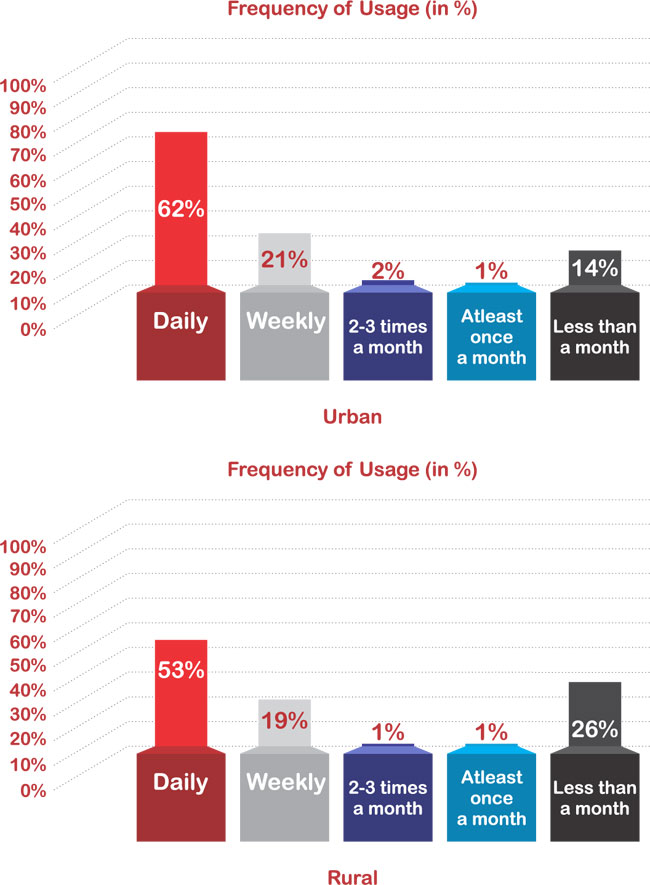
    The report also finds that an estimated 281 Million daily Internet users, out of which 182.9 million or 62% access internet daily in urban area, as compared to only 98 million users or 53%, in rural India. Almost double the proportion of Rural Users access internet less than once a month in rural India as compared to Urban India.


    Gender:

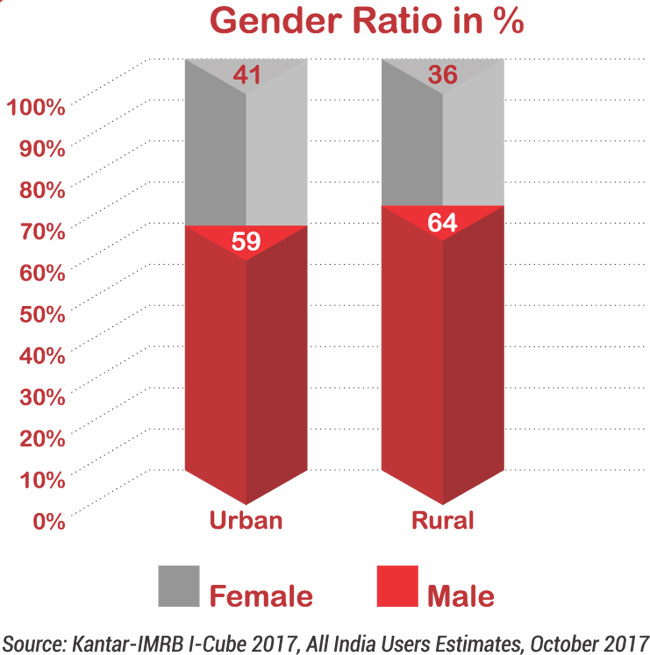
    Internet user market is still a male preserve in India. There are estimated 143 million Female internet users overall, which is approximately 30% of Total Internet users. While “Digital India” is paving its way in rural India, the underlining digital gender gap still persists. Digital literacy is therefore a key to ensure everyone stays informed, engaged and safe online.


    Among the Rural Internet users, the ratio between male to female Internet users is 64:36. The proportion of Internet users by gender in Rural India has seen much change over last year with Internet users among rural females growing steadily. The increasing gender parity in internet usage is a welcome development.


    Demographics:

    In terms of other parameters of demography, according to the report, internet is the preserve for youngsters, with Students and youngsters accounting for around 60% of all internet users in India. The demographic profile and the purpose of usage are interlinked. Popularity of entertainment, social networking etc makes internet more attractive for youngsters presently. Unless digitalisation of important civic and social services as envisioned under e-governance programmes really take-off, the internet will remain to be perceived as a medium of entertainment for youngsters.

    Internet in india_10-1-18.compressed


  • Online ads to touch Rs 9,700 cr by Dec 2017


    By A Correspondent


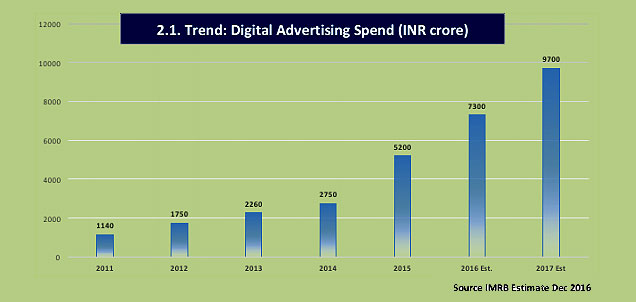
    The digital advertising spend in India was estimated to be around INR 7,300 crore at the end of 2016, growing at a rate of 40% over 2015. The growth in spends on digital advertising is expected to continue at a CAGR of 33% to touch INR 9,700 crore by December 2017. The digital advertising market was pegged at INR 5,200 crore by the end of December 2015. These are the latest findings of the ‘Digital Advertising in India’ report, jointly published by the Internet and Mobile Association of India (IAMAI) and Kantar IMRB Kantar.


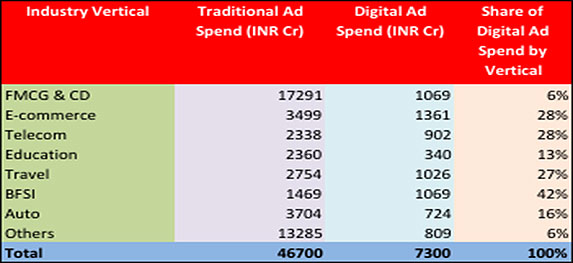
    The report finds that the digital advertising spend is about 14% of the total advertising spends in the country. In terms of volume, E-commerce leads the digital advertising spends with around INR 1,361 crore, followed by FMCG, Consumer Durables and BFSI. However, a comparison of these verticals in terms of share of spends on Traditional vs Digital show that BFSI organisations incurred the highest share on digital advertising spends. 40% of their overall advertising spend was on Digital followed by E-commerce, Telecom and Travel.


    Share: Traditional vs Digital Advertising Spends by Verticals

    Source IMRB Estimate Dec 2016

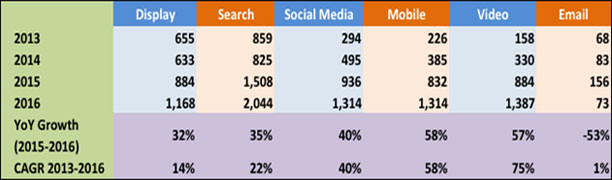
    In 2016, it is estimated that Search ads (close to INR 2,044 crore) constituted 28% of the overall ad spends followed by Video (close to INR 1,387 crore) which contributes to around 19%; Mobile and Social Media (close to INR 1,314 crore) each are at around 18% and Display ads (close to INR 1,168 crore) at 16%. Spends on Video ads have shown a significant increase and accounted for 19% of the overall spends in digital advertising. In all likelihood, this has been driven by new online entertainment (movie, TV series) channel launches, by enhanced monetisation across various platforms and high CPMs on premium content. This category is estimated to witness significant growth till 2020. Spend on mobile advertising (SMS/in-app ads) also recorded high YoY growth of 58% from INR 832 crore in 2015 to around INR 1,313 crore in 2016. Spending on email ads has reduced substantially (-53% YoY) and is now estimated at only INR 73 crore.


    Spend by Ad Avenues & CAGR (INR crore)

    Source IMRB Estimate Dec 2016


  • Digital Commerce to reach Rs 220,330 cr by Dec 2017: IAMAI-IMRB


    By A Correspondent


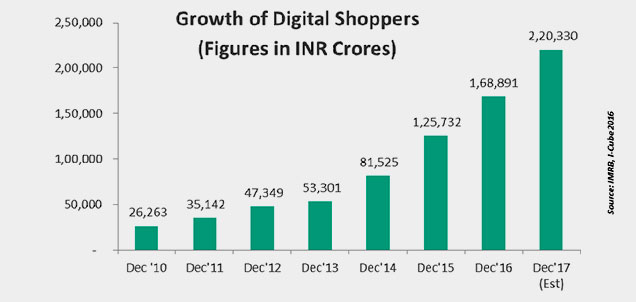
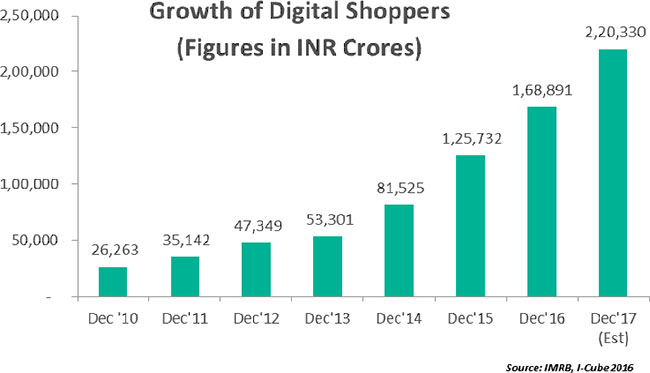
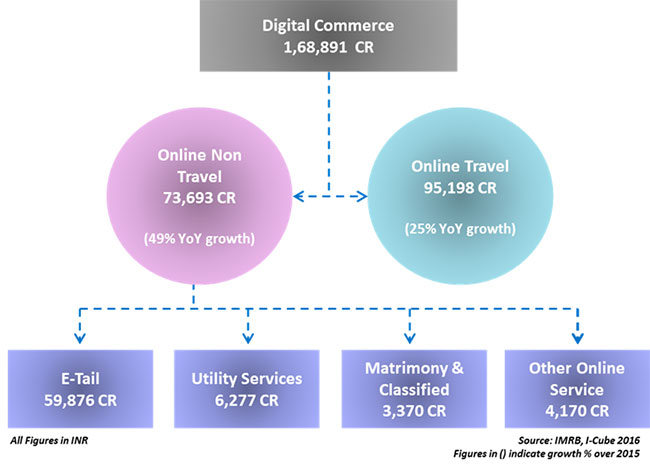
    The Digital Commerce Market has grown at a CAGR of 30 per cent, between December 2011 and December 2016 to reach INR 168,891 crores by the end of December 2016. It is estimated to reach INR 220,330 crores by December 2017, according to the Digital Commerce report 2016, published by the Internet and Mobile Association of India (IAMAI) and IMRB Kantar.


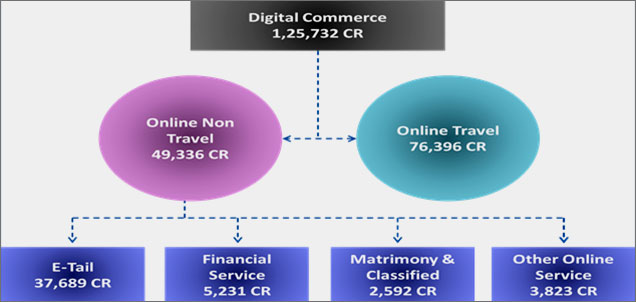
    The report finds that Online Travel industry continues to grow strongly with 56 per cent share while share of online non-travel has improved over the previous year to reach 44 per cent.


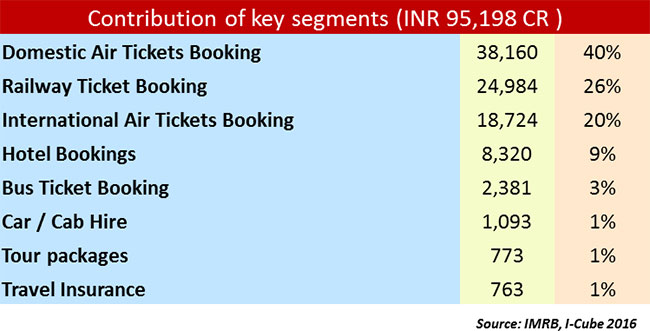
    Domestic air ticket and railways booking continue to be among top contributors to the Online Travel spends. These were the segments that were the top contributors in previous year also. Hotel Booking has seen a substantial growth of 60 per cent, from INR 5200 crore in December 2015 to INR 8320 crore in December 2016. Domestic Air Tickets Booking is the highest contributor in this segment and has grown 20 per cent from INR 31,619 crore to INR 38,160 crore in 2016. The online travel market is expected to reach close to INR 1, 18,598 crore by December 2017. The segment was valued at INR 95,198 crores in December 2016.


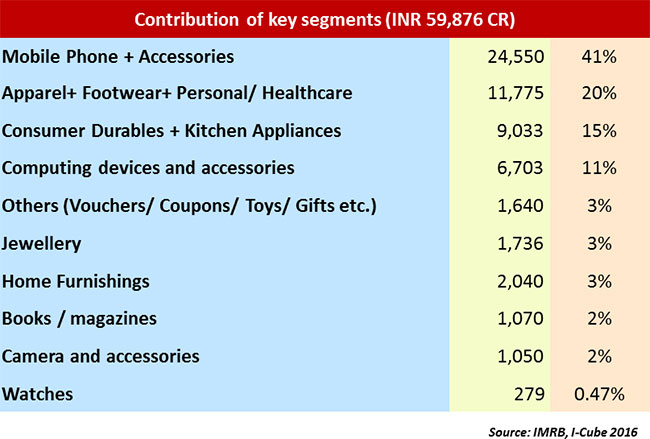
    The report also finds that E-Tailing maintained a strong performance with 59 per cent growth. In the E-Tail category, Mobile Phone and Mobile Accessories continue to be the top contributor to the overall pie. Another product category that has registered sharp growth is apparel, personal health care products and accessories. These two categories collectively account for 60 per cent of the overall spend in E- Tail segment. The E- Tail segment is expected to reach around INR 94,964 crores by December 2017. It was pegged at INR 59,876 crores in December 2016.


    The report also finds that Online utility services market (eg: payment for DTH/ Telephone Bills/ Electricity Bills etc) registered close to 20% growth between 2015 and 2016. The market reached close to INR 6277 crores in terms of overall online transactions as on December 16.  The segment is expected to reach INR 7,532 crore by December 2017.

    Other online service market that includes online bookings done for entertainment, online grocery and online food delivery, was pegged at INR 3823 crores in December 2015. In December 2016 the market reached close to INR 4,170 crores. Online food delivery is the top contributor within this segment with a market value of INR 2,040 crores. This growth is expected to continue in future and the market is expected to reach INR 4,587 crores by December 2017.


  • E-commerce to touch Rs 2.1 trillion by Dec 2016: IAMAI-IMRB


    By A Correspondent


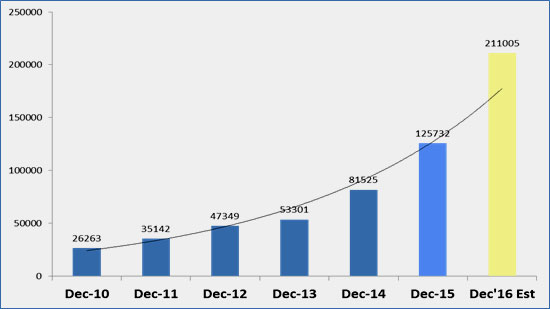
    The Digital Commerce Market has grown at a CAGR of 30%, between December 2011 and December 2015 and was valued at Rs 125,732 crores by the end of December 2015. It is estimated to reach Rs 211,005 crores by December 2016, according to the Digital Commerce Report 2015, published by the Internet and Mobile Association of India (IAMAI) and IMRB today.


    The report finds that Online travel industry continues to grow strongly with 61% share while share of online non-travel has improved over the previous year to reach 39%. In December 2015 share of e-Tail was 29%. Mobile Phone and Accessories, PCs and Apparel and Footwear continue to be the dominant categories that are selling within the e-tail segment. According to Nilotpal Chakravarti, AVP -IAMAI, “The growth trajectory of digital commerce signifies the coming of age of online transactions in India. No longer Indians are wary of transacting online. Another notable facet of the report is the substantial growth in non travel online transactions.”


    Domestic air ticket and railways booking continue to be among top contributors to the Online Travel spends.  These were the segments that were the top contributors in previous year also. Hotel Booking has seen a substantial movement in Y-o-Y growth at 165%, from Rs 1965 crores in December 2014 to Rs 5200 crores in December 2015. Spend on online railway ticket booking has also grown at around 34%, from Rs 16200 crores in 2014 to Rs 21708 crores in 2015. Online travel is expected to grow at a CAGR of around 40% to reach Rs 122815 crores by end of 2016.


    The report also finds that E-Tailing maintained a strong performance with a 57% Y-o-Y growth. Among E-Tail categories, Mobile Phone and Mobile Accessories continue to be the top contributor to the overall pie. Given that there is an increased demand for Smartphones in India, this could be a contributing factor. Computer and consumer electronics, as well as apparel and accessories, account for the bulk of India retail ecommerce spends contributing close to 49% collectively to overall spend in E-Tail segment. Apparel and Footwear sale has almost doubled as compared to the previous year, recording a 52% Y-o-Y growth from Rs 4699 crores in December 2014 to Rs 7142 crores in December 2015. This segment is expected to gain further momentum and reach Rs 72639 crores by end of 2016.


    Component share of E Tail (Rs 37,689 CR)

    Mobile Phones + Mobile Accessories

    14,109

    37%

    Apparels + Footwear + Personal / Healthcare Accessories

    7,142

    19%

    Consumer Durables + Kitchen Appliances

    6,452

    17%

    Laptops / Net books / Tablets / Desktops

    4,726

    13%

    Home Furnishings

    1,468

    4%

    Jewellery 

    1,120

    3%

    Other Products (Vouchers / Coupons, Toys, Gifts, Flowers, Handicrafts, Stationary etc.)

    994

    3%

    Books

    875

    2%

    Cameras + Camera Accessories

    803

    2%


    According to the report, Financial services market grew at a CAGR of around 17% between 2012 and 2015. The market reached close to Rs 5231 crores in terms of transactions as of Dec’15.  The demand for online utility payment is expected to reach Rs 6068 crores by Dec’2016.


    Other online service market that includes booking movie tickets and tickets for other events, online commuting or cab hire, online grocery and food deliver, was Rs 3823 crores in Dec’2015. In December 2014 the market was around Rs 2025 crores. In future online grocery and online food delivery are expected to emerge as big ticket items. Demand for other online service is expected to grow at a CAGR of 36% to reach Rs 5207 crores by December 2016.


  • Online railway ticket booking witnesses a spurt

    By A Correspondent


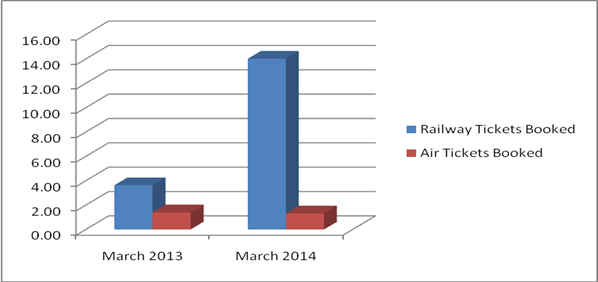
    According to the latest Internet Economy Watch, published jointly by the Internet and Mobile Association of India (IAMAI) and IMRB, the online booking of railway tickets increased from 3.63 million in March 2013 to 14.02 million in March 2014 registering a y-o-y growth of 286 per cent. While online booking of railway tickets grew phenomenally, the air tickets booked online in March 2014 were 1.31 million as compared to 1.40 million in corresponding month last year.


    Source: IAMAI/ WAM Data March 2013-14


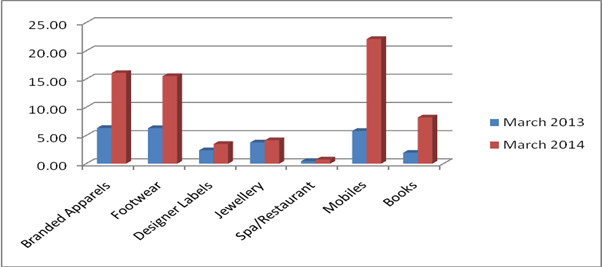
    The monthly tracker also finds a y-o-y growth of 154 per cent in online user visits to branded apparel category. While branded apparels witnessed 16.08 million online user visits in March 2014 as compared to 6.34 million user visits in March 2013, the footwear segment registered 15.51 million online user hits in March 2014 as compared to 6.30 million user hits in March 2013.


    Source: IAMAI/ WAM Data March 2013-14


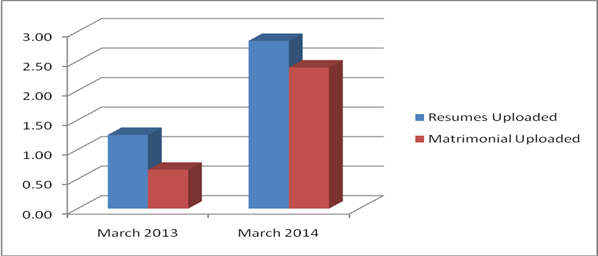
    According to the data captured from major matrimonial sites in the monthly tracker, the number of profile uploads in March 2014 were 2.39 million as compared to 0.66 million in the corresponding month last year. The number of resume uploads increased to 2.84 million in March 2014 from 1.25 million in March 2013.


    Source: IAMAI/ WAM Data March 2013-14


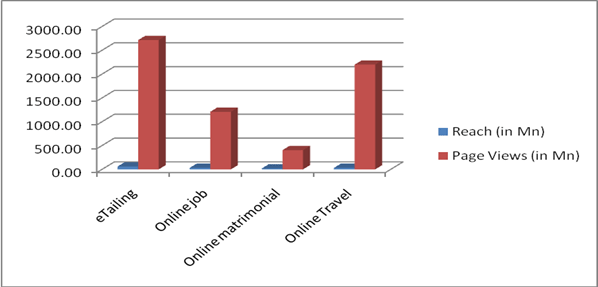
    The monthly tracker further indicates 59.48 million people accessed various e-tailing sites. There were 2714.28 million page views in the category. The user reach for job and matrimonial websites is 31.18 million and 19.86 million respectively with 1209.48 million and 403.20 million respective page views. Online travel segment has reach with 32.13 million reach and 2198.801 million page views.


    Source: IAMAI/ WAM Data March 2013-14


    Sourced from all India active internet data, the monthly internet tracker is based on WAM data captured from various relevant sites, and encapsulates online usage for e-tailing, online travel and vertical classifieds.


  • Mobile adspends grow 10% of total online spends in 2013: IAMAI-IMRB

    By Our Research Associate


    With Over 930 million mobile users in India and the figure increasing by 8.35 million every month, there is a huge opportunity for small and big brands to explore mobile for marketing their products and connect to consumer in a more efficient way, notes the Internet and Mobile Association of India [IAMAI]. The ability to leverage mobile to target and reach out to the right audiences in the best possible manner is what will make the difference and determine the success or failure and the future seems to be inclined towards mobile marketing, IAMAI adds.


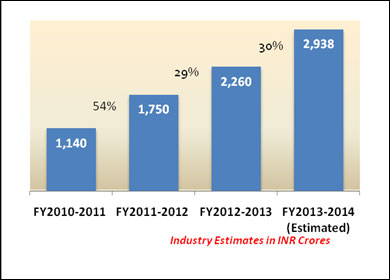
    The online advertising market in India is projected to reach Rs 2,938 crore by March 2014, according to the findings of ‘Digital Advertising in India’ report, jointly published by the Internet and Mobile Association of India (IAMAI) and IMRB International. It is to be noted that during 2012-2013, online adspend amounted to Rs 2,260 crore and advertisements on mobile phones and tablets grew from a 7% share in FY 2011-2012 to 10% of the Indian online ad market in FY 2012-2013, totaling to spends of around Rs 230 rore.


    Figure 1: Indian Digital Advertising Market Growth

    Source: IAMAI & IMRB International


  • Mobile device usage rises 173%: IAMAI

    By A Correspondent


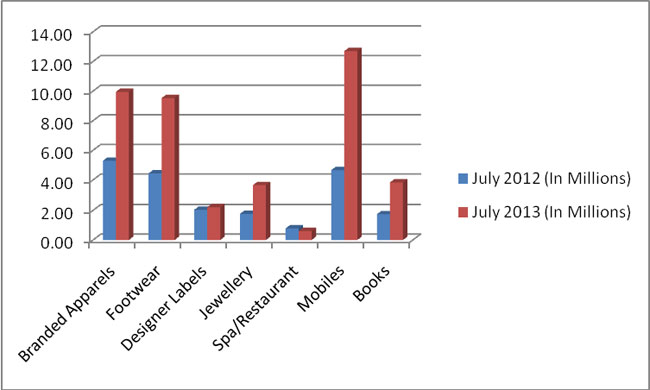
    The surge in interest of mobile devices and smart phones can be gauged from the latest Internet Economy Watch, published jointly by the Internet and Mobile Association of India (IAMAI) and IMRB. The segment has witnessed 173% y-o-y growth in July 2013 with 12.70 million hits in July 2013 as compared to 4.66 million hits in the corresponding month last year.


    The branded apparel segment witnessed 9.95 million hits in July 2013 as compared to 5.29 million hits in July 2012, a y-o-y increase of 88%. The online user visits to designer footwear segment increased from 2.04 million hits in July 2012 to 2.21 million hits in July 2013. A significant increase y-o-y growth of 107% for jewellery segment has been registered with 3.65 million hits in July 2013 as compared to 1.76 million hits in July 2012.


    Source: IAMAI/ WAM Data July 2013


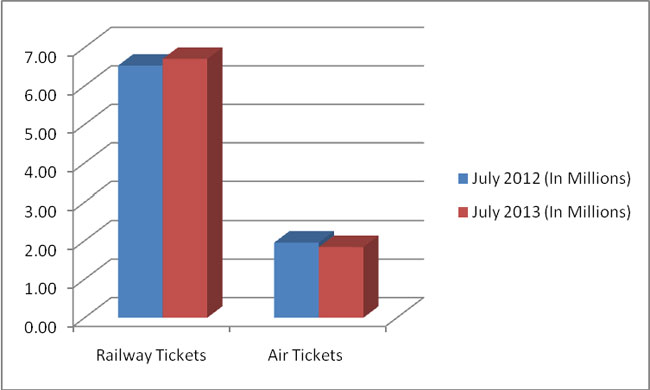
    As per the data for July, while the online booking of air tickets decreased from 1.95 million hits in July 2012 to 1.84 million in July 2013, there has been a marginal increase in online booking of railway tickets from 6.53 million in July 2012 to 6.70 million in July 2013.


    Source: IAMAI/ WAM Data July 2013


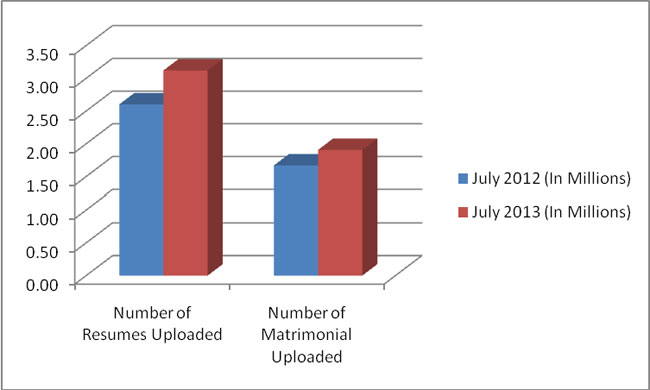
    The number of resume uploads in July 2013 were 3.12 million as compared to 2.60 million in corresponding month last year. The profile uploads on matrimonial websites was 1.91 million in July 2013 as compared to 1.67 million in July 2012, a y-o-y growth of 14%.


    Source: IAMAI/ WAM Data July 2013


    Sourced from all India active internet data, the monthly internet tracker is based on WAM data captured from various relevant sites, and encapsulates online usage for E-tailing, Online Travel and Vertical Classifieds.


  • Mobile VAS Market To Reach Rs 29,300 cr by end-2013

    By A Correspondent


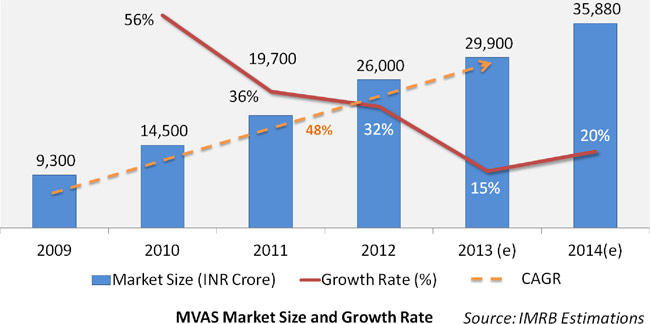
    The Mobile Value Added Service (MVAS) market is expected to reach Rs 29,300 crore by the end of 2013, from Rs 26,000 crore in 2012, registering a Y-o-Y growth of 15 percent, according to the latest IAMAI-IMRB report on MVAS in India, released on Tuesday (Aug 20). The impressive growth rate can be attributed to the rising adoption of mobile internet in India, notes an IAMAI communiqué.


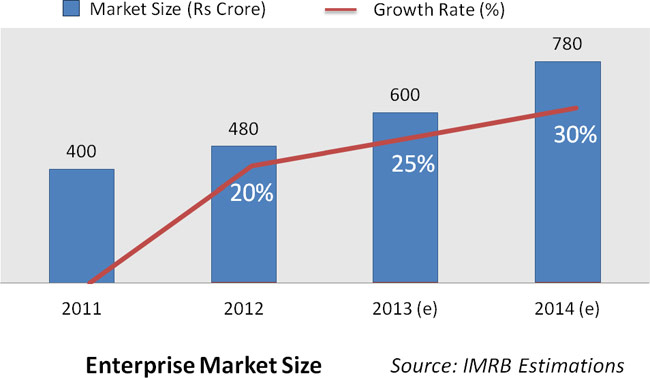
    According to the report, MVAS for the enterprise market is estimated to grow by 25 percent to reach Rs 600 crore by the end of FY2013. Further, the report finds that the enterprise market is expected to grow by 30 percent in FY 2014 to reach Rs 780 crore.


    According to the report, falling prices of handset, device capabilities and cheaper data accessibility are the primary drivers for the growth of enterprise MVAS market.


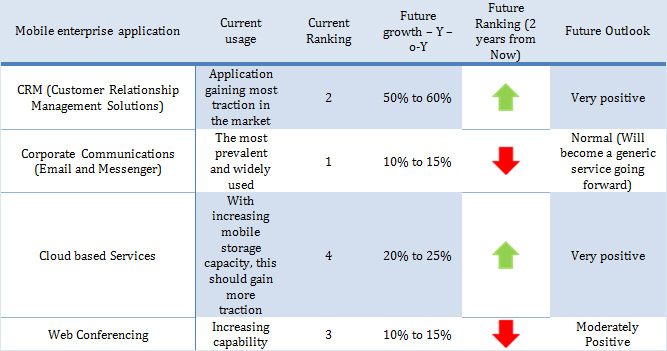
    The major categories of the MVAS services in the Enterprise segment are CRM (Customer Relationship Management Solutions); Corporate Communications; Cloud based Services and Web Conferencing.


    The report further finds that a Special Category: BYOD (Bring your own Device) has emerged in the market in recent times. It is estimated that there will be an Rs 100-INR 150 per device per month opportunity for an enterprise that is moving towards BYOD. However, this solution will bring in the required synergies only when the scale of the enterprise is more than 1000 employees.


  • MxM Mondays: Why do marketers not spend enough on digital media?


    By Ananya Saha and Robin Thomas


    According to the latest IAMAI-IMRB report on Digital Advertising, as of March 2012, the total advertising spends, including classifieds, was valued at Rs2,850 crore. It is expected that by FY2013 the digital advertisement spends will be Rs4,391 crore.


    Search advertising constitutes about 20 per cent of the total online advertising spend or about Rs570 crore. Display advertisement, which has many components, forms a sizeable portion of advertising spends. Advertisements on portals and vortals form 13 per cent of the overall pie (Rs369 Crores). Advertisements on Social Media, Email and Videos over the Internet form 3 per cent (Rs94 Crores), 5 per cent (Rs144 Crores) and 2 per cent (Rs59 Crores) respectively. Mobile ads form nearly 4 per cent (Rs90 Crores). A major proportion – around 53 per cent of the overall digital advertising spends – are classifieds listings (Rs1,496 Crores).


    These numbers seem impressive, but there has been some concern that marketers are not spending enough on Digital Media. The theme for this week’s MxM Mondays is ‘Why do marketers still not spend enough on digital?’ While marketing spends may be shifting to the digital media globally, in India, television and print still rule. Is it because digital still doesn’t reach the masses, and homemakers, in particular? Or is that the bucks (hence commissions) are still big in TVCs? MxM spoke to some players in the industry to find out:

     

    Ambika Sharma

    Ambika Sharma, MD and CEO, Pulp Strategy

    The shift to digital media is not happening as fast as the industry would like it to be. However, we are witnessing an increase in aptitude and attitude with regards to usage of digital media. Marketers are not using the media aggressively as they prefer to wait-and-watch. Even then, they are aggressive on ‘search marketing’, but not other aspects of digital media.


    There is hardly any youth brand which is currently not on digital platform. Education is one prominent category that has been using digital media. The cents for digital, however, remain restricted. But as the impact of digital media grows, the impact of mobile advertising has seen a decrease as most people now do not prefer to click on banner ads on mobile screens. Some studies show that in the past one-and-a-half-year, the user has been ignoring banner ads.


    The digital spends depend on ROI, search and impressions, which needs robust backend engine. E-commerce websites have been the heavy users of digital advertising to create impressions. But there is little or no response mechanism on impressions and the visibility is highly fragmented. The numbers, like there is TAM for television, are not available for digital media. If a marketer advertisers on three digital platforms, every platform gives their own numbers. So, there is no comprehensive measurable strategy.


    Going forward, digital media will grow, but it will be a long while before it catches up with other media vehicles. Lotof factors such as measurability, reach, people not preferring to buy online are affecting the growth.

     

    Gyan Gupta

    Gyan Gupta, CEO, I Media Corp Limited (IMCL), Dainik Bhaskar

    In the US, the online spend is 29 per cent of the total advertising pie; in UK, it is 26 per cent. Now if you see the figures in India, it is not even 5 per cent. The trend shows that there will be 50 per cent increase.


    But I will not say that marketers in India are spending enough yet. The typical spender (who spends on television) is yet not on-board. Till the main spenders come on-board, the growth will be limited. FMCG’s have a deep share of the pocket, and it is necessary that they spend on digital media. Auto companies, e-commerce companies, financial companies have been heavy spenders on this medium.


    What are the marketers spending on, and how they spend also becomes important. What needs to be analysed is if the cost of acquisition is happening, if the leads are getting generated, how much a brand is spending on digital activation vis-a-vis on brand promotion. Trending is happening. This year will actually showcase the brands spending on digital media.

     

    Harneet Singh Rajpal

    Harneet Singh Rajpal, Vice President-Marketing, Domino’s Pizza India

    The use of digital media is picking up in India. For any marketer present in India, the digital media is beginning to become a part of their media plan. It is on radar for everyone, especially in the categories where youth is the target.


    For Domino’s, digital media has been important ever since we began our online ordering platform. Currently, it helps us drive traction. Hence, our media spends for digital medium have increased over the last two years. For us the return-on-investment is visible for every buck we spend on this media, since it results from direct conversion from inventory to revenue generation.


    We now spend close to 4-5 per cent of our total advertising budget on digital marketing, from almost nothing in the last two years. We work with leading publishers in the domain to create applications for Google search, Facebook and social media. I must say that on Facebook, we have the largest number of fans in the food category, and also followers on Twitter.


    Social Media management needs time and investment. It is important that the brand keeps the target in mind when planning the digital activations. Going forward, marketers will have to evaluate the prospects digital media brings. Of course, that depends on category to category. Digital media is still limited because of its reach, whereas traditional media garners higher reach. Also, the confidence about using the media is not too high among the marketers since there are no hard numbers to prove its success. The penetration of internet and the efficacy of the media will be tested over time.


    Jonathan Bill, Senior Vice President and Business Development, Vodafone India

    Digital Advertising is a growing medium in India. It will be everything we are hoping it to be and that too quicker than we think, so I think the business is starting to get in a healthy shape. The advertisers are starting to embrace digital more openly and they should do so, because India has the third largest internet population on the planet.


    On TV and Print bagging bigger ad share, I think that is a legacy issue among advertisers, but I do get a sense that it is fast changing. In the West, however, TV and Print advertising have declined in favour of online advertising. Print, therefore, has very less revenue share from advertisers as compared to online advertising and now online is beginning to even threaten television as a medium.


    I think we just need to continue on the path we are going. The quality of sales and, to a certain extent, the market needs to be made. The West took nearly two or three years to be made as far as the start of digital advertising market is concerned and in India we are only about a year ready. So, I am very bullish on digital advertising in India, particularly on mobile on three to five years timeline.


    Narayanan SP

    Narayanan SP, Senior Vice President, and Head VAS Mobile Commerce and Long Distance, Idea Cellular

    Compared to the global benchmark, certainly advertisers in India are not spending as much money on digital or mobile, but this is something which will change over a period of time. Marketers are experimenting to see if it makes sense for them to connect digitally for certain set of products/features and whether digital is the right medium to communicate or engage their brands. Thus, lot of experiments are happening.


    On the internet front, we are already seeing a significant traction which may not be as big as the international market because of the low internet penetration in India. So if you are looking at a certain type of product wherein the target audience are already digitally connected, then it makes immense sense to go digital. Digital, I believe, will evolve as more and more customer profiling is done and advertisers are able to target their customers precisely. When advertisers are able to measure the ROI (Return on Investment), then we definitely believe that a lot more investment will come into digital.


    The fact that TV and Print still bag more advertising share will definitely change over a period of time in terms of mobile being one of the vibrant channels. This does not mean print and television advertising disappear but, you will see an increase in spends on digital advertising and mobile advertising in particular over a period of time. This is because mobile is able to give the advertiser not only a more precise profile of the customer which makes it a lot easier for the advertiser to reach out to its consumers effectively, but it also allows the advertiser to interact with customers and measure the results of their campaigns effectively.


    Mobile industry, for instance, has a wealth of data in terms of customer usage, but there has not been much mining of the data which can be heavily leveraged by the advertisers. However over a period of time, you will see a lot more advertisers leveraging this data.

     

    Rakesh Rao

    Rakesh Rao, National Sales Head, Zapak Digital Entertainment

    The digital media has been growing exponentially. The year-on-year growth of this media vehicle is close to Rs2,800 crore, and is supposed to reach close to Rs4,000 crore in a year. So to say that it is not a preferred media would not be the right statement. Of course, it is not a dramatic growth, but given the growth of internet and smart phones, digital media is becoming a part of our daily life. The marketers are also following the trend.


    The ROI, when compared to TV and radio, is much more measurable. Cost per lead and cost per click measure actual conversions. This is the only interactive platform too, while rest of the media only give reach.


    Education, travel, finance are becoming the biggest spenders on digital because of conversion aspect. E-commerce, and categories like travel that look at selling inventory believe in digital media.


    The challenges that this media is encountering is getting TV-centric brands such as FMCG onboard because of reach. It is a given that while TV is cost-effective when it comes to reach, digital media will catch up in some years. About 60 per cent of these brands are on digital, but 40 per cent need coaxing. There is no hindrance apart from the fact that broadband numbers need to grow. Digital media is here to stay and grow.

     

    Sandip Tarkas

    Sandip Tarkas, President (Customer Strategy) and CEO, Future Media and T24

    As far as Future Media is concerned, our advertising spends on digital have been increasing year-on-year. Despite a lot of digital activities done by marketers specifically on social media, it does not reflect in spends. The problem with digital is not a lack of a credible or universal measurement system, but the fact that it is too measurable as people try to measure every little thing. Although there are so many metrics which evaluate the digital medium, I don’t think it is a lack of measurability at all, as in digital we are clearly able to measure our CPM’s (Cost per Thousands) and so on. Digital is something we use for more engagement rather than reach because it does not offer reach.


    We look at advertising based on two things – reach and cost efficiency. And then you look at everything else – whether the medium is interactive and so on. So, it is primarily about reach and cost efficiency. Digital media spend in India is a reflective of India’s internet penetration, whereas in a lot of markets digital penetration is very high. In those markets both print and television advertising have declined and digital advertising has been growing.


    In India too, digital is growing much faster than the traditional media, and the growth of the media certainly shows the growing importance of digital. The current size of the digital advertising pie is reflective of the kind of inroads it has made in the country.


    On digital being a 360-degree medium in itself and the role of online video and social media advertising, the biggest gain happening in digital at present is the fact that it is changing quite rapidly. Since the late 90s when we first started using digital advertising until now, the role of the medium has changed quite drastically.


    Digital today not only offers more opportunities for engaging the consumers, but the vehicles used in digital have also been changing with time. For instance, in the early days television ads would continue for quite a lot of time, but today with more options, even the television channels have begun to announce that the programme will be back in say a minute or two. So as consumers have more choices, the way the medium gets utilized also changes. Digital, I believe, be it in any form – video, social, mobile – if it is not going to be interactive, it will not be very successful.


    For anybody targeting the youth, digital is an inescapable medium. I believe the biggest change in digital advertising will take place through mobile, particularly mobile VAS and the data cost. Growth spurt in digital advertising will also come through the increase in smart phone usage and the lowering of data cost will revolutionize digital advertising.


    This is because India has a very high tele-density and today mobile phones have reached the lower-most strata. I believe digital advertising in India will explode once mobile advertising comes of age but, right now it is still in its infancy.


    Eventually digital advertising will impact television and print ads as marketers will have to allocate their budgets for digital advertising, once it comes of age. It may probably hit print advertising first and then television but for that to happen there is still some time.

     

    Sanjay Tripathi

    Sanjay Tripathy, Executive Vice President – Head Marketing and Direct Channels at HDFC Life

    There is still limited spend on digital due to lack of knowledge about the medium and utilizing it effectively as a part of marketing plan; reach/penetration of the medium; and its ability to create impact in the short term. Digital still reaches about 10 per cent of the Indian population and there hasn’t been much of a development in building infrastructure to support the growth of internet. TV continues to be the mass medium which gets the maximum eyeballs and reach.


    While the ROI variables will drive spends to digital, marketing needs a serious mind shift to look at the additional advantages which digital brings along –  a medium which allows two-way dialogue  and measurability to the last mile.


    Thirty per cent of our budgets are dedicated to digital this year – a big move from the fact that we spent a negligible amount last year. As BFSI marketing and advertising becomes more ROI focused, digital media will play an important role. Digital budgets will have a healthy growth each year and will also account for a significant part of the marketing budget.


    While marketing spends may be shifting to the digital media globally, in India, television and print still rule. This is because reach plays an important role. Penetration of Internet in India is still low compared to international markets. The consumption of non-traditional online media is still low and 360 degree integrated communication planning in India has not evolved to have online as an integral part of marketing plans. Also, online medium do not works in sync with other media.


    While there has been a tremendous amount of growth in the usage of internet among SEC A, SEC B audience, internet is yet to gain as big an audience in tier 2 or tier 3 cities. TV continues to be the mass medium due to lack of digital infrastructure. It is the reach and channel affinity which mainly drives the spending and this is where a traditional channel like TV gets one up over digital. There is also a problem of lack of content on digital. Either the content has not been customized to cater to the audience or often the language becomes a hindrance in consuming the content.


    But digital media will make a huge impact. Level of engagement, interactivity and ROI afforded by the medium means it has big role to play. For brands which don’t engage their users online will tend to lose their relevance. As reach increases, the importance and level of competition will also increase –  YouTube already affords a higher reach compared to most of the TV channels and is increasingly becoming an important part of the traditional media mix.


    Digital offers tremendous potential for business – whether it’s about spreading awareness or generating business even in the face of a slowdown. In fact, as people tighten up their purse strings, they will want to do more research before they arrive at a purchase making decision and internet remains the primary medium of product research.


    I see the spends going up because the whole media pie has been asymmetric- if you look at the reach-frequency formula and compare it to TV, print, radio and then digital. There are more people spending time on digital in comparison to other traditional media touchpoints. I see the digital percentage increasing in the overall pie.


    Youtube and pre-roll videos have become a mainstay when it comes to hosting TVCs on digital and these unique ad formats are as effective in reaching out to audience as a TVC. For print QR codes help bridge the gap between offline and online world.

     

    Saugata Bagchi

    Saugata Bagchi, Senior VP, Tribal DDB India

    The primary challenge is the need of cracking an ROI metric, which is acceptable by advertisers across the board.  The media spends are happening, but is it delivering enough clickthrough rate goes unanswered. Digital media cannot ensure high reach like television, but with 12 per cent penetration among various categories it can definitely give high frequency. Currently, only 25-30 per cent of population is online; hence, the spending on this medium will remain lower than other mediums.


    The point of advantage is that there is a big influx of youth, and they are ready to spend. While the marketers would want to catch the youth online, they (marketers) get no justification in form of numbers to spend much on media. Hence, they prefer doing mall activation to spending on digital platform. The agency and publishing community need to be more forthcoming to speak to the marketers, and in their language.


    Digital media is currently registering 15-18 per cent year-on-year growth, but it is important to note the gap between digital and television media.


    Since the offices of MxMIndia are closed on Monday, August 20, there will be no MxM Mondays next week. We will announce the theme for the next edition on Tuesday, August 21.


  • Slow and not-yet-steady…


    By Robin Thomas


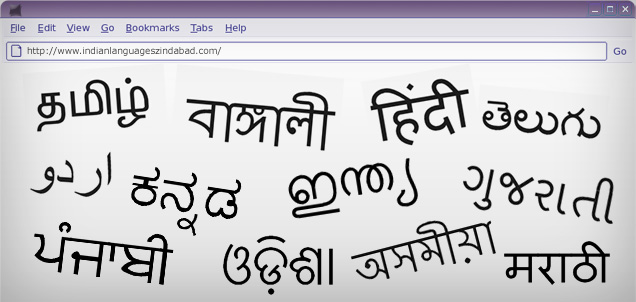
    India is a country where majority of the people don’t speak English and its media – print, television and radio, specifically – have a larger share of local language content. But the same cannot be said about the internet, at least now. The internet in India is still, by and large, dominated by the English language content. According to the ‘Internet World Stats’ 2010 report, after English, Chinese is the second widely used language on the internet followed by Spanish, Japanese, Portuguese and German. These results, perhaps, assure India that there is immense scope for Indian language content to not only flourish, but also increase user interactivity.


    Take for instance, i-Cube report 2011 by IAMAI-IMRB which states by December 2011, there were 121 million claimed Internet users. There are 90 million (70 mn in urban cities and 20 mn in rural villages) users that use Internet at least once a month (active Internet users). Of the active Internet users in urban cities, 26.3 million access Internet through their mobile phones. This has been the most recent change in the access behaviour and it is expected that this trend will continue to grow in the immediate future.


    BG Mahesh

    Mr BG Mahesh, Founder and MD, Oneindia.in observed: “Whatever is happening in print and TV will happen on the Internet. The language pie is far bigger than English in print and TV. English will also grow, but the language pie will be very large.”


    Even as the internet consumption rapidly grows, the Indian language content has also been evolving over the years. According to industry estimates, the search volume in Indian languages is less than 2 per cent of the total search that takes place online. The online growth of Indian language consumption is mainly said to be because of video consumptions.


    Hemant Jain

    Mr Hemant Jain, Senior Vice President, Hungama Mobile pointed out the need for relevant language content and the need for increasing access of language content to the consumers. “I believe that not only there is a need of content in local languages, but more importantly the content should have local context for it to be more relevant for the consumer. The challenge in increasing access to content in Indian language includes the standardization of fonts and internationalized domain names, an issue the Indian government is already working on. The two biggest challenges I foresee are bandwidth infrastructure to deliver ease of access and local language to drive mass adoption.”


    With online video touted as the next big thing for content consumption in Indian languages, there has been an increase in the Indian language video content found online, which may be due to the fact that video has more takers than written content.


    Some steps are said to be taken to increase local language content for instance, Raftaar, a Hindi language search engine developed by Delhi-based research firm Indicus Analytics, debuted earlier this year. Local language newspapers have gone online: webduniya.com offers content in Hindi, Tamil, Telugu and Malayalam. Malayala Manorama is another local language paper offering news online in Malayalam language.


    “There was a time when we saw 85 per cent of our traffic was from NRIs. Post 2007, we saw the page views increasing from India, now we get over 60 per cent of our traffic from India. The broadband penetration, mainly due to BSNL, has helped the growth of internet in non-urban India. Also, most schools have internet in their curriculum. So children lead the usage of internet at homes and other members have felt they might as well use the internet” added Mr Mahesh of Oneindia.


    As far as search in Indian languages is concerned, there have been efforts to localize the content. Google, for instance, in search has ‘transliteration’ which allows users to type Indian languages using Latin text. Google also has search options in the Indian languages and is said to be working proactively with the government as well as content companies in India to come out with a solution that would increase Indian language consumption on larger scale.


    Lalitesh Katragadda

    Mr Lalitesh Katragadda, Head of Products, India-Google, pointed out the need to solve the language consumption problem in order to increase the number of internet users. “We are going to rapidly run out of users if we don’t solve the language problem, which is making the internet work for Indic users. The challenge is that the Internet for the next 3 billion users will not be built by websites alone, or by monetary interests, which has driven the Internet for the first billion and a half. The Internet for the next 3 billion users will, by force, have to be built by the users themselves. For example, AdSense allowed a way for people to monetize their content, which got the content ecosystem to flourish and so on.”


    Mr Arpan Chatterjee, experienced online media professional and consultant with webdunia.com stated: “Lotof work is happening on this front, with Indian language search engines and Google having Search in major Indian languages. Major social networking sites are also now getting into Indian languages. But the availability of quality Indian language online content is still limited, except for some news portal of large Hindi or regional newspapers.”


    Arpan Chatterjee

    Also monetization of language content is a challenge today as there is not enough language content, and as a result, there is little or no language consumption online. There is a need to drive up language content in the online space. According to Mr Mahesh, not only is the government support crucial for this development, but the publishers too must take steps to help increase language consumption. “One needs a lot of patience and sustaining power to do well in the Indian language space. There are many opportunities in this space – ecommerce will be a reality in the language space in the coming years. With mobile internet becoming big one can think of providing various language services for the massive mobile user base in India,” he added.


    Nevertheless the growth of consumption of Indian language content may take some time as the broadband penetration in India is still very low. Another avenue, as pointed out by Mr Mahesh is, to look at is the mobile, as it is believed that the next phase of the internet explosion will come from mobile. Mobile, which is one of the highest penetrated devices in the country today, is expected to not only expand the internet usage, but also bring in more user participation which may result in the development of more Indian language content.


    Mr Chatterjee is of the view: “With more than 70 per cent penetration in mobile phone connections in India , and internet on mobile touching close to 100 million users, with more than 40 per cent being only mobile web users – only accessing the web through mobile. Mobile is the medium which can drive Indian language usage to a new level. Even in countries like Bangladesh, mobile payment solutions have helped get into interiors of the country.”


    With multiple devices now opening up opportunities – smart phones, tablets, and so on which are likely to spur language consumption online and mobile, government support is again is equally crucial, believe industry players. Access to mobile internet must be made at affordable rates especially with the arrival of 3G. “Mobile internet browsing is pathetically slow in India. 3G has arrived, but it is not affordable for majority of the users. Affordable, fast mobile internet plans and font support will change the mobile internet scene in India” said Mr Jain.


    Although the Indian language content in the online space has evolved over the years, it is said to be witnessing a slow adoption of its content especially from publishers mainly because of monetizing challenges. Digital players believe that like print, television and radio, Indian language consumption in the online space will also grow faster and soon have bigger share than the English language. One of the main reasons for this to happen is estimated to be because of the expansion of literacy rates and the increasing broadband and mobile penetration. ” India, with a much larger youth population, needs to put more focus on language online content and use mass channels like education portals, government services websites into multi lingual formats to drive language usage,” concluded Mr Chatterjee.


  • Email Marketing: Vast opportunities make it a favourite with brands

    By Robin Thomas


    Easily the most preferred medium for a brand or marketer to get close to his consumer, digital has never seen such a fervent chase being put up by its users. While it was mostly search and display advertisements that advertisers flocked to, much of digital advertising is still unexplored territory. The importance of engaging the youth through social media marketing has only just been realized, while video marketing and mobile advertising are also gaining traction among marketers.


    According to a recent IAMAI-IMRB report on Digital Advertising (as on March 2012), the total advertising spends including classifieds was valued at Rs2,850 crore.  It is expected that by FY2013 the digital advertisement spends will be about Rs4,391 crore.


    The March 2012 report on digital advertising points out that search advertising constitutes about 20 per cent of the total online advertising spend or about Rs570 crore.  The report also states that advertisements on social media, email and video over the Internet constitutes about 3 per cent (Rs94 crore), 5 per cent (Rs144 crore) and 2 per cent (Rs59 crore) respectively. What is noteworthy is that a major proportion, around 53 per cent, of the overall digital advertising spends come from classifieds listing (Rs1,496 crore).


    With such infinite possibilities continuing to emerge on a frequent basis around the medium, one tool that has been a favourite with the marketers in the recent past is email advertising. With just a handful of players that operate in the realm of providing email services, it becomes all the more challenging for owners to come up ideas that catch the attention of the advertisers. The question is whether there is enough being done around the vertical or if companies are missing out on the edge that this medium can possibly offer.


    The IAMAI – IMRB Digital Advertising report already states that email advertising is worth 5 per cent of the overall digital advertising spends. According to industry estimates, email advertising is expected to grow from the current Rs144 crore to Rs250 crore in the next year or two. The role or purpose of email marketing is said to be about delivering the message and inviting consumers into brand engagement. Further, with mobile internet being touted to take internet inIndiato new heights, email marketing is expected to also thrive in the long run.


    Mr Prasanth Mohanachandran, Co founder, AgencyDigi stated: “email marketing is very relevant and important today, it is cost-effective and reaches to wide range of audience. While it is already witnessing growth, mobile will only further grow email marketing as nearly 27 per cent of mails received by consumers are on handheld devices. The challenge, however, is to find newer ways to reach out to the consumers’ inbox and not their spam. Segmentation in email marketing will also help brands reach their relevant consumers.”


    Mr Gaurav Nabh, Business Head, Quasar was of the view that since email is the most used platform for internet users in India, it is absolutely important and critical for any brand as a medium for reaching out to its consumer. “It is a communication medium, much like print, radio or TV. What you do with this platform and how you are able to maximize its effectiveness depends on the idea and approach,” he said.


    What is noteworthy about email marketing is that it acts as a reach building medium by allowing brands to segment the audience as per their demographics and profile, and thus directly targeting them. While email marketing may be a cost-effective medium enabling larger reach, the challenges that accompany it are also large. Most email advertisements tend to be unsolicited mails and thus enter the spam mail. Lack of creative email advertisements could be another challenge for this business and hence it must not only get more creative but, also innovative in terms of rich media and interactivity and so on.


    “A lot has been done with email marketing as a platform – from embedding previews of videos to lead generation, polls and voting. The limitations of the platform are based on poor bandwidth and technology limitation of most email clients and platforms. email marketing has been most successful for finance and real estate sector – helping them in generating leads. email marketing is here to stay as it has a role and purpose and the fact that it is cost effective. Email marketing will over time be seen not as a reach builder, but that of targeted awareness, and a medium to initiate and enable dialogue rather than just spread the message,” affirmed Mr Nabh of Quasar.


    Mr Saurav Patnaik, VP-Marketing, Kenscio Digital Marketing Pvt Ltd was of the view that email marketing or digital direct marketing does not lack innovation, but to a great extent, is lacking creativity. “The agency’s focus has been on producing beautiful communication, but not much attention has been given to this channel. The road ahead is bright for this channel of marketing. We are very positive about the future and India as a market is growing and more the penetration of the internet happens the bigger it will get in the next few years,” he said.


    Mr Gupta of DGM India noted: “Spam is a big issue, due to which it faces similar issues as SMS marketing. Like SMS, email marketing is also being done by loads of small/unorganized players. Due to this the larger players with opted-in databases are not getting their due pricing and share. Because of its nature, email marketing is being predominantly used for activation/ response oriented campaigns rather than branding campaigns. It is, in fact, very cost effective for these objectives. Also it is very effective in lead generation campaigns for BFSI, travel packages, auto, online listing businesses etc. It also works very well for highly niche products.”


    While industry players are of the opinion that email marketing is here to stay and will grow over the years there is a need to be innovative and creative in delivering the message to the audience. E-marketing must be used to send relevant information and brands must start a meaningful dialogue with their consumers through email marketing. In order to escape spam and reach their consumers directly, email marketing could be used as a perfect tool for permission marketing. As internet consumption through mobile or smart phones grow, and consumers are given unique experience on mobile, email marketing could possibly witness a whole new chapter in the way it gets consumed.