By Ranjona Banerji
 Some amount of handwringing in India about how the British media was more courageous than the Indian media when it came to the recently ousted prime minister Boris Johnson.
In the UK, on the other hand, there has been consistent anger on how the British media was not courageous enough when it came to Boris Johnson.
This tweet by the actor Hugh Grant sums us that anger:
“Dear World, You may be wondering what happens next in terms of the British Constitution. The answer is that 3 newspaper owners – all of whom are not domiciled in the UK for tax purposes – get together and choose our next Prime Minister or “Poodle”. The Queen then anoints them.”
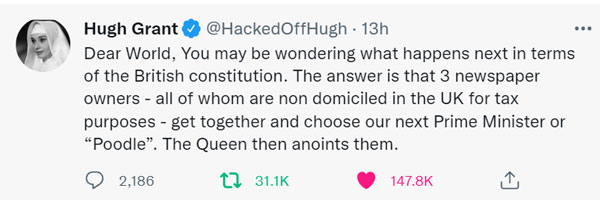
Scathing.
Grant himself has taken on the worst of the British media and won.
What it does tell you is how low we have fallen in India that an excoriated media is seen as something to look up to.
And, cliché alert: it’s all relative.
So the faults of the British media are not comparable to the dire capitulation of most of the Indian media.
And similarly, the fact that X former governments had similar transgressions does not provide excuses for current governments.
Context and degree.
That’s what the Indian media needs to look for and cannot bring itself to do.
Every journalist and commentator who looks to past for justifications for current transgressions fails to see context. And probably is scared of the consequences of not bowing down to the powers-that-be.
With good reason of course, if your main colour of choice is lily-livered cowardice.
It is true that the British media has been traditionally left and right with a bit in the middle.
It is also true that the Indian media was once mainly middle and is now largely right.
This The Economist on Boris Johnson:
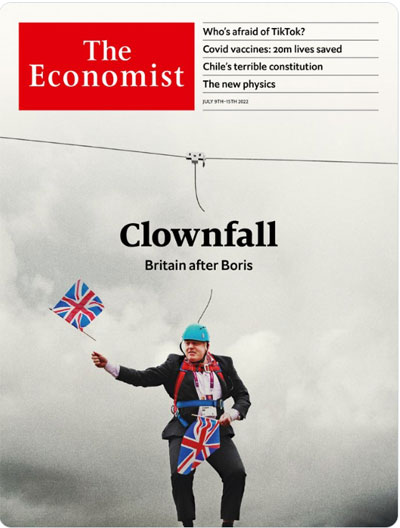 “The party will hope that its agony is now drawing to a close. But that depends on it taking the right lessons from Mr Johnson’s failure. One is about character in politics. Mr Johnson rejected the notion that to govern is to choose. He lacked the moral fibre to take hard decisions for the national good if that threatened his own popularity. He also lacked the constancy and the grasp of detail to see policies through. And he revelled in trampling rules and conventions. At the root of his style was an unshakable faith in his ability to get out of scrapes by spinning words. In a corner, Mr Johnson would charm, temporise, prevaricate and lie outright. Occasionally, he even apologised.”
You can tell immediately that none of these problems which the journal has with Johnson apply to Indian politics at all. If you suggest either character or moral fibre as a prerequisite to a political career, you would be laughed out of a newsroom.
In the Indian media, lying is seen as a fine art. Dissemination is accepted as a primary trait of politicians. Lack of constancy and inability to grasp policy details is spun to reflect a mind that only sees the bigger picture. The problem with the Conservative Whip’s sexual transgressions would obviously have absolutely no role to play at all in the Indian political sphere.
In fact, the growing crisis in the Conservative Party and Boris Johnson’s tenure would have played out very differently in the Indian political scenario. And the media would have had a strong hand to play in finding excuses for every misstep, lie, prevarication and disaster.
I have deliberately picked The Economist because it is seen as centrist and capitalist. Apart from being seen as a voice of reason by many.
How does the mainstream Indian media compare in largely being true to its principles, any principles?
Dismally.
Of course, there is a readymade excuse: that the Indian government has no qualms in going after publications which it feels are overly critical.
And most of the mainstream media has no courage.
And that explains this cover and why you won’t see something like this in India in the near future.
Ranjona Banerji is a senior journalist and commentator. She writes on MxMIndia on Tuesdays and Fridays. Her views here are personal