Tag: Huffington Post

  • Ranjona Banerji: The HuffPo Revelations… truly Pulitzer Prize-worthy

    By Ranjona Banerji


    Since I last wrote on Tuesday, Huffington Post and Nitin Sethi have given us new revelations in their ‘#PaisaPolitics’ series on transgressions and anomalies in the electoral bond funding system implemented by the last BJP-led Narendra Modi government. What words to I use to describe these revelations? Shocking? Appalling? Corrupt? Clever? Nehru did it first? Because to some, almost every travesty of democracy, justice, culpability, probity or prudence which the Modi government does must be excused in some way or another. But let’s set that aside.

    What part 3 of the series told us is that the Modi government made rules and then the Prime Minister’s office broke the rules for upcoming assembly elections in 2018. This is all from government documents, procured by transparency activist, (retired) Commodore Lokesh Batra. Part 4 exposed how the government lied that these bonds would be anonymous. And Part 5 is on how the government broke an anti-money laundering law to allow the sale of expired bonds worth Rs 10 crore to benefit an unspecified party, after the Karnataka state elections of 2018 led to a hung assembly.

    https://www.huffingtonpost.in/entry/electoral-bonds-modi-illegal-sale-state-elections_in_5dce6b7ee4b01f982effa205

    https://www.huffingtonpost.in/entry/bjp-anonymous-donors-electoral-bonds-state-bank-of-india-narendra-modi-arun-jaitley_in_5dcf7239e4b01f982f022b85

    https://www.huffingtonpost.in/entry/narendra-modi-expired-electoral-bonds-finance-ministry-arun-jaitley-state-bank-of-india_in_5dd6820ee4b0e29d727fc172?ncid=other_twitter_cooo9wqtham&utm_campaign=share_twitter

    Now Huffington Post has not given up. And Opposition parties demanded a debate on electoral bonds in the Rajya Sabha, over which the House was adjourned as the Vice-President of India, BJP stalwart Venkaiah Naidu refused to allow it.

    But as you watch the discussion on this, inasmuch as we are not distracted by Pragya Thakur becoming part of the Parliamentary defence committee or Modi’s latest headgear, the opposition is largely to blame for the various messed created by the BJP and Modi. The Indian media, by and large, remains unable to hold the Modi government to account.

    Whether it’s pollution across North India or the brutal crackdown on JNU students in Delhi, the conversation is limited to farmers and their habits or the AAP government or the police and their methods. The BJP and the Modi government however are too high up to be named or touched. This mark of shame will never leave the Indian media.

    Across social media there is a conversation that Nitin Sethi deserves a Pulitzer Prize (only for Americans) for his work in this series. But given that awards in India are largely tarnished by government involved and self-aggrandisement, I would argue that the better reward would be for the rest of the media to acknowledge the immense significance of his work and take it further. What Sethi has done is expose inherent corruption within the BJP and the Modi government. This is one instance. There will be more. If Parliament and the Judiciary are hamstrung by their severe inadequacies or lack of will or gumption, then the onus falls on who? Don’t laugh, but it has to be the media and the people.

    **

    The announcement by Union Home Minister Amit Shah in Parliament that the National Register of Citizens, which has caused enormous distress and cruelty in Assam, is now going to be taken across the country is chilling and despicable. As despicable as the nonchalant reactions. Yes, newspapers have written edits and news channels have had discussions. But India needs to wake up.

    Even the Times of India has been moved with this mild reproof, “One needs to take a step back and think through what the move entails conceptually. It is akin to asking 125 crore Indians reapply citizenship. This is unprecedented anywhere in the world. Moreover, what happens to the lakhs of crores of people who might be excluded by the arduous process of NRC proof? We could have a humanitarian crisis. The government needs to tread with great caution on this one.”

    One part of me says Times Now will definitely applaud the NRC especially if it mainly affects Muslims and other religious minorities, “termites” in Shah’s own despicable language. But the TOI edit has laid out the future for us: Nazi Germany.

    Say it. Understand it. And then decide what to do with it.


    Ranjona Banerji is a senior journalist and columnist. She is also Consulting Editor, MxMIndia. Her views here are personal

     

  • Mediaah! HuffPost and Times of India — Great Match or Mismatch?

    By Pradyuman Maheshwari


    I am personally delighted to see the launch of the India edition of Huffington Post. Two reasons: One, we hear from politicians and the TV channels that India’s stock is rising in the world order, but it’s another thing to have an international news vehicle like Huffington Post enter India. And, two: I take great pride in the fact the Editor-in-Chief Sruthijith KK (SK) has been a friend. He was out there helping raise public opinion about this blog when it was in an independent avatar and was being taken on by a leading news daily.

    He was part of my team at dna in 2006-07, although he didn’t report to me directly. I was in touch with him till around a couple of years back, but met him at his office a couple of weeks back when I was in Noida.

    I am not very sure whether I have helped shape his career, but it surely feels good to see someone rise up the ranks to one of the most coveted jobs in the country. He was a good colleague, excellent at his job and went on to do some great work at Mint, Economic Times and later as editor of Quartz.

    The reason for this piece is not about SK or the fact HuffPo has entered the country, it’s about:

    1. Do we think HuffPo India it has a future?

    2. Is the Times of India-HuffPo marriage the right match or a mismatch?

    Does HuffPo have a future? Of course it does. Am sure the spreadsheets would’ve been done, but a lot depends a lot on how long the two partners keep investing in it. And, more importantly, how much the flavour of the US edition is retained here.

    There are a few other players who are into similar ventures in India: FirstPost, Scroll, Daily O, TheNewsMinute and Quartz. The last of these is where SK worked until recently, so he is obviously clued in to the kind of work HuffPo India needs. The scale is different of course. From the first look, HuffingtonPost.in appears to promise several stories every day, some original and many curated. It will have its set of blogs, and I am sure many of these will make for a good read.

    When I heard about HuffPo choosing Times of India as its partner in India, I was unsure if it would work. The internet requires a different style of operations which large media companies in India haven’t been able to establish. That’s one of the reasons why most websites of mainstream media print entities aren’t any great shakes. But the choice of SK and the dozen-odd journalists he has hired is excellent and could well get the team to produce compelling content.

    And finally to the point of whether TOI was the right choice for HuffPo India? My view: I am not sure. This isn’t the first time HuffPo has aligned itself with the big fish. In France, it’s partner is Le Monde. So TOI is not a special case.

    But what happens when TOI does some disdainful stuff like the focus on Deepika’s cleavage. Will HuffPo India damn it? Will it carry a campaign on Paid Content or something around the Arnab Goswami brand of primetime television journalism?

    I remarked on this when I met SK recently but didn’t push for an answer and get him on the backfoot. He obviously knows that it’s not easy to have a mainstream player like The Times of India as one of your parents.

    It’s not that one Times group publication hasn’t damned another in the past. I remember an editorial in The Times of India and Maharashtra Times taking on Vinod Mehta’s case on a  story on Maharashtra strongman YB Chavan in 1989.

    An India Today report sums up what happened following the publication of the YB Chavan story in the Independent (a daily that the Times of India ran from 1989 until the mid-1990s):

    “Intriguingly, the most scathing criticism of the report came from the editorial columns of the paper’s own sesquicentenarian sister. After excoriating “juvenile zeal for sensationalism”, the Times of India concluded: “The hysterical self-righteousness of sections of the press is only a facade for perpetrating politically-motivated intellectual terrorism.”

    So, Ariannan Huffington and Sruthijith KK  need not feel intimidated by Big Brother Times of India. There’s precedence.

    In a  2865-word opener Ms Huffington, talks about her views on India and what her site will be doing here. She writes:

    “And while HuffPost India will be reporting on all the challenges India is facing and all that is dysfunctional and not working, we’ll also be relentlessly telling the stories of what is working. To start with, we are spotlighting organizations that are tapping into Indians’ collective creativity and compassion to improve the lives of individuals and communities.”

    Just the kind of stuff that works in India and the rest of the world.

    Back to where we started.

    1. Do we think HuffPo India it has a future? Yes, it does. Will it be a financial success? We aren’t sure, but if The Times of India group isn’t able to manage this, who can?

    2. Is the Times of India-HuffPo marriage the right match or a mismatch? This isn’t going to be run by the TOI bosses at Bahadurshah Zafar Marg, but the boys and girls at Times Internet headed by Satyan Gajwani. So, things could well be different. But what happens when someone screws up in the paper or the channels or there’s a negative story in one of the various events that the group organises? We hope that there is no reason for such an eventuality, but given that there’s just too much at stake for The Times of India group in India, if things get too uncomfortable, no marks for guessing what will be given a go-by.

    But it would be fair to give Ms Huffington, Mr Satyan Gajwani and Mr Sruthijith a fair chance with the India edition of Huffington Post. Best wishes to them!


  • Now even Times of India partner Huff​Po takes off on “seriously sexist tweet”


    By Ranjona Banerji


    The poor Times of India. In this globalised world, the venerable old newspaper’s sex and trivia-filled website is once more the focus of world attention. And all because of one tweet about a film star’s cleavage that went wrong. As  media watchers will know, the matter escalated after that and was compounded to the nth degree by the editor of Bombay Times writing the worst open letter in the history of open letters – to use the kind of hyperbole so popular with Indian politicians. Even so, it was an appalling piece of writing.


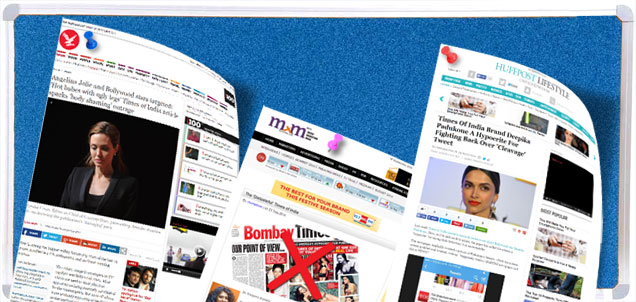
    Now the new scrutiny of the TOI website and glamour sections’ blatant sexism coupled with third class writing and then rolled in sleazy bad taste has hit even its international partner, web phenomenon The Huffington Post. This is what Huffington Post UK had to say: “Last week Times of India posted a seriously sexist tweet about Bollywood star Deepika Padukone. Now, as if to add insult to injury, the paper has called the actress a “hypocrite” for saying their behaviour was unacceptable.”

    http://www.huffingtonpost.co.uk/2014/09/24/times-of-india-deepika-padukone-cleavage-tweet_n_5871672.html


    The Huffington Post tied up with The Times of India in August this year.


    Since TOI’s fight with Padukone got so much social media play, it was not long before people noticed the other rubbish on TOI’s website. Like a story about how many big stars (female) had bad legs. The writer – I use the word loosely – had commented on the legs of many international and Indian stars. This particular story has since been deleted but this is what The Independent had to say about it:

    http://www.independent.co.uk/news/people/times-of-india-hot-babes-with-ugly-legs-article-targeting-angelina-jolie-and-bollywood-stars-sparks-outrage-9753587.html


    The website Mumbaiwalla, which tracks and reports on high society happenings in Mumbai and India, wrote this excoriating piece on the Bombay Times letter to Padukone:

    http://mumbaiwalla.com/?p=2040&preview=true


    But the best response has undoubtedly come from India’s best-known (or should be best known) a stand up comedians and actors. This video by the group that calls itself All India Bakchod on an edit meeting at TOI is nothing short of brilliant.

    http://www.scoopwhoop.com/news/aib-toi-dig/


    For too long has the TOI management brazenly declared that journalists and editors know nothing, therefore legitimising the policy of letting marketing rule by catering to the lowest common denominator, selling news space and lowering the profile of its flagship “brand”. At the same time, the newspaper is what the group gets its legitimacy from. Frankly, this is what happens when you claim that anybody can be an editor and then pick the most unsuitable person for the job. In here is an underlying lesson for all media houses in India. Sometimes the Rupert Murdoch principle brings you straight to News of the World controversy and global discredit.


    TOI has been going straight down that path held together only by the journalists who still do their jobs and all credit and commiserations to them. Having worked there for some years (now a decade ago) through some very difficult political times, I have always been careful in tempering my criticism because I have seen the good side! But subsequent events have shown – particularly the advent of Medianet just before I quit – just how low the group can go. And why they deserve nothing but contempt.


    One last word of advice: please get rid of all those HR and marketing people pretending to be editors. They’re not doing you any favours and just making you a laughing stock.


  • Troll travails thanks to Twitter

    Ranjona Banerji

    By Ranjona Banerji


    Warren Buffett’s research has shown that while people may no longer read mainline newspapers, they are still loyal to their local community papers. Or at least that’s why Hathaway has invested in any number of community papers in the US but will not put money into the mainstream media. The same research also shows that people who do not buy mainline papers will read them online but not if they have to pay.


    This is a lesson about the internet that the traditional media in the west especially has yet to understand. In India, newspapers are free online but even they have irksome proceedings – like having to register to read the e-paper format like The Hindu. Others like Mail Today only have an e-paper format and no website which is also annoying.


    The freedom of the internet is what makes it appealing – even if no more than 200 people gathered to protest internet curbs – and this includes freedom from opening the wallet.


    The Huffington Post and Daily Beast both every effectively use social media like twitter and Facebook to push their stories – the Indian media is not quite so effective. Although Firstpost (web) and Mid-Day (paper) are not too bad and Firstpost also has the advantage of a fan base which retweets.


    The Times, London is a downer because it requires a one pound payment to open any story and the question is not of the amount so much as the procedure. This also stops The Times from reaching a wider audience as its stories cannot get picked up websites which collate news of a certain kind or allow readers to pass interesting articles along.


    * * *


    Until someone invents something better, Twitter remains the best disseminator of news as it happens. There are disadvantages, as passionately delineated by Namita Bhandare in the Hindustan Times (http://www.hindustantimes.com/technology/SocialMedia-Updates/Running-away-from-the-trolls/SP-Article1-868619.aspx). Bhandare’s problem is mainly to do with the viciousness of internet trolls and she has clearly suffered. But of course it could be argued that the only reason that these “trolls” are so annoying/frightening is because of the enormous access that the internet provides. These “trolls” exist in real life also but we may not meet them that often. The internet cannot invent new ways of human behaviour.


    This response to Bhandare’s article by someone who calls himself a “troll” (aah, irony thou are not dead in India yet) is also illuminating  http://chamchaa.wordpress.com/2012/06/10/an-open-letter-to-namita-bhandare/.


    * * *


    From my personal experience as a columnist for many years I can safely say that people will insult you if they want via any medium of communication open to them. Twitter is just one more. I for one have got death threats, legal notices envelopes filled with talcum powder pretending to be anthrax and plenty of questions raised about the sexual habits of my ancestors and in the old days, all these came via the post office. So what, say I?


    Years of reading letters to the editor (in practically every publication I have been part of) has at least made me realise that people are dying to be heard and deeply resentful when their voices are blocked – or when they perceive it as such. Twitter gives them such a wonderful platform to vent and get rid off their frustrations. Worse than any “troll” remains the famous Mumbai postcard writer with the initials ‘MSK’ whose imagination and capacity for personal insults was prodigious. I believe he is no more and his loss is deeply felt. These are the people who make becoming a journalist worthwhile.


    Yes, there are offensive people on Twitter but one can either not encourage them or just shut them off!