By A Correspondent
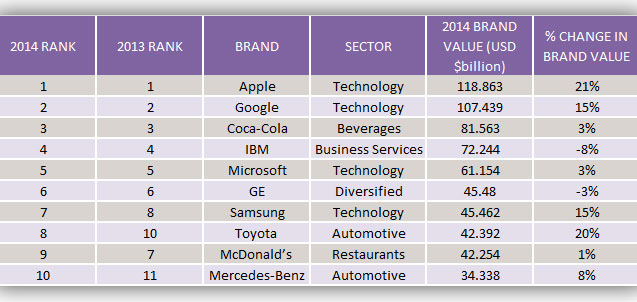
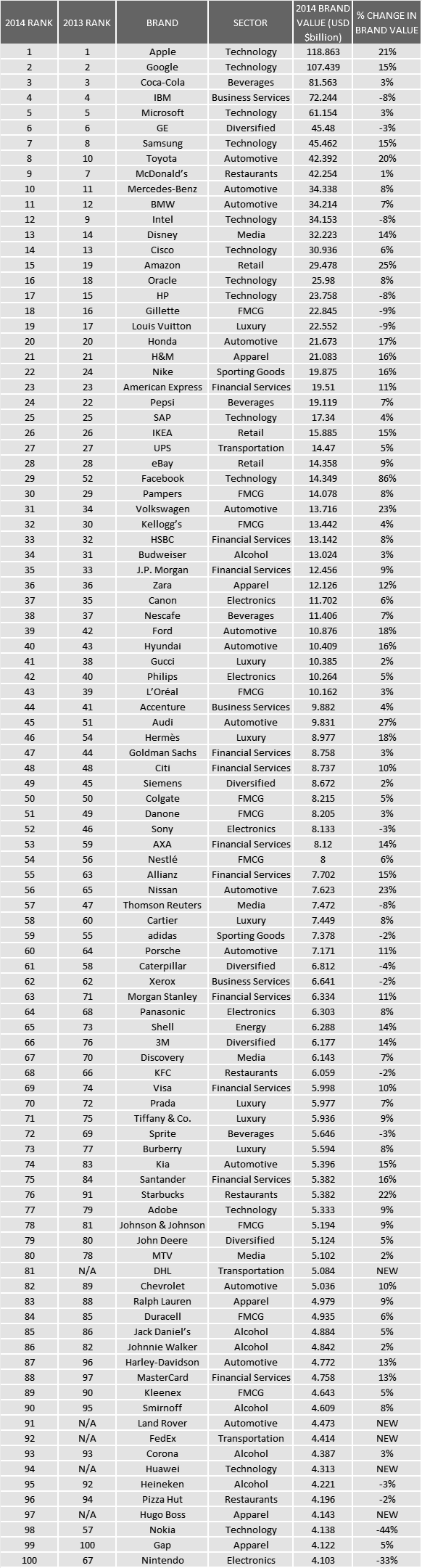
For the second year in a row, Apple and Google claim the top positions on Interbrand’s Best Global Brands ranking. Valued at USD $118.9 billion, Apple (#1) increased its brand value by 21 percent. Google (#2), valued at $107.43 billion, increased its brand value by 15 percent. For the first time in the history of Best Global Brands, two global brands – not just one – have each earned a brand value that exceeds USD $100 billion.
Huawei (#94), the Chinese telecommunications and network equipment provider, also makes Best Global Brands history as the first Chinese company to appear on Interbrand’s ranking. With 65 percent of its revenue coming from outside of China and with its earnings continuing to climb both domestically and across Europe, the Middle East, and Africa, Huawei is quickly becoming one of the largest telecommunications equipment makers in the world. The company is currently the third largest smartphone manufacturer in the world-just behind Samsung and Apple. The Chinese brand is one of five new entrants to enter the Best Global Brands ranking this year-the others being DHL (#81), Land Rover (#91), FedEx (#92), and Hugo Boss (#97).
“Apple and Google’s meteoric rise to more than USD $100 billion is truly a testament to the power of brand building,” said Jez Frampton, Interbrand’s Global Chief Executive Officer. These leading brands have reached new pinnacles-in terms of both their growth and in the history of Best Global Brands-by creating experiences that are seamless, contextually relevant, and increasingly based around an overarching ecosystem of integrated products and services, both physical and digital.”
Interbrand’s Best Global Brands methodology analyzes the many ways a brand benefits an organization-from delivering on customer expectations to driving economic value.
When determining the top 100 most valuable brands each year, Interbrand examines three key aspects that contribute to a brand’s value:
>> The financial performance of the branded product and service
>> The role the brand plays in influencing customer choice
>>The strength the brand has to command a premium price or secure earnings for the company
2014 Overview: Brands Entering the “Age of You”
In addition to identifying the top 100 most valuable brands, this year’s Best Global Brands report also examines three pivotal ages in brand history that have reshaped business for the better: the Age of Identity, the Age of Value, and the Age of Experience. Interbrand contends that a new, emerging era is upon the global business world: the Age of You.
“As consumers and devices become more connected and integrated, the data being generated is creating value for consumers, for brands, and for the world at large,” said Mr Frampton. “As a result, brands from all categories and sectors will get smarter-with products and devices working in concert with one another, across supply chains, and in tandem with our own individual data sets. Brands that seek to lead in the forthcoming Age of You will have to create truly personalized and curated experiences, or what we call ‘Mecosystems,’ around each and every one of us. Such brands will have to rehumanize the data, uncover genuine insights, and deliver against individual wants, needs, and desires.”
Said Ashish Mishra, Managing Director, Interbrand India, “The Age of You era that is upon us will enable micro-segmentation, absolute customisation and personalisation – notions hitherto considered impossible. In the flat world of now, the elements of the future ecosystems are all ready. However disjointed developments around Big data, technology platforms, content, software, devices and apps together have created a complex information over class. The need of the hour is to integrate them around the customer needs and desires. And to do so, we will need to employ both intelligence as well as imagination, thus creating inspiring precedence for the world to follow”
Â
Key Report Highlights
Â
2014 TOP RISERS: Facebook (#29, +86%), Audi (#45, +27%), Amazon (#15, +25%), Volkswagen (#31, +23%), and Nissan (#56, +23%)
Â
Facebook (#29, +86%): The world’s largest social network, Facebook continues to exceed expectations. Reported on its Q2 earnings call, income from its operations was a staggering USD $1.4 billion. One year prior it was USD $562 million. Facebook’s ad business on mobile phones has been particularly strong. For the first time in its history, the company reported that revenue from advertising on mobile phones exceeded half (53 percent) of all its advertising for the quarter. Facebook’s acquisitions of messaging service WhatsApp for USD $19 billion and Oculus VR for USD $2 billion signal a new strategy unfolding. The company is building a vast product portfolio, brimming with competing services and apps.
Â
Audi (#45, +27%): Audi is the top-rising automotive brand in this year’s Best Global Brands report. It was a record-breaking year for the brand, having sold the greatest amount of cars in its history, and having achieved an operating profit of more than USD $6 billion. The company also awed audiences at the 2014 International Consumer Electronics Show (CES) in Las Vegas, Nevada with its A7 self-driving car. Audi also plans to introduce 17 new or revamped models this year and will move forward with the production of an electric version of the R8 sports car in a push to gain momentum on rival BMW (#11). The company also plans to invest more than USD $30 billion through 2018 in new products, technology, and production sites. Earlier this year, it also announced a partnership with Google, which will allow Audi drivers and passengers to use an Android-powered entertainment and information system that will run on the car’s hardware.
Â
Amazon (#15, +25%): It was another banner year for Amazon, “Earth’s most customer-centric company.” Amazon’s commitment to responsiveness has become part of the brand’s mythos. It continues to grow its core business through services such as Amazon Prime, which, at one point, garnered more than a million subscribers in a single week. Expansions on previously popular product lines-the new Kindle Paperwhite and Fire Phone-brought more customers into the Amazon ecosystem, while a content licensing agreement with HBO helped it to make a bigger push into the entertainment sector.
Â
Volkswagen (#31, +23%): Volkswagen, Europe’s leading automaker and one of this year’s top-rising Best Global Brands, is striving to become the world’s leading automaker by 2018. Its latest model, the XL Sport, recently debuted at the Paris Motor Show and served as yet another symbol of the innovative power, passion, and technical competence of the Volkswagen brand. Beyond its manufacturing and design capabilities, Volkswagen’s “Think Blue” concept continues to prove that ecological sustainability remains a top corporate objective.
Â
Nissan (#56, +23%): Nissan continues to drive up the Best Global Brands ranking with improved financial and brand performance. Nissan’s leadership consistently pushes brand building as a major priority across the organization, clearly identifying the link between a strong brand and market share. Nissan’s recent car launches-Qashqai, Murano, and Rogue-have demonstrated how its “Innovation and Excitement for EVERYONE” brand positioning is shaping its product lineup.
Â
2014 NEW ENTRANTS: DHL (#81), Land Rover (#91), FedEx (#92), Huawei (#94), and Hugo Boss (#97)
Â
DHL (#81): The burgeoning e-commerce market has opened a sea of opportunity for delivery and logistics companies. As international online shopping continues to grow-and is poised to grow 200 percent in the next five years-brands like DHL and FedEx have made strides in bolstering their e-commerce capabilities. The most valuable brand of the new entrants to this year’s Best Global Brands ranking, DHL announced recently announced a five-year strategy plan aimed at tapping emerging markets to grow its global market share. As part of its plan, its MAIL division will be renamed Post – eCommerce – Parcel to better reflect its character under the new strategy.
Â
FedEx (#92): FedEx is also realigning its business to make the most of the booming e-commerce sector. Earlier this year, the company launched a new service designed to make it easier for customers to control when and where packages are delivered. The service is called FedEx Delivery Manager and is available through multiple digital platforms, including a free mobile app. Customers can request alerts via email, SMS text, or phone. FedEx has also developed a host of Web-based services to help brick-and-mortar retailers boost their online sales. Retailers can easily integrate FedEx’s Web Services platform into their own Web systems-allowing them to track shipment information. With FedEx’s Web Integration Wizard, its customers can track the shipments directly via the retailer’s home site.
Â
Land Rover (#91): British carmaker Land Rover continues to refine its product lineup with fresh styling, high-tech platforms, and downsized engines. Since being acquired by Indian automobile company Tata Motors in 2008, Land Rover has witnessed double-digit growth each consecutive year. This past year, Land Rover’s unit sales rose 15 percent year-over-year to nearly 350,000.
Â
Huawei (#94): As mentioned previously, Huawei is both a new entrant and the first Chinese brand to ever appear on the Best Global Brands ranking. In 2013, the Chinese telecommunications and network equipment provider reported a net profit increase of 34.4 percent to CNY ¥21 billion (USD $3.38 billion) up from CNY ¥15.6 billion in 2012. As companies, as well as entire industries, continue to shift from legacy storage and equipment to more agile products (cloud services, 3G routing, security solutions, etc.), Huawei is poised to dominate key areas of the IT market-from mobile phones to carrier-grade networks.
“Huawei’s rapid growth and long-term investments in its brand helped it earn a place among the world’s most valuable brands,” said Frampton. Despite its low brand awareness in the U.S., Huawei has gradually expanded its reach around the world. It continues to demonstrate its technological prowess in both its consumer products as well as in its enterprise solutions-and it remains well positioned to meet the needs of customers in both emerging and developed markets.”
Hugo Boss (#97): Hugo Boss, the German fashion house, was one of the strongest-performing apparel brands globally in the past year. The company saw revenue grow 10 percent in Europe, where it makes more than half its sales, while the Americas grew 7 percent, and Asia grew just 2 percent, largely due to China’s slowing economy. On the whole, Hugo Boss is moving away from selling through partners and starting to run its own stores, allowing it to have greater control over price points and the way the clothes are presented. This year, Hugo Boss celebrated its 20th anniversary with an exhibit at the Saatchi Gallery in London, a microsite, and a multichannel campaign. The microsite offered a look into the Saatchi Gallery exhibit by illustrating 20 iconic Hugo Boss items and 20 internationally acclaimed artists. Clicking on a product brought consumers directly to the e-commerce site where they could either purchase the product or find it in a store.
Â
Key Sector Highlights
Â
Leading automotive brands continue to rethink the future of mobility. A combined focus on energy-efficient products and integrated technology is helping leading auto brands drive brand loyalty and value.
This year, the collective brand value of the automotive brands appearing on the Best Global Brands ranking increased 14.6 percent. All 14 automotive brands collectively make up a combined brand value of USD $211.9 billion. With three out of the five Top Risers hailing from the automotive sector, the past year proved to be a record-breaking one. This year’s top 14 automotive brands include: Toyota (#8, +20%), Mercedes-Benz (#10, +8%), BMW (#11, +7%), Honda (#20, +17%), Volkswagen (#31, +23%), Ford (#39, +18%), Hyundai (#40, +16%), Audi (#45, +27%), Nissan (#56, +23%), Porsche (#60, +11%), Kia (#74, +15%), Chevrolet (#82, +10%), Harley-Davidson (#87, +13%), and Land Rover (#91, NEW). Toyota, which has been the most valuable automotive brand on the Best Global Brands ranking since 2004, continues to be a leader in green technology development. Since the launch of its first-generation Prius 17 years ago, Toyota has sold a total 3.2 million units of the vehicle globally. Toyota has also expanded its hybrid range to a total of 25 vehicles, including the Prius Plug-in Hybrid. Toyota plans to spend USD $7 billion on environmental technology in the fiscal year ending March 2014, an increase of 11 percent compared to the previous fiscal year. ÂWith the era of the connected car rapidly approaching, the sector’s Top Risers-Audi, Volkswagen, and Nissan-are working to redefine the essence of the driving experience and build stronger emotional ties with their customers.
The technology sector leads as the most valuable category overall. Legacy and one-time leading brands struggle to evolve at the pace of change.
Out of this year’s top 100 brands, 13 hail from the tech sector. The category as a whole grew 11.3 percent year-over-year, and collectively is worth USD $493.2 billion in brand value. While Facebook (#29, +86%), Apple (#1, +21%), and Google (#2, +15%) represent this year’s fastest growing brands, a number of one-time leading brands experienced the steepest decline in brand value. Finnish communications and information technology provider Nokia (#98, -44%) experienced the largest decline in value among the top 100 brands, dropping from its #57 position in 2013 to #98 this year. Once a dominant player in the cell phone industry, it has seen its market share decline steadily since 2010, struggling to compete against rivals Apple and Samsung. Microsoft (#5, +3%) acquired the Finnish brand’s consumer products in April this year, and despite changes in leadership and operational structure, it remains unclear how Microsoft will use the brand and how it will evolve in the future. Japanese consumer electronics company Nintendo (#100, -33%), had another difficult year. The brand fell 33 places this year to take the #100 position, with a brand value of USD $4.1 billion. The company has acknowledged its woes in the hardware space, and CEO Satoru Iwata also publicly stated that the company must evaluate other opportunities, including those in the mobile market. Earlier this year, he announced that the company has plans to start a new health-related business by March 2016.
Â
Against the backdrop of global economic recovery, financial services brands experience growth in brand value.
The value of financial services brands has experienced steady growth in recent years. All 11 financial services brands appearing on this year’s Best Global Brands ranking increased in brand value: American Express (#23, +11%), HSBC (#33, +8%), J.P. Morgan (#35, +9%), Goldman Sachs (#47, +3%), Citi (#48, +10%), AXA (#53, +14%), Allianz (#55, +15%), Morgan Stanley (#63, +11%), Visa (#69, +10%), Santander (#75, +16%), and MasterCard (#88, +13%). On the whole, companies within the financial services industry are continuing to build brand value by engaging with their customers and providing more seamless, convenient, and fully integrated experiences. Many financial services organizations have increased investments in mobile marketing, social media, online video, and more-and such efforts, as evidenced by this year’s Best Global Brands ranking, are paying off.
Â
Leading luxury brands continue to embrace digital platforms. A new era of exclusivity is paving the way for personalization and curated brand experiences.
While luxury brands have been slower to embrace online channels, the rise of digital sales, online browsing, and brand consideration is forcing them to reimagine their respective customer experiences. As reported by Luxury Interactive and ShopIgniter, 65 percent of luxury marketers expect digital marketing to be the most important form of marketing for their brand.
Â
Detailed brand profiles, thought leadership articles, interactive charts, and interviews with brand leaders from around the world are available at bestglobalbrands.com.

 By Gulveen Aulakh