Tag: Hotstar

  • Octa to launch Second Income campaign on Hotstar

    By Our Staff


    Octa, a global brand of investment services, has announced the launch of a new campaign on the streaming platform Hotstar, which helps cricket enthusiasts watch their favourite teams play live. All through the IPL season, Hotstar will be streaming Octa’s Second Income campaign video clips during the matches.


    Said an unnamed Octa spokesperson: “At Octa, it is our deep conviction that everyone should be able to diversify their income streams. With the Second Income campaign, we want to show that the world of investments is not something beyond the reach of the general public. On the contrary, anyone willing to put their time and effort into financial education can discover the benefits of investing online and generating additional income.”


  • IPL ads through the lens of Hotstar


    By Vikas Mehta


    Vikas MehtaI am currently travelling and based at a university campus in Telangana. The access to screen is mostly through mobile and as such have been watching IPL on Disney+ Hotstar. Trust me it is a very different experience. Or should I say unusual.On Star Sports the ad breaks seem to be rushed, many a times in a hurry to squeeze in as many ads as possible, the ads have to be rudely interrupted, as the game has resumed. Indeed, sometimes one gets a feeling that we are watching an ad programme with bits and pieces of cricket thrown in. But Hotstar being a subscription-based service, its dependence on advertising revenue is low. So, there are fewer ads and these are not crammed in. Quite, unusual.


    But what set me thinking were the types of ads on Hotstar. I was expecting some very different ads. Aimed at the GenZ. The young, mobile generation. In reality, most of the ads were the same that ran on Star Sports, signalling some combined deal or rate.  And a few exclusive ones that I saw were surprisingly targeting a very different consumer segment than what I imagined.


    Take, for example, the ad for Samsung curd maestro. No, it’s not a new gizmo launched by Samsung but a refrigerator which has a separate compartment to make fresh curd or dahi. The product is not new, it has been around for some time and I do think that it is a great innovation for our country as curd is a part of our staple diet. Curd making usually requires warm temperature and then we love the curd which is thick and set, not the loose wobbly type. So a fridge which actually makes the curd and let it set, is a welcome feature. But, should it be on Hotstar? Shouldn’t it be on Star TV for a better reach? Or is it targeting the working woman, a millennial, as the ad depicts? Or indeed, it could be targeting the working millennial men. After all, they are being exhorted to share the load.


    Then I saw the ad for New Samsung Galaxy S phone. A right fit for the people watching IPL on Hotstar. Maybe, Samsung did a corporate deal with Hotstar and is now distributing the time available to various brands. Not just about the right choice but complying with a good deal.


    Then there was the Garnier Hair Colour ad. That too seemed a misfit for Hotstar in my mind. Okay, okay. I do get it that the modern, contemporary lifestyle is making many youngsters get white hair very early, but will a larger segment buying hair colour solution not be watching the match on Star Sports? The ad definitely, given its casting is talking to the millennials.


    When I look at both, Garnier and Curd Maestro, another plausible theory comes into mind. As said earlier, Hotstar being a subscription channel, could be selling ad inventory at a lower price and that is encouraging brands, who may be using the platform to address a small or niche segment.


    In my mind, there are two bigger or fundamental questions. One: Is OTT a distinct channel with its own dedicated base? Even when at home, an event like IPL, is it watched through OTT or DTH/cable? Irrespective of whether it is watched on big or small screen. How many viewers who subscribe to Hotstar also have DTH connection at home? What is the duplication factor?


    Two: Is screen viewing becoming a more individual pursuit? GenZ, even though they are at home and have a DTH connection prefer to watch it on their individual small screens (laptops or mobiles) and the millennials watch it on TV, with friends or families? My dipstick evidence shows that with GenZ, watching sports is becoming an individual pursuit but interestingly, while they do watch alone, they are furiously chatting away with each other, exchanging views, developing memes etc. Normal social behaviour, but in a virtual world.


    The one ad that I saw on Hotstar and did not see or maybe missed on Star Sports was that for Slice Credit card. Now I had never heard about this brand except, if my memory serves me right, I see them as the new shirt sponsor for Mumbai Indians. Its benefit is to slice the slow and it is for the fast ones. It has an animated/ cartoon execution but it left me in a daze. Maybe I am too slow for it or out of touch with reality but it looked like an ad which may inspire the GenZ. Are credit cards seriously targeting GenZ? But after a product like Cred, whose purpose is to pay my credit card bills and then reward me for doing so, while surreptitiously collecting all my purchase behaviour data, I can imagine not just a product like Spice Credit Card but also its ads. And the only thing usual, or is it unusual, is its association with MI who have very unusually, or is it becoming usual for them, lost a record eight matches in a row.


    Two weeks ago, I had written about how the Tata Neu app showed me a message that Big Basket is not delivering to my area, whereas in reality I have been using BB since some time. I am happy to say that the app seemed to have recovered some ground as this morning I got a message that I have received some Neu coins when I shopped through Big Basket app. The Neu family seems to be coming together.


  • On the field and off it: The big IPL year


    By Shailesh Kapoor


    Shailesh KapoorThe biggest sporting event in India is currently underway. With each passing year, IPL seems to only grow in stature and brand value. This time, there are two new franchises, and the spectators are back in the stands too, albeit with a cap of 25 per cent. More franchises mean more matches and more talent on display, all of which eventually leads to higher monetization and valuation of brand IPL.


    But the eyes this year are not just on the ongoing IPL but also on what’s to follow on the IPL front over the next few weeks. IPL broadcast rights are up for renewal, and we are set to see a fierce battle in the auctions scheduled for mid-year.


    IPL is a crown jewel for Disney (Star), not just in India, but even worldwide. Hotstar, on the back of IPL, contributes more than 30 per cent to Disney+’s global subscriber base. Needless to say, Star India will stretch itself beyond its limits to retain both television and streaming rights.


    But there’s the newly-merged entity that goes by the working title Zee-Sony, which is a serious contender. Sony has been down the IPL road before, being the first ones to put their money on it, when the league was only an experiment, not a proven success story. With the combined might of two big networks, Star India’s competition is tougher than it was five years ago.


    Add Reliance (Viacom) to the mix, and we have a three-way tussle for IPL rights on the cards. BCCI’s decision to not go for combined bids this year makes things even more interesting, because it puts streaming platforms like Amazon Prime Video into the reckoning, along with Google and Facebook.


    No amount of speculation can prepare us what may eventually happen when the e-auction commences on June 12 this year. But whatever the outcome is, it will shape the landscape of the Indian media industry for the next few years, even the next decade.


    The television industry is India has been struggling for relevance, despite being the medium with the highest reach, and by some margin too. IPL (and cricket in general) is one of the few things that keeps television relevant to the times, as far as media planning and buying goes. Digital viewership may have gone up, but television remains the dominant medium of sports consumption. The entire television industry, and the advertisers’ group (brands and media agencies), will be keenly awaiting the outcome.


    Till then, there’s some real cricket on the grounds to keep us busy. For another seven weeks, the cricketing action will continue to enthrall millions across the nation. It will also act as a reminder for the potential bidders everyday, on how big the opportunity in front of them is.


  • Sweet news on Sankranti. Uday Shankar joins James Murdoch to grow Lupa Systems

    By Our Staff


    So where’s Uday Shankar going? That was the question everyone seemed to ask when he announced his decision to move from Star/Disney last year? But the two big rumours were him joining former Star India owners – the Murdochs and Mukesh Ambani’s Jio.

    Some meetings with the Jio bosses are said to have happened, but we know we haven’t heard the last on this from the Reliance Industries headquarters.

    In the meantime, Shankar took charge as the FICCI big boss, and we do know that he wouldn’t have assumed that position without something major that we was going to be doing.

    So here’s News #1:

    CEO James Murdoch and and the former Chairman and CEO of Star India and President of Walt Disney Asia Pacific, have announced that they are forming a new venture to explore technology and media opportunities in emerging markets.

    The new partnership reunites Murdoch and Shankar, who worked together building Star India into the region’s largest media company, prior to its sale as part of the merger of 21st Century Fox and The Walt Disney Company.  Star now reaches 600m+ viewers every week and operates Hotstar, Asia’s leading OTT platform.

    Said Murdoch in a statement: “After two decades of working in India and the region, at Star and more recently at Lupa Systems, it’s great to be entering into a renewed partnership with Uday.  Our collaborations over the years have been immensely rewarding for consumers, our various shareholders, and our colleagues. I’m very pleased to be renewing that partnership now.  As connectivity continues to accelerate and expand across South Asia and the whole region, new opportunities for innovation, across consumer sectors, will multiply.”

    And this is what Shankar said: “James and I enjoyed a great partnership at Star and I am enormously excited to be in partnership with him again.  At Star, we had the great benefit of working with the best and brightest Indian talent, combined with global vision and a desire to disrupt the old order. Digital Technology promises to transform the lives of many millions of people in this part of the world and I have every confidence that we can harness technology, enterprise, and tremendous talent to create a great business that is also great for society.”

    The communique misspelt Shankar’s name as Shakar, which perhaps is appropriate. Shakar is Sugar in Hindi, and this is a sweet piece of news for media watchers in India.

    “Lupa Systems set up its India presence less than two years ago and has already created a promising portfolio of technology investments. Partnering with Uday, to build ambitiously for the long term, will take us to another level,” said Nitin Kukreja, Managing Director of Lupa Systems India. Kukreja, if one remembers, was with Star India/Disney and was the boss of Star Sports.

    What’s News #2. Like you, we too are waiting.


  • Time to Rejig the Content Mix?


    By Shruti Pushkarna


    Shruti PushkarnaThe only change we witnessed on January 1 was calendrical. 2020 was a washout, with bad news hitting us consistently from every part of the globe. The ghastly spread of coronavirus wasn’t the only peril we dealt with. Don’t forget the floods, cyclones, frequent earthquakes, economic slowdown following the lockdown, rising unemployment and brutal pay cuts. The only hope in sight was the promise of a vaccine roll-out in 2021. Just as we were getting ready to usher in a world capable with fighting the virus, the World Health Organisation announced that we were unlikely to develop herd immunity in this new year.


    On the political front too, countries are busy competing for attention. Apart from the usual blows and soap opera antics, the Narendra Modi government has been unable to placate or negotiate with the protesting farmers. And across the Atlantic, United States made history as the outgoing President Donald Trump incited supporters to storm into the Capitol and ransack offices, leading to the death of a police officer.


    I don’t think it gets any crazier. News coverage has never been so potent. The airwaves are dominated by issues that seemingly affect ‘everyone’. With the fundamental existence of every human being at stake, newsmakers have been busy chasing issues of national importance like never before. This also means that anything labeled as ‘special interest’ or ‘social responsibility’ takes a backseat.


    Unfortunately, disability-related coverage falls in the above category. The media perceives issues facing the disabled to be significant only to a handful of the country’s citizenry. Even though data indicates that fifteen percent of the global population lives with some form of disability. Add to that friends and families of the disabled. Also, the elderly who often acquire age-induced-impairment. Another common belief is that the larger political, social and economic problems have no impact on persons with disabilities.


    News is largely driven by what a select few minds deem ‘relevant’ to the majority. Needless to say, profit generation defines their decisions. Unless one of these decision-makers has any personal experience with disability, we are unlikely to see a change in what’s dished out for national consumption.


    Let’s shift focus to general entertainment. Here too, channel owners decide what sells or what type of content is worthy of mass appreciation. That’s why for years together, our choices were limited to saas-bahu drama, cheap dance and music shows and ludicrous comedy.


    Before subscription-based platforms launched in India, many of us believed the business model would fail in a market driven by cable television and piracy. But clearly we misjudged. Audiences jumped up at the idea of choosing desirable content from different genres. The market finally catered to individual interests as opposed to mass production based on banal assumptions about the target group. Restricted outdoor activity due to Covid-19 has of course taken OTT to a new level of popularity.


    Today, we live in an era where ‘content is king’. There is a market for everything and businesses targeted to a niche are likelier to succeed. The consumers are not only armed with choices but multiple (tech) devices. With squirrel-like attention spans, they are in constant search for what’s relevant at an individual level.


    Streaming services like Netflix, Amazon and Hotstar, have numerous categories such as science fiction, thriller, reality TV, adventure, crime, mythology, biopic and so on. I feel there’s a tremendous possibility of producing content on subjects like disability, or other forms of exclusion that plague the societal mindset.


    The able-bodied are unable to comprehend the challenges faced by those living on the peripheries because they don’t see or hear about it. The media can endow visibility to those who are absent from our normal course of existence. When people start seeing stories of disabled from places of education, work or entertainment, ableism will slowly begin to recede.


    Content producers have a massive influence on the general public vis-à-vis understanding of issues, people and situations. They are responsible for shaping opinions and generating curiosity.


    Are they willing to make their offerings more inclusive in light of the new content consumption patterns? Can we expect to read, see and hear all that impacts every single one of us? Can the specialized content also represent the minorities that remain faceless even in the 21st century?


    If media is a reflection of our society, then the blatant narcissism and apathy should shock us into advocating for change.


    Shruti Pushkarna heads operations of the New Delhi-based Score Foundation where she works as Director-Programmes & Communications. She is a former journalist (part of the founding team of MxMIndia) who has moved full-time to the social sector. Shruti writes for MxMIndia every other Thursday. Her views here are personal. She can be reached via Twitter at @shrutipushkarna

     

  • IPL 13 Rules. And how!


    By Indrani Sen


    Ever since IPL 13 began on September 19, 2020 with a massive 20 crore viewers on Star India Network and Disney + Hotstar, the tournament has been delivering high ratings on TV and OTT platforms.
     

    On the digital media front, IPL 13 is generating huge tractions over and above its coverage through Star India’s OTT platform Disney  + Hotstar. On October 30, 2020 Wavemaker published a press release on their mid-season report of “IPL Mesh 2020” covering matches from September 19 to October 24. Mesh is Wavemaker’s Realtime Data Intelligence tool which has integrated data from “multiple consumer touchpoints across Digital ecosystem ranging from Social Listening, Google Searches, Website visits, BARC, Video analytics in partnership with VIDOOLY, Interaction data points collected from Facebook, Twitter, Instagram and YouTube” to arrive at the observations and predictions shared in the report.


    The press release by Wavemaker contains a few charts and whets the appetite for the total report. The report predicts that the IPL buzz volume of the digital track will grow from 37 Mn in 2019 to 60 Mn + in 2020. During the first 36 days of the tournament, CSK was the driving force behind the interactions on social media. Now that CSK has failed to secure a place in the playoff matches, it will be interesting to watch if the buzz volume of the track gets affected. Similarly, it would be interesting to see who takes the place of M S Dhoni as wicketkeeper in the Leading Player Index Leader Board.


    In the Leaderboard ranking of most loved ads, Dream 11, Oppo and Tata Motors took the first three positions in desending order. IPL 13 has also seen a never before engagement in gamification of Cricket Fantasy League with the top five Fantasy League in September 2020 generating 30 million google searches and 90 Million web traffic. Based on historical data, the report claims that there will be huge surge both in TVP and social buzz during the next two weeks which will counter the drop in the social media buzz over during the last few weeks as shown in the chart above.


    While the Wavemaker’s report reconfirms the accelerated growth of the digital media intractions in India, in traditional TV media also IPL 13 continues to deliver high ratings to the satisfaction of the advertisers who have invested their advertising rupee in cricket. A fortnight back on October 15, TAM released “IPL 13 Advertising Report 1” based on their ADEX data covering the period from September 19 to October 10 (25 natches).  The report has shown an 8% growth registered in average ad volumes from IPL 12 to IPL 13 during the same time span/ number of matches. 5 out of the top 10 categories have been from E-commerce with 35% share of IPL 13 advertising volume and Oppo India’s commercial made it to the top position quite fast during IPL 13 compared to 2nd position in IPL 12.


    The most interesting fact which has emerged from this Advertising Report is the participation of new categories and brands in IPL 13. According to the TAM Adex report 30+ new categories and 150+ new brands advertised during IPL 13 compared to IPL 12. It remains to be seen how the advertising frenzy builds up further during the last two weeks of IPL 13, strategically scheduled during the pre-Diwali season in this pandemic hit year.


  • Disney+ Hotstar VIP embraces Tamil

    By A Correspondent


    With its next big leap in content, Disney+ Hotstar VIP aspires to become the personal screen for Tamil content-watching audiences.
     

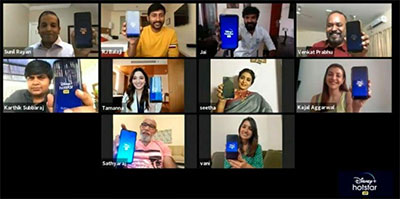
    Starting this Diwali, there is a major line-up planned, the first of which is blockbuster movie Mookuthi Aman starring Nayanthara and RJ Balaji. The platform is also set to launch specials shows – LIVE Telecast directed by Venkat Prabhu and starring Kajal Aggarwal; My Perfect Husband starring actors Sathyaraj and Seetha, Triples produced by Karthik Subbaraj and starring Jai Sampath and Vani Bhojan and November Story starring Kollywood’s Tamannaah Bhatia. And there’s more planned.


    Said Sunil Rayan, President & Head, Disney+ Hotstar: “We have always been at the forefront of reinventing and reimagining content in India. As we lay the foundation of presenting authentic stories that appeal to Tamil audiences, we are very excited to partner with some of the most prolific minds of the industry. As we announce the launch of new movies-before-theatre and Hotstar Specials shows, we are adding to our existing promise of providing great Tamil entertainment across Live Sports, before TV access to Star VIjay shows and much more – giving our audiences a wide array of content to choose from”


  • Pariksha launches on Hotstar during IPL

    By A Correspondent


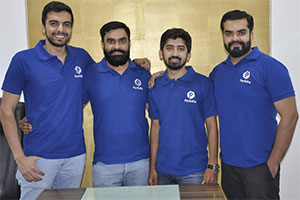
    Pariksha, a Pune-based edtech start-up has launched an advertising campaign during the IPL on Hotstar. The advertising campaign will be launched in the six languages that the company operates in.

     

    Said Karanvir Singh, Founder, Pariksha: “It will by far be the largest EdTech campaign in terms of languages launched by any EdTech company in India. This is Pariksha’s first branding exercise to create more awareness around its offering and brand across the country. We would like to extend our market dominance.”


  • How India’s Gen Z is addicted to Streaming


    By Indrani Sen


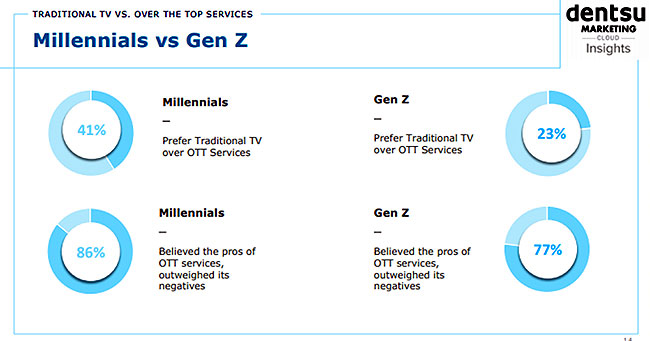
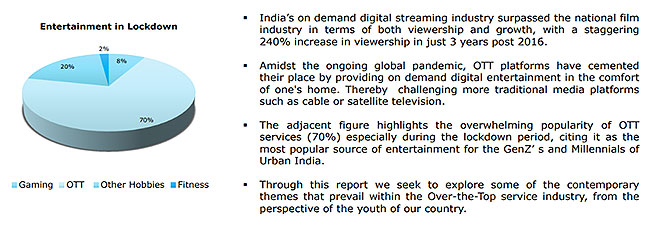
    Covid-19 has transformed the media consumption trends in India. Globally, streaming platforms gained in a big way since the pandemic struck and India is no exception. The report published by Dentsu Agies Network – “Now Streaming: The Indian Youth OTT Story” – is a study conducted among urban India’s Gen Z & Millennial reconfirms this trend. These trends could be reflecting behavioural changes of the two younger generations which are likely to last even after the cloud of pandemic shifts from the Indian sky. The highlights of the findings from the report are shown below:

    Source: https://dentsumarketing.cloud/dmcinsights.php


    As many as 74% of the respondents came from the Top 8 metros with 26% coming from rest of urban India. 47% of the respondents were male and 52.2% were female. 78.5% came from Gen Z (5 to 25 years) and 21.5% came from Millennials (25 to 39 years).  The report therefore cannot be taken as uniform trends across urban youths across India but trends which are visible among youths residing in the top 8 metros and mostly below 25 years of age. They are, however, the future targets of marketing and advertising in India.


    Average daily time spent in hours

    Gen Z Millennials
    On line Gaming 1.97 1.11
    Binge Watching 4.45 3.66


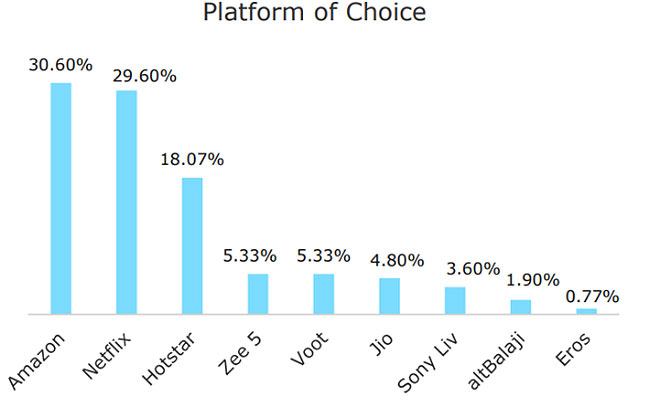
    Among the various OTT platforms, Amazon Prime and Netflix lead the pack, followed by Hotstar. The other OTT platforms are yet to build up significant presence among the Indian youths. Gen Z spends more time than Millennials both on gaming and binge watching on OTT platforms.


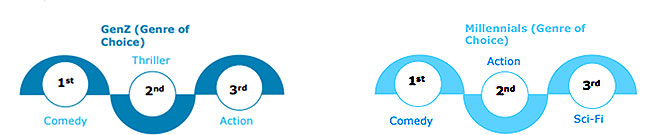
    The choice of genres by the two sections of youth explains the popularity of the top three platforms which offer more content as per their preference. Zee 5, Voot, Jio, Sony Liv, etc have less content to offer in the Comedy, Action, Thriller and Science Fiction genres. Amazon Prime, Netflix and Hotstar have also invested more in production of original content. However, the report has also shown that both in North and South India across different demographics the primary usage of OTT platforms were for viewing TV shows and movies.


    During the lockdown north Indian youths invested on an average in three OTT subscriptions than their counterparts in south India who invested on an average in two OTT subscriptions. The Gen Z invested on an average in 3 OTT subscriptions while Millennials invested in 2 OTT subscriptions during the same period. The report does not give details of the demographic profile of the sample, but we can safely assume that the sample was skewed towards higher SECs as indicated by higher spends on OTT subscription by Gen Z, most of whom would not have been financially independent and had to ask their parents for the subscription money. Obviously their parents were not financially affected due to the economic slowdown during the lockdown and could afford to indulge their children. The report therefore captures mainly the trends of OTT consumption of urban youths from 5 to 25 years age belonging mostly to NCCS A and the top 8 metros.


    The report has also captured that 73% have no concern about the content of the OTT platforms. The other 27% have stated obscene content, anti-national content, strong and bold language of the content as well as content hurting sentiments of religion/ caste as causes of concern related to OTT platforms. On the other hand all respondents had concerns about internet connections, pop-up ads and buffering related to steaming of the contents. Both Millennials and Gen Z have shown a clear preference for OTT services and believes that the positives factors outweigh the negatives.


    The report concludes that content distribution, attractive marketing, transitioning the gaming industry and personalisation are the key factors which is helping consumption of OTT platforms to dominate over consumption of traditional TV viewing. The analysis does not mention about the tie ups between OTT platforms and Telecom giants like Airtel, VI and Jio, a practice which began in 2017/ 2018 and has been continuing since then.


    As per the range of packages offered by the three telecom companies, it appears the leading OTT platforms do not believe in exclusive tie ups with any single telecom company and have created a level playing field for all the service providers by having tie ups with all of them. It seems this survey did not probe into this aspect of free subscription with mobile connection among the Gen Z and Millennials, most of whom would have been enjoying some such free benefits through a single sign in. The findings of the reports outweigh the apparent skewing of the sample and a few gaps and have provided all of us a crystal globe for gazing into the future of media consumption.


  • Hotstar reaches out to migrant workers in Singapore

    By A Correspondent


    To offer South Asian migrant workers residing in Singapore moments of respite during this uncertain and difficult time, The Walt Disney Company is working with the Singapore government to bring the Hotstar streaming service to migrant workers during this period.
     

    The workers can live stream more than 85,000 hours of movies, cricket matches, Star India TV shows and live news on their mobile phones. Available in nine languages, the content offering includes more than 2000 movies and 900 TV shows. The service is currently available only on Android phones in Singapore, but will be available soon on iPhones as well. This initiative ends on 21 July 2020.


    Said Uday Shankar – President, The Walt Disney Company APAC and Chairman, Star & Disney India: “We are honoured to work with the government to bring Hotstar to migrant workers in Singapore. In these unprecedented challenging times, we humbly hope that by offering the workers content that speak their language and reach their hearts, we can help lift their spirits and bring some moments of comfort and inspiration.”


  • Disney+ Hotstar Premium to air ‘The Simpsons’

    By A Correspondent


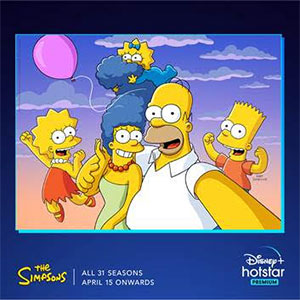
    After the launch of Disney+ Hotstar in India, the platform is now bringing the award-winning series ‘The Simpsons’ to India. Notes a communique: “Created by cartoonist Matt Groening, a collection of over 675 episodes spanning 31 seasons will be available on Disney+ Hotstar Premium.”


  • Hotstar will be Disney+ Hotstar set from April 3

    By A Correspondent


    Star India has announced the upgrade of Hotstar to Disney+ Hotstar from April 3, 2020. With a fresh new look and enhanced user interface, Disney+ Hotstar will offer content from Disney and technological expertise of Hotstar, giving users an unparalleled video streaming experience.


    Three distinct offerings – Disney+ Hotstar VIP, Disney+ Hotstar Premium and an ad-supported basic tier will be available for consumers.


    Said Uday Shankar – President, The Walt Disney Company APAC and Chairman, Star & Disney India: “With the success of Hotstar, we ushered in a new era for premium video streaming in India. Today, as we unveil Disney+ Hotstar, we take yet another momentous step in staying committed to our promise of delivering high-quality impactful stories for India that have not only entertained but also made a difference in people’s lives, a promise that is even more meaningful in challenging times such as this. We hope the power of Disney’s storytelling, delivered through Hotstar’s technology, will help our viewers find moments of comfort, happiness and inspiration during these difficult times.”