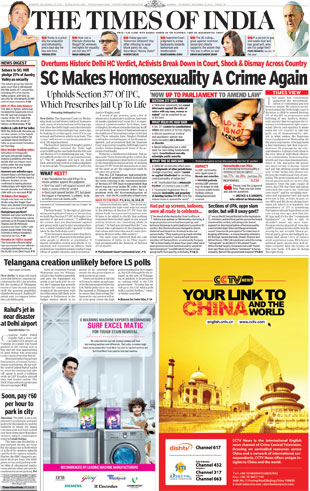
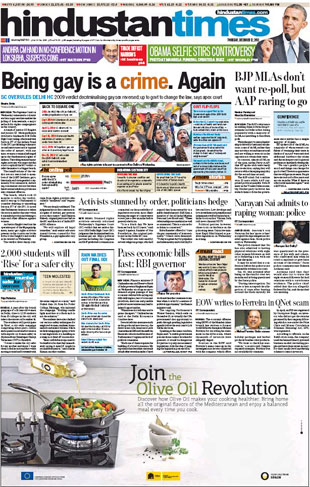
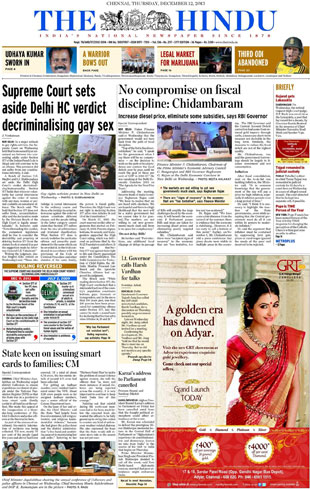
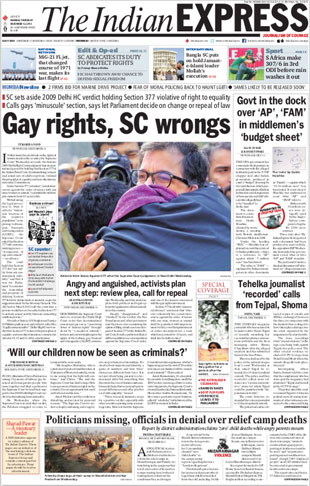
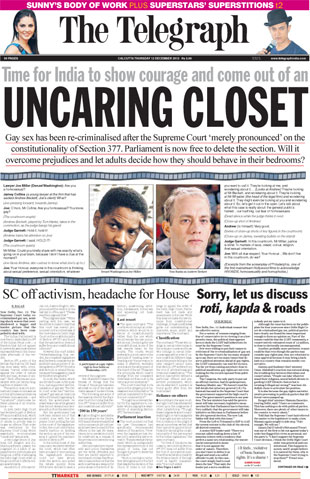
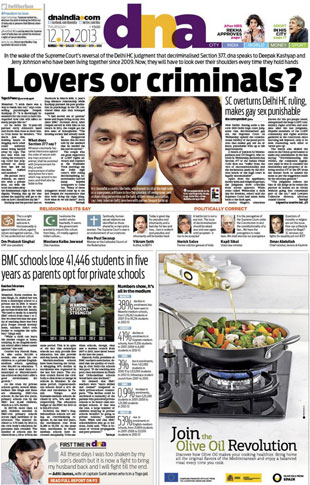
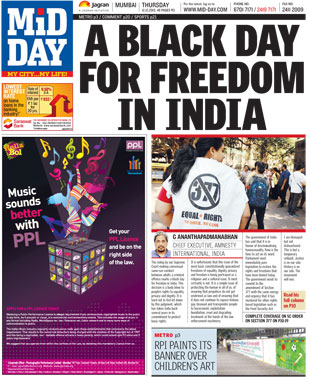
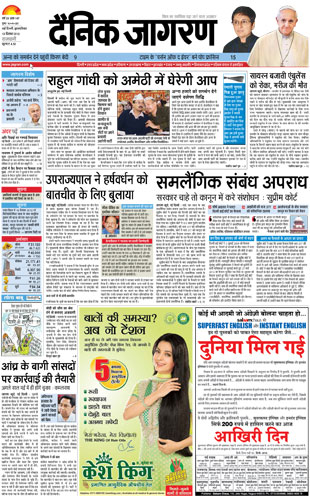
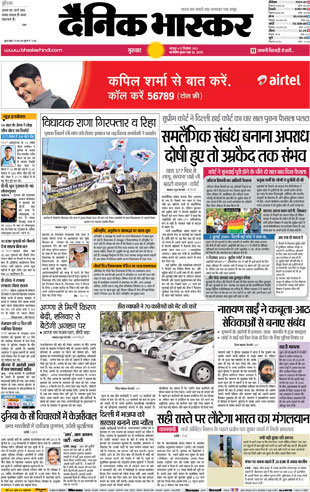
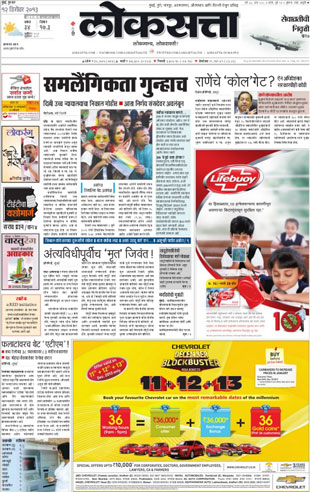
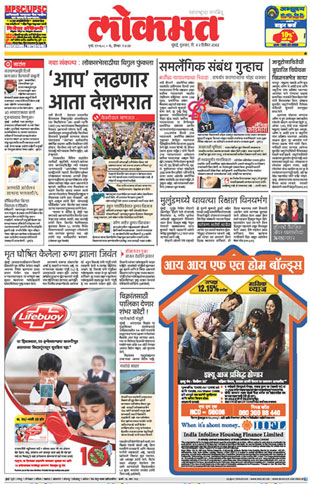
How the frontpages of select Indian newspapers looked on the Supreme Court’s Sec 377 order:
|
|
|
|
|
|
|
|
|
|
|
|
|
|
|
|
|
|
 How the frontpages of select Indian newspapers looked on the Supreme Court’s Sec 377 order:
|
|
|
|
|
|
|
|
|
|
|
|
|
|
|
|
|
|
By A Correspondent
With the Telecom Disputes Settlement Appellate Tribunal (TDSAT) dismissing the pleas of broadcasters against the TRAI ruling on the 10+2 minutes ad cap given the Supreme Court ruling that it (the TDSAT) cannot hear cases challenging TRAI regulations, the News Broadcaster Association and music channels are reported to getting set to approach the High Court on the issue.
Although an NBA member we spoke with wouldn’t come on record, the decision on approaching the High Court had been taken immediately after the Supreme Court decision as the TDSAT decision of dismissal was imminent.
However, given that the TRAI’s 10+2 regulation is in force, there is an urgency to file petitions in the High Court. News and music channels believe that the ad curtailment regulation will drive them out of business, and while they are in broad agreement of bringing down the ad duration, they believe 10+2 minutes is unachievable.
By Shreya Roy & Saumya Bhattacharya
A slew of measures rolled out by leading companies such as IBM, Google, Infosys, etc, to ensure that employees with an alternate sexual orientation are not disrespected, harassed or discriminated against, may be undone by the Supreme Court ruling on Wednesday, HR, legal experts and gay rights activists say.
The top court pronounced that gay sex is illegal, overturning a 2009 Delhi High Court judgement that had decriminalised homosexuality.
5-10% of India Inc’s workforce
“With Section 377 being upheld, companies will find it even more difficult to have the tough conversations that are required in order to be fully inclusive,” said Saundarya Rajesh, founder-president, Avtar Career Creators & Flexi Careers India.
“This gives leeway to discriminate against colleagues from the LGBT community, and more room for taunts, and harassment,” Anjali Gopalan, founder, Naz India Foundation added. “In the minds of people, this criminalises the homosexual individual and sets back years of work companies have done for inclusion.”
“The focus at Infosys has been to ensure employees have a safe and harassmentfree workplace irrespective of their sexual orientation or gender identity,” an Infosys spokesperson said via email. “We do not foresee any changes to the policies that we have.” Infosys Gay Lesbian employees and You (IGLU) aims to create a safe and respectful work environment for employees from the LGBT community.
It conducts awareness programs and exclusive events to create awareness and foster inclusion. “We are reviewing the situation and will want to understand the full legal implication of the ruling,” a Google spokesperson said. The company set up it Gayglers network aimed at creating an inclusive work environment by sensitising staff and increasing awareness on LGBT issues in India in 2010.
The LGBT community makes up about 5-10% of India Inc’s workforce, according to a LGBT Resource Guide created by Google, IBM, Goldman Sachs and Community Business last year. Nearly a third of 455 LGBT employees reported facing harassment in the workplace, according to ‘Out’ number in India, LGBT Workplace Diversity and Inclusion Survey 2011-2012, conducted by Mingle (Mission for Indian Gay and Lesbian Empowerment).
As many as 80% report hearing homophobic comments, jokes or anti-gay rhetoric at their workplace.