Tag: Hindu

  • Sachin Kalbag is back at Mid-Day, as Editor-in-Chief


    Sachin Kalbag
    Sachin Kalbag

    Senior journalist Sachin Kalbag has been appointed Editor-in-Chief (Print and Digital). He has joined the Dainik Jagran group-owned Mumbai daily today. He will also oversee the group’s weekly paper, Sunday Mid-Day and the website, mid-day.com.

    This is Kalbag’s third stint with the paper, having joined it as a trainee in 1994. He has also worked across various publications over the last three decades, and other than being Editor of Mid-Day from 2011 to 2015, he was also Resident Editor of The Hindu’s Mumbai edition (2015-18) and Executive Editor of Hindustan Times (2018-22). Since 2022, he has been working with The Takshashila Institution as Senior Fellow. For a bit, he was also Washington DC correspondent with the now-suspended DNA newspaper.

    Kalbag takes charge from Tinaz Nooshian who has moved on.


  • Suresh Balakrishna joins Hindu as Chief Revenue Officer

    Suresh Balakrishna

    By A Correspondent

    Senior media professional Suresh Balakrishna has joined The Hindu group as Chief Revenue Officer. MxM learns that he has joined the Chennai-based group today (Oct 31).

    In July this year, Balakrishna had announced his moving on as CEO South Asia and Middle East of Kinetic Worldwide, the out-of-home agency of the WPP group. Earlier, he worked with BPN, Initiative and Rapport at the IPG Mediabrands group and a slew of media groups including DNA, India Today, Hindustan Times, Zee Entertainment and The Times of India group.

  • Mother-of-all-slip-ups as Mumbai Mirror publishes matrimonial ad praising ‘Hindu’

    By A Correspondent


    Given that we aren’t quite in the market for either a groom or a bride, we normally give the matrimonial ads in the various papers a miss. But when we were alerted about it later in the evening, we couldn’t help laughing out loud. Well, actually it was more of rolling on the floor laughing out loud. Or ROFLOL, in whatsapp-ese.


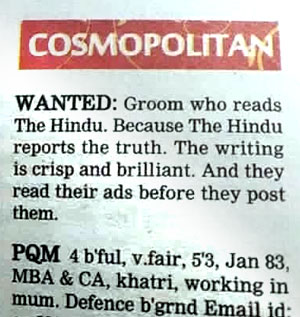
    So there was this matrimonial ad on Page 39 of Mumbai Mirror yesterday (Sunday, June 7), under the Cosmpolitan sub-headed. It started with:  “WANTED: Groom who reads The Hindu.”


    It was okay until then, but it later became evident that someone in the Times of India classified sales room has been had. Read this: “Because The Hindu reports the truth. The writing is crisp and brilliant.”


    It was clear that this is someone from a rival publication’s dirty tricks department. We’ve heard that the winds of change are blowing at the Mount Road MahaVishnu (as the Hindu is known, given its HQ is located on Mount Road in Chennai and it’s revered much by readers and all constituents), but we are not sure if the Hindu could take a joke to this level.


    Or it could be some other competitor, who will now use this as a testimony of the standards that it follows.


    Or it could be from someone within the system out to crucify and embarrass the biggie heading the matrimonials department.But the last line in that ad is what will really hurt Bennett, Coleman and Company Limited hard, and make everyone in that organisation hand his/her head in shame. “And they read their ads before they post them.”


    Read the entire ad again: “WANTED: Groom who reads The Hindu. Because The Hindu reports the truth. The writing is crisp and brilliant. And they read their ads before they post them.”


    In Bambaiyya, in the typical ‘tapori language of Mumbai’, one would say: “Poora, khol diya, bhai”. Or “Ijjat ka royal falooda banayaa”. Indeed.


    An important gatekeeping lesson for not just the folks at BCCL, but in every newsroom in the country. Watch that classified ad before  it’s published!


    Meanwhile, even though ideally some heads ought to roll for what’s happened, we would urge the BCCL management to handle this with care. And if you are going to sack/transfer the juniormost employee for this, ensure that his/her biggest boss also gets the same treatment.


    Uff, did we say a bit too much? Kya?

  • Ranjona Banerji: Indian journalism exposed by ‘one year’ coverage


    By Ranjona Banerji


    The great gaps in Indian journalism have been exposed by the coverage of one year of the Narendra Modi government at the Centre. And also, the great divide within.


    The media, print, television and digital (if only we could add radio to this list), have embarked on a first anniversary analysis of the government’s performance. This includes report cards, which former prime minister Manmohan Singh used to do with his Cabinet.


    However, who do you find to both praise and critique the government’s performance and appear to be objective? Commentators and analysts have been very sharply divided between pro-Modi and anti-Modi since the nation kicked into election mode in 2014. The supporters are usually either BJP members or open admirers. The anti-brigade are the usual suspects and somewhat larger in number because they include academics and activists.


    The only recourse therefore to “balanced” coverage is to ask members of the BJP itself and BJP-appointed members of organisations or pro-BJP corporate to assess the government’s performance. Obviously there is no balance there at all but perhaps there is no option.


    So that’s as far as columnists and analysts go. What about bog-standard newspaper coverage? Here we see, more or less, straight outright hero worship. The Times of India’s Mumbai edition gives the Modi government over 77 per cent on May 26, the anniversary of the swearing-in or anointment as TV anchors preferred to gush. Oddly a survey for May 16, the first anniversary of the election results, in the same newspaper, showed many Indians, especially those living in Mumbai, not quite so happy with the government’s performance. Perhaps something dramatic happened in the last 10 days that the rest of us are unaware of?


    The Economic Times outdid its sibling paper with its 20 or more days of coverage and analysis of the first year. The paper on May 26 led with the headline “Lage Raho Narendrabhai”, a salute to the successful Lage Raho Munnabhai movies about the life and times of a lovable petty gangster. Not sure if the editors saw the irony there or had not seen the movies… Judging by the gush and mush, I would reckon they thought they were just being super-clever.


    The Hindustan Times, Hindu, Telegraph, Indian Express and so on follow the model but with comparatively less hero worship… but am not sure that that’s saying a lot… TV is so idiotically breathlessly ra-ra that analysis is sometimes not possible. The websites have managed to be better sources of opinion than newspapers but is that because they depend not as much on advertising revenue?


    **


    Rather than speaking to so many “experts”, how would it have worked if newspaper reporters or maybe editors themselves, actually ventured out to the streets to speak to the general public. After all, they are the ones who vote and who wanted “achche din” after four years of stagnation. Had these people understood that the promises made were dismissed as “jumla” or that the promised good days were not supposed to arrive for the next 60 years?


    It might have been interesting to know how editors would spin the word on the street. Surveys are so much easier and so what if they’re not always right? You can always increase the margin of error to plus-minus 15 per cent, no?


    The foreign media, perhaps most interested in India because of Modi, has been more balanced in their assessment. This is actually a scathing indictment of the Indian media as a whole because it means that too many managements and editors put business interests ahead of truth… Hmm, what’s new, eh?


    **


    Meanwhile, some Hindi newspapers reported that chairs were broken by crowds angry with Modi’s one-year celebration speech in Mathura on Sunday. Did any English newspaper or TV channel report this?


    Ranjona Banerji is a senior journalist and commentator. She is also Consulting Editor, MxMIndia. The views expressed here are her own. She can be reached via Twitter at @ranjona


  • HT, Hindu & ABP groups get together to offer single-platform reach to advertisers

    By A Correspondent


    Six leading publications of the country – Hindustan Times, Hindustan, The Hindu, The Hindu Tamil, The Telegraph and Ananda Bazar Patrika have come together and formed the OneIndia group as a platform to facilitate reach to the largest print audience with a single advertisement.


    OneIndia, available by invitation to select display advertisers only, offers the unique benefit of a single-platform reach comparable and incremental to television, along with the many clear benefits of print, such as immediacy, impact, comprehension, credibility, and a clutter-free environment, to name a few.


    Talking about the key idea behind this alliance, Benoy Roychowdhury, Executive Director, HT Media Ltd., said, “The idea behind OneIndia is to provide an unduplicated reach like never before, along with a single-window service, in order to invite non-print and infrequent print advertisers to experience and profit from the significant benefits of print advertising.”


    Apart from the fact that print media readership is significantly more upmarket than television, several research studies globally have also demonstrated that print plus TV has driven more than 20 per cent incremental push-through in brand equity compared to TV alone. Further, some recent media multiplier research studies by leading international research agencies have demonstrated that print advertising in Asia-Pacific indexes three times more than TV on RoI, and five times more on brand impact.


  • Ranjona Banerji: The shame of the PR influence on the media

    By Ranjona Banerji


    It is interesting indeed to see that newspapers have chosen to report on the Maharashtra government’s decision to ban the sale of Mahyco’s Bt cotton seeds in the state but has not gone very far beyond that. In another story on Friday morning, a Parliamentary panel has sought a probe into the current stand-off over the introduction of Bt brinjal in to India.


    Criticism of Bt cotton in the media started off by being as expected but soon buckled under the tremendous pressure brought upon it by Mahyco Monsanto Biotech. Earlier in this column we have discussed the “expose” on The Times of India done by P Sainath in the Hindu. The marketing department of the TOI used articles done after a Mahyco Monsanto junket to promote the company, years after they were originally written.


    Although there have long been allegations that the forced or over-encouraged use of genetically-engineered cotton seeds have been detrimental to farmers as yields have fallen and land has to be fallow for too long. The initial success of Bt cotton, coupled with the promises made, led to high expectations from farmers and a corresponding high debt burden. This in turn led to most of the suicides by farmers is what most activists and social workers have alleged.


    While many such stories appeared initially, the enormous pressure brought upon the media by the company and by the government saw the stories petering out. Monsanto, the American company and Mahyco, the government venture, both employed very persuasive PR to push their case. The Sainath column in Hindu, in fact, went through all the mistakes and misrepresentations in the Times of India Bt cotton junket, point by point. A Parliamentary committee which went to the same areas of Maharashtra a few months later found an area rife with debt and suicides – sometimes quoting the same people who claimed to be happy in the TOI report.


    In Friday’s papers, TOI has a single column story while Hindustan Times has a more detailed report.


    The shame of the PR influence on the media is not just about glamour or lifestyle stuff, although that is rampant and in some cases institutionalised. But when it comes to corporate pressure, especially from aggressive companies who are willing to use the law and every other avenue to protect themselves from criticism, the media comes up against a formidable opponent. In the case of Monsanto and Mahyco, having initially put up a fight, most of the media seems to have capitulated. Friday’s stories have been carried only because the Maharashtra government has finally accepted that the shift to genetically modified cotton has not been the universal success initially claimed.


    Time perhaps for the media to find its teeth again?


  • IRS 2011Q4: Not much change in rankings but dailies witness significant growth

    By A Correspondent


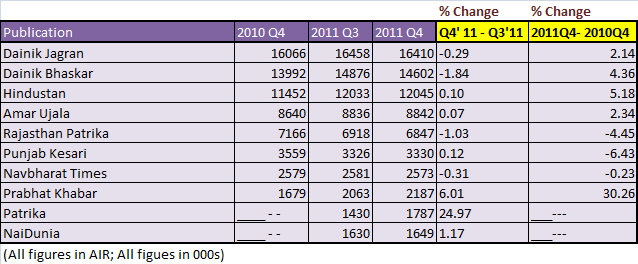
    Top 10 Hindi Dailies:

    IRS Q4, 2010 v/s IRS Q4, 2011

    There is not much of a difference in the rankings of the Top 10 Hindi Dailies. Dainik Jagran, Dainik Bhaskar,Hindustan, Amar Ujala and Rajasthan Patrika continue as the Top 5 Hindi Dailies. When compared to IRS 2010 Q4, IRS 2011 Q4 reveals the Top 4 Hindi Dailies, namely Dainik Jagran, Dainik Bhaskar,Hindustanand Amar Ujala have further strengthened their readership.


    A look at percentage change from Q4, 2010 to Q4, 2011 finds that Dainik Jagran has witnessed a growth of 2.14 per cent, Dainik Bhaskar grew by 4.36 per cent,Hindustanby 5.18 per cent while Amar Ujala grew by 2.34 per cent. The only Hindi daily to have witnessed double digit growth is Prabhat Khabar with a whopping 30.26 per cent growth in Q4, 2011 as against Q4, 2010. A total of five Hindi dailies have witnessed growth Quarter on Quarter.


    Q3, 2011 Vs Q4, 2011

    But the results for IRS Q4, 2011 Vs Q3, 2011 have a slightly different story to tell. The top two most read Hindi dailies – Dainik Jagran and Dainik Bhaskar – have witnessed a decline in Average Issue Readership (AIR), the decline is however marginal. Besides Dainik Jagran and Dainik Bhaskar, the Hindi dailies to have recorded growth in Q4, 2011 v/s Q3, 2011 are Hindustan, Amar Ujala, Punjab Kesari and Prabhat Khabar.


    Top 10 English Dailies:

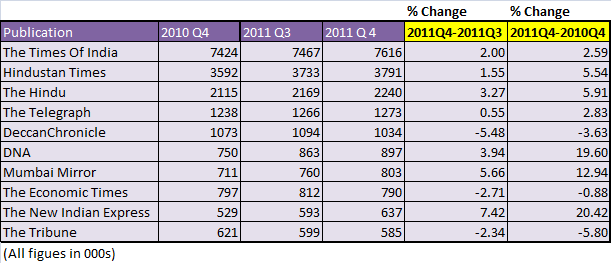
    IRS Q4, 2010 Vs IRS Q4, 2011:

    The English dailies have performed exceedingly well in Q4, 2011. Seven out of the Top 10 English dailies have registered growth in their AIR. While DNA, Mumbai Mirror and The New Indian Express have registered growth in double digits, the top four English Dailies: The Times of India, Hindustan Times, The Hindu and The Telegraph have also witnessed growth quarter on quarter.


    IRS Q4, 2011 Vs Q3, 2011:

    The results for Q4, 2011 in comparison to the previous quarter also highlight the growth for most of the top Ten English dailies.


    Top 10 Language Dailies:

    IRS Q4, 2010 Vs IRS Q4, 2011:

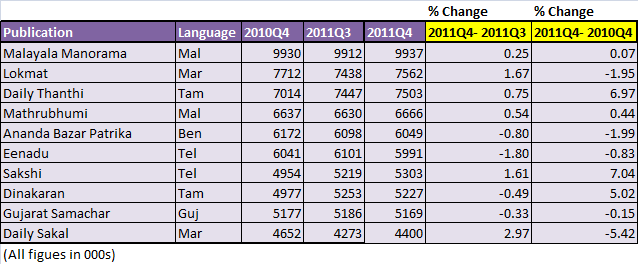
    The Q4, 2011 results as compared to the Q4, 2010 results have shown mixed reactions for Language dailies as only five publications witnessed growth since Q4, 2010 to Q4, 2011. Malayala Manorama continues to be the number one publication among the Language Dailies. According to IRS Q4, 2011 v/s Q4, 2010 findings, the Malayalam daily grew 0.07 per cent.


    Ranked second is Marathi daily, Lokmat which saw a decline of 1.95 per cent. The other Language dailies to have registered growth in their AIR are Daily Thanthi, Mathrubhumi, Sakshi and Dinakaran.


    Unlike the top two dailies, Daily Thanthi, ranked as third Language daily, grew by 6.97 per cent in IRS Q4, 2011 when compared to IRS Q4, 2010.


    It has been observed that the Malayalam dailies – Malayala Manorama and Mathrubhumi and the Tamil dailies – Daily Thanthi and Dinakaran have recorded growth in their AIR. Malayalam, Marathi, Tamil, Telugu, Gujarati and Bengali are some of the popular language dailies to have found a place in the Top 10 Language dailies.


    IRS Q4, 2011 v/s Q3, 2011:

    The top four Language dailies: Malayala Manorama, Lokmat, Daily Thanthi and Mathrubhumi have registered growth in their AIR numbers in IRS Q4, 2011 v/s IRS Q3, 2011. Besides the top four language dailies, Sakshi, the Telugu daily and Daily Sakal, the Marathi daily have also witnessed growth in their readership numbers.


    AIR or Average Issue Readership is defined as the readers of an average issue of a publication i.e. the estimated number of those who have read or looked at any issue of the publication within a specified time interval, which is equal to the periodicity of the publication (excluding the day of the interview). This is the preferred currency of media agencies across the country though often publications quote Total Readership (TR) when their AIR numbers are not impressive. MxMIndia only uses AIR in its IRS reportage.


  • Making fun of Page 3 culture

    By Ranjona Banerji


    Have to say, I just love the new Hindu ads. Making fun of your competition is not just unexpected from India’s most sober newspaper but it is also rare in India. Are these ads a direct response to The Times of India’s Chennai campaign, where the ads alleged that the Hindu put people to sleep? Perhaps not, since the Hindu campaign seems all-India and directly accuses the Times of dumbing its readers down. There is nothing implied in the Hindu ad – we can clearly see that all the idiots being quizzed on their knowledge (or lack of it) claim to read The Times of India, bleeped out though the name may be.


    The print ads include one which says “we also have pages 1,2, 4, 6” and so on, a clear dig at The Times’s introduction of society and celebrity news on Page 3 of the Bombay Times many years ago. “Page 3” culture is now part of our lexicon and indeed Madhur Bhandarkar even made a film about it, almost as scathing as the Hindu’s ads. The funny thing is that we always have had a society-celebrity media, what Bombay Times did was to both magnify and expand it. The even funnier thing is that almost every other publication in the country was quick to copy the TOI. Even the Hindu, which may not have a celebrity circus page, was increased its light feature content.


    It’s also curious that DNA ran a very similar campaign to the Hindu’s recently – interviewing young people who knew nothing about anything except Bollywood and then it turns out that they only read DNA After Hrs! In DNA’s case, there was apparent pride in ignorance; Hindu mocks it.


    In these times, when the media itself has become the news, the Hindu ads – done by Ogilvy – are bound to get attention and approval. There are many who believe that trivialisation of the media is dangerous and that there is cynical marketing manipulation of our apparent obsession with Bollywood. The Press Council of India chairman Markandey Katju is probably nodding away happily, especially when he sees line like “Because government malfunctions matter more than wardrobe malfunctions” – another of the Hindu’s print ads.


    For my money however far worse than the trivialisation of newspapers is the fact that all celebrity news and gossip is actually fake – paid for by the stars, studios, sponsors and so on. The readers are fooled into believing that what they are reading is the result of some digging up by journalists – as it used to be in the old days, even film news. The truth of course is that it is handed to newspapers by public relations companies or by the marketing department to the editorial staff.


    Bad enough that we are trivial, we are also, it seems, foolish and exploited!


  • Arun Anant will be CEO, Hindu from Feb 6

    By Tuhina Anand


    It is learnt from sources close to the development that Mr Arun Anant is all set to join Kasturi & Sons Ltd as its Chief Executive Officer. He is slated to join on February 6, 2012 and will be responsible for all the non-editorial operations of the company.


    Mr Anant’s appointment comes following the recent development of Mr N Ram, the Editor-in-Chief and Publisher of The Hindu, Business Line, Frontline, and Sportstar stepping down thus paving way for restructuring at the senior level. Mr Ram had mentioned the appointment of a new CEO very soon.


    Mr. Anant, a B. Tech from BHU and a Post-Graduate in Management from IIM Ahmadabad, has earlier worked with The Economic Times and was the CEO of UTVi (now Bloomberg UTV). After moving from UTVi, he has set a management consulting firm called Inc Value. He has also worked on the agency side at Lowe where he was the GM Strategy.


    Also read

    N Ram to call it a day at Hindu

    http://www.mxmindia.com/2012/01/n-ram-to-call-it-a-day-at-hindu/


    Don’t be complacent: N Ram’s goodbye letter

    http://www.mxmindia.com/2012/01/dont-be-complacent-n-rams-goodbye-letter/


    Photograph: incvalue.com

  • Hindu on expansion (and consolidation) mode

    By Tuhina Anand


    The Hindu Group seems to be in the midst of activity with plans of new launches, expanding footprint and getting new people on board. There has also been talks of  The Hindu shutting its printing press in Delhi to rationalise its operational costs. K Balaji, Managing Director, Kasturi and Sons Limited talks to MxMIndia exclusively and shares details on company’s growth plan.


    Talking about The Hindu beyond the Tamil Nadu market, Mr Balaji said, “We have traditionally been strong in Kerala and Andhra Pradesh with the possible exception of Hyderabad. We are the No.1 English Daily in these markets. In Kerala we have editions out of Trivandrum and Kochi. We are strengthening our presence by adding Kozhikode early next year. Although Kerala is dominated by Malayalam dailies, we are seeing a trend in English language aspiration. People want to learn the language for personal and professional reasons. This we feel will grow the English readership in that state. We are well poised to nurture that market.”


    He added, “Andhra Pradesh in general is turning out to be an English readership aspirational market, and we feel with our core strengths we are growing at a good rate. We do have plans to supplement these markets with growth in Bangalore and Hyderabad, which will further consolidate our position as the largest read English newspaper inSouth India.”


    It is learnt that The Hindu in all probability is looking at its Kozhikode launch on January 14, 2012. It is also learnt that Smart Buy (The Hindu BusinessLine supplement) with focus on metro is expanding its footprint. Talking about Smart Buy, Mr Balaji said, “This product was launched three years back and the response for it has been encouraging and we plan to take it to the next set of cities in the south such as Coimbatore.” It is learnt that the Coimbatore entry for Smart Buy is slated for December 14, 2011.


    It is also leant that The Hindu is roping in a Vice President for its circulation, a post which has been vacant for a while. Though details on the new appointment could not be obtained, Mr Balaji, responded, “This is part of the strategy to strengthen the senior management team to take the organization to the next level of growth.”


    On the rumours to shut the production facility in Delhi, he said, “We are not shutting down our Delhi Edition. Our production facility at Delhi has been catering to the entire Northern India. A growing circulation and capacity constraint meant that the paper was reaching late in several markets. Earlier this year, we entered into a strategic alliance with Hindustan Times and as part of the tie up we are utilizing their printing facilities in the north to the service to our readers. We have already started our printing from Mohali, Allahabad and Noida, and expect to add Lucknow to the list.”


    “Yes, we have charted a growth plan to consolidate existing markets as well as tap into new markets for both The Hindu and Businessline. It is too early to comment on our plans for growth,” concluded Mr Balaji.