Tag: Hindi

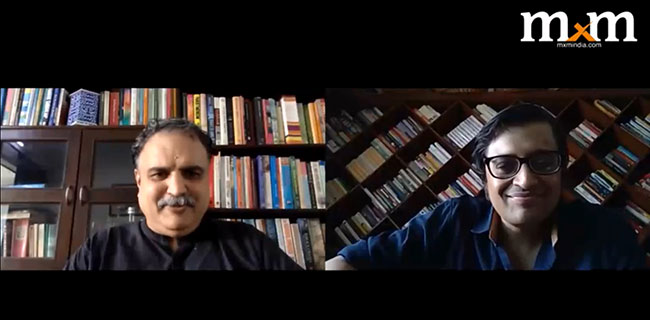
  • Arnab Goswami Unplugged


    By A Correspondent


    For the second consecutive week, Republic Bharat has been the numero uno Hindi news channel as per data provided by BARC. In Week 33 – which is August 15 to 21, 2020, Republic Bharat is ahead of all other Hindi news channels in terms of weekly impressions in the overall, rural and urban segments as per info on the BARC website (see chart below).
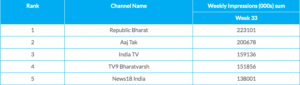
     

    Source: BARC India. Week 33: Aug 15-21, 2020. HSM (U+R) : NCCS All : 2+ Individuals

    The Republic business team also furnished us with data which highlights its performance given some slicing of demographics and we’ve requested BARC to ratify it. If and when we get the approval, we will carry it here.


    While the reason for this red hot interview was the success of Republic Bharat in the ratings roster and hence the emergence of Republic as the #1 news network in these two key languages, when you are chatting with an Arnab Goswami, you can’t not stray into issues like his journalism, the noise factor on his shows, charges of his BJP bias, etc etc.


    So did we do an Arnab on Arnab? No, we didn’t. We let him speak. We didn’t interject. No change in body language to put him on the defensive. This interview was done in a flash. We had to set up the Zoom call in less than five minutes. So we weren’t armed with specific instances when he has stretched himself on telly. So if were to judge it ourselves, yes, we could’ve have been tougher on him. Grilled him.


    But, then, we aren’t Arnab Goswami. MxMIndia editor-in-chief Pradyuman Maheshwari interviewed him the way he normally conducts other interviews. Asked him the relevant questions, joked around a bit.


    It’s not an Arnab on Arnab. It’s an MxM with Arnab. And Arnab let Pradyuman speak. Ha ha. Watch. Enjoy. Like.


    If you’d like to share this others, you can share this link. Or if you want to only share the Youtube link, please take this: http://bit.ly/mxmwitharnab



  • The Anchor: Sanjay Reddy on 7 reasons why regional GECs should be treated differently

    #1 Ethnicity and Culture: India is a multi-cultural society, where every state has its own culture and language. Shows that do well in Hindi Speaking Markets (HSM) might not do so well in Tamil Nadu or even Andhra Pradesh. The GECs of the market need to show content that is in tandem with the culture of the masses.


    #2 Identification & Familiarity: Viewers like to feel associated with content that they can identify with and which feels familiar. Any major shift from this safe zone can sometimes (not always) lead to the viewer leaving the show. Most of these regional markets have their own movie Industries, showcasing their need for differentiation and attraction to what seems familiar.


    #3 Targeted Advertising: Most retailers look for the most cost-effective way to reach their target audience. If the TG is based only in Maharashtra, it does not make sense to advertise on a Hindi channel as the spillover would be tremendous. Thanks to the presence of Marathi channels in the region, the ROI is high and the spillover is limited. Having a strong GEC with content targeted at the regional market makes it a more appealing and value-for-money proposition for the advertiser.


    #4 Continued Experiments with Programming: Regional GECs speak to a smaller audience compared to the Hindi GECs. Hindi GEC need to provide content that caters across HSM giving it the chance to experiment with content and create shows that might not appeal to masses in small towns but might end up doing well in metros and big cities. In case of Regional TV GECs, yes sure here also people can experiment but anything too over the top might not go well will the audience and as most brands look at regional TV for targeted advertising, there are only a few mistakes that a channel can make, a typical chicken and egg situation.


    #5 Relationships in South and North GECs: When it comes to relationships, North and South India have a few differences. In AP a man can get married to his sister’s daughter – something that is totally unheard of in the north, similarly a marriage between a man and his bhabhi is an accepted fact, something that won’t be taken well in AP. This was just a small example but surely both GECs need to have different treatment in story structure and relationships.


    #6 Production Costs: Given the kind of advertising spends a regional channel sees, compared to a national Hindi GEC, it would be unfair to compare the two. Sets from the top Hindi shows are too high-maintenance for regional channels. There are regional channels that have spent a lot on their sets and shows but there can be only one show in the channel that can get such lavish budgets.


    #7 Influence of Western Culture: HSMs are more prone to western cultural influences, something that can be seen with successful shows like Indian Idol, India’s Got Talent, KBC, Big Boss, Masterchef India etc, which are remakes of popular international shows. Shows with a contemporary packaging haven’t done too well in regional markets.


    Sanjay Reddy is EVP – South Cluster, Zee Entertainment Enterprises Limited

  • Business Standard celebrates use of Hindi in biz

    By Akash Raha


    Business Standard Hindi recently celebrated Hindi Diwas and activated the initiative which was aimed at promoting the use of Hindi language in business parlance. This initiative of Business Standard is going to commence at the end of this month. The tag line for this initiative is “Behtar Business woh, jo aapke bhaasha mein ho!”


    Speaking on necessity and efficacy of spreading the business language in Hindi, Mr Arun Natesh, Head-Marketing, Business Standard said, “This initiative was important as there are a lot of people in the country do their business in Hindi, because that is the language of the masses. But inspite of that, there are a lot of words and terminologies that people use that is not easily understandable as it lacks homogeneity. So the idea is to promote business terminology and language in Hindi. Since our newspaper gives them comprehensive information on business, our initiative empowers them in understanding the effective terminology of use.”


    For this initiative, they compiled a special pullout which looked at the usage of the Hindi language online, in mobile and the growing interest globally for the language by the likes of Microsoft and Google.


    As a part of this initiative Business Standard organized quizzes testing knowledge of business terminology. Enthusiastic participation was seen across Mumbai, Delhi, Lucknow, Patna, Bhopal, Raipur and Kolkata. Business Standard went to the premises of organizations like SBI, LIC, Allahabad Bank, NABARD, BHEL, Bhilai Steel Plant, Bank of Baroda, Union Bank etc.


    Business Standard, in Hindi, reaches out to small and medium entrepreneurs, traders, small investors etc. Keeping this focus, the paper itself is designed around meeting this need by adding locally relevant content. Business Standard also brings to the reader what its editorial team is famed for – incisive and in-depth analysis of events. In recent times, the paper has strengthened the coverage of local commodity information immensely benefiting the large trading community.