Kantar has launched #PlanetY, a study providing an nderstanding of the attitudes, values and behaviour of today’s youth. The study uncovers insights of two generations – Centennials and Millennials; based on interviews with over 7500 upmarket youngsters (15-29-year-olds) across metros and mini metros.
Talking about the study, Hemant Mehta, MD, Insights Division, South Asia, Kantar, said,:“Centennials and GenZ are increasingly becoming key consumer segments for the marketers. Selling to the youth is a challenge faced by every brand today. With youth leading their lives online and through their smart phones, it is imperative that marketers understand the various touch points in their target consumers’ lives as well as decode the distinct roles that different digital properties play. This led us to design a comprehensive study like #PlanetY which tries to decode this consumer segment in a never before seen level of granularity. We are confident that this will help marketers understand their young consumers better and connect with them innovatively.”
Kantar has partnered with Frrole to roll out TGI Social+, a tool that will bring together consumer profiles from TGI embedded with social media analytics to provide a comprehensive understanding of online consumers.
Commenting on the new offer, Hemant Mehta, Managing Director, Insights Division, Kantar said: “We know that consumers express themselves more openly and candidly when they are online. Social media analytics gives marketers a unique opportunity to comprehensively understand their consumers, gather their feedback, their likes and dislikes, their issues and interests effectively. This 360-degree understanding of their consumers can help them tailor their messages sharply and make them more relevant and reach the right audience. TGI Social+ is our unique, first of its kind offer that helps brands to engage and talk to their consumers in their language using relevant themes, at relevant times and on relevant online channels.”
Added Amarpreet Kalkat, CEO, Frrole: “We are delighted to partner with a global leader like Kantar to bring together online and offline insights in one place, creating a first of its kind offering that has been missing from the arsenal of marketing teams. It allows both of our customers on the agency as well as brand side to develop a holistic picture of their consumer and the market. It also allows them to answer previously unanswered question during planning and measurement, without having to bother about the hitherto isolated nature of data sources. That will now be a thing of the past for those who use TGI Social+.”
Kantar IMRB has released its ICube 2018 report on digital adoption and usage trends in India. The annual tracking study, considered as the currency for digital adoption in the country, gauges the changing digital ecosystem in India, measuring Internet usage by demographic, activity and device segments.
Said Preeti Reddy, CEO, Kantar South Asia:  “The Internet is transforming the way consumers and marketers interact with each other in today’s digital world. Kantar IMRB’s ICube; which has tracked the digital evolution in India for last 20 years, provides key measurement metrics necessary for planning any digital marketing or communication initiative. ICube continues to provide government, policy makers, digital businesses, marketers and communication specialists the intelligence necessary to stay on top of the developments across different facets of digital platforms and services.â€
Key findings include:
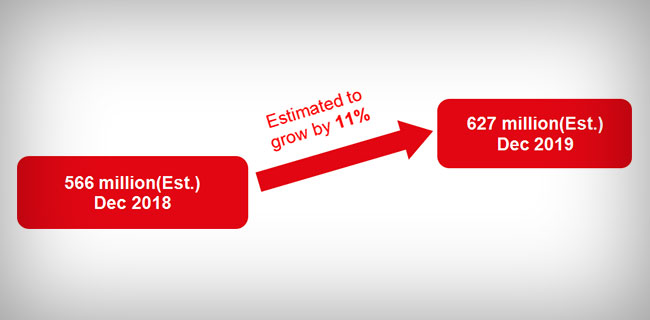
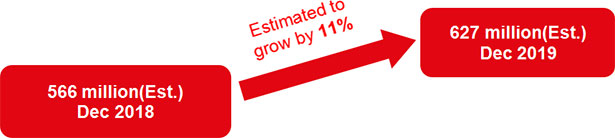
:: The number of Internet users in India has registered an annual growth of 18% and is estimated at 566 million as of December 2018 – 40% of overall internet penetration.
:: The report also projects double digit growth for 2019 and estimates that the number of internet users will reach 627 million by the end of this year.
:: Of the total user base, 88 percent, or 493 million Indians, are defined as regular users, having accessed internet in last 30 days. 293 million active internet users reside in urban India, while there are 200 million active users in rural India.
:: Unsurprisingly, the 97% of users use mobile phone as one of the devices to access Internet
Rural India’s Digital Frenzy
While internet users grew by 7% in urban India, reaching 315 million users in 2018, digital adoption is now being propelled by rural India – registering a 35% growth in internet users over the past year. It is now estimated that there are 251 million internet users in rural India, and this is expected to reach 290 million by the end of 2019.
Increased availability of bandwidth, cheap data plans and increased awareness driven by government programmes seem to have rapidly bridged the digital gap between urban and rural India. Consequently, the penetration in Rural India has increased from 9% in 2015 to 25% in 2018
:: Bihar shows the highest growth in new Internet user addition
With one of the highest growth rates in the state GDP, it is no wonder that Bihar registered the highest growth in Internet users across both urban and rural areas; registering a growth of 35% over last year. This is closely followed by Orissa.
Internet is now more gender balanced than ever before
The gender digital divide is now closing. Kantar ICUBE 2018 reports that women today comprise 42% of total Internet users. Besides their sheer presence in the digital universe, women are also equally engaged and active in the digital world – spending as much time on the Internet as men.
Added Hemant Mehta, Managing Director, Media and Digital, Kantar IMRB: “The latest edition of Kantar IMRB ICubeTM report shows that today the digital base in India is growing by over 75 million users each year – as much as the entire population of Germany! It is fascinating to note that the digital revolution is now sweeping small towns and villages perhaps driven by increased accessibility at affordable data costs. What is also particularly interesting, is the increase in the usage of digital in Rural India, where more than two-thirds of active internet users are now accessing the internet daily to meet their entertainment and communication needs. Marketers have a big opportunity today where they can use digital to reach their consumers – both in urban and rural India.â€
The Mobile Marketing Association (MMA), with Kantar IMRB have released a report titled ‘The Power of Mobile Gaming in India’, offering the latest data and insights on mobile gaming trends in the country. With India’s mobile app market growing at breakneck speed, mobile gaming platforms are increasingly commanding a substantial share of the advertising pie. The report was released in association with POKKT, a smart phone advertising platform for mobile games.
According to the report, three out of four Indian gamers play mobile games at least a twice a day, for an average of 60+ minutes, each day. Mobile gaming is also quite prevalent in Tier 2 and Tier 3 cities, with similar amounts of time spent on gaming by users in these regions. With over 250 million mobile gamers, India has emerged as one of the Top 5 gaming countries, globally. With so much time spent on mobile devices, there lies a huge opportunity for marketers to tap into the space.
“While it is common to assume that gamers tend come from a younger generation, this research has proven otherwise, and removes the stereotypes of a typical gamer. By changing their perception of what a “gamer†is, marketers can tap into a relatively untouched space and reach out to a sea of customers. Furthermore, since 55% of gamers perceive ads to be more personalised on gaming platforms, there is a much higher level of acceptance,†said Rohit Dadwal, Managing Director of MMA in Asia Pacific.
“The Indian market is already known to be a mobile-first economy. The fact that mobile gamers are on their devices twice a day or more, there is ample opportunity for marketers to get creative in the way they run their marketing strategy. Whether it’s through partnerships or simply putting in an algorithm to retarget customers, the potential for monetisation is huge,†added Moneka Khurana, Country Head, MMA India.
Said Hemant Mehta, Managing Director, Kantar IMRB and Chief Strategy Officer, Kantar South Asia: “Consumers have taken to mobile gaming in a big way, yet it still remains a relatively untapped advertising channel in India. Our study shows that mobile gaming is truly mainstream today, attracting a wide range of audiences. Besides being a highly sticky medium, it offers high engagement levels akin to OTT platforms. Personally, one of the most interesting findings was the low resistance to in-game advertising, as compared to other channels. This is a golden opportunity for marketers to communicate with their consumers, especially since mobile gamers perceive in-game ads to be more personalized and relevant than traditional media,â€.
Added Rohit Sharma, CEO & Co-founder, POKKT: “POKKT has today more than 140 million monthly users who are average spending more than 60 minutes every day playing mobile games on average. On top of this we have built huge machine learning and data capabilities to do better targeting for advertisers. Brands can certainly benefit from advertising on mobile gaming platforms due to the longer attention span given to mobile games, agreeing with the fact that mobile games is a huge platform for mobile advertising in India.â€
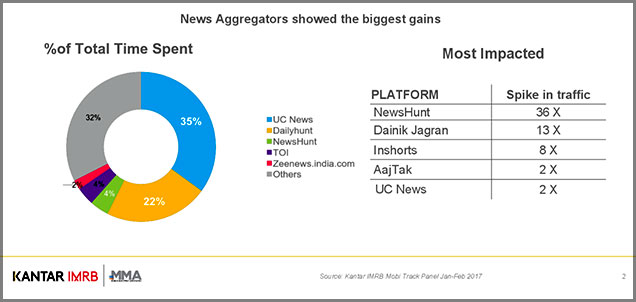
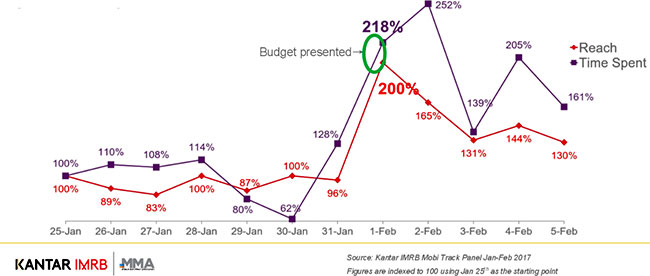
Coming in the wake of demonetisation, news platforms saw a surge in traction driven in large part by the Budget 2017-related narratives, as per a study conducted jointly by market insights major Kantar IMRB and the Mobile Marketing Association (MMA India). the A steady diet of budget forecasts contributed to an increase in overall time-spent in the days leading up to the Budget presentation. This was followed by a massive spike in engagement on February 1, the day of the Budget speech.
A second spike in traction was witnessed over the weekend following the Budget as readers caught up on in-depth analyses and the long-term implications of the Budget announcements. News aggregators drew the lion’s share of engagement among smartphone users—the top two aggregators accounted for almost 60% of total time-spent on news related content. The Times of India was the most popular of the standalone platforms with twice the traction of its nearest competitor Zee News. Platforms like Dainik Jagran, Inshorts, and AajTak saw the highest gains in traffic during this time, notes the study.
Kantar IMRB’s Mobi Track smartphone usage panel was used to analyse consumption of budget related content in the weeks leading upto and during the Budget 2017 presentation.
“Looking at the data from Kantar IMRB’s MobiTrak smartphone usage panel—the surge in budget-related news consumption confirms people’s attention and interest in the event. Engagement levels were expectedly highest among the digital generation i.e. 20-24 year olds —they accounted for the highest Reach and Time Spent  across all demographics. The desire for multiple points-of view was evident in the strong preference for news aggregators, a stark contrast to the behaviour of offline-readers who tend to limit their reading to a handful of print publicationsâ€, said Hemant Mehta, Managing Director, Media – Digital and Chief Strategy Officer, Kantar IMRB.
Added Preeti Desai, Country Manager India, MMA: “News consumption is undergoing two fundamental shifts across the globe including India. One is the rise in news audiences accessing news via their mobile devices, the other is the increase in people who read or watch news through social platforms. Mobile will continue to grow leaps and bounds as one of the primary mediums that Indians will access ‘News’ and the multiple spikes during 2017 budget showcases how fast Indians have adopted reading news not just in English but also in multiple languages (15+). It is important to note the second spike – post-Budget Day – the time spend is actually higher during the weekend and indicates that apart from short news Indians also reached out to various mobile news sources for longer in-depth analysis post the budget day. With rapid changes in the mobile landscape, it is important to keep a continuous pulse on the way consumers interact and these passive probes and insights on mobile usage in India by MMA and Kantar IMRB are of critical importance to the modern day marketers as they acknowledge mobile as the third largest advertising medium in India, after TV and Print. Mobile Ad spends are expected to grow to Rs10,000 crore in 2018 [Source: Mobile Ecosystem and Ad-Sizing Report India 2016].â€
The Mobile Marketing Association (MMA) in association with Kantar IMRB has released a report on Smartphones and Feature Phones Usage and Behaviour 2016-17 in India. The report studies the evolving nature of the Indian mobile consumers, and provides insights and behaviors individually on smartphones and feature phones.
KEY FINDINGS ON SMARTPHONES
I. Time spent on mobile surpasses any other media
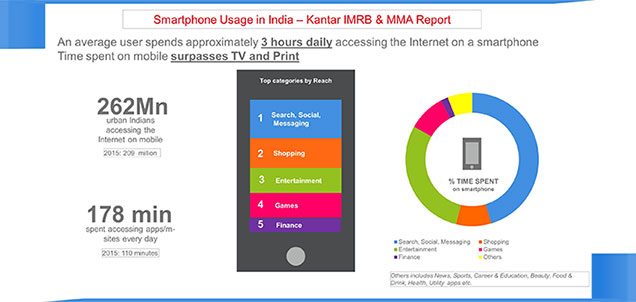
An average consumer spends 3 hours per day on their smartphones (an increase of 55% from 2015), which surpasses time spent on TV or any other media. Social media and messaging apps were the clear leaders accounting for almost 50% of all time spent on smartphones.
II. Women more engaged than Men
The study shows that Women spend 2x more time on their smartphones compared to Men – on YouTube and games. They also spent 80% more time on Facebook than their male counterparts.
III. Online shopping gains in leaps and bounds
Another finding revealed the rise of online shopping category, which now has 15% higher reach than the entertainment – making it the second most popular category in terms of reach.
KEY FINDINGS ON FEATURE PHONES
I. Prime users are from upper SECs
The study shows a whopping 75% of feature phone users were from the upper SECs, while only 25% of respondents were from SEC C, D and E (NCCS).
II. Feature phone users don’t intend to switch
A big revelation has been that almost 85% feature phone users do not intend to switch to smartphones on their next purchase indicating that the functional benefits of feature phones combined with their durability, battery life and ease of repair were highly coveted by these users.
III. Feature phones users spend more on mobile plans
Feature phone users spend more money on their mobile plans. The ARPUs was almost 20% higher compared to the national average.
Said D Shivakumar, Chairman and CEO, PepsiCo India Holdings and Chairman of the Mobile Marketing Association: “With over 85% mobile penetration, we are today one of the largest mobile markets globally and insights on mobile usage in India are of critical importance to the modern day marketer. We are in an age now where we need to seriously think about marketing measurement and attribution, giving marketers better measurements, tools and confidence in connecting marketing to business outcomes. A thorough understanding of the differential usage and consumer segments that are using smartphones and feature phones will only help marketers use their monies more efficiently. While most designing and applications are being targeted at smartphones, this report is a wake-up call. Today, the mobile is undeniably the closest we can get to our consumers, and it is this that will help marketers seek to understand – and leverage – a consumer’s path to purchaseâ€.
Added  Preeti Desai, Country Manager, Mobile Marketing Association India: “Mobile is clearly the third largest mass medium in terms of Ad spends in India today, with estimated spends in 2016 amounting to ₹.4,200 Cr. Hence it becomes very important for the industry to have credible research and measurement guidelines and reports, to help fully understand and leverage mobile’s ability to drive the future growth of business. With this in mind, MMA India has collaborated with Kantar IMRB to deep-dive into the dynamics implications and impact of smart phones and feature phones India focusing on each category separately and giving each their due focus. The insights of this study will be published in a series of industry reports that will go a long way in helping marketers use the medium effectively and efficiently. It is a great data set for marketers to reassess and optimize their spending with the most impactful allocations in their marketing mix, while leveraging mobile with double digit spend.â€
Hemant Mehta, Senior Vice President, media and retail, Kantar IMRB, said, “Mobile has had an outsized influence on the way consumers interact with each other, make decisions, transact and shop. This has significantly impacted the way companies and brands connect with their consumers and do business. But we’ve only seen the tip of the iceberg. With the advent of 4G, reduced data costs and free voice and SMS, we expect to see even more rapid changes in the mobile landscape. It is, therefore, important to keep a continuous pulse on the way consumers interact with and use their mobile phones. Along with MMA, we at Kantar IMRB have embarked on a journey to help marketers understand the impact of these changes and to identify emerging trends. The Smartphone and Feature phone reports are a step in this direction – providing an unbiased and insightful view on the evolution of mobile usage in India.â€
The report enables all members of the ecosystem to stay updated with consumer mobile trends and media consumption habits. Also at the same time, it elaborates the role of mobile as an influencer in the consumer path-to-purchase.
The weather was very unpredictable in Mumbai. But the interesting conference by IMRB International did not let it affect the moods of the people who attended it. K Ramakrishnan or Ramki as he is popularly known,General Manager and Country Head – Household Panel at IMRB Kantar World Panel and the host for the day, welcomed the audience to ‘Consumer Connections 2016’.
To explain the agenda in brief and to give the audiences a head start about what to expect from the conference this year, Ramakrishnan invited on stage Preeti Reddy, ‎CEO at Kantar Consumer Insights, South Asia, Kantar and Josep Montserrat, Global CEO at Kantar Worldpanel. They explained how useful this research will be for brands to reach out to consumers in a better way. Montserrat also focused on the work they have done and the potential that India has. For making the session a little fun, the host subjected the two experts to a quick round of rapid questions, which both answered quite rapidly as well as wittily. An example, when Reddy was asked what comes to her mind when she hears about research in India? Pat came her reply, “Over worked and under paid.â€
This was followed by the presentations about consumer trends to look forward to. Rashmi Nair, Group Business Director, IMRB Kantar Worldpanel presented about ‘What lies ahead for urban India in 2016’. Her presenting was engaging from the word go and she very intelligently incorporated many popular Bollywood movie dialogues to explain her topic. She gave example of Patanjali- the brand which doubled its sales in just one year. This shows the trend of demand for local brands. She also explained how more focus is now given on the aspirations and lifestyle of the rural people.
Next presenter Prafull Babar, Group Business Director, IMRB Kantar Worldpanel was an instant hit with the audience because he gave chocolates as a prize whoever gave a close enough answer to his questions. His topic was ‘Penetration Rules’. He explained the five key principles of buying behaviour, which were as follows:
:: Brands grow fastest by attracting more buyers, not by getting buyers to buy more often
:: Plenty of penetration headroom, no matter how big you are already
:: Most of your buyers only buy you once in a year
:: Your buyer base is in constant churn – over a third will not buy next year
:: When buyers come, frequency will follow – no need to chase
‘New products Benchmarks’ was explained by VinayKhamkar, Business Director, IMRB Kantar Worldpanel. He explained that one key way to gain newer buyers is launching new products. The fact that consumers can set norms for successful launch of products was clear through his presentation. One of the key learning from this presentation was that new variants do better than new brands. He further explained about how the norms have been calculated and the research that has gone behind this study.
Consumer Mix Model (CMM) evaluates how consumers respond to different media campaigns by analysing their impact on purchasing behaviour. This was presented by Devika Satam, Insights Director, IMRB Kantar Worldpanel. She explained that the consumer is at the heart of every marketing strategy. CMM evaluates the impact of media. It helps brands to understand the consumers’ response, optimize the media mix for better returns and calculate ROI (Return On Investment) based on actual purchase behaviour.
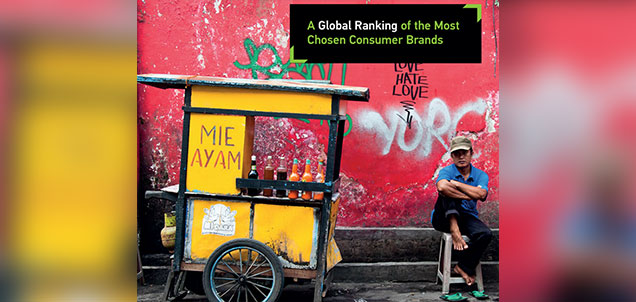
Andy Parkinson, Global Markets Director, Kantar Worldpanel spoke about the book Brand Footprint on global ranking of the most chosen consumer brands by Kantar Worldpanel. Parkinson said Coca Cola remains the number one chosen brand of 2016 and the rise of Sunsilk has been consistent and very surprising. He also explained the entry of Indomie noodles, an Indonesian noodle brand in the global list. The reason behind local brands succeeding was the main focus of his presentation and one of the key reasons was identified as the affordability of the brand. On the other hand, Henry Swann, Global Solutions Director, Kantar Worldpanel gave an overview of the World Panel Online. It is an online data and analysis tool which gives global access to insights anytime and anywhere.
Hemant Mehta, Senior VP, Media and Retail, IMRB concluded the conference by giving a summary of the presentations. He also gave an insight of what they are working on currently, which were Data Management Platform (DMP), data integration and behaviour based segmentation to power activation.
IMRB International, a leading market research firm announced the appointment of K Ramkrishnan (Ramki) as General Manager of IMRB Kantar Worldpanel business.
Commenting on the appointment Hemant Mehta, SVP, Media & Retail, IMRB International said, “With over 20 years of experience in Consumer marketing, Product/ Brand management, Sales and Strategy development, Ramki brings to the organisation valuable expertise in conceptualizing long term strategies, managing innovation and brand development based on consumer insights. As the portfolio of services from IMRB | Kantar Worldpanel expands, I am sure that Ramki’s experience will be a tremendous asset to us and our clients.â€
K Ramkrishnan
Talking about the move, K Ramkrishnan said: “I am delighted to be part of IMRB Kantar World Panel. I am very excited to drive the Panel service at a time when a lot of change is being seen in the way consumers consume – the changing consumption patterns, the growth of e-commerce, changing media landscape and the rapid inroads made by technology in the consumers lives.  I hope to be able to see and present insights in a way that would be more focused on offering solutions to the marketers, having been one myself all these years. I guess being on this side of the table will help me appreciate better the needs of the marketers and help them craft appropriate strategies for addressing their business issues.â€
Ramki holds B.Tech degree in Chemical Engineering-AC Techfrom Anna University, Chennai. He has received his MBA from Bharatidasan Institute of Management, Tiruchirappalli.
Target Group Index (TGI) is a single-source, global continuous database providing valuable and comparable consumer insights from over 60 countries across five continents. In addition to consumption behaviour and demographics, TGI also understands the consumers’ changing attitude, values, lifestyle, as well as media consumption, making it one of the most comprehensive encyclopedias to decode the urban Indian consumer.
TGI India covers an annual sample size of 40,000 SEC ABC Urban Consumers across more than 190 towns. The comprehensive information coverage extends across 17 sectors, 400 product categories, 4,000 brands and 250 attitudinal statements.
Hemant Mehta, Senior VP, IMRB International
It took us time to establish Target Group Index. Fifteen years back, people were not ready for the product, and there were very few agencies and clients who were buying. Today, it has become an integral part of the marketing decision-making process. When we started, we used to do a study once every two years and today, we do a study twice a year. We started out by only measuring the key markets, which is one-lakh-plus towns. Today, we go all urban, so that shows that there is a need which the industry clearly has for the product, the fact that we’ve got clients who are using it and looking at updates twice a year, just speaks for itself. It’s come a long way, the country has changed and we have changed, but we try to keep pace with the expectations of clients, giving them more frequent information and larger-scope coverage. Today we cover about 42,000 consumers every year. Also, so far we had not been covering the North East, but now entering Assam. Not just Guwahati, but even the rest of the state.
Between 2008 and 2014, household spends, that share of wallet itself, has changed. Today, we are mirroring a developed Western economy, where less than 40 per cent of the household budget is being spent on food and grocery, and 60 per cent on everything else, like commuting, education, children, services etc. That itself shows how much the country has changed. And keeping pace with that, in every round of TGI, there are additional requirements which are added. This year we’ve added six new categories. Even the way we are shopping has changed, and we’ve gone straight to online. The interesting thing is while some brands have not reached certain markets, consumers have reached out to those brands and e-commerce is playing a big role. Suddenly e-commerce is changing the expectations and behaviour which is going to have a profound impact on the way we distribute brands and make them available.
Geoff Wicken, Head of TGI International, Kantar Media
A lot depends depends on how companies organise themselves. And it’s really a question of how dynamic and big the businesses are in the local markets. In many cases, you’d say that international businesses have a certain amount of sizing the local markets; that’s how they became international. But generally speaking, with the exception of a small number of cases, international companies do tend to devote their decisions about research buying to local operations. Thesheer speed with which things are changing [is remarkable]. If you can look at the GDP growth over the last 15 years and that plays through in TGI, for just about any product category, you see a higher percentage of growth, a more rapid growth in India than pretty much anywhere else. China is obviously a place that’s been growing fast as well.
E-commerce is evolving in a different way here because of the difference in retail distribution. In more developed markets, it becomes an overlay on what’s already there. [In markets like India or in Africa] there hasn’t been an infrastructure of fixed telephony or even classic online internet access. What mobile brings, is the ability for people to leapfrog two levels.
As told to Dyanne Coelho
What’s New in TGI 2015
Aligning to the new 2011 Census definitions
First comprehensive understanding of North Eastern consumers with the additional inclusion of a 660-size sample
Reporting on the new SEC system
Coverage of new, emerging categories – Green tea, olive oil, anti-acne creams, CC/BB creams, lipcare, toners and astringents
Comprehensive coverage on the digital behavior of consumers, e-commerce, m-commerce and shopping behavior
Life-stage segmentation for efficient targeting
New India. New Perspective. New Lens – Key Themes
1. Geographic Redefinition
With more towns acquiring the status of metros, population shifts in this strata have increased consumerism as well as diversities in consumption patterns. Each big city is now heterogeneous, owing to the multitude of markets and sub-cultures it houses. The phenomenon of cities within cities generates opportunities, as well as challenges for marketers to micro-target their offerings to distinct markets and sub-groups. Increase in Census towns, owing to proximity to big cities and a shift of industries to small towns, have led to a continuum of the urban and rural. Product adoption is equally fast in the rural areas as a result of this.
2. Household Redefinition
There has been a 22 per cent decrease in the number of households without elderly in the last nine years, giving rise to two new target groups: the empty nesters and households with less dependency. There is also an increase in dual-member earning households with a 30 per cent rise in working women in the last 15 years.
The implications of this, therefore, are that there are new consumer classes with the power to spend on their distinct needs, women-centric products, products and services targeted towards the elderly, increasing spends on children, etc. Meanwhile, the share of expenditure on education has more than doubled in the last five years.
3. Consumer Redefinition
Need for brands to be omnipresent online and offline, given the increasing power of the internet and social media??
The consumer today is outdoors more often and offline for longer (40 per cent increase in time spent out of home and 12 hours of average internet usage per month) as compared to three hours in 2003). With the internet providing access to everything s/he needs — search, watch, transact, consumers are practically living in a home-away-from-home. Brands need to be present both offline as well as online, and always present; not just when there’s a campaign or when they have something to sell??.
Â
Changing influencer profile again because of the power of social media
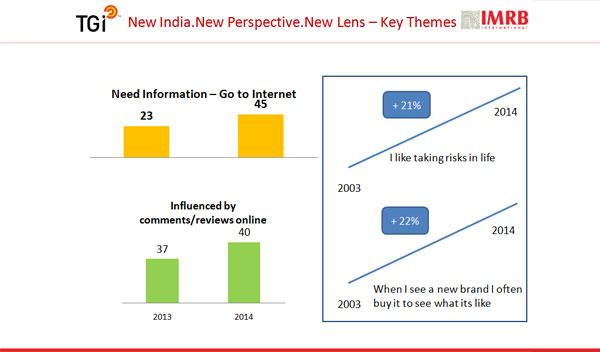
There are shorter attention spans but increasing influence due to the power of social media. As many as 45 per cent [of consumers] turn to the internet when they need information on anything. They feel empowered when they are equipped with information and reviews from likeminded people. Hence, they are more likely to experiment and take calculated risks. There has been a 21 per cent increase in those who have claimed to take risks in the last 10-11 years. Brands and marketers should recognise the changing profile of influencers and advocators, and target their communication towards them. The messaging should be short and succinct, but have a ‘talkability’ element to last longer and spread wider
Affordable Luxury
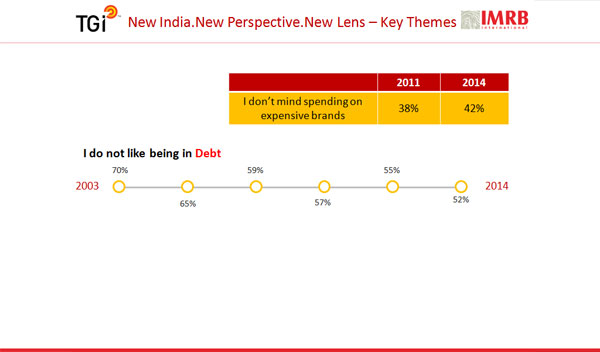
With more disposable income and an increase in the power to spend and information available at one’s fingertips, aspirations are on the rise. Consumers today will go the extra mile to get what they want. Credit is no longer a dirty word, with the percentage of those who do not like being in debt declining from 70 per cent to 52 per cent in the last 10 years. Affordable luxury is the order of the day. For the marketer today, the thrust would be, not on creating products and services restricted by budgetary constraints, but that of making high-end premium products available to consumers through various options of packaging, financing etc.
Category usage is not restricted to needs any more. Consumers today buy in to categories not because they need them, but because they want them. The other implication for a marketer would be to move from ‘need identification’ to ‘need creation’. ‘Tell me the reason why’ instead of ‘Tell me what to buy’ is the new-age consumer mantra
Â
4. Category Redefinition
With the landscape changing, categories are also being replaced faster. Mobiles have replaced a lot of erstwhile categories like radio, camera, digital diary etc. On the other hand, a broad-based category gives way to multiple sub-categories with focused special benefits like face creams giving way to anti-ageing, anti-blemish and anti-acne lotions or creams. Watching out for category redundancies is something a marketer should be cognizant of in today’s changing times.
The TGI studies sit at the forefront of the media and marketing industries, providing comprehensive insight into the online and offline behaviour of consumers. Today, TGI in India is more widely used than ever, to assist in the understanding of target markets and to aid marketing and advertising decisions.
Deepa Mathew is Group Business Director, Media & Retail, IMRB International


 It took us time to establish Target Group Index. Fifteen years back, people were not ready for the product, and there were very few agencies and clients who were buying. Today, it has become an integral part of the marketing decision-making process. When we started, we used to do a study once every two years and today, we do a study twice a year. We started out by only measuring the key markets, which is one-lakh-plus towns. Today, we go all urban, so that shows that there is a need which the industry clearly has for the product, the fact that we’ve got clients who are using it and looking at updates twice a year, just speaks for itself. It’s come a long way, the country has changed and we have changed, but we try to keep pace with the expectations of clients, giving them more frequent information and larger-scope coverage. Today we cover about 42,000 consumers every year. Also, so far we had not been covering the North East, but now entering Assam. Not just Guwahati, but even the rest of the state.
 A lot depends depends on how companies organise themselves. And it’s really a question of how dynamic and big the businesses are in the local markets. In many cases, you’d say that international businesses have a certain amount of sizing the local markets; that’s how they became international. But generally speaking, with the exception of a small number of cases, international companies do tend to devote their decisions about research buying to local operations. The sheer speed with which things are changing [is remarkable]. If you can look at the GDP growth over the last 15 years and that plays through in TGI, for just about any product category, you see a higher percentage of growth, a more rapid growth in India than pretty much anywhere else. China is obviously a place that’s been growing fast as well.