Tag: Hathras

  • Shruti Pushkarna: Has the media turned a deaf ear to disabled victims of rape?

    Shruti PushkarnaBy Shruti Pushkarna


    The two rape cases from Hathras and Ballabgarh have occupied the news space this past month. And rightfully so. It’s shocking and truly disgusting. Not just the act itself, but also the fact that such incidents keep recurring despite the media glare, new laws, nationwide protests, et cetera. Sometimes it feels as if we’ve become immune to such acts of violence. Frankly, our nation is governed by a ‘chalta hai’ attitude for most things. What’s scary is that rape, murder, lynching, violence of all shape and form is gradually beginning to fall in that mindset as well.


    I don’t intend to debate on the rape rate or the mindset behind it or how much our society has accepted it as part of everyday reality. I’m not even going to argue with the various stances concerning how women should dress, where they should go, do we need to re-educate our boys or their mothers perhaps. Instead I want to cite a few cases where the rape victims were disabled.


    In a country where our political leaders and other influential groups propagate ‘men will be men’ attitude, women remain perennial victims to a skewed sense of patriarchy. To top that, a physical or mental impairment, is doubly disabling for women. Between the months of April and October, three rape incidents were reported from Uttar Pradesh, Assam and Madhya Pradesh.


    The environment was never safe but the pandemic has added to the woes of women with disabilities, as they are unable to find easy access to any kind of support. Stranded away from family, friends and community, they face myriad challenges on a daily basis vis-à-vis acquiring food material, traveling for work, getting medical aid in case of emergency, or any other household help. Personal safety has become a growing concern.


    However, the news media in these three cases raised no hue and cry for the victims who were visually impaired. One wonders why. Was their tragedy lesser than that of a sighted woman? Or is it because they didn’t have the appropriate tags of  #Dalit or #Muslim to make for eyeballs especially in the TRP-driven television news market?


    True that disability issues don’t find much coverage in the media because they are perceived to be not ‘mainstream’ enough. But rape is a crime that affects the majority. Then why must the media discriminate when it comes to raising a voice against the heinous act itself? Like I said, the offence doesn’t become any less atrocious if the casualty is not able-bodied. In fact, quite the contrary.


    Women constitute 41 per cent of the total disabled population in India. According to a news report from September 2019, the United Nations committee of independent experts on the rights of persons with disabilities emphasised on the need for India to have a separate category of data on violence against disabled women and girls. Very often, ableist women rights’ movements overlook this group because they are labeled as asexual. Even disability advocacy groups rarely address the sexual needs or exploits of such women. In short, crimes against them are invisible to the political leadership and law enforcement agencies.


    When it comes to yelling matches on the ‘idiot box’ every night, the disabled women are out of sight there too. They don’t get invited to debates on issues concerning women, their views disregarded by the ableist world. Do you recall any disabled perspectives during the recent outrage against Nikita Tomar’s rape or the (in)famous #MeToo movement? Probably not.


    As I write this piece, Donald Trump and Joe Biden are neck to neck in the race for US President. God forbid if Trump wins again, we’ll have one of the most powerful countries in the world led by someone who thinks very little of women or persons with disabilities. Is this a reflection on what the society in general thinks of them as well? One can only hope and appeal to the goodness in humanity.


    Shruti Pushkarna heads operations of the New Delhi-based Score Foundation where she works as Director-Programmes & Communications. She is a former journalist (part of the founding team of MxMIndia) who has moved full-time to the social sector. Shruti writes for MxMIndia every other Thursday. Her views here are personal. She can be reached via Twitter at @shrutipushkarna


  • Ranjona Banerji: Time to speak up on Hathras gangrape!

    By Ranjona Banerji


    Has the tide turned? Has the Hathras gangrape and now murder case reached national attention more than a fortnight after the gruesome crime was perpetrated? Has the fact that a young woman was not just gangraped by four men but also that her tongue was cut off and her spine broken infiltrated our national consciousness? Has the subtext that she was a Dalit and the accused upper caste men now become the main text as one more example of caste hatred, discrimination and desire to oppress and suppress? Has the lack of any attempt at justice, done or seen to be done, seeped through our apathy? Has the fact that this happened in Uttar Pradesh, whose chief minister boasts about law and order in his state, floated up to our comprehension? And has this crime against humanity managed to knock off the perpetual television and Kangana Ranaut created melodrama over Sushant Singh Rajput’s death with its convoluted storylines off our TV channels?

    It took the death of the young woman to wake the Indian media up and pay attention. Unlike the December 2012 case, where the gangrape itself filled society with anger and sickness. By the time “Nirbhaya” died, politicians had been excoriated, lapses in the state administration were shown up, the people were on the streets, human and women’s rights organisations were organised, and law and order was discussed threadbare.

    Compared to that, even the outrage we see now is radio silence. The levels of anger have been slow to rise between September 14 and now, as has been the case in every gangrape since 2012. Who is willing to concede that the reason for this slow awakening is that the rape happened BJP-ruled state of Uttar Pradesh? And further, who will now dissemble that there is not a caste angle to the lack of outrage? Rape is an oft-used tool in caste oppression and suppression. Are we going to now pretend that we did not know that? Caste biases within the media are also well-known. One prominent female TV anchor even put out an argument that the caste angle in this rape case should not be discussed.

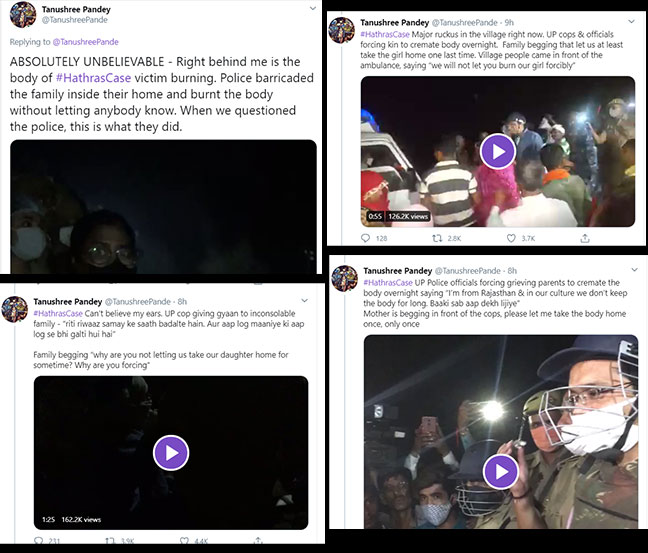
    It was a series of brave tweets from India Today, Aaj Tak reporter Tanushree Pandey on the forced late night “cremation” of the victim’s body by the UP Police that has set off the current anger on social media. (see screenshots) A flurry of news reports followed that.

    https://www.hindustantimes.com/india-news/hathras-rape-victim-s-body-forcibly-taken-away-for-cremation-by-up-police-alleges-family/story-mFbRkp7cwMLbZlzcMjAgVL.html

    https://www.ndtv.com/india-news/up-hathras-rape-victim-cremated-by-cops-family-begged-to-pay-last-respects-2303004

    The news is now out in the open and cannot be stopped for the moment. How brave reporters will remain in the face of what will be an enormous pushback remains to be seen. This is where India’s TV anchors have the opportunity to prove that they will support their own reporters and stop acting like government and/or BJP mouthpieces.

    The Modi government has continued its assault on dissent and the current action against Amnesty India, which has led to the shut down of its operations in India, has left only a few prominent voices to talk about human rights abuses. TV personalities like Arnab Goswami have made their contempt for human rights clear over the years. But if the media does not speak up now, at least for the victim of the gangrape in Hathras, then what is our larger responsibility to democracy?

    https://www.newslaundry.com/2020/09/29/help-us-get-justice-please-dalit-girl-assaulted-in-ups-hathras-succumbs

    As the link above demonstrates, the fact that the family were Dalit has made them even more vulnerable and less likely to find justice. Our administrative and political system are part of our social structure and unless we protest, there will be no change. The late-night cremation by the police is nothing but an attempt to put the family in its place by denying them the right to hold their own mourning rituals. It is also a clear move to destroy evidence and further shield the upper caste accused. And as ever, displays our contempt for women.

    The media has no option here but to expose further police and administrative cover-ups. Or, will it take the coward’s way out and destroy all the work done by the few reporters and journalists who have followed this horrific case? I don’t trust most of our TV anchors with the most influence, but one can only hope…


    Ranjona Banerji is a senior journalist and commentator. She is also Consulting Editor, MxMIndia. Her views here are personal