Tag: Harsha Razdan

  • Dentsu finally gets a CEO from outside. Harsha Razdan is CEO, South Asia

    By Our Staff


    If you remember, Dentsu, the advertising and marketing services network, had a series of exits. Topping it all was the exit of big boss Ashish Bhasin. And then started a massive hunt for a CEO. Almost every biggie in the business was met with.


    When they couldn’t find anyone, they called in old warhorse Sunil Lulla to stand in.  Lulla had just moved out of BARC and was busy growing his own consulting gigs. But that was till December.


    And yesterday (Thursday), Dentsu Asia Pacific announced the appointment of Harsha Razdan as CEO, South Asia. This is effective May 1, 2023. So we will see him at Goafest 2023.


    Said Rob Gilby, CEO APAC, Dentsu: “India has been through the most profound and impressive digital transformation and the future of the digital economy is bright; with new opportunities being generated by the advent of 5G, proliferation of affordable devices, and the development of a new economy accessible to all,” adding: “Harsha is an exceptional leader with a deep strategic understanding of the competitive landscape. His background in brand building, overlayed with deep knowledge of tech-driven transformation brings formidable cross-capability expertise and will drive growth opportunities in creating a new value ecosystem for clients with consumers at the centre.”


    Added Razdan on his appointment: “It is a very exciting time to be leading an agency network in India, especially with the significant progress we are seeing in the digital development of our market and what that means for brands. India is leap-frogging other markets in its adoption and development of new technologies, and it’s critical that agencies are capitalising on new opportunities for brands to speak to new consumers. I can’t wait to get started.”


    Razdan has worked with PepsiCo and Unilever, and consulting practices including Accenture where he spent four years in the UK. He joins Dentsu from KPMG where he is a Senior Partner, responsible for overseeing both Clients & Markets and Consumer Markets, Life Sciences & Internet Business. He also sits on the Advisory Leadership team as well as the Global Consumer & Retail leadership team.  He will be based in Mumbai reporting to Rob Gilby, CEO APAC, dentsu.
     

  • KPMG & Infomo announce partnership to fight FB-Google duopoly

    By Our Staff


    KPMG in India and Infomo today announced its alliance to develop digital advertising solutions for enterprises and large publishers utilising the InfomoR3- a sell-side adtech platform.

    Notes a communique: “The current programmatic digital marketing value chain is currently plagued by ad-fraud and privacy issues (user data abuse). The KPMG in India – Infomo solution transfers total control back to the sell-side stakeholders and is a transparent real time alternative to advertisers and agencies.”

    Speaking about the partnership, KPMG in India’s Head of TMT sector- Satya Easwaran, said that as “digital marketing gains centrestage in advertising arena, publishers will need to strengthen their technology footprint to ensure there is a direct connect between the advertisers and the target audience. KPMG in India – Infomo solution, aims to do just that by providing performance marketing opportunities to advertisers.”

    Added KPMG in India’s head of Digital Consulting practice Akhilesh Tuteja: “KPMG in India-Infomo digital marketing solution is a comprehensive solution, which aims to maximize the effectiveness of digital interactions. It offers win-win outcomes to all the members of the ecosystem and including large publishers, enterprises, telecom carriers and consumers. The solution is innovative and enables direct interaction and engagement with advertisers, agencies, channel promotions and campaigns through digital channels.”

    Said Harsha Razdan, KPMG in India Head of Business Consulting practice: “By leveraging our telecom and media experience, we believe we can assist clients with their digital transformation journey enabling them to take control over pricing and monetise performance marketing opportunities.”

    Added Infomo Founder & CEO Ananda Rao: “By working closely with KPMG in India we address two critical components in our solution set that we offer, Strategy and Managed Services that will enable telecom operators and publishers to monetise their first party data but also offer new offerings to its enterprise and SME customers.” Speaking of the current limitations faced by the industry Rao said: “Advertisers in the digital world require extensive audience reach, known audience targeting, and measurable audience engagement. Our partnerships with telecom carriers and leading publishers around the world provide advertisers access to massive known audiences. Our platform provides a range of new and powerful capabilities enabling sell-side stakeholders to directly enable their inventory buyers to directly interact and engage the known consumer bases they bring to the table within the value chain.”

  • KPMG and RAI undertake joint study to understand growth of private label space

    By A Correspondent


    With a view to understanding the private label space better, consulting firm KPMG and Retailers Association of India undertook a joint study to understand the growth and driving factors of the online private label space titled – The online private label growth paradigm. To identify the trends that are contributing to the growth of private labels in India, KPMG held discussions with various set of online and offline retailers with a pan India presence.


    Here are some of the key highlights of the study:

    Online private labels are expected to continue to be a driver for profitable growth for e-commerce marketplaces

    Growth of private labels between 2019 and 2022 is expected to grow at 1.3-1.6x faster than e-commerce platforms. It will continue to generate 1.8-2.0x higher margins than external brands

    Category focused platforms were relatively early to launch online private labels and currently have 25-40 per cent of sales contribution, compared to approximately 5-10 per cent for multi category platforms

    Category focused platforms recorded faster growth as compared to multi category platforms largely driven by private labels growing at approximately 1.2-2.5X relative to the platforms growth from 2016-2019

    Online private labels allow platforms to attract new consumers, improve consumer stickiness and thereby, increase market share. Big e-commerce players, across product categories, attribute greater than 50 per cent of their private label sales to repeat purchases

    Online private label purchases in categories such as apparel, grocery and cosmetics see repeat purchases exceeding about 60-65 per cent, indicating that having a strong private label strategy will be a good initiative

    Private label growth and their higher profitability translates to better valuations

    Private labels offer supply chain efficiencies and greater product customisation abilities that later translate into higher margins – for instance a leading grocery marketplace improved its category margins by launching premium labels in organic and superfood categories


    Commenting on the India findings, Harsha Razdan, Partner & Head, Consumer Markets and Internet Business, KPMG in India said: “With a gradual shift from unbranded to branded, online retailers are also launching their own private label brands, thus providing consumers a much wider choice of products and channels to choose from. Private labels have the potential to offer higher margins on account of supply chain efficiencies and better control over operations. Further, this could also lead to higher consumer stickiness, thus becoming a critical element of the overall business strategy. If one takes a long-term view, the journey of private labels gradually moving to brands will be shaping the future of retail.”


  • Do loyalty programmes ensure brand loyalty?


    By A Correspondent


    Digital disruption and new generational influences are making customer loyalty tough to hold onto these days, but fresh thinking on loyalty programmes is key to winning and retaining customers, according to KPMG International’s The Truth about Customer Loyalty report.


    With the holidays nearing, KPMG’s  survey of over 18,000 consumers in 20 countries, with 1721 being from India explores the nature of customer loyalty and how some traditional loyalty programmes, long a mainstay of customer retention strategies, may not be keeping consumers brand-faithful.


    Said Harsha Razdan, Partner and Head, Consumer Markets and Internet Business, KPMG in India: “In India, brands and retailers are ready to run miles to acquire a customer. It becomes even more difficult to retain acquired consumers, unless there is a unique value proposition along with related benefits. The fact that over 55 per cent of consumers in India say they will buy from their favourite company even if it is cheaper and more convenient to buy from a rival company is further proof that loyalty endures. Loyal customers can be a reliable repeat source of revenue for retailers/brands.”


    “The study in India revealed that when a consumer is loyal to a brand, 93 per cent will recommend it to their family and friends. 47 per cent will remain loyal, even after a bad experience. This substantiates that retailers today will need to re-imagine and re-invent to continue to lure/excite the new digital tech-savvy consumer. They will need to invest in creating convenient loyalty platforms, educating consumers about the program uniqueness and get the consumer to experience the benefits that the program has to offer. These programmes should make the consumer feel special, wanted and proud of being associated with the retailer/brand. Retailers/brands should continue to engage with consumers while ensuring that consumer data and interests are protected,” added Razdan.


    What Indians feel:

    Of the over 18,000 respondents from 20 countries, 1721 were from India. The maximum number of respondents were millennials (in the 17-36 age group).

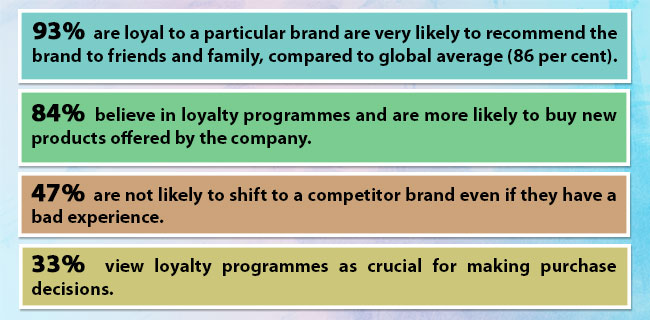
    — 93 per cent of the respondents who are loyal to a particular brand are very likely to recommend the brand to friends and family, compared to global average (86 per cent).

    — 84 per cent of the respondents in India believe in loyalty programs and are more likely to buy new products offered by the company

    — 47 per cent of the respondents are not likely to shift to a competitor brand even if they have a bad experience

    — 33 percent of the customers in India view loyalty programs as crucial for making purchase decisions


    What engenders brand loyalty today?

    Brand loyalty doesn’t only earn companies repeat business from their loyal customers–over 86 per cent of consumers globally, from Gen Z to the Silent Generation, say they would recommend a brand they loved to friends and family.

    In terms of earning customer loyalty, 59 per cent of the consumers surveyed globally said they are loyal to their favourite brand because of a personal connection compared to 74 per cent in India. 75 per cent consumers globally said their loyalty was driven by product quality compared to 81 per cent in India, 66 per cent consumers globally as compared to 74 per cent in India said their loyalty was driven by value for money and 57 per cent consumers globally as compared to 73 per cent in India said their loyalty was driven by customer service.

    Meanwhile, only 37 per cent globally see loyalty programs as an effective way to earn their loyalty. And 55 per cent of consumers who are enrolled in loyalty programmes internationally use them infrequently –a few times a month or less. 96 per cent of the millennials surveyed globally said companies need to find new ways to reward loyal customers altogether.


    Here is what KPMG recommends to improve customer loyalty programmes:

    Revitalise them.

    Around half of the surveyed consumers globally agree that companies should find new ways to reward loyal customers. This number stood at 97 per cent for India. Responsible personalisation, emotional connection and purpose-driven causes should be key considerations.


    Keep it simple.

    Make loyalty programmes easy to join and simple to use. Globally, 60 per cent agree loyalty programmes are too hard to join and/or earning rewards is a challenge. 80 per cent in Brazil and China feel that way, 76 per cent in India feel this way and as do nearly seven out of ten millennials globally. Lengthy registration processes, rules and conditions, technical difficulties with redeeming awards are all likely to turn customers away.


    Maintain relevance amid the noise.

    Retailers need to ensure their loyalty programmes stay relevant to customers. 49 per cent of loyalty programme members globally agree they belong to too many programmes. This is particularly the case for consumers in China (72 percent), Brazil (70 per cent) and India (61 per cent).  Too many programmes equate to too many apps, so it’s no surprise that customers forget their memberships, lose track of their points and perhaps decide that the rewards are not worth the effort.


    Promote awareness and familiarity.

    Regular communication to consumers through social channels, email or advertising can help programmes remain top of mind with consumers. More than one in three consumers globally who did not belong to any loyalty programmes globally said they were not aware of any. 17 per cent globally compared to 21 per cent in India have not joined a program. Lack of awareness (42 per cent) is one of main reasons stated by respondents in India for them not being part of any loyalty programme in India


  • KPMG explores behaviour and choices of customer in latest report

    By A Correspondent


    KPMG International has launched the second edition of ‘Me, my life, my wallet’, that continues its exploration of the multidimensional  customer — what’s truly driving behaviour and choices — and how this is set to change as the customer of tomorrow emerges. This year’s edition is based on ethnographic interviews and an online survey, conducted during 2018, by GLG and Foresight Factory on behalf of KPMG International. The survey included nearly 25,000 consumers across Brazil, Canada, China, France, India, the UAE, the UK and the US.


    The research explores six key themes of critical importance to organizations and institutions around the world, namely; trust, data, wealth and retirement, generational surfing, the customer of the future and the B2B customer. It also provides an in-depth look at STEP (Social, Technological, Economic and Political) events influencing consumers and highlights emerging patterns of behaviour around the world.


    “The Indian consumer is difficult to understand, and as the online revolution progresses beyond the big cities and starts gaining momentum in the country’s heartland, they are getting more complicated still. The rewards for companies who take time to learn, though, are substantial,” noted Arun M Kumar, Chairman and CEO, KPMG in India.


    A few interesting highlights for India include:

    :: India, consumers trust technology companies (75 per cent), wealth management companies (62per cent), power & utility firms (62per cent), banking (75per cent) the most. The least trusted entity is the government at 51per cent, a high figure compared to the global average (37per cent).

    :: 87per cent would trade their personal data to a company for:

    o better customer experience and personalization – 26per cent

    o better products and services – 24per cent

    o better security – 21per cent

    :: 58per cent will most likely view brands on social media that “offer deals or discounts”

    :: 55per cent would rather lose their wallet than their phone

    :: Globally, 66per cent of consumers are interested or very interested in technology – this leaps in the fast-growing economies of China (81per cent), and India (83per cent)

    :: Globally, 38per cent of consumers are anxious about unauthorized tracking of their online habits by companies, governments, and criminals; 47per cent in India

    :: Globally, 51per cent of consumers are anxious about identity theft; 52per cent in India

    :: Globally, almost a quarter (24 per cent) of consumers say they would not trade their data, this falls to 13per cent in India

    :: Consumers in India are more trusting with their data than consumers in other markets. Globally, 37per cent of consumers don’t trust anyone with their social media data, in India 13per cent. Globally, 31per cent of consumers don’t trust anyone with their mobile data, in India 10per cent.


    Added Harsha Razdan, Partner and Head, Consumer Markets, KPMG India: “Consumers are anxious, with younger generations feeling it the most. They like new technology but are concerned about handing over personal data, and what that could mean for their privacy and security. Our research demonstrates that organizations should be aware of the heightened awareness people have about the value of their data; they want to feel that they are in control at every stage of the business relationship. Many companies haven’t yet fully grasped the concerns consumers have about sharing their data, or how this could affect consumer loyalty. Yet more and more businesses are looking to monetize the data they hold – whether that’s what we put in our shopping basket, how many times a week we exercise, or what we choose to watch. Consumers are more aware of the value of their data, and businesses need to be responding to this new, tech-driven, data-savvy type of customer.”