
Tag: Hard Knocks

  • Hard Knocks: Katju’s unreal expectations

    By Anil Thakraney


    The Chairman of the Press Council of India, Justice Markandey Katju, reminds me of a very strict uncle. You don’t mess with the guy. You quietly listen to him and obey his orders. Or else get ready for some nice punishments. Katju thinks the Indian media tends to be irresponsible, that it’s not doing its job, which is to serve the people. That there’s too much of celebrity journalism. And yes, he gets really riled on the issue of paid news. And yes, he wants to change things around. By carrot or by stick… whatever it takes.


    Of course the man’s heart is in the right place, and he means well. And good luck to him in his mission to clean up the desi media houses. But am afraid it’s not going to work. This issue is too complex and layered to be solved by Katju’s simplicity and good intent. And even threats of punishment won’t work. Here’s why.


    Broadly speaking, the Indian media is run by proprietors and not by editors. Let’s be clear about that. So however honest and diligent the editor might be, the control room is really run by the owner of the publication or the TV channel. And these people are businessmen. They don’t worry about public service, they are focussed on return on investment. They are not in the game to make India a better place, they are here to liven up their own balance sheets. They are not saints, they are suits. In this scenario, dodgy practices is a sad but logical outcome. Because there is too much competition in the mass media. Hundreds of channels and thousands of print brands are chasing the same ad pie. In how many ways can you divide one cake? Mouths have to be fed, no? This then results in excessive celebrity coverage. What to do, everyone wants a piece of SRK! And irresponsible journalism. How can you get eyeballs by following boring rules in the news room? And yes, paid journalism. If the advertisers aren’t gonna entertain me, I have to find other revenue channels, thank you very much.


    Anyway, good luck to Mr Katju. He deserves no less than a Nobel if he can clean things up out here.


    ***


    PS: It’s common sense to me, but I don’t understand why the TV chiefs don’t get it. The ONLY reason some goons hurl chappals and rain punches on important people is to get noticed, to get their 15 minutes of fame. And beaming their actions on screen is playing right into their hands. Just don’t feature these incidents, simply report them. Is that so difficult to understand? There are other ways to get TRPs. Try SRK!
  • Anil Thakraney’s Hard Knocks: The damned misleading adverts

    So, finally the government has woken up on the issue. No less than the Prime Minister’s Office (PMO) has gotten into the act. The plan is to come up with policies that can control the malaise of misleading ads.

    Well, to be honest this should have been done a long time ago. The Indian mediascape is lined with ads that make false/exaggerated promises. Health drinks that will make your child grow tall. A magic lotion that will sprout hair on that bald pate. Cars that give you outstanding mileage on Indian roads (wow!). The dubious list is long.

    Yes, the ideal solution is self-regulation. But it will never work, there are just too many brand managers ready to play mischief for that extra market share point. Therefore unfortunate though it is, we do need some powerful and implementable regulation in force so that consumers don’t get fleeced.

    However, and this is the crux of the problem: More than policies, we need hard punishment delivered to the offenders. Because penalties for misleading ads are very light in India, it becomes tempting to cheat. In the US, consumers can file for huge sums in damages if a brand has lied to them. And they do often get rewarded with the big bucks, and quite swiftly too. This ensures that brand managers think many times before misleading their consumers. In India, harassed grahaks have to do a lot of legwork at consumer courts; and even when the ruling is in their favour, the compensation is a pittance.

    So let’s have the regulation in place by all means. But there needs to be severe penalties spelt out to discourage mischievous marketers.


    ***


    PS: Ads for cars have seen a sudden surge; almost every other commercial is for a gaadi these days. Guess sales are down because of massive hikes in price of petrol and diesel, and there’s a bit of panic in the auto companies. But instead of offering cash discounts and other usual freebies, why don’t they offer schemes like ‘Free 10 litres petrol every month for one year’. That’s actually just Rs 9,000, but it could strike a chord with a junta reeling under murderous fuel price hikes.

  • The Anchor: Anil Thakraney’s 4 reasons why Steve Jobs was so special

    The entire world seems to be in collective grief over the death of Steve Jobs. As if people have lost someone close. Does it make sense? When you consider he was just another businessman out to make a lot of money. And there are thousands of very loaded industrialists all over the world. Most of who we don’t care much about. And Jobs, unlike rival Bill Gates, wasn’t even big on charity work. So then why do we all adore him? Even those of us who have never touched an Apple product in our lives. (I certainly haven’t.)


    There are many reasons behind the cult of Jobs. Here’s my little list on what made the man so special. And my reasons actually lie within Apple’s own legendary ‘Think Different’ advert. It’s as if the script was written with Jobs in mind. Businessmen and industry leaders must pay close attention to what it takes to catch consumers’ hearts and minds. From across the world.


    #1 Because he was a rebel: Jobs did not conform to the industry standards, nor did he try to surpass them. Instead, he showed them the finger. He was a true inventor, a visionary, who believed he could do it his way. Self-belief was at the heart of his success. And that’s how a lad working out of a car garage went on to build an international tech empire.


    #2 Because he didn’t just make and market products, he pushed the human race forward with his bold innovations. Product innovations that are not just technologically marvellous, but are slick and aesthetically rich. Consumers don’t just wait for a new Apple product. They queue up for it. They save up for it. They dream about it. Jobs never short-changed his buyers by taking short-cuts. He thought big. He delivered better.


    #3 Because instead of throwing out the ‘square pegs in the round holes’ from his organization, he trained, nurtured and cherished the misfits. He saw the genius in his crazy, offbeat employees. He knew he needed people who thought differently, if his vision for Apple was to come good. Look around you… very, very, very few leaders in the corporate world are capable of such an ideology. That’s why we have just one Steve Jobs.


    #4 Because he genuinely, passionately believed he could change the world. And he did.


    Links: The unforgettable Apple advert.
    [youtube width=”400″ height=”250″]http://www.youtube.com/watch?v=4oAB83Z1ydE&feature=related[/youtube]
    A touching tribute to the tech king.
    [youtube width=”400″ height=”250″]http://www.youtube.com/watch?v=XzWft8ZtTTY[/youtube]

    ***


    PS: Apparently there’s a TV journalist called Mandeep Something inside the Bigg Boss mad house. And she wailed on national television that she hasn’t gone to crap for four days. If a journo is doing stuff like this, can we really blame the other bimbettes on the show for all the nonsense? Anyway, guess now you know why it’s called a crappy show.

  • Anil Thakraney’s Hard Knocks: The Bitch Boss

    This completely ridiculous reality show is now in its fifth season. Five, five, five, five… as the hosts Sallu and Sanju very irritatingly croon. Therefore how much ever many of us loathe Bigg Boss and its floozy contestants, we have to grudgingly admit the format works. It’s also worked in the western nations, where the show is called Big Brother.


    The serial is totally dumb in its content, and that’s by design. Because it is targeted at the low-brow viewers, and there are plenty such in every nation. People who look for cheap laughs after a hard day’s work, and particularly enjoy it when the contestants slam and abuse each other. Which is why the channel and its producer only pick people with shady backgrounds and aggressive demeanour…. even retards will do… as they are most likely to clash with each other. In fact, even to be offered a part in Bigg Boss is tantamount to a grave insult.


    It’s very tempting for me to trash Bigg Boss five, five, five, five, five. It’s a sitting duck for ridicule. Examine the fantastic star cast: Twelve dumb chicks, one transvestite and one confirmed sex pest. And two hosts, both of whom face criminal charges in assorted cases. And that’s just the start.


    But I have decided to hold my fire, grab some beers and catch the demented action whenever I can. Because the hard truth is this: There’s a big market out there for this sort of crap. And you can’t argue with business and TRPs beyond a point.


    Ganda hai par dhandha hai, as it’s often said.


    ***


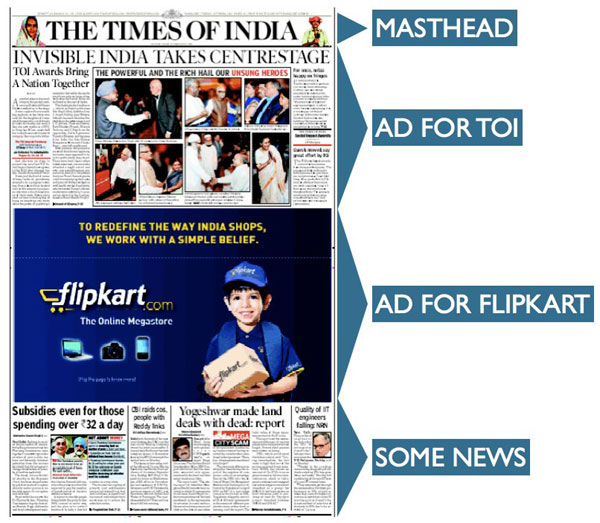
    PS: Found this image floating on the net. A good example of how valuable readers are to the publishers of the TOI. And the irony is that just a few days back the newspaper was gloating over its rising readership!


  • Anil Thakraney’s Hard Knocks: Why did telemarketers lose the game?

    Today morning, I sent a text message to 1909, and in a matter of seconds, forever banished telemarketers from my life. Or at least I hope I did. (This is India, where there are many laws, but many more people ready to flout them.) But at the same time it did make me feel a wee bit sad as a communication professional. Here is a powerful medium destroyed by the foibles of some very incompetent telemarketers.


    I am not a direct marketing guru, but here are three key reasons I think why the tele guys lost the plot. You can add your own.


    1.  Badly trained, poorly paid staffers who lack even basic communication skills. ‘Hello sir, main XYZ se bol rahi hoon, aapko ek free SIM card ka offer hai, kya aap interested hain?’ Imagine I could be doing 100 important things when this call arrives. Even hanging precariously by a cliff. Is it too difficult for callers to politely ask for a ‘good time’ to call?  We often do that with friends, leave alone strangers. Who knows, some courtesy may encourage people to at least have a conversation. And in telemarketing, that’s half the battle won. I really think some amount of smart training would help.


    1. Poor sense of timing: I would get calls at 10.30 AM Monday, the peak work hour, from someone selling me a holiday package to Macau. Or, on a lazy Sunday noon, from a chap asking if I want a computer printer. Worse, someone texts me at night offering Yoga classes. Is anyone even trying to think out there on when to sell what?


    1.  I know this is a cold calling business, but does have it to be like blind shooting in the dark? Is market segmentation so difficult in telemarketing? Can’t the proprietors invest some funds in market research before hitting the phone? I’ll give you an example. Once, an expensive time share resorts seller called my driver. Overhearing their conversation, I encouraged him to talk, so we could have some masti. Not only did the excited tele girl ‘sell’ him a Rs 2-lakh-worth worth life membership, she even agreed to drop by his chawl for a cup of tea. I told him to have fun!


    All said, it’s a pity, really. Because telemarketing is a very useful tool for one-on-one communication. And it’s failed in India because it’s run by people who just don’t get it.


    ***


    PS: Must say I am more than surprised with the overreaction and anger in India at Shoaib Akhtar’s book. The mud he’s flung at fellow cricketers in his book, as per reports, is totally consistent with his own brand personality. He’s lived an entirely controversial life, so why must his book be any different? What were people expecting? A collection of sweet lullabies? Hello? Branding, anyone?

  • Hard Knocks: Why does the ad world lose talent?

    During my interview with O&M’s chief Piyush Pandey for MxMIndia, he mentioned that the biggest challenge the industry faces today is one of hiring and retaining talented people. That some of the most interesting people don’t want in. His theory is that it has mainly to do with remuneration, and the problem of agencies not being able to pay people properly. Surely he’s right, he must know being an industry leader. But I think there’s more to it than money. Here are two other reasons why I believe the ad world does not attract as much talent as it should, and why many of its stars defect to other industries.


    One, there is killer competition amongst ad agencies, and the pressure and anxiety to win and retain accounts is intense. Now while business rivalry is healthy, when it borders on desperation, something’s gotta give. So not only do clients suck the agencies dry, some also tend to treat agency personnel with disdain and disrespect. This leads to loss of morale within an ad agency office, and the inevitable happens. One is always looking around for better career options. We must remember not all ad agencies are led by heavyweights like Piyush and Balki. Who can stand up to an unreasonable client. For most agencies, putting up with all sorts of demands from clients becomes a way of life. There’s the sword of losing a client perpetually hanging on the head. And frankly, I really can’t see a way out of this mess. It was like this decades ago, and it’s pretty much the same now.


    The other thing ad agencies have done is to give up the strategic planning function to the clients. Sure, large agencies have the so-called planning department, but these guys often do a cosmetic job for the brands. And are more like an extension of the market research agency. There was a time when client servicing people would offer major strategic insights. Now no one expects any from them. Either the creative directors figure out their own strategies, or the brand managers inflict one on the agency. It’s no longer cool being a suit in the agency business, it’s become more of a maintenance job. How can we then blame the officers for leaping over to brand management?


    And that’s also the case with media specialists, post the disbanding. I wonder if there are any media planners left. I only hear of media buyers being in demand purely for their abilities to cut sweet deals with media owners.


    It can’t be only about money. It never is.


    ***


    PS: With Twitter on a roll, every Seeta, Geeta and Reeta thinks she can be a journalist. Guys and gals, while I appreciate your enthu, do give us journos some credit, we must be in possession of at least a few skills, if not many! Ghazal master Jagjit Singh (who’s very much alive at the time of writing this, and all the best to him) was declared dead by some over-excited tweeters. Clearly, the khujli to “break news” is not restricted to the media.

    The lesson: Dear tweeters, leave news to us. And stick to sharing your lunch menu.