With IPL coming back, Hansa Research, through its syndicated study IPLomania, has said it delve in to how these brands can exploit the opportunity in a relatively new version of the IPL.
According to a communique, the last edition of IPL (2019) saw some 120 brands being advertised on the platform. This year Hansa is tracking all of those along with a few new brands that are expected to advertise in the 2020 edition. The current market dynamics have diversified the category pool that usually advertises on the IPL platform. New brands/ categories will be on air this year due to the IPL being scheduled in close proximity of the festive season. With a plethora of categories – E-Commerce, FMCG, Auto, E-Wallets, Alcohol, Gaming, OTT, Paints, Real Estate, Education, Smartphones, Telecoms, Electronic, Banking, Wires, Social Media, Oral Care – the clutter would be the most difficult to break this year.
Said V Sudarshan, Senior Vice President, Hansa Research: “IPL turns 13, and everything about the event this time is different. Cricket enthusiasts are all looking forward to the new season right in the middle of the festive season, with a brand new sponsor, in a foreign land. What remains the same is the passion and awe-inspiring participation from the brands, which ultimately makes IPL a grand essential sports platform for advertising in the country,” adding: “We have crossed our expectations this year from IPLomania in terms of Revenue” which not only brings in some positivity amidst the gloom, but also reiterates the fact that brands are not just spending on IPL but are also keen in understanding how the spends have helped them.”
Sundar told me about it casually, like he usually does. He could well have been telling me “I am going to get a cup of coffeeâ€. I accepted the news casually, mumbling something like “Good, congratulationsâ€. I can’t recall if I shook his hand. No theatrics from either side. Both of us were there when our father accepted the same award 22 years ago. May be both of us knew this was going to happen.
Enough will be said and written about his various activities in the industry, so I am not going there. In my mind, no one else deserves it more. He has been tireless, period. The only thing about this news was that I didn’t hear about it from the driver, who somehow always seems to know more about Sundar’s whereabouts, and happenings relating to him, than I do.
Our growing up years in Chennai were pretty unremarkable and middle-class to the core. Busy father. Housewife mother. Grandmother and an aunt always at home. Six siblings, who as I think about it, were all pretty well-behaved, perhaps even boring. Lots of cousins and family around. Home was a place to be shared. The front door was hardly ever shut, except at night. One day in the ’70s there was a lot of hushed talk. My father and his elder brother, and the wives, were in a huddle. I later learnt that my dad had quit his job, which was his life. He was to do something on his own. The import of it hardly made a dent to my teenage senses. Over the next few months, lots of people kept coming and going. There was a sense of urgency and preparation. The puja happened, and R K Swamy opened shop in his brother’s house, I suspect because he could delay rents as much as he wanted.
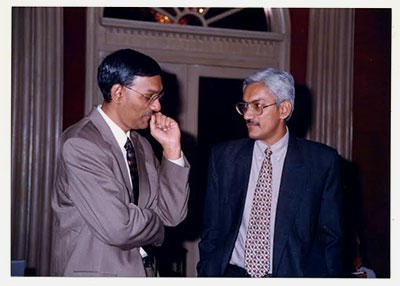
A vintage pic of the Swamy brothers: Shekar (left) with Srinivasan Swamy
The rest of it was a whirl. So many people working so hard to meet so many unreasonable deadlines. Sundar finished his MBA, and went into the business, five years after it started. Comments were heard. “He is looking after his father’s business†was a common refrain, like he was literally sitting in the shop. Little did people know.
R K SWAMY the agency was never meant to be another shop. The DNA from ever was to build a lasting institution. The ambition stretched beyond the Chennai roots, which in itself was unusual. In this, Sundar played a strong role, running around from city to city, often trailing behind Mr Swamy. As one of our colleagues put it, if Mr Swamy was the Account Director, then Sundar was the Account Supervisor carrying artworks around. Clients always came first, people always had to be respected and family interests came thereafter.
BBDO joined hands in the mid-80s. We kept building the core advertising business. We recast the Research activity. We created a Television programming game. We expanded into diversified marketing services. We pioneered the Analytics and Customer Marketing space, embracing marketing technology. We ventured to build a US presence, on our own.
All of this underpins Sundar’s ability to take that risk, and continue with the DNA of building the institution. He is a serial entrepreneur – no angel investor or VC here – on his own dime. He has been in the lead, helping fashion the foremost Indian-owned and controlled advertising and marketing services group, by itself a serious contribution to the industry.
Sundar no doubt grew up in the business. But his participation stretches way beyond to very many social causes. He gives, more than he takes, again and again and again. There is a lesson there, somewhere. Perhaps awards come when one does this without nary a thought.
For the second year in a row, Hansa Events and Activation has been chosen by Vodafone to showcase the Vodafone McLaren Mercedes team F1 car across eight cities in India. This is part of Vodafone’s promotion in a lead-up to the races in New Delhi.
Sujit Kote, GM, Hansa Events and Activation, Mumbai, said, “The show-car activity was a tremendous success last year due to which we have been chosen to handle this again this year. Besides Ahmedabad, Pune, Bengaluru and Chennai, the activity will also be done in Hyderabad, New Delhi, Kolkata and Bhopal. Over 300,000 consumers have already participated and are part of the social media buzz that’s been built around this.”
Hansa Events & Activation, has included a car simulator allowing fans at the airport and malls in Mumbai to experience racing in a Vodafone McLaren Mercedes car at racing tracks across the world.
Hansa Events & Activation is part of the R K Swamy Hansa Group, a leading Marketing Communications and Services Group, serving over 250 leading companies in India and the USA.
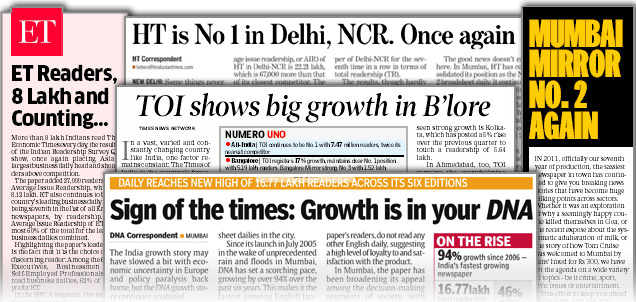
It’s ironic. Mumbai is where most of the biggie media agencies exist. Some of the largest spenders are headquartered here. Still, publications pull out all stops to make crazy claims.
Okay, they aren’t incorrect and the initiated amongst them can obviously see through the claims, but those who don’t – the lay reader, the young homemaker or the senior citizen who is not in the know – is sure to wonder what the truth. And if he/she subscribes to more than one paper, we are sure there will be some confusion.
Obviously, the belief is that the reader is an ass. But this is a policy that can backfire terribly.
But the confusion in a city like Mumbai is thanks to the two types of data that MRUC throws up in its IRSes – Average Issue Readership (AIR) and Total Readership (TR). Publications put up the data which throws them in better light. Also, newspaper X is a compact (tabloid- like-sized) newspaper while Y is a broadsheet. So one may be the #2 overall, another may be #2 broadsheet. Z may be #2 by TR and Y may be #2 by AIR.
Fact is AIR is the accepted currency and there is a section which believes that a newspaper that comes free with another paper shouldn’t be taken for review. But there is a section which says that if a newspaper is able to attract revenues separately, that’s decidedly the best yardstick for the product’s utility. Perceived or otherwise.
Sadly, the conferences which the Market Research Users Council and Hansa Research Group would conduct to release every round of the Indian Readership Survey have been done away with. The detailed dump is no longer handed out to the trade media. All of this charade of X, Y, Z could’ve been avoided had we got city and region-wise numbers from the MRUC (or via Hansa), but that’s not to be.
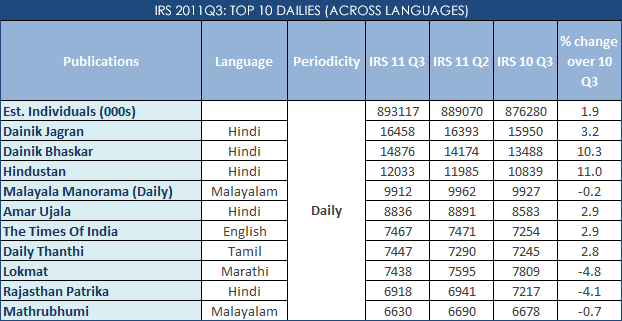
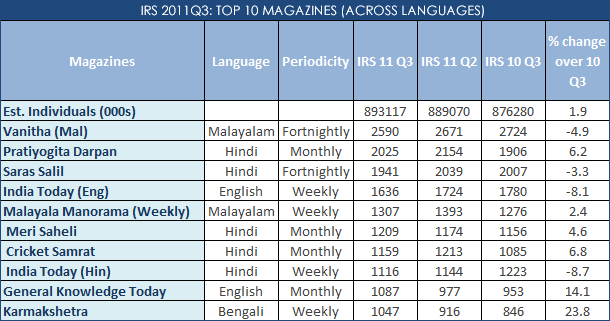
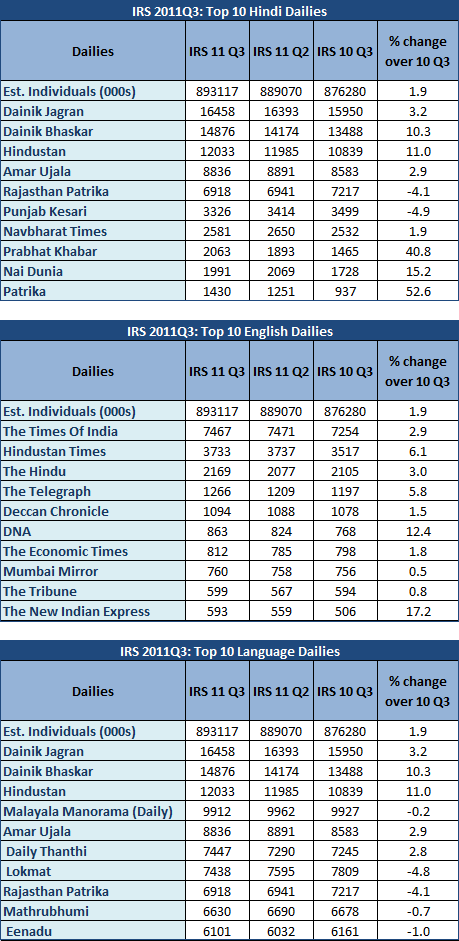
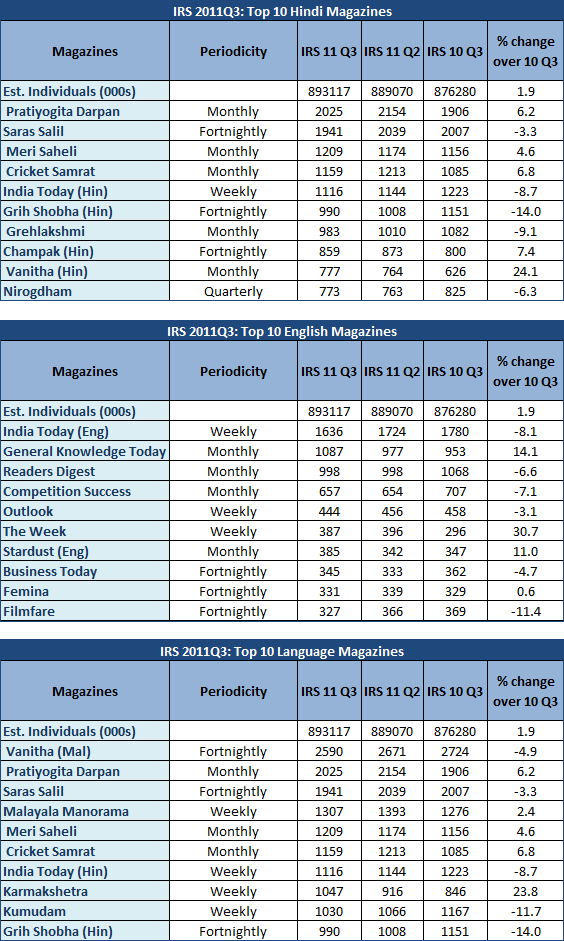
Let’s look at the tables in detail (that we have based on the toplines publicly available).
There’s no need of words. The growth or degrowth percentages tell the story. Some spectacular successes. Others not so.
Hansa Research has been awarded the first prize at a Market Research Society of India seminar. The paper showcased an innovative method to know real household income
Collecting income data in India is fraught with roadblocks. While surveys are considered accurate at capturing product usage and ownership, the same cannot be said of income because of the sensitivities involved. Income tends to be over-estimated in lower classes and under-estimated in upper ones. Measuring real income requires specialized elaborate income studies, which is beyond normal research studies.
Hansa conducted a special income study to accurately measure income. The study also measured product ownership/consumption. Based on this information, Hansa developed a model to predict real income based on product consumption, separately by population class. This model was validated with the help of ‘National Account Statistics’, traditional MHI and New SEC. To arrive at real income in any customized study, all one needs to do is to capture details of 18 products and use the model.
Mr Suresh Nimbalkar, Senior Vice President, Hansa Research said: “Income is intuitive, easy to understand and use. It is one of the most differentiating variables. As a result, there was a constant need expressed by the industry to provide real income. The Hansa IRS team took up the challenge of providing the real income to its users.”