By Vikas Mehta
 In today’s age of data and empirical evidence, classical advertising is losing its relevance. Not everyone is convinced about the role of traditional advertising. The number of likes, shares, retweets, enquiries is all that matters. Talking about emotional connect only just does not make sense.
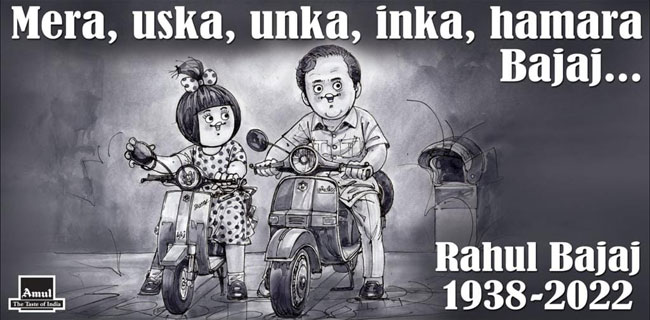
The power of communication, specifically advertising, was never better illustrated than now, after the passing away of Rahul Bajaj on Saturday. All posts, messages and some memes too talked about the iconic ‘Hamara Bajaj’ campaign in the same breath as Rahul Bajaj. It’s seems as if the man had ruled the two wheeler industry because of Hamara Bajaj. It seems the enormous success the brand was accorded was all due to Hamara Bajaj. It seems that Hamara Bajaj was the embodiment of Rahul Bajaj. Nationalist, outspoken and proud Indian businessman.
Nothing can be further away from the truth.
Bajaj became the dominant two-wheeler player in India for decades because of the ‘licence raj’. It was the government prerogative to decide how much production capacity even private players could have in India. Demand be damned. Some bureaucrats would decide the India needed to produce only x number of scooters. So if someone was doing that (read Bajaj), where was the need for more players? It suited Bajaj. They need not invest in R&D because the consumer had no choice. They needn’t have expanded because not only did the government not allow it but by creating an unmet demand, a huge black market was created for Bajaj scooters. Bajaj dealers were rolling in cash and so was, one suspects the company.
So, Rahul Bajaj, in the guise of nationalism was against liberalisation. He had openly declared war on liberalisation policies by forming an informal Bombay club of businessmen who felt threatened by competition due to liberalisation.
And the arrival of Hero Honda seemed like the death knell for Bajaj. It was Rajiv, his son, who shrewdly bailed his company out. He first discontinued scooters, the product on which Bajaj was built and then invested heavily in R&D. Some collaborations like with Kawasaki, to gain time, was the first indicator of the direction that Rajiv sought.
And of course Hamara Bajaj, a simple advertising campaign, gave a temporary respite to the beleaguered scooters. Actually it was not as much nationalistic as it was about India rising. For a scooter brand which had thrived on protectionism, to cash in the liberalised India sentiment was as ironic as it could get.
And it gave space to Rajiv and his team to get into a hitherto, niche 175-200cc motorbike segment.
It was actually not a resurrection. What came out of the ashes of the now tainted scooter legacy was Pulsar. It is public knowledge that Rahul disagreed with Rajiv on discontinuing scooters. To give credit to the man, he allowed Rajiv a free hand. But when Pulsar was born and Bajaj as a brand seemed to have been relegated into the background, Rahul did put his foot down. It was not to be Pulsar but Bajaj Pulsar.
The last 48 hours seem to have vindicated traditional advertising. In spite of all the facts above, every newspaper – English or vernacular, every social media commentator on Facebook or LinkedIn was trying a play of words with Hamara Bajaj. So, while we pay our tribute to the departed, let’s not forget what made the man pass into folklore was a simple advertising campaign which has transcended time, and which has once again shown the power of advertising.
Vikas Mehta is a senior advertising and marketing services professional and educator based in Dehradun. He writes off and on for MxMIndia. His views here are personal