
Tag: guest column

  • Guest Column by Shashidhar Nanjundaiah: Writer’s block, Walter Benjamin, and the problem of plenty

    By Shashidhar Nanjundaiah


    There are several reasons I’ve grown from a frenetic writer to an occasional one. And as always, let’s blame it on the usual suspect. Among the most significant reasons for my sporadicity is that social media has given me a writer’s block.


    As the 1930s German philosopher Walter Benjamin wrote, the proliferation of art destroyed the aura around the artist. The introduction of mechanical reproduction in the 19th century meant that it could be copied and distributed without the authenticity of the original. With the proliferation of social media, there is no aura in writing anymore.


    Ideas were never a writer’s domain alone. But putting them into words was somehow a privileged talent, so from Chaucer to Chetan Bhagat, people have heard the voice of the writer, not the voice of the people with ideas. When social media arrived, few expected it would be a platform for writing. It did evolve a new style of writing—pithy, pointed, direct—that was commensurate with the shifting marketplace of attention. Today, everybody on social media seems to have terrific expression skills.


    With the rise of storytelling and of professional storytellers that you can hire if you have ideas, the proliferation seems complete. It all started with writing for brands, and that’s a form of writing that flourishes to great business advantage. But the new trend is to share philosophical thoughts, social observations, professional dos-and-don’ts as well. In other words, writing on social media finally seems to be settling down.


    And in that environment of having lived more than a decade in the Facebook-LinkedIn-Twitter era, it’s a good time to take stock of what this new form of writing brings to the table: What is the biggest difference between traditional writing and new forms of writing? Has this new democratic form of expression evolved a different consciousness? Does the new style reflect honesty and individuality, or does it echo inevitability and perfunctoriness?


    Perhaps the biggest difference is that it’s largely shorn of pomp and superiority. Writers have traditionally been the bearers of information, insight, new thought and above all, new meaning to life’s various domains. They wielded authority and influence in what was largely one-way communication. The reverential attitude of readers towards traditional writers may persist, but the writing is no longer lapped up without analysis or independent commentary. The comments, typically underneath an article, are read with as much gusto as the article itself.


    Security of the control over privacy walls also means more honesty. Today’s writing is personal and modest in scope, often an opinion that seeks approval in smaller, more intimate, friends’ circles within the social media. Echo chambers always existed, but social media platforms have increasingly put up opaque privacy walls, enabling us to express without the constraint of public view.


    Manipulating the perception of popularity is much like old times, except that its management is both easy and well-supported by the very platforms that also democratise communication. Because these ‘walls’ can be broken at will, they also enable us to segment audiences for our writing with much more precision—and influence.


    But what about the content? Social media observers will tell you that only one among hundreds of articles on social media catches genuine public fancy. Yet this ratio is very encouraging if you like the democracy of writing. In all fairness, I am routinely amazed at the number of people with ideas and insights—and these are people across domains, ages, and the proverbial professional ladder. You needed specialists to write about science, engineering, medicine, and so on, because those trained in any of those domains are not trained in writing, and vice versa. Not anymore, it seems. Simple, honest expression transcends formal training, and of course, the plethora of material available on the social media is great training material in itself.


    It is this plethora that is responsible for my writer’s block. Amidst this welter of insight, all of which seems well-consumed, how do I wedge out my niche thought? What if my idea gets torn apart—what would that do to my self-esteem as a writer? Benjamin would give us the Mona Lisa smile—my reading of him has always been that he played with ambiguity to overcome Fascist threats. In hushed undertones, he would say, this is all a good thing. It’s just history repeating itself. What happened to art with mechanical reproduction is happening to writing with social media’s digital reproduction. If, as Benjamin argued, the loss of aura at the hands of reproduction makes the original work of art lose its authenticity, we may propose that in the age of digital reproduction, it is enhanced.


    Reproduceability on social media has been well-harnessed—and it seems that’s a good thing. Along with ‘likes’ and emojis, what makes your favourite platforms rub their hands in glee is  reproduction through retweets, shares, or anything else they call it. Sharing—which can be seen as akin to printing more copies—is not always the norm, though. Many users of LinkedIn copy with impunity—and many of these are HR managers who are in charge of personnel behaviour. More often than not, attribution remains dubious and the promoters of the platforms seem to have no real problem with unattributed copying, since it’s all free. It seems intellectual output becomes property only when there is a monetary transaction to it. That said, those who copy are clearly not as worried about getting a message across as they are about promoting their visibility, and that, to me, is a telling difference.


    As you can tell from the tone I’m using, a traditional writer like me frowns at such newfangled but seemingly well-accepted behaviour as copying. Since it is all free and non-transactional, does it also make it ethical? Has copying without attribution become a disruptive new trend? Will it sound the death of intellectual property in writing? Good old time will tell. Democratization is great, but I now need to wrap my head around yet another new normal in proliferation and reproduceability.


    The author is an independent media educator and communication analyst with interests in social media’s effects on traditional media. He may be reached over email at shashi.nanjundaiah@hotmail.com. He has been an editor of magazines and the dean and director of leading media schools including Symbiosis and India Today Media Institute.


  • Guest Column: Manish Agarwal on Basic Principles of Gamification

    By Manish Agarwal


    Gamification, the new argot that has been making headlines lately, is not the same as game development; it’s not about making console or mobile games for mere entertainment. As the best in the business describe it, Gamification is the use of game mechanics and game design techniques in non-game contexts and is a powerful tool being used by brands globally to engage with their stakeholders.


    Gamification has helped marketers get their users engaged in desired behaviours by taking benefit of humans’ psychological tendency to connect with game techniques. Since the term is a recent buzzword in India, it remains largely unlearnt by the same marketers. Here are a few basic principles to Gamification that I think can go a long way in strategising for your next Gamification effort.


    Defined Objective: You got to determine the primary objective. What is the desired action out of the effort? If you think its entertainment, you are not a marketer but a gaming company. You will have to invest a few days and brainstorm on this; try and involve the team that will be eventually gamifying your service.


    Make It Measurable: You have a boss somewhere who trusts in you but is concerned about the RoI too. You will have to prove to him that the gamification effort has really helped; ensure you are able to measure and map the performance. A combination of techniques can help – include a call to action that can be measured, evaluate the KPIs before and after the implementation, have trials with focus groups and so on. We are a digitally connect world, exchange notes with marketers across the globe on relevant forums if you wish to.


    Repeated Feedback: Feedback is crucial. Repeated feedback is unavoidable. As Charles Coonradt explains, “Increasing the frequency of feedback improves the quality and quantity of performance. When feedback is illustrated on charts and graphs, the impact is greater.” Feedback will help you find answers to some of the questions that have been sitting in your head unattended.


    It’s Not About Rewards, It’s About a Sense of Achievement: The most powerful rewards are intrinsic not extrinsic. Personalise the reward mechanism. Incorporate a mechanism that allows the user to show his status (a personalised message on his social media page, a direct congratulatory message, a leaderboard etc.) It makes a difference on an individual level.


    Don’t Stop: Gamification effort is never a one-time assignment, it’s a process. It requires to be practised regularly, with an improved shot each time. Keep some budget aside for this every quarter.  What is more important is that you rethink about your objective (point #1) each time you want to gamify!


    Manish Agarwal is CEO, Reliance Entertainment Digital


  • Guest Column: Newspaper archives would be morgues if news would die

    By Anita Pujari


    It was my first day at work at the nation’s biggest newspaper house. I could hardly suppress my eagerness to see the famed old lady who had set sail in 1838 and had meandered into homes and lives across the country like no one else had. I expected to find the historic first issue befittingly holding pride of place in the Archives, probably in a temperature-controlled vault, safe and secure from man and nature.

     

    I was stunned to find that no one knew where it was and no one particularly cared. It was going to be six months of playing Sherlock before I prised out from beneath mounds of newspaper bound volumes, this solid paper box, boxes in fact with those priceless original copies of what everyone knows as The Times of India the name which came about much later in 1861. At birth on November 3, 1838 the name was The Bombay Times & Journal of Commerce. The bi-weekly at Rs 30 per year turned daily in 1850. The history of the newspaper is what legends are made of and one could safely say that ensconced in the pages of this longest running chronicle lies the history of India.


    Did I say history of India? I’ll add a rider – not chronicled always as it really happened. I will never forget the week spent going through the TOI of April 14, 1919 to a few days beyond. The issues had been preserved on microfilm and it was easy to roll from page to page, enlarging the tiny text and looking for Jalianwalla Bagh massacre (April 13, 1919) for a visiting researcher who had not found it. How could there be no coverage of the incident? We found it eventually – less than 100 words, lost amongst the other national news, saying there had been an incident of rioting in a public garden in Amritsar (!).


    In talking about newspaper libraries, one often comes up against the metaphor of the “newspaper morgue.”  I have often wondered on this choice of word and who or what led to its global usage. Was it apathy or lack of vision or perhaps both? As I see it, newspaper archives must have existed since the newspaper itself. Unless an effort was made to save a copy and put it into safe custody (the erstwhile morgue), the day’s edition would have been truly a ‘has been’ like its ephemeral nature.  This effort by publishing houses the world over to build and maintain an archive of what is said to be “a chronicle of the times we live in” has ensured that the history and socio-political-economic development of people, thoughts, events, and nations did not get lost. This primary information rarely if ever gets into books that one could easily buy or borrow. If not collated and preserved, the news happenings around the world would be lost for good.


    Several nations have their National Library as the depository (compulsory deposit of every issue of newspaper, book published) and the archive (ensuring preservation and access) of what is considered the nation’s heritage. Where nations failed, newspaper publishers have stepped in to preserve and share their news archives. The British Library’s newspaper collection comprises 52,000 titles from all over the world, dating back to the 16th century and is housed on nearly 50,000 km of shelving.  The National Library of Australia has a collaborative programme named Australian Newspapers Digitization Program (ANDP) digitising historic Australian newspapers published between 1803 and 1954 and making them available online. It uses Web 2.0 technology and is truly innovative and unique as it allows users to interact, contribute and add value to the newspaper content – tag, add comments and correct the electronic translated text


    Storage and access of newspaper archives has been a problem with every collection which was partly addressed by preserving on microfilm – high on long term integrity but low on search and retrieval, and in recent times as Digital Archives – high on ease of retrieval and dissemination but plagued with technology obsolescence issues. A mix is ideal if you have the budget.


    Having handled print, microfilm and digital archives, I can say that news research is medium-agnostic and has much to do with the archivist’s research skills and passion to find answers. Every newspaper house that has a Library/Archive would have a recollection of a person/s who made that difference and added that value to the business of newspaper production. Mr Roy of Anand Bazaar Patrika, Ram Kolhatkar of The Times of India archives, and many others that scribes would remember.


    News clippings, the most important source of reference and research in a news library at one time has been replaced now by Digital Archives, but the key to search and retrieval is still the indexing or in digital parlance – metadata. Else it will be as exhausting as Google. I often joke with my editorial colleagues that Google is not just exhaustive but exhausting – whether you admit it or not you rarely go beyond five pages of results and that’s when you are the diligent kind. What gets served therein rarely gets checked on authenticity let alone authoritativeness. How many bother about corroboration. Wikipedia has become the first and last stop for research, oblivious to its basic tenet of freely editable information. This makes it all the more critical for a newspaper house to develop and maintain its own authoritative and wholesome Archive and professional researchers.


    A newspaper archive is an important repository of the history of the paper’s interaction with its community. It is also a reflection of the changing mores of the community and society as a whole. I have seen research studies on umpteen anthropological issues get addressed from the archives of newspapers. Say the matrimonial columns over the decades – terrific insights on values, religion-caste, education, aspirations. Interesting study when ads by parents started getting replaced by ads by the groom/bride and how tone and tenor of expectations changed.


    Advertisements – the ever-changing creative sphere of communication between seller and buyer. Tracing back advertisements by say HLL, LIC, the colas or film releases through newspaper archives is like looking into a treasure trove and coming up trumps. You would be surprised to know that in the newspapers of yore, the front page was fully advertisements. Anything from a hat to a horse carriage found ad space. The creatives make for delightful reading of commerce in the 1800s and 1900s.


    I remember a particularly impressive exhibition held by the Delhi Public Library to celebrate their 60th anniversary in 2010. They called it – The Newseum – a unique display of their newspaper archives, presenting a visual history of Hindi & English newspaper advertisements since 1951 as well as memorable photographs, cartoons, articles giving a telling insight on those decades.


    At a conference held in February 2013 by the Association of Media Libraries and Archives (AMLA), a young research student of JNU Library shared his work on creating an Archive of Indian Newspaper Cartoons as a resource-base for socio-political economic research.


    So are archives and archivists important in the media industry? Yes, of course, and more so in the days of unauthenticated internet content and with the advent of a Digital Archives Management System (DAMS). Add to that the instantaneous needs of 24×7 news delivery and new media. Morgue? It is time for a new metaphor, perhaps.


    Anita Pujari was until recently Vice-President, Research Archives & Syndication at DNA and Head- Archives and Syndication of the Zee News cluster. She was head of the archives at The Times of India group


  • Guest column: Building brands through regimens

    By Ashita Sarin


    I was at the supermarket on a recent weekend, replenishing some of my skin care products when I came across products to cleanse, exfoliate, and scrub, moisture as well as serums, pore refiners, and masks. These were sold in a range with specific instructions to use them in sequential order of 1, 2 and 3.

     

    This got me thinking about the phenomenon of regimen. There has been an influx of products in the market, which seemed to be packaged as a combination deal, which will then provide optimum results.


    Regimen speaks to an outcome that is in fact tangible, but only if the process is followed or as defined, regulated. It helps one get positive results, quite a motivator, indeed.


    How has this come about?

    Quite simply it is owing to enhanced disposable income. Based on this marketers have invested in product development and launched products that cater to these “new needs. They get to package a number of products with the promise of greater efficiency if used in combination. L’Oreal, Estee Lauder, Kiehls, Clinique are just some of the  brands that boast a cleanser, a serum and a moisturizer to be used in combination to get the desired results of beautiful, glowing skin.


    Increased media exposure reinforces the focus on “glowing, flawless, youthful appearance” and consumers have a keen interest in additional products that will deliver. One cold cream doesn’t suffice. The consumer has access to and wants more for “perpetual youth”. Yesteryear’s cream has been replaced with serum, lotion, and sunscreen, and pore minimize or radiance boosters.


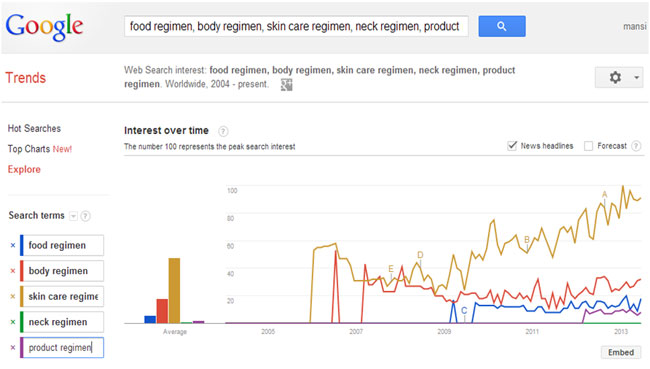
    Amongst categories wherein regimen is more prevalent, skin care pops up as a top runner.


    The study above shows that the online search is highest with regard to the skin care category.


    There is an influx of products and brands for hair and skin care. Brands like Garnier, Vaseline, Nivea Olay, Lakme, Sunsilk, L’Oreal have all infiltrated the market with regimen based product lines.


    With skin care as opposed to body care, the “visibility” factor is high hence willingness to invest is much higher.


    The space is now occupied with products that promise to cleanse, tone, exfoliate, hydrate, protect, moisturize,


    The primary focus is on anti aging care. The Indian consumer is not only aware of more than a cold cream, but she is concentrating on safeguarding her youth. Serums, creams, lotions and capsules together promise to arrest the clock.


    So what makes this promise believable? Why are women willing to believe that not one but a combination of six (somewhat expensive) products will give them the glow, radiance and plumpness associated with youth?


    A combination of high research molecules, naturals, exotic ingredients, high advertising expenditure and brand credibility elevates believability. Cosmetic companies spend millions every year on product research and marketing.


    Regimen based products do a few things very well.  They create a combination platform. It is difficult to be informed enough to chose one part from a brand and another from a different brand. This creates a preconceived platform in the consumers mind in terms of efficacy and the need to purchase all products to get the desired effect. Anti aging range from brands such as Ponds, Garnier, Olay, Kiehls, Body Shop all communicate the need for products to work in tandem,


    These products also carry tangible cues such as additives like amino acids, retinol, hyaluronic acid, sirutin technology, RX technology, antioxidants, more organic like narcissus, lavender, primrose oil, rose essence etc all of which are either patented or awaiting patenting. These terms lead consumers to believe that the regimen recommended products do in fact have the right ingredients to come together and create paramount benefits.


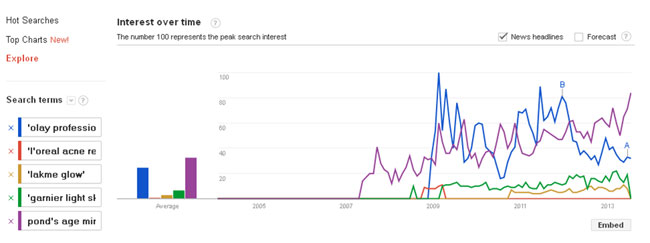
    Brands in India that have created a niche for themselves in the anti ageing regimen range are Olay and Ponds Age Miracle. Studies below show, that in terms of awareness as well as brand penetration, these two brands and their product lines are well received.


    So what are they doing differently to the other players in the market? Consistency and an established frequency of communication across media ensure that consumers get the same message at all times. The benefits attached to a regimen where step 1, 2 and 3 contribute to an overarching effect not achieved by any one product but all recommended is what helps create a convincing platform for consumers.


    But this has to be based in something deeper, something more in tune with who we are as human beings. Do we like regimen because we like order? As children we are taught – when to wash, brush, bathe, drink milk, go to school, do homework, play, go to bed, etc. Regimen seems to be established at an early age. Is the stage for 1, 2, 3 set very early in life and is this something that marketers are cashing in on?


    Would this move into other categories like oral care? Could we establish principles for brush, floss, gargle, whiten, brighten and create different products for these functions? Or even for fabric care. Detergent, softener, dryer sheets, black, stain remover.


    I guess it depends on product research that will establish a sequence for optimum benefit and then plug into our desire for regimen.


    For now I’m warding off old age, with my 1, 2, 3 step skin routine.


    Ashita Sarin, Senior GM – Marketing at DY Works


  • Guest Column by Saurabh Parmar: Branding in today’s digital age of Brand-Consumer Interaction

    By Saurabh Parmar


    In almost every conversation we have with a client or a potential one, the word ‘brand’ comes up. The interesting bit in most cases – I see the interpretation vary. And remember I am talking about marketeers here. I don’t think there is a right or wrong but the definition of what a brand is has evolved in this digital age.


    For me, a brand has never been a logo or a fancy tagline. It’s not even a vision or mission statement. At the end of the day it’s a dynamic entity which lives what it says, it evolves from where it is, it understands from it’s customers.


    It means a lot of those things which are probably taught in brand identity classes – Colours used, shape of the logo, brand identity guidelines, the thought behind the brand  etc. Yet  I earnestly believe – it has always been about something more – How the people perceive the brand.


    Think about brands like Apple, Vodafone or Dominos.. What do you see? What do you feel? And the exact answer will change, depends on who you ask. The logo, tagline, marketing campaign, product remain the same but people’s interpretation of it defines the brand for them and to an extent their social circle.


    This is more so in today’s world – where customers are directly interacting with brands via social media, where there are more brands making more noise via marketing and where technology is changing proximity and interactions between humans themselves. As a result, the dynamic nature of a brand is all the more obvious.


    I like brand X let’s say a restaurant but  if the food was bad last time or whether the waiter was rude or service slow all those things impact brand perception. But it doesn’t take a direct interaction always does it?


    Friends who have been raving about a product or place, a Zomato review or a review in HT or 5 of your friends having already like this new place on Facebook -all these live interactions influence our brand perception over time.


    So what should a brand do? There’s lots it can do, but for me 6 main things which stand out:

    1. (From the above) Remember brand building does not happen on day 1 only it keeps happening till the day you exist and if you are fortunate or maybe unfortunate enough people will have opinions even after you cease to exist. So be open to constant evolution.


    2. Having said that, like any human being you may evolve how you talk, how you interact, what you say but you remain mostly true to your core beliefs. Same goes for brands.


    3. Brands are often afraid of taking a stand, having an opinion. We believe that’s not the way to go, great brands stand for something and they also stand against something.


    4. An often heard statement ‘Great brands need to be larger than life’. I tend to differ and more so in today’s day and age of a cluttered market with enough brands shouting their greatness.


    Brands need to be true to life – They are based on a customer’s needs and aspirations and needn’t look down from a pedestal or exaggerate their own identity which makes it hard for a customer to trust them. (Eg: How many men believe that by spraying a deo, women will start swarming around you but for years brands have failed to go beyond the thought)


    5.Great brands focus on transparency -to their customer, their employees and other stakeholders. An interesting example by McDonald’s http://www.youtube.com/watch?feature=player_detailpageandv=oSd0keSj2W8


    6. They do not look at advertising as a means to display but as a means to communicate. And that brand-consumer interaction does not happen in silos but in an environmental and cultural context.


    Saurabh Parmar is Founder and CEO, Brandlogist Communications


  • Guest Column by NN Sachitanand: Rape, Punishment and the Media

    By NN Sachitanand


    Punishment, as meted out by our courts, has two dimensions : retributive and deterrent. The first directly affects the convicted person. The second is supposed to impact society. Retribution can normally be executed by the power of the state without much of a problem, unless the sentence involves sensitivities which can cause security-related problems.


    Achieving deterrence is not that simple. In primitive societies, retribution and deterrence were closely interlinked. Punishments were openly executed for the public to see, whether it be flogging or incarceration in stocks or burning at the stake or decapitation. To enable more people to get the message the bodies of hung criminals swung on gallows and decapitated heads were placed on pikes for days on end. If we adopted those tactics today I am sure the number of dowry-related bride burning cases would go down drastically if the convicted husbands/in-laws were publicly burnt at the stake and acid throwing crimes would become very rare if the perpetrator was doused by acid as retributive punishment in front of TV cameras.


    But we live in more humane times where, despite the uncivilized nature of the crime, retributive punishment by the state is supposed to be more restrained and low profile. So, convicts spend time in jail away from public gaze and are quietly released at the end of their sentences while executions have become the “rarest of the rare” and are carried out almost clandestinely. That takes most of the sting of deterrence out of punishment.


    There is, however, another way deterrence can be given a fillip even within the limits of today’s “civilized” punishment system. And this is where the media comes in. To achieve deterrence, justice must not just be done but also seen to be done. Our media, thanks to the unbridled freedom given it, does a good job of reporting crime and making a hue and cry about it. But it has singularly failed in highlighting convictions. While the commission of ghastly crimes like rape and murder form front page news, the conclusion of a case against the perpetrators and passing of judgement merit only a cursory mention tucked away in the inside pages.


    Consequently, most convictions and associated punishments do not catch the attention of the public, thereby dissipating their deterrent effect. It is a short step from this to the belief that the state is either not serious or incompetent to bring evildoers to book. For those inclined to commit a crime, this is a green flag to take to lawlessness, whether it be chain snatchers or rapists or bride burners or hit men.


    Admitted that the media is constrained from highlighting each and every conviction because of the limitations of space, time (in case of electronic media) and competing items of public interest. But exceptions can be made when it comes to serious social crimes like rape, paedophilia, bride burning and the like. Convictions and punishments in such cases should be given prominence, particularly by those local publications and TV channels which cover the region where the crimes were committed, so that at least the local folk feel the deterrent effect.


    The regional media should not only convey news about the convictions but also include details of the convicted persons such as their photographs, backgrounds, criminal history and other relevant information such as their professional positions, membership of associations and parties etc. This will impress upon the viewer and reader the fact that even well-connected persons cannot escape the long arm of the law.


    Speaking about the well-connected, it is only after the recent horrific rape-cum-homicide incident in a Delhi bus that such startling facts came to light that several legislators and parliamentarians are charged with rape. Even if they have not yet been convicted, the very fact that such lowly specimens were selected by their respective parties because of their “winnability” discredits the loud demands of the party leaders that the Delhi rape perpetrators should be handed the severest punishment.


    This is a golden opportunity missed by our media to expose the duplicity of these political leaders. The national press should have gone to town with this information, publicizing each and every one of these tainted legislators with their photos, background, the details of the rapes they are charged with and aggressive interviews with their party leaders demanding explanations about why such anti-socials were even selected as candidates in the first place. This was an occasion for an unrelenting campaign against the tendency of our political parties to cynically compromise with evil in exchange for electoral advantage.


    It is not that the Indian media is ignoring the incidents of rape. The problem lies in sporadic, episodic and uneven coverage. One of the ways the media can prod a lethargic administration and judiciary to shed their indifference is to maintain a structured data base of reported rape incidents and, off and on, keep publishing prominently such information as state/district/city -wise incidence, historical statistics like timeline of cases reported, being pursued in court, convictions obtained etc. It will take a bit of hard work to gather and organize such data but there are NGOs, women’s organizations, police and court records which can be tapped. The idea is to expose those administrations which are the most deficient in pursuing rape cases, shaming the respective political parties in government to perform better. This has to be a sustained campaign in which every newspaper, magazine and TV channel should participate.


    Finally, although it is true that newspaper space and TV time are prohibitively costly, if our media is sincere about their anxiety about the welfare of women in this country, they should devote a regular amount of space /TV time every day for women’s issues, problems, accomplishments, news etc. If whole pages can be devoted to cretinous stuff like the fulminations of politicians, vacuous remarks of celebrities and nauseating overdose of cricket, perhaps half a page a day devoted to the better half of the population would not be asking for too much!


  • Don’t be scared of the Dolly Bindras in media: Shishir Joshi

    By Shishir Joshi


    This is not in defence of the media. As you read along, you may realize it. In fact, it is quite to the contrary.

    Foremost, let me lay down some of the allegations against the media and some of the prevailing perceptions;

    That the media is a king-maker. That it is corrupt. That it is far away from the realities impacting the society. And that it thrives on sensationalism.

    Partly, it is the media, itself, which is to blame. For the corruption. (Bhrasht-aachar; read, corrupt behaviour.) And for the perception.

    Let’s start with the most recent one. Media as the king-maker. Allegations which have shattered the holier than thou image. And as eminent journalist Arun Shourie put it in a TV show, “Time and again instances have come up where journalists themselves have been responsible for the betrayal.”

    Many, largely unrelated to media, strongly believe media is corrupt. Unfortunately, what they mean by ‘Media’, could really be a handful, but, those who get branded, are just any and everyone who is associated with ‘media’.

    So, to begin with, here’s a dekko to clarify some prevailing misconceptions.

    Very few people really know and understand how a news organization operates. In the fifty-odd people who work, in what is seen by the outside world as the ‘powerful’ editorial of any news organization, a little less than half, say twenty or so, are what everyone knows as Reporters (working Journalists in the real sense).

    They are the ones who have a contact with the ‘outside’ world. Or, that, the outside world really knows about. (The other non-reporter face known to the high and mighty could be the editor, but, increasingly, it is the CEO or the Marketing /sales head who is a far more ‘popular’ face.

    Within those twenty reporters, barely four or five such Journalists deal/interact with those in High places; by this, I mean, with Political heavyweights (by Reporters covering the political beat) film stars (mind you, not any film start, but only the big five of Hindi cinema) and Sports, again, here not just any sport or any sports heavyweight, but Cricket an d the mighty Sachin, no less.

    So now, of an approximate 50 odd, we have come down to the top five in any Editorial, who have the opportunity to rub shoulders with the Rajas (not to be mistaken with Spectrum Raja. And within that, on a rare occasion will one odd Journalist really mis-use his seat or position.

    All this also depends on the reach and impact that the Media house commands, in circulation or readership. (NDTV among policy makers and Hindustan Times in Delhi do count for being heavy weights…umm… what a coincidence). Needless to say, a fancy designation helps.

    So if a Managing Editor of one among many many many media organizations is found to step into grey area or is caught on tape, mediating or promising solutions, this could be just ONE he or she caught in the act isn’t it? Is it then fair to brand all of media as corrupt?

    It may be unfair. But the guilty, is the media itself. And some of these journos in power. And the perception that they have created.

    How often have we seen PRESS stickers adorning two wheelers and cars of media persons. Any self respecting journalist who holds a valid identity card from his organization will tell you that these stickers are not required. Not required unless you are using them to ensure the traffic cop does not stop you.

    Maybe those using these stickers do not know this, but the ‘public’ and the traffic police surely believe this is the reason.

    To say press stickers are by themselves to blame, would be highly unfair.

    We also have a mushrooming number of ‘king-maker’ journalists. Who throw names, host parties and ensure that the bigwigs attend their private dos.

    Rarely does the ‘King’ , either a big-ticket politician or a film star, not oblige. Graciously, he ensures that the journalist is addressed by his first name, and a few back slaps later, the powerful man is back in his den.

    Only a handful would cringe at the thought of a powerful and popular name walk into your living room and back-slap you, chat up your family and share a chai with you. What the action leaves behind is you, the journo beaming from ear to ear, like a fat cat having stolen a bowlful of cream, with the rest of your family, friends and neighbours in a daze.

    Mind you, there is nothing wrong in the high and mighty visiting you.

    But, where the hacks go wrong, is when they start believing that powerful are in love with you the person and not you the Journalist. I promise you, it can’t be further away from the truth, in most cases.

    And as you bathe in the halo of the big one calling you by your first name and your family and some friends gazing at you with renewed affection and respect, you fail to see the rest of the neighborhood, who see you as an ass-licker. That is perception, as it gets created.

    You, in fact are an ass with a big bloated ego, refusing to see the writing on the wall. “You are so dear to me,” says the politician and you glean with pride. What you don’t read between that line is he muttering under his breath that “I accept you only with your designation and organization.”

    The power of a journalist, in today’s age (unless his good deeds speak volumes) is like the hair on the head, the tooth in your gums and the nail on your fingers. It is valued only when it is in its place. Worthless when chopped.

    There was a time when Journalists wielded the power of the pen. The power, by what they wrote. Based on facts and fair play. That was power. Real power laced with absolute respect.

    Today, the power has corrupted. Absolute power (based on a belief that he is the king maker) has corrupted absolutely.

    The far and few, but absolutely corrupt journalist is powerful not by what he is capable of writing, but his ability to WITHHOLD information. The power to conceal a story, often at the cost of a favour, or as seems in the case of the Radia tapes, through an alleged TRADE-OFF makes the corrupt journalist in the lot nothing less than a white-collared extortionist.

    But you hate them, you call them names and yet, you do not speak out against them. What is it that scares people when it comes to speaking up? Or speaking out? Unless it is in hushed tones? Politicians have been hurling abuses at each other, taking names, in the spectrum scam. But no one has dared name the journalist(s) or media houses at all. Only after social media (and later a few magazines) began talking about it, have names begun cropping up. The role of the journalists is beginning to get scrutinized.

    While social media has been active in this case, mainstream media has been largely mute. Be kind to thy comrades for they may one day come and lord over us. Is that the reason why?

    But what stops the rest of the world from talking about these names in public? Two reasonings come to my mind.

    One, Industry captains do not wish to rub India’s much watched English channel(s) and powerful newspapers the wrong way. “I am seen on it, quoted by them and would continue wanting to be seen there” is what they believe. Any rubbishing of the network, or its key stake holders would mean, being blacked out.

    The second, and more real fear is of an unwarranted backlash. I call it the Dolly Bindra effect. Nobody wants to rub Media big-wigs the wrong way. However wrong they may be. They may be paper tigers, but tigers no doubt. Their byte is more poisonous than the (non existent) bite. They have a habit of bouncing back and, like the boxing cushion, slamming right into your nose.

    So, however much you dislike them, hate their guts, have evidence of their alleged wrongs or have taped conversations of political coziness, you would rather shut up and lead your life.

    After all, we all know what happened to Shweta Tiwari and Samir Soni on BiGG Boss season four when they took on Dolly Bindra, right? Shweta was stung in the face, Samir was ousted. And the one who got maximum press, was Dolly, who returned to the BiGG BOSS house with a bang.

    PS: Remaining quiet has never been a solution. Mute spectators to a crime too, are as much guilty as those perpetrating the crime.

    It is time you speak up against those, whom you believe are corrupt under the garb of being honest. It is important too. For others, Citizen Journalism, or social media, is a solution.

    For, isn’t it a commoner like you and me who exposed the Adarsh scam or the CWG or the initial lid of the various scams in recent times?


    Shishir Joshi is the co-founder of Journalism Mentor, and till recently was the Group Editorial Director of the Mid-Day group of publications.